
SAP consultants understand configuration and business processes well. However, many cannot explain where AI fits into those processes.
This skill gap becomes more visible as customers move to SAP S/4HANA Cloud and SAP Business Technology Platform. Customers increasingly expect AI-supported scenarios in finance, procurement, and supply chain. Traditional training rarely covers SAP Joule or SAP AI Foundation. It also may not cover the governance of AI recommendations.
SAP Business AI certification and related learning journeys on SAP Learning can help close this gap. They provide professionals with a structured learning path. This guide explains seven skills for AI-enabled SAP projects. The skills apply to consultants, developers, and architects. It also provides a learning roadmap and highlights common mistakes.
Why Traditional SAP Skills Are No Longer Enough
For many years, SAP careers centered on functional consulting, ABAP development, and Basis administration. They also focused on process configuration and system implementation. These skills remain the foundation of every SAP project.
However, customers now ask additional questions during project workshops. They want to know how AI can automate repetitive decisions. They also ask how business users can get faster insights. Another question is how SAP data can support recommendations within existing workflows.
Answering these questions requires professionals who understand business processes and AI capabilities. They do not need to become data scientists. Instead, they need practical knowledge of how AI works within SAP environments.
The resulting profile combines business understanding, SAP expertise, and AI awareness. This helps explain why SAP Business AI certification attracts consultants, developers, and architects. The associated learning paths are also relevant to these roles.
What SAP Business AI Certification Covers
SAP Business AI certification helps professionals demonstrate their understanding of AI in SAP environments. This goes beyond basic AI vocabulary.
SAP Learning offers learning journeys and courses on SAP Business AI strategy. The content covers AI-supported business processes, SAP Joule, and SAP AI Foundation. It also covers SAP BTP extension scenarios and responsible AI principles.
SAP regularly updates its certification portfolio. Therefore, confirm the current exam names and topic areas on SAP Learning. Do this before planning your preparation.
The required depth depends on the role. A finance consultant does not need to build an AI model. However, they should understand how AI supports invoice processing and financial analysis. They should also understand automated recommendations.
An architect does not need to train a large language model. However, they must know where AI services run. They also need to understand how SAP data reaches those services. Security and governance are equally important.
This knowledge allows professionals to participate in AI transformation projects with greater confidence.
This knowledge allows SAP professionals to participate in AI transformation projects with more confidence. Also read SAP AI Use Cases.
Why Business AI SAP Learning Is Becoming a Career Requirement
AI adoption changes project roles, because a consultant’s value no longer depends only on configuration knowledge. Customers now expect professionals to answer how a specific SAP process can become more intelligent, and this question requires continuous learning in four areas: AI use cases inside SAP applications, the business value of AI capabilities, SAP AI architecture and implementation considerations. The goal is to extend SAP expertise instead of replacing it. For example, a procurement consultant who understands AI-supported supplier analysis can advise on sourcing decisions, a developer who knows SAP AI services can build better extensions, and a solution architect who understands AI integration can design landscapes that accept new AI services without a major redesign.
Seven Skills SAP Professionals Need for SAP Business AI Certification
The following seven skills build on each other, starting with strategy and architecture and ending with career positioning. Each skill describes what to learn and why it matters in SAP projects.
Skill 1: Understand SAP Business AI Strategy and Architecture
The first skill is understanding the SAP Business AI strategy and where AI fits in the SAP portfolio. SAP Business AI connects business applications, enterprise data, AI services and workflows, with the purpose of delivering intelligence inside the process where a decision happens. A traditional analytics approach shows a sales forecast on a dashboard, whereas a Business AI approach can place a recommendation directly in the sales process, which changes how users act on it.
Professionals should know the main components, such as SAP Joule, SAP AI Foundation and generative AI capabilities, and the business areas where they apply, including finance, supply chain planning, procurement, HR and customer management. They should also understand the principles behind them: data quality, security, governance and responsible AI. Consequently, explaining AI value in SAP business terms becomes a core consulting skill.ide business processes. Understanding this difference helps professionals identify where AI creates practical value.
Skill 2: Build SAP AI Foundation Knowledge
SAP AI Foundation provides the technical basis for AI development and operation on SAP BTP, for example through access to generative AI models in the generative AI hub, SAP AI Core for running AI workloads and SAP AI Launchpad for managing them. Developers and architects should understand how AI services connect with SAP applications, how extensions are built and how enterprise data supports AI scenarios. Functional consultants do not configure every component, but knowing how the pieces connect helps them communicate requirements to technical teams and estimate effort realistically.
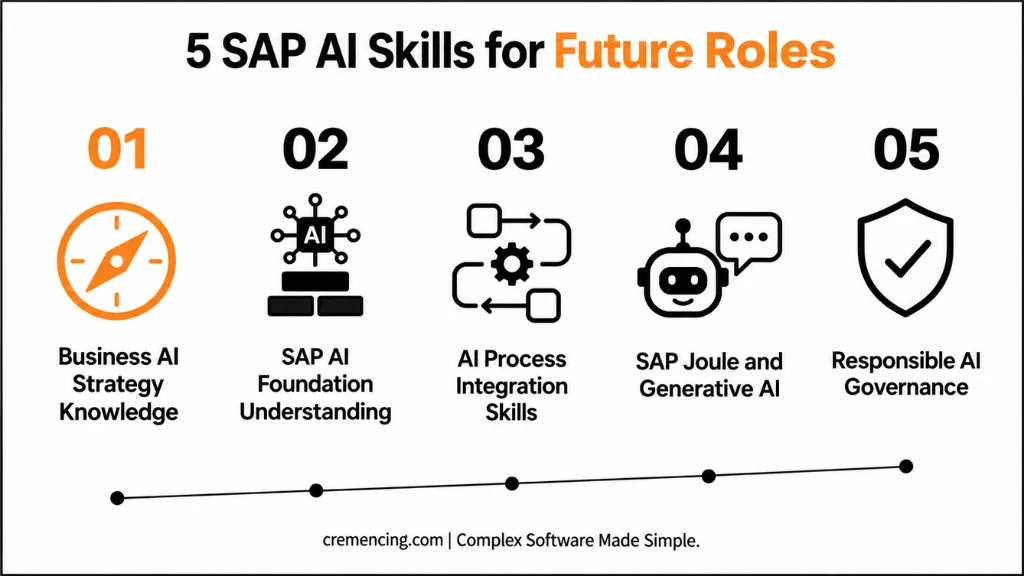
Skill 3: Connect AI With SAP Business Processes
Understanding AI concepts has limited value unless professionals know where AI fits inside a business process, and this difference separates general AI knowledge from SAP-focused expertise. A model succeeds in an enterprise only when it improves a business activity. A finance team, for instance, needs AI that reduces manual invoice review and identifies exceptions, which supports faster financial decisions, while a supply chain team needs demand predictions that connect with planning processes instead of ending in a report. Professionals should therefore learn how AI applies to finance automation, procurement, supply chain, customer experience and HR, and this process-oriented thinking is essential for taking part in SAP Business AI projects.
Skill 4: Learn SAP Joule and Generative AI Capabilities
SAP Joule is SAP’s generative AI assistant, and it lets users interact with business applications through natural language. Professionals should understand what Joule does, how users interact with it, how its answers and actions connect with SAP workflows and authorizations, and where customization may be required. A sales user may ask about customer opportunities, a finance user may ask for an explanation of financial figures, and an analyst may need faster access to operational insights. The key skill is understanding how the assistant fits into specific SAP scenarios, because this understanding lets professionals communicate with both technical teams and business stakeholders. Joule availability varies by SAP solution and release, so check the current scope for your landscape.
Skill 5: Understand AI Services on SAP BTP
The fifth skill is understanding how AI services connect with applications, data and extensions on SAP Business Technology Platform, which provides capabilities for application development, data management, integration, AI services and enterprise extensions. Consider a company that wants an AI-supported procurement recommendation. The consultant must know where the SAP business data originates, how the AI service processes it, how the recommendation returns to business users and how security and governance stay intact, for example through role-based access and controlled data exchange. In SAP S/4HANA Cloud, side-by-side extensions on SAP BTP also support the clean core principle, which makes this knowledge relevant beyond AI projects.
Skill 6: Understand AI Governance and Responsible AI
AI adoption creates new responsibilities, and SAP professionals need to understand how organizations control AI use as well as what AI can do. Data privacy, security, transparency and human oversight form the core of this topic. Recommendations that affect financial decisions, supplier selection or employee processes must be explainable and controllable, which means that implementation decisions, such as which data to expose and who approves AI-generated results, follow from responsible AI principles. This skill matters most for SAP architects, solution consultants and transformation leaders, because they decide where AI enters a process and how it operates.
Skill 7: Position AI Knowledge for Career Growth
A certification alone does not create career growth, because the value comes from connecting certification knowledge with practical SAP experience. An SAP FI consultant with Business AI knowledge can help design AI-supported finance scenarios, an SAP developer with AI skills can build intelligent extensions, and an architect with AI understanding can plan landscapes that integrate AI services. Therefore, professionals should present SAP Business AI certification together with concrete project examples, such as an identified AI use case or a prototype on SAP BTP. SAP certifications are role-based, so hands-on practice supports exam preparation as well.
Skills Comparison: Traditional vs. AI-Ready SAP Roles
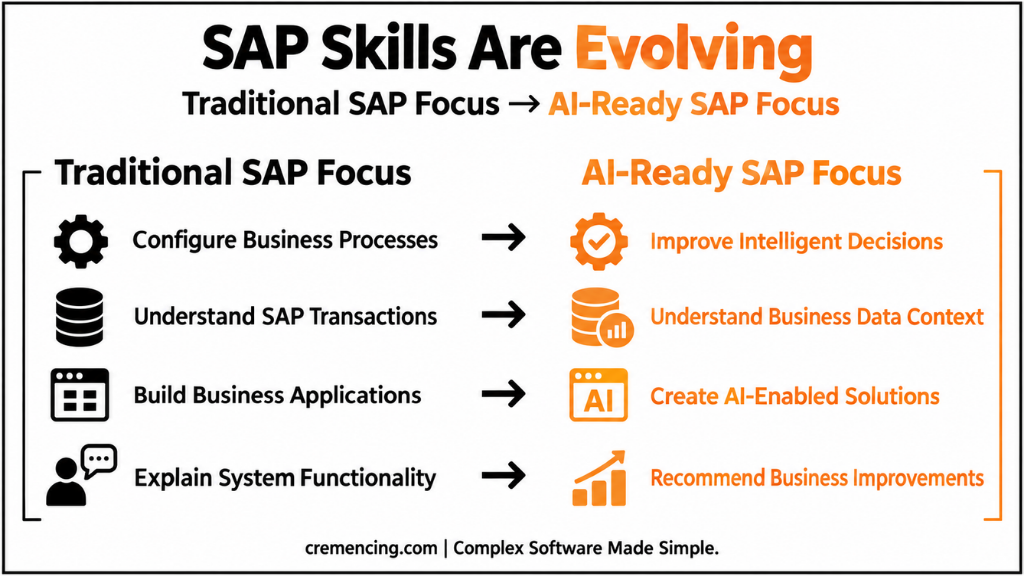
TThe table shows how each skill area changes when AI becomes part of SAP projects.
| Skill area | Traditional SAP focus | AI-ready SAP focus |
|---|---|---|
| Business processes | Configure and support processes | Identify where AI improves decisions |
| Data knowledge | Understand SAP tables and transactions | Understand data context for AI scenarios |
| Development | Build applications and extensions | Build AI-enabled SAP solutions |
| Consulting | Explain system functionality | Recommend intelligent business improvements |
| Architecture | Design SAP landscapes | Design AI-connected enterprise landscapes |
H2: Building a Business AI SAP Learning Roadmap
A roadmap keeps the preparation practical, because each stage builds on the previous one and ends with a result you can show.
Stage 1: Learn SAP Business AI Concepts
Start with the SAP Business AI overview, the Joule basics and the responsible AI principles on SAP Learning. This stage gives you the vocabulary and the scope of SAP’s AI portfolio, and it helps you decide which role-specific content to study next.
Stage 2: Understand SAP AI Technologies
Continue with SAP BTP basics, SAP AI Foundation, the generative AI hub and the integration with SAP S/4HANA. Where available, use a trial or free-tier SAP BTP account for hands-on practice, because building a small prototype explains the architecture faster than reading about it.
Stage 3: Apply AI Knowledge to Your SAP Role
Choose one process from your own area, such as invoice exception handling or purchase requisition approval, and document where AI could help, which data it needs and which controls apply. Then prepare for the certification with this example in mind, since it connects the exam topics with real project work.
Common Mistakes When Learning Business AI
Focusing Only on AI Theory
Machine learning terminology alone does not explain how AI improves SAP operations, because SAP professionals also need process knowledge to judge where a model creates value.
Ignoring SAP Data Context
AI depends on meaningful business data, so professionals must understand how SAP data, such as master data and transactional documents, supports intelligent decisions and where its quality limits the result.
Treating AI as Separate From SAP
The biggest opportunity comes from combining SAP expertise with AI capabilities, and AI knowledge becomes more valuable when it connects directly with enterprise processes.
Learning Without Practical Application
Certification should support real project capabilities, which is why professionals should practice identifying AI use cases inside SAP environments instead of memorizing exam topics.
Conclusion
SAP Business AI certification matters because SAP professionals need to understand how AI connects with enterprise processes. They also need to connect AI with business data and decisions. Customers increasingly expect this knowledge from consultants, developers, and architects.
The seven skills in this guide provide a practical learning structure. They cover strategy, SAP AI Foundation, governance, and career positioning. These skills can support both learning and project work.
Looking ahead, SAP continues to embed Joule and Business AI scenarios into its cloud solutions. SAP is also extending AI services on SAP BTP. Therefore, these skills will become increasingly relevant with each release.
Professionals who combine SAP expertise with applied AI knowledge will be better prepared. They can support the roles created by SAP S/4HANA Cloud transformations.
Frequently Asked Questions
1. What is SAP Business AI certification?
SAP Business AI certification validates a professional’s understanding of SAP AI concepts, technologies, and business applications. It helps SAP consultants, architects, developers, and business users understand how AI capabilities connect with SAP processes, data, and enterprise transformation strategies.
2. Why should SAP professionals learn Business AI SAP skills?
SAP professionals should learn Business AI SAP skills because enterprise roles are changing from traditional implementation toward intelligent process transformation.
AI knowledge helps professionals identify where automation, recommendations, and intelligent assistance can improve SAP processes. Combining SAP expertise with AI understanding allows consultants to contribute more effectively to future transformation projects.
3. What topics are covered in SAP Business AI learning?
Business AI SAP learning typically covers SAP’s AI ecosystem, including AI concepts, SAP Business AI capabilities, SAP Joule, AI Foundation, responsible AI principles, and practical enterprise use cases.
SAP provides learning journeys, self-paced courses, and certification resources to help professionals build AI skills for different SAP roles.
4. Is SAP Business AI certification useful for SAP consultants?
Yes, SAP Business AI certification can help consultants expand their existing SAP expertise into AI-driven business transformation.
For example, an SAP finance consultant can better understand AI-powered finance scenarios, while a supply chain consultant can identify opportunities for intelligent planning and automation.
5. How does positioning Business AI SAP certification help career growth?
Positioning Business AI SAP certification correctly means connecting AI knowledge with business outcomes instead of presenting it as only another credential.
Professionals should explain how they can help organizations apply AI within SAP processes, improve decisions, and support intelligent enterprise initiatives.
6. What is the role of SAP Joule in business AI learning?
SAP Joule is SAP’s AI assistant designed to help users interact with SAP applications through natural language and AI-powered assistance.
Professionals learning SAP Business AI should understand how Joule supports business scenarios, improves user experiences, and connects intelligence with daily SAP workflows.
7. Do SAP developers need AI skills?
Yes, SAP developers increasingly benefit from AI skills because future extensions and applications will include intelligent capabilities.
Developers should understand areas such as SAP BTP AI capabilities, AI services, integration patterns, and how AI features can be embedded into SAP solutions.
8. How can professionals start SAP Business AI learning?
Professionals can start by learning SAP Business AI fundamentals, exploring AI use cases, and understanding how SAP applications use AI capabilities.
SAP provides learning journeys, courses, hands-on resources, and certification preparation options through SAP Learning platforms.
References
SAP AI Learning and Certification Resources


One Response