
Most people assume the difference between a senior SAP consultant and a solution architect is simply years of experience or breadth of product knowledge. That assumption is wrong. Plenty of professionals who know SAP S/4HANA inside out still struggle the moment a conversation moves past configuration and development — because architecture isn’t about knowing more modules, it’s about making trade-off decisions that knowledge alone doesn’t prepare you for.
The moment the discussion shifts to why one integration pattern beats another, where an extension belongs, or what a legacy process costs the target architecture, product expertise stops being enough. This guide breaks down the nine skills that actually separate an SAP solution architect from a specialist — and none of them are “know more SAP products.
Mastering Modern SAP Architecture
Moving from a traditional consultant to a solution architect requires a fundamental mindset shift. Rather than focusing solely on individual module configuration, architects must master end-to-end landscape design and evaluate critical technical trade-offs. This transition demands a strong grasp of modern SAP S/4HANA deployment models, side-by-side extensibility, and seamless multi-system integration patterns.
To build a sustainable enterprise architecture, solution architects must prioritize Clean Core principles across all customization decisions. Decoupling custom business logic via SAP BTP keeps the core stable while allowing continuous innovation and seamless future upgrades. Balancing security, data governance, and operational readiness ultimately ensures scalable digital transformations across complex cloud environments.
What Is an SAP Solution Architect and Why the Role Matters
An SAP solution architect is a member of the SAP implementation team, and their role is vital to the successful implementation of an SAP project.
An SAP solution architect’s job is to translate the business requirements into an end-to-end technology solution, which is to be designed to fit into an organization’s SAP landscape.
The position is neither business nor technical.
A working consultant can concentrate in the working of a particular business process. An ABAP Developer can create a Technical Implementation. A Basis or cloud engineer can specialize in infrastructure and operations.
It is the responsibility of the SAP Solution Architect to comprehend how all these pieces will connect and how a decision in one area will impact the rest of the solution.
Let’s take a typical example of a company that is implementing SAP BTP alongside their SAP ECC migration and transitioning to SAP S/4HANA.
A good SAP solution architect doesn’t just pick SAP products. They consider business requirements, technical considerations, lifecycle, security, integration, and maintainability when making architectural decisions.
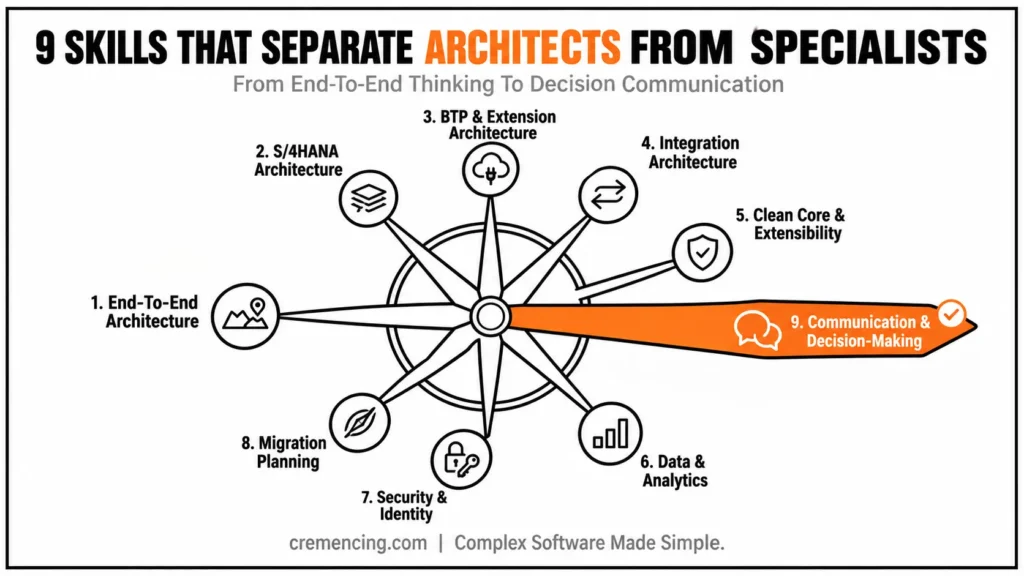
9 SAP Solution Architect Skills — At a Glance
- End-to-End SAP Architecture
- SAP S/4HANA Architecture
- SAP BTP and Extension Architecture
- Integration Architecture
- SAP Clean Core and Extensibility
- Data and Analytics Architecture
- Security and Identity Architecture
- Migration and Transformation Planning
- Communication and Decision-Making
How the Role Has Changed in Modern SAP Landscapes
Typical SAP setups focused on a fairly limited ERP system. The architecture aspect was dominated by the SAP application, the SAP database, the infrastructure, the interfaces, and the custom ABAP development.
Today’s landscapes are more fragmented.
An organization can use SAP S/4HANA as its digital core and link SAP BTP applications, third-party SaaS platforms, legacy systems, data platforms, mobile applications and external partners.
Therefore, the architect needs to know more than SAP configuration.
SAP’s current guidance for architecture focuses on aspects like clean core, extensibility, integration, cloud adoption, and leveraging SAP BTP in modern solution landscapes.
SAP also offers architecture resources via the SAP Architecture Center and SAP Well-Architected Framework.
1. End-to-End SAP Architecture
The first skill that separates an SAP solution architect from a specialist is the ability to see the entire landscape.
You don’t need to configure every component yourself. You do need to understand how the major components interact.
That includes areas such as:
- SAP S/4HANA
- SAP BTP
- SAP Integration Suite
- SAP Analytics Cloud
- SAP Datasphere
- SAP Cloud ALM
- SAP SuccessFactors
- SAP Ariba
- SAP Customer Experience solutions
- Third-party platforms
The important skill is knowing where each component fits.
Suppose a business asks for a new customer-facing application. A weak architectural approach starts with the question, “Which SAP product can we use?”
A stronger approach starts with:
- What business problem are we solving?
- Who will use the application?
- Where does the master data reside?
- Which system owns the transaction?
- Does the application need real-time integration?
- Where should the extension logic run?
- What security model applies?
- How will the application be monitored?
This shift from product-first thinking to architecture-first thinking is critical.
An SAP Solution Architect should be able to draw the landscape on a whiteboard and explain the responsibility of every major component.
You should also understand architectural boundaries. S/4HANA should not become a dumping ground for every new requirement. BTP should not become an excuse to move every customization into the cloud. Integration platforms should not become repositories for uncontrolled business logic.
2. SAP S/4HANA Architecture
S/4HANA knowledge is essential for architects working on modern SAP transformations. But knowing S/4HANA transactions isn’t enough. You need to understand how the architecture changes the way organizations design solutions.
Important areas include:
- Simplification and data model changes
- Universal Journal
- Business Partner
- Embedded analytics
- CDS-based data access
- Fiori and SAPUI5
- RAP
- Extensibility
- Clean Core principles
- On-stack and side-by-side extensions
- SAP S/4HANA Cloud deployment models
An architect working on an S/4HANA transformation must understand the relationship between business requirements and the target architecture.
For example, imagine a company has hundreds of custom ABAP objects in ECC.
The wrong approach is:
ECC custom code → automatically move everything to S/4HANA
The better approach is:
Analyze → classify → simplify → retire → redesign → extend where appropriate
Some custom functionality may no longer be required. Some may be replaced by standard S/4HANA capabilities. Other requirements may need redesigned extensions. That is why SAP S/4HANA architecture is not simply an upgrade skill.
It is a decision-making skill.
3. SAP BTP and Extension Architecture
SAP BTP knowledge has become increasingly important for solution architects because modern SAP landscapes often require extensions outside the core ERP system.
- The key is not memorizing every BTP service.
- The real skill is knowing when and where to extend.
SAP’s extensibility guidance in general aims to maintain the core clean and using the right on-stack or side-by-side approach to create extensions. SAP BTP offers services which can be used for application development, integration, data management, automation, or even AI scenarios.
An SAP solution architect should understand the following:
- SAP BTP account structure
- SAP Integration Suite
- SAP Extension Suite
- SAP Build
- APIs
- Events
- Identity and access
- Cloud integration patterns
- Application lifecycle management
Consider a requirement to add a custom approval application.
You might implement the logic directly inside S/4HANA. Or you might build a side-by-side extension on SAP BTP.
The correct decision depends on factors such as:
- Upgrade impact
- Data ownership
- Process coupling
- User experience
- Security
- Integration requirements
- Lifecycle independence
The architect’s job is to evaluate those trade-offs. A strong SAP solution architect can explain why an extension belongs in a particular architectural layer and what happens if that decision changes five years later. If you’re still weighing whether to pursue certification, we’ve broken down whether the SAP Solution Architect practical exam is actually worth it in 2026.
4. Integration Architecture
An average business could integrate SAP S/4HANA with other enterprise systems such as CRM, HR, e-commerce, banking, logistics, tax, payments, and external partner systems. This is one of the most crucial SAP solution architect skills; hence, integration architecture is a significant part.
You should understand different integration styles, including:
- Synchronous APIs
- Asynchronous messaging
- Event-driven integration
- Batch processing
- File-based integration
- OData services
- REST APIs
- SOAP services
- IDocs
- Business Events
The goal is to select the right integration pattern for the requirement.
| Integration Style | Best For | Latency | Failure Handling |
|---|---|---|---|
| Synchronous APIs | Simple lookups, real-time responses needed | Low | Immediate error, no retry built-in |
| Asynchronous Messaging | Reliable processing (e.g., payment confirmation) | Medium | Retry queues, guaranteed delivery |
| Event-Driven Integration | Real-time reactions to business events | Low–Medium | Depends on event broker durability |
| Batch Processing | High-volume, non-urgent data transfer | High | Errors surface only at batch end |
| File-Based Integration | Legacy system compatibility | High | Manual monitoring often required |
| OData / REST APIs | Modern app-to-app communication | Low | Standard HTTP error handling |
| IDocs | SAP-to-SAP or SAP-to-legacy exchange | Medium | Built-in status monitoring (WE02/WE05) |
For example, a payment confirmation may require reliable asynchronous processing. A simple application lookup may use a synchronous API. A high-volume data transfer may require a different pattern entirely. You should also understand integration ownership.
Ask:
Which system owns the data?
Who initiates the transaction?
What happens when the target system is unavailable?
How do we retry failures?
Where do we monitor errors?
How do we prevent duplicate messages?
Those questions often matter more than the integration technology itself.
5. SAP Clean Core and Extensibility
Clean Core has moved from being a technical preference to a major architecture consideration. The basic idea is straightforward: keep the ERP core as standard and stable as possible so the organization can adopt innovations and upgrades with less disruption.
But implementing Clean Core requires more than telling developers not to customize. The architect needs to create an extension strategy.
Every customization request should raise questions such as:
- Is standard functionality available?
- Can configuration solve the requirement?
- Is an in-app extension appropriate?
- Should the requirement use a side-by-side extension?
- Can an API support the integration?
- Does the customization create upgrade risk?
- Who owns the extension after implementation?
The architect should also understand technical debt. A custom modification that solves today’s problem may create tomorrow’s upgrade cost. The role of the architect is to make that trade-off visible before development begins.
This requires collaboration with functional consultants, developers, security teams, and business stakeholders. Clean Core isn’t about eliminating every custom requirement.
It is about placing custom logic in the right architectural location.
6. Data and Analytics Architecture
An SAP Solution Architect increasingly needs to understand how operational data becomes business insight.
That requires knowledge of:
- SAP S/4HANA data structures
- CDS views
- SAP Datasphere
- SAP Analytics Cloud
- Data integration
- Data governance
- Master data
- Real-time and batch analytics
The architect should distinguish between operational and analytical requirements.
For example, an S/4HANA system may own transactional data, while an analytics platform may combine information from SAP and non-SAP sources.
The architecture must answer the following:
Where is the source of truth?
Where should data be transformed?
Who owns the data model?
How quickly does the business need the information?
What security rules apply?
How long should the data remain available?
These decisions influence architecture, cost, performance, and governance. You do need to understand the data flow well enough to prevent architectural mistakes. A strong architect can trace a business KPI from the executive dashboard back to the source transaction and explain every major transformation in between.
7. Security and Identity Architecture
Security cannot sit at the end of an architecture project.It must exist from the beginning.
SAP Solution Architects should understand:
- Identity providers
- Single sign-on
- Authentication
- Authorization
- Role design
- SAP Identity Authentication
- SAP Identity Provisioning
- OAuth
- API security
- Network security
- Data protection
The challenge becomes greater when the landscape includes multiple cloud and on-premise systems. A user may authenticate through a central identity provider and then access S/4HANA, BTP applications, and third-party services. The architect needs to understand the trust relationships between those systems.
For every integration, ask:
- Who is calling?
- How are they authenticated?
- What permissions do they have?
- How are credentials managed?
- What happens when access is revoked?
- How are security events monitored?
Security architecture also includes data protection.
A solution that technically works but exposes sensitive customer or employee data isn’t a successful solution. The strongest architects involve security teams early rather than presenting security as a final approval gate.
8. Migration and Transformation Planning
An SAP Solution Architect often works in environments where the current landscape is not the target landscape.
That makes transformation planning a core skill.
You may need to support:
- ECC to S/4HANA conversion
- Greenfield implementations
- Selective data transitions
- Cloud migrations
- SAP BTP adoption
- Legacy application retirement
- Integration modernization
The architect must understand the difference between a technical migration and a business transformation.A system can be moved successfully while the organization keeps the same inefficient processes and excessive custom code. That is not necessarily a successful transformation.
During planning, assess:
Current state → Business pain points → Target state → Transition architecture → Migration waves
The transition architecture is particularly important.
Large enterprises rarely move everything at once. They may operate ECC, S/4HANA, cloud services, and legacy applications simultaneously. The architect must design for that temporary state.
This means understanding dependencies, interfaces, data synchronization, security, and operational ownership during each migration phase. The best architecture isn’t only the final diagram. It’s the roadmap that gets the organisation there without losing control.
9. Communication and Decision-Making
This can be one of the most underrated skills of the SAP solution architect.It isn’t possible to have a great solution and not be able to explain it.
Architects communicate with:
- CIOs
- CTOs
- Enterprise architects
- Business stakeholders
- SAP functional consultants
- Developers
- Basis teams
- Security teams
- Project managers
- Vendors
There is a need for different levels of detail for each audience. A CIO might need to be aware of business impact, risk and cost.A developer require interfaces, extension points, and technical restrictions.Requires authentication and authorization information for a security architect. It’s up to you to ensure that everyone stays on the same page without drowning them in too much detail.
Architecture communication is generally strong if:
Strong architecture communication usually includes:
- The business problem
- The architectural options
- The recommended approach
- The trade-offs
- The risks
- The decision required
Avoid presenting architecture as a collection of technology names.
Instead of saying
“We’ll use SAP BTP and Integration Suite.”
Explain:
We’ll keep the transaction in S/4 HANA, expose the needed capability via a supported API, and use Integration Suite to decouple the external application, thus minimising direct point-to-point dependencies and enabling the external application to evolve independently.
That’s the essence of architecture communication. It links technology with a decision.
How to Build These SAP Solution Architect Skills
It is not necessary to be equally knowledgeable in the nine areas at the same level. Rather, create a T-shaped skill profile. Dive into 1 or 2 disciplines, building up your breadth of architectural knowledge in others.
For example:
Deep expertise:
SAP S/4HANA architecture + ABAP extensibility
Broad knowledge:
BTP + Integration + Security + Data + Cloud + Operations
Then practice architecture through real scenarios.
Take a business requirement and create the following:
- Current-state architecture
- Target-state architecture
- Integration diagram
- Data-flow diagram
- Security model
- Extension strategy
- Migration roadmap
- Architecture decision record
The goal is to practice making decisions—not just drawing diagrams. You should also learn to evaluate trade-offs.
For every major architectural decision, document:
Option A: Benefits, limitations, risks
Option B: Benefits, limitations, risks
Recommendation: Why one option fits the business better
This creates a decision trail that helps teams understand why the architecture looks the way it does. Certifications can also help structure your learning, but hands-on project experience remains critical. Work on transformation programs, integration projects, cloud adoption, or S/4HANA implementations whenever possible.
The more real constraints you encounter, the stronger your architecture judgment becomes.
The more real constraints you will face, the better you will get at your Architecture judgment.
Common Mistakes That Hold SAP Solution Architects Back
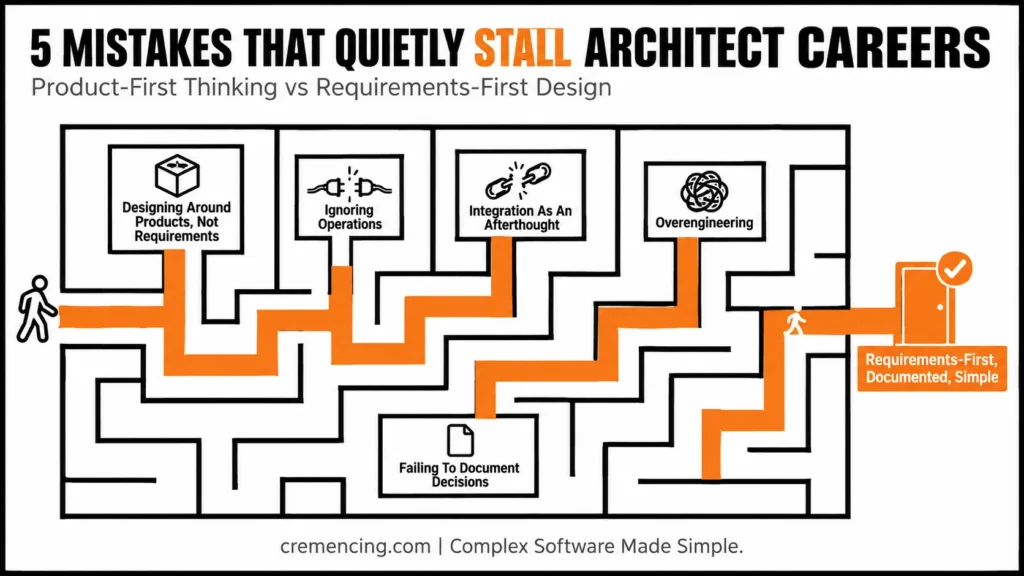
Mistake 1: Designing around products instead of requirements
The first mistake is to design products rather than requirements. The first mistake is to design around products rather than requirements. Decisions made when starting with “Let’s use SAP BTP” or “Let’s build in S/4HANA” can be premature.
Start with the business requirement and constraints.
Then select the technology.
Mistake 2: Ignoring operations
There is no finished solution until it’s deployed in the production environment. Monitoring and alerting, incident management, support ownership, backup, disaster recovery, and lifecycle planning are also required.
The operating model is a must in architecture.
Mistake 3: Treating integration as an afterthought
Long-term dependency can be introduced in Point-to-point integrations. Establish system ownership and design integration patterns early in the development process.
Mistake 4: Overengineering
Not all needs must be supported with a complex cloud architecture. There is a price to complexity. The best architecture is the simplest that meets the requirements and provides enough space for future changes.
Mistake 5: Failing to document decisions
Decisions in architecture are revisited. If a team does not have documentation, then they might go over the same ground again or overturn decisions without understanding what the constraints were. Capture the context, options, decision and consequences in an architecture decision record.
Conclusion
Knowing every SAP product was never the bar for becoming a solution architect — connecting them into one coherent, defensible solution is. The nine skills here, from end-to-end architectural thinking to communicating trade-offs at the CIO level, are what separate someone who configures SAP well from someone organizations trust to make the calls that outlast a single project.
You don’t need equal depth in all nine. Go deep in one or two, stay broad across the rest, and let real project constraints — not certifications alone — sharpen the judgment that actually defines the role.
Frequently Asked Questions
1. What does an SAP solution architect do?
An SAP solution architect is responsible for the design of end-to-end solutions that integrate business requirements, SAP technology, and other enterprise systems. The position usually entails SAP S/4HANA archiving, integration, extensions, security, data planning, and transformation. The architect also leads technical decisions from various teams and makes sure the solution is sustainable beyond implementation.
2. What skills does an SAP solution architect need?
The SAP solution architect must have a wide range of knowledge in the fields of SAP architecture, S/4HANA, SAP BTP, integration, security, data, extensibility, and cloud transformation. Another crucial aspect of both communication and decision making is that architects need to discuss technical trade-offs with both technical and business parties.
3. Should an SAP solution architect know SAP BTP?
Indeed, knowledge of SAP BTP is becoming more critical for architects making architectural designs in modern SAP landscapes. It’s important to be aware of how BTP enables extensions, integration, automation, data, and application development. While it is not necessary to learn all of the BTP services, it is important to understand the potential of a BTP-based architecture and how it can provide complexity if it is not warranted.
4. What is the difference between an SAP solution architect and an SAP technical architect?
The roles can sometimes overlap, but typically the SAP solution architect’s attention is on the whole solution and the role of technology in meeting business needs. An SAP technical architect may delve deeper into technical architecture, infrastructure, integration, security, or development. The clear definition varies with the organisation and project structure.
5. What is the most crucial skill that an SAP solution architect needs?
The most vital skill is end-to-end architectural thinking. An architect needs to be familiar with the interaction between business processes, SAP applications, integrations, data, security and operations. With in-depth knowledge in one facet comes the ability to understand the impacts of decisions on the landscape, which makes the role unique.
6. How long does it take to become an SAP solution architect?
There’s no fixed timeline, since it depends on prior experience. Most professionals spend several years working as SAP functional or technical consultants before moving into an architect role. Building the T-shaped skill profile — deep expertise in one or two areas plus broad knowledge across S/4HANA, BTP, integration, security, and data — typically takes real project exposure over multiple implementations, not just study time.
7. Is SAP BTP certification necessary to become a solution architect?
Certification isn’t strictly necessary, but it can help structure your learning and validate your knowledge to employers. What matters more is hands-on project experience — working on transformation programs, integration projects, or S/4HANA implementations where you actually make architectural trade-off decisions, not just pass an exam.
8. What is Clean Core, and why does it matter for SAP architects?
Clean Core is the practice of keeping the SAP S/4HANA core as standard and unmodified as possible, so organizations can adopt upgrades and innovations with minimal disruption. It matters because architects must evaluate every customization request and decide whether it belongs in-app, side-by-side on BTP, or isn’t needed at all — placing custom logic in the right architectural location rather than eliminating it entirely.
9. What tools or frameworks do SAP solution architects commonly use?
Architects often rely on SAP’s own guidance resources, including the SAP Architecture Center and the SAP Well-Architected Framework, along with SAP Cloud ALM for landscape and lifecycle management. Beyond SAP-specific tools, architects also use standard practices like architecture decision records (ADRs), integration and data-flow diagrams, and current-state/target-state architecture mapping.
10. Can an SAP functional consultant become a solution architect?
Yes, this is a common career path. Functional consultants already understand business processes deeply, which is a strong foundation. To transition, they typically need to broaden their knowledge into technical areas like integration, security, extensibility, and cloud architecture, while developing the end-to-end thinking and cross-team communication skills that separate an architect from a specialist.




One Response