

Introduction
Organizations are now moving towards the use of AI to automate routine business processes, but few are aware of the effect of the SAP AI agents already working in the background. These autonomous systems are not merely experimental but are actively showing efficiency improvements, which are measurable.
It’s the third of the month, and your finance team is still manually matching bank statement lines to open items in FBL5N, a job that used to eat five business days every close cycle. Down the hall, procurement is sitting on a stack of routine purchase orders waiting for a human to sign off on something a rules engine could clear in minutes. Neither team is understaffed. They’re just doing work that no longer needs a person attached to it.
That’s the gap SAP AI agents close, not as a future roadmap item, but as tools already running inside live S/4HANA and BTP-connected landscapes today. This isn’t about replacing judgment calls; it’s about routing the repetitive 80% of a process to software and leaving people the 20% that actually needs a human. Below, five agents already do the work they touch in the SAP stack, and where teams tend to get the rollout wrong.
What are SAP AI agents?
SAP AI agents refer to independent software programs that are integrated into SAP systems and perform certain tasks without human supervision. These agents are proactive in their data monitoring, decision-making, and action toward operational rules, unlike traditional AI tools, which need manual input or oversight.
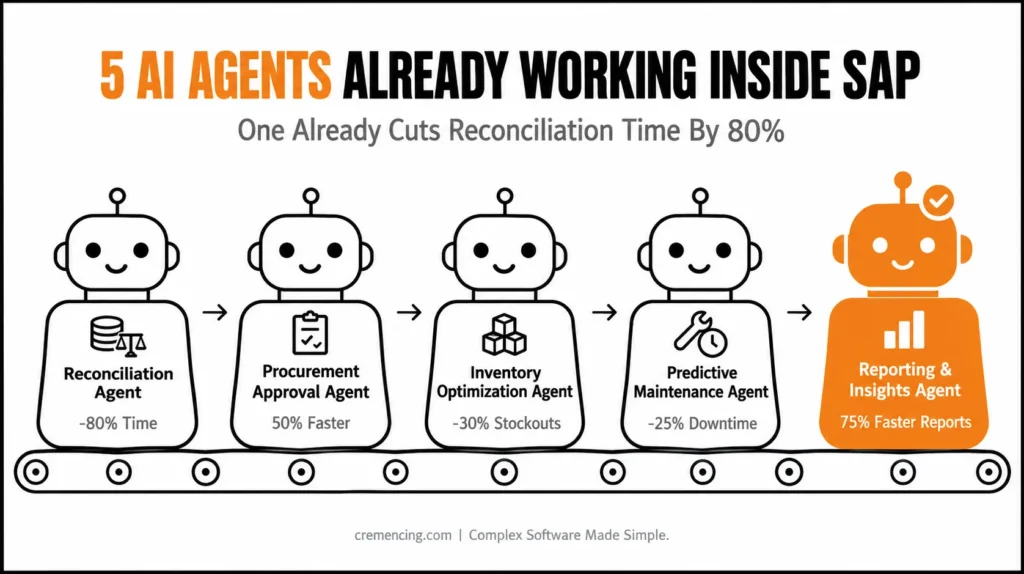
SAP AI agents have key features such as the following:
- Automatic Task Performance: Agents automatically perform tasks like approvals, reconciliations, and reporting.
- Context-Aware Decision Making: AI takes into account historical data and current conditions, then takes action.
- Real-Time Process Monitoring: This is where workflows are tracked by the agents, and only when there is a need to intervene does the agent notify the human.
In practice, “SAP AI agent” isn’t one product; it’s a pattern SAP implements across several tools:
- Joule, SAP’s generative AI copilot embedded across S/4HANA Cloud and SuccessFactors, handles conversational, task-triggered automation.
- SAP AI Core and AI Launchpad on BTP host the machine-learning models that power prediction and anomaly detection (the layer most “reconciliation” and “predictive maintenance” agents actually run on).
- SAP Build Process Automation orchestrates the workflow and approval logic that ties a prediction to an action.
| Feature | Function |
| Reconciliation Automation | Maps transactions and reconciles differences. |
| Predictive Maintenance Agent | Notifications about possible equipment malfunctions. |
| Procurement Approval Agent | Authorizes normal purchase orders in accordance with a set of guidelines. |
| Inventory Optimization Agent | Raises and lowers stock and predicts demand. |
| Reporting & Insights Agent | In real-time, it creates dashboards and predictive analytics reports. |
These AI agents enable operational efficiency, minimize errors, and enable employees to work on high-value tasks. Machine learning algorithms are used to analyze past and present data to identify trends, anomalies, and patterns
The functioning of SAP AI agents.
Knowledge of SAP AI agent functionality can assist organisations in implementing it successfully. The following is a step-by-step account:
Step 1: Data Ingestion.
The information gathered by agents is based on various SAP modules, which include finance, procurement, and supply chain. Accurate and up-to-date data is critical for decision-making.
Step 2: Pattern Recognition.
Machine learning algorithms are used to analyze past and present data to identify trends, anomalies, and patterns. As an illustration, a reconciliation agent establishes recurring mismatches in transactions.
Step 3: Decision Simulation.
Agents plan actions by simulating various possible results to select the most appropriate course of action, with minimal risk and maximum efficiency.
Step 4: Autonomous Execution.
Once approved, the agent independently carries out the action, whether it reconciles accounts, approves a purchase, or changes inventory levels.
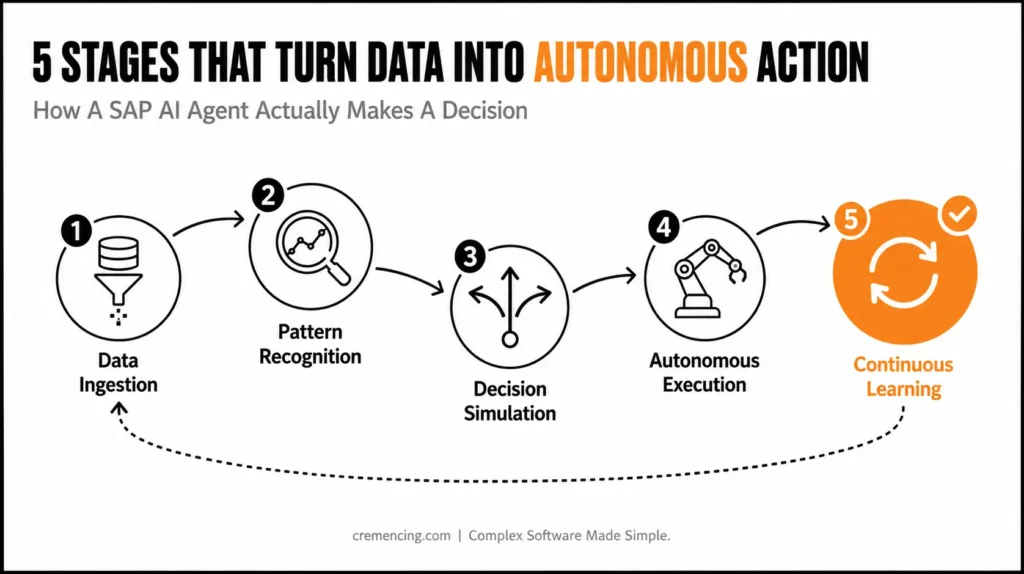
Step 5: Continuous Learning.
The agents observe the results and make use of machine learning to optimize the decisions to be made in the future. This process of continuous improvement will guarantee increased accuracy and improvement of processes with time.
5 SAP AI Agents Moving Real Results
| Agent | Likely SAP Layer | Typical Prerequisite | Deployment Model |
|---|---|---|---|
| Reconciliation Automation | S/4HANA Finance + AI Core | Clean, structured GL/bank data | On-prem or Cloud |
| Procurement Approval | Ariba / S/4HANA MM | Defined approval matrix in place | Cloud-first |
| Inventory Optimization | S/4HANA + Analytics Cloud | Demand history ≥ 12 months | On-prem or Cloud |
| Predictive Maintenance | Asset Intelligence Network | IoT/sensor data feed | BTP-connected |
| Reporting & Insights | SAP Analytics Cloud / Datasphere | Governed data model | Cloud |
These agents have direct payoffs and are already demonstrating their worth in the actual enterprise setting.
ROI and benefits of SAP AI agents
Implementing SAP AI agents provides quantifiable results, such as:
- Time Savings: Daily operations such as reconciliation and approvals, among others, are handled in a shorter time.
- Cost Reduction: Automation cuts down operational costs that are related to manual processing.
- Improved Accuracy: Minimizes errors and inconsistencies in transactions and reporting.
- Improved Decision-Making: Predictive analytics and real-time insights are used to make improved decisions.
| Metric | Traditional Process | AI Agent Enhanced | Improvement |
| Reconciliation Time | 5 days | 1 day | -80% |
| Procurement Approval Speed | 2–3 days | 1 day | 50% faster |
| Inventory Stockouts | High | Reduced | -30% |
| Reporting Turnaround | 48 hours | <30 minutes | 75% faster |
With the strategic placement of AI agents, organizations can have a high ROI within months as teams are freed to work on higher-value tasks.
Common SAP AI Agent Mistakes and Best Practices
Even well-performing SAP AI agents require careful implementation.
Common Mistakes and Best Practices for SAP AI Agents
- Using AI agents as a set-and-forget device.
- Neglecting data quality or partial integration.
- Adding excessive exceptions to the agents.
- Not giving adequate training in human monitoring.
Best Practices:
- Thoroughly audit data before deployment.
- Begin with high-impact, repetitive processes.
- Keep track of performance and modify rules accordingly.
- Make sure that staff is aware of the outputs and limitations of AI agents.
- Integrate AI decision-making with human assessment of critical tasks.
SAP AI Agent Opportunities Competitors Miss
Most of the organizations use SAP AI agents but cannot use them to their full potential:
- Cross-Module Automation: Linking finance, procurement, and supply chain agents to streamline end-to-end workflows.
- Predictive Insights: AI can predict business trends beyond routine operational activities.
- Scenario Testing: Agents are able to simulate a what-if scenario to inform strategic planning.
The exploration of these opportunities enables organizations to maximize ROI and have competitive advantages over companies that use AI to complete isolated activities.
Make your business processes smarter today using SAP AI agents. Get to know how to use high-impact automation and increase efficiency instantly.
Conclusion
The pattern across all five agents here isn’t “AI replaces people”; it’s AI absorbing the repetitive middle of a process so people only step in at the exceptions. Reconciliation, approvals, inventory triggers, maintenance flags, and reporting are all high-volume, rules-heavy work, which is exactly the profile that machine learning handles well and humans find draining.
The teams getting the most out of this aren’t deploying all five agents at once. They’re piloting one, usually reconciliation or procurement approvals, since those have the cleanest data and clearest rules, proving the ROI on their own numbers, then expanding module by module.
If you’re evaluating where to start, the data quality and approval-matrix prerequisites above are the two things worth checking before anything else. The operational efficiency and ROI of these autonomous agents are a fact, as the company has been able to cut its reconciliation time by 80 percent, reporting time by 40 percent, and efficiency by 15 percent.
By preventing common mistakes, capitalizing on best practices, and exploring some opportunities that seem to have been overlooked, such as cross-module automation and predictive insights, organizations can make full use of SAP AI. Placing such agents strategically is not only more likely to streamline the workflow but also to liberate employees, as they are able to focus on more valuable, more strategic tasks. For more insights, read our blog: SAP AI
Frequently Asked Questions.
Q1: What are SAP AI agents?
SAP AI agents are autonomous systems that carry out a certain task within SAP software without human intervention continuously.
Q2: What amount of time can the AI agents save?
Other agents, such as the reconciliation automation agent, can help cut down on processing time by up to 80%.
Q3: Do SAP AI agents have the capacity to be implemented easily?
This requires careful planning, thorough data audits, and gradual implementation, but the high ROI makes the effort worthwhile.
Q4: What are the most useful tasks of AI agents?
High-volume, routine work like reconciliation, purchase approvals, inventory adjustments, and reporting is best suited.
Q5: Could SAP AI agents be helpful to small businesses?
Yes. Even mid-sized firms can achieve efficiency gains, reduce costs, and improve accuracy without large-scale deployment.
Q6: What’s the difference between Joule and an SAP AI agent?
Joule is SAP’s conversational copilot interface; an “agent” more specifically refers to the autonomous, rules-plus-ML process running behind it or on BTP AI Core.
Q7: Does SAP AI Core require S/4HANA, or can ECC systems use it?
BTP-based AI Core connects to both, but with different integration efforts and supported scenarios.
Q8: Can these agents be customized with ABAP, or is it low-code only?
Depends on the layer. Build process automation is largely low-code, while custom logic on S/4HANA may still involve ABAP/RAP extensions.
Resources
SAP AI Overview
AI & Automation
Forrester Report: AI in Enterprise Operations.





One Response