

Introduction
Enterprise SAP projects have trouble getting off the ground before they start. The consequences of wrong architectural decisions include integration issues, the need for customization, security concerns, and long-term maintenance issues within SAP landscapes. When designing with SAP S/4HANA, SAP BTP, and cloud solutions, it is important for SAP architects to understand if a proposed architecture adheres to the recommended guidelines. SAP Architecture Validator supports teams in analysing enterprise SAP designs and optimize them according to SAP guidelines.
This article describes the process of architecture validation, its importance, and how organizations can apply validation practices before undertaking to construct a complex SAP landscape.
Why SAP Architecture Validation Is Becoming Important
SAP Architecture Validation is gaining importance. SAP Architecture Validation is rapidly gaining importance.
The SAP landscapes are much more complex than the traditional ERP landscapes. Previous SAP environments were typically focused on using only one SAP ERP system and making only a few integrations outside of SAP. Today’s enterprises are connected ecosystems supported by SAP S/4HANA, SAP BTP, SAP Integration Suite, analytics platforms, cloud applications, and third-party systems.
This change has added more decisions in the architecture that need to be made prior to implementation. Architects should consider the location of business logic, data flow between systems, how to extend systems, and who will be responsible for security across platforms.
An apparent good design for phase one of a project can cause operational issues later. For instance, creating too much custom logic in SAP S/4HANA can complicate the upgrade, and having too many standalone extensions can lead to an unnecessary number of integration dependencies.
By testing architecture, these risks can be detected before they turn into implementation issues. Teams can discuss design decisions earlier, in the design process, and make design changes in the approach to the solution before running into problems during testing or production.
Validation is more than just determining if a system can technically be operated for SAP architects. It includes assessing design for scalability, maintainability, security, integration standards, and future business needs.
What Is SAP Architecture Validator?
SAP Architecture Validator is a tool provided by SAP that validates the architecture of SAP Web services. SAP Architecture Validator is an architecture review approach that enables SAP teams to assess if enterprise solution designs adhere to the expected architecture principles and recommended SAP patterns. Helps architects to understand and review proposed SAP landscapes prior to development and implementation activities.
Architecture validation aims to develop confidence that a solution design meets enterprise objectives and the SAP-recommended practices. The responsibilities of the various systems, the way they are integrated, the ownership of the data, security mechanisms, and the operational processes of the system should be clearly defined in a validated architecture.
The review of several aspects for architecture validation may be required in practical SAP projects:
- Application architecture
- Integration architecture
- Data architecture
- Security architecture
- Extension strategy
- Cloud adoption approach
- System landscape design
One such example is an organization that is thinking of transforming to SAP S/4HANA that needs to determine what to do with current custom applications. Some applications will transition to SAP S/4HANA; some will be replaced by standard functionality; and others will be SAP BTP extensions. An architecture validation process can provide assistance in making these decisions prior to development.
The significance of SAP Architecture Validator can become more apparent in large enterprise environments in which various teams are involved in the final solution. If not validated, various project teams could develop various architectural solutions and end up with inconsistent designs throughout the SAP landscape.
How SAP Architecture Validator Supports Enterprise Design Decisions
Architecture validation provides a structured review process for SAP solution designs. Instead of evaluating components separately, teams analyze how different parts of the landscape work together.
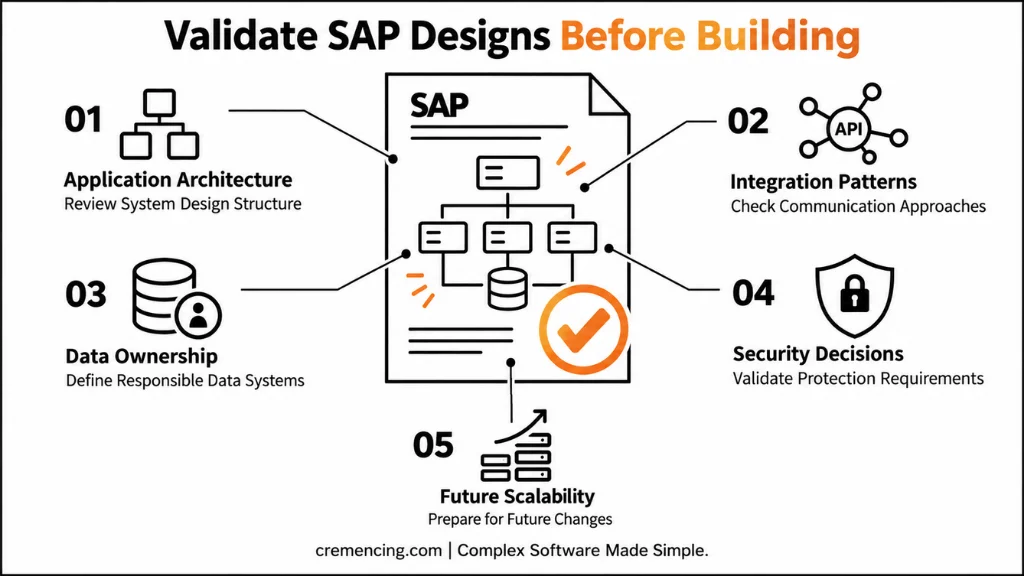
One important area is architecture consistency. Enterprise SAP environments often contain multiple implementation projects running at the same time. A validation process ensures that new solutions follow existing architecture principles instead of introducing isolated patterns.
For example, one project may decide to build custom functionality directly in SAP S/4HANA, while another project uses SAP BTP extensions for similar requirements. Without architecture governance, the organization may end up with inconsistent extension approaches that increase support effort.
SAP Architecture Validator helps teams ask important design questions:
- Does the solution follow SAP clean core principles?
- Are integrations based on appropriate SAP APIs or services?
- Is data ownership clearly defined?
- Are security requirements considered?
- Does the architecture support future upgrades?
- Are SAP cloud services used appropriately?
These questions help architects move beyond technical implementation details and evaluate the long-term impact of design decisions.
Architecture validation is especially useful during early project phases because changes are easier and less expensive before development begins. Once applications, integrations, and custom developments are already created, correcting architectural issues becomes more complex.
SAP Architecture Validation Within Modern SAP Landscapes
Modern SAP architecture requires coordination between multiple SAP platforms. A typical enterprise landscape may include SAP S/4HANA as the business core, SAP BTP for extensions, SAP Integration Suite for connectivity, and SAP Cloud solutions for specialized business processes.
Each platform has a specific role, and architecture validation helps define those boundaries.
For example, SAP S/4HANA should generally remain focused on core ERP processes, while SAP BTP can provide additional applications, extensions, and integration capabilities. The architecture decision depends on business requirements, technical constraints, and lifecycle considerations.
A validated architecture should clearly explain:
- Which system owns business processes
- Where custom development should occur
- How applications communicate
- How data flows between systems
- How users access services
- How the landscape will be maintained
This becomes particularly important for organizations adopting SAP S/4HANA Cloud. Cloud implementations require careful decisions because traditional modification approaches may not be suitable. Architects need to evaluate standard functionality, configuration options, APIs, and extension approaches before selecting a solution design.
SAP architecture validation therefore supports the transition from traditional SAP implementation models toward modern cloud-based enterprise architectures.
Role of SAP Architecture Guidelines in Validation
Defined architecture guidelines are important to SAP architecture validation as they give a baseline to check if the proposed solution meets the recommended design principles. Architecture reviews are easily subjective, especially when there are no guidelines, and each team views solutions based on their technical preferences.
SAP architecture guidelines contribute to consistency within enterprise landscapes by providing guidelines for designing applications, integrations, data and infrastructure. These guidelines are particularly relevant in organisations with several SAP systems, as they help to limit the development of isolated architecture patterns per individual project.
The one important rule that is followed in modern SAP architecture is the concept of maintaining the clean core approach. SAP S/4HANA (S/4HANA Business Suite) implementations are increasingly directed towards reducing any unnecessary changes within the ERP system. In architecture validation, teams check if custom requirements can be covered in the configuration, standard SAP capabilities, or implemented in SAP BTP via APIs or side-by-side extensions.
A business might need a special approval application, for instance, linked to procurement processes. Architects can consider using an SAP BTP extension instead of making direct changes to SAP S/4HANA. The validation process looks at the following before approval of the design: Upgrade impact, integration requirements, security, and application ownership.
Using SAP Architecture Diagrams During Validation
An SAP architecture diagram is an important component of architecture validation because it provides a visual representation of the proposed solution. Complex SAP landscapes often contain multiple layers, and diagrams help teams understand how these components interact before implementation begins.
During a validation review, architects commonly analyze diagrams that represent:
- SAP system landscape
- Application relationships
- Integration flows
- Data movement
- Security boundaries
- Extension components
- Cloud services
A well-prepared diagram allows architects to identify potential design issues early. For example, an integration diagram may reveal that two applications are directly connected through custom interfaces when an SAP Integration Suite approach would provide better governance.
Architecture diagrams also improve communication between technical and business stakeholders. Enterprise architecture decisions often involve people with different levels of technical knowledge. A clear visual model helps explain why a specific design approach was selected and what impact it will have on business processes.
However, diagrams should not only document systems after implementation. Their primary value comes when they are used as decision-making tools during planning and validation. A diagram that accurately represents the proposed architecture allows teams to review dependencies, identify risks, and challenge assumptions before development work begins.
SAP Architecture Validator and SAP S/4HANA Design Reviews
SAP S/4HANA transformation projects require detailed architecture validation because they involve significant changes to business processes, application structures, and technical landscapes. Moving from SAP ECC to SAP S/4HANA is not only a technical migration; it is an opportunity to redesign how enterprise systems operate.
During S/4HANA architecture validation, teams typically review areas such as:
| Validation Area | Key Questions |
| System Architecture | Does the target landscape support business and technical requirements? |
| Extension Strategy | Should custom functionality remain inside S/4HANA or move to SAP BTP? |
| Integration Design | Are interfaces using appropriate SAP-supported approaches? |
| Data Architecture | Are ownership and data flows clearly defined? |
| Security Model | Are identity, authorization, and access requirements considered? |
For example, an organization migrating a custom SAP ECC application may discover that the existing development depends on outdated interfaces or direct database access. Architecture validation helps identify whether the application should be redesigned, replaced, or integrated differently.
The validation process also supports SAP’s clean core strategy. Instead of carrying unnecessary customizations into the new environment, architects can evaluate whether standard S/4HANA capabilities or cloud extension approaches provide a better solution.
This approach reduces future upgrade challenges and helps organizations maintain a more manageable SAP environment.
SAP Architecture Validation
Although architecture validation provides significant value, organizations often face challenges when introducing formal validation processes. One common challenge is involving architects too late in the project lifecycle. When architecture review happens after development decisions are already made, changing the design becomes more difficult.
Architecture validation should happen during early project phases, ideally before detailed development begins. Early involvement allows teams to evaluate alternatives and select appropriate solution patterns before resources are committed.
Another challenge is balancing standardization with business flexibility. SAP architecture guidelines provide recommended approaches, but every organization has unique requirements. Architects must evaluate whether a standard pattern fits the business scenario or whether a different approach is justified.
Data ownership is another important consideration. In connected SAP landscapes, multiple systems may process related information. Without clear ownership definitions, organizations can create inconsistent data across applications.
Security validation also requires careful attention. Architecture reviews should evaluate authentication, authorization, communication security, and compliance requirements. Security decisions made after implementation may require significant redesign efforts.
Best Practices for Effective SAP Architecture Validation
A successful SAP architecture validation approach requires collaboration between enterprise architects, SAP consultants, developers, security teams, and business stakeholders. Each group contributes different knowledge required to evaluate the complete solution.
One important practice is establishing architecture review checkpoints before major implementation decisions. These reviews should happen during solution design, integration planning, extension decisions, and before moving solutions into production environments.
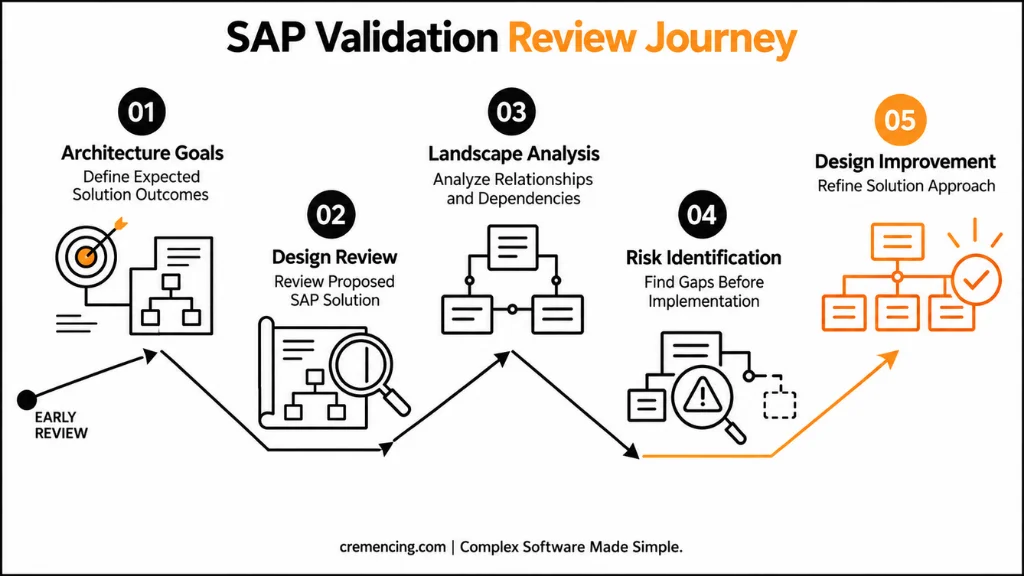
A structured validation process normally reviews:
- Business capability alignment
- Application responsibilities
- Integration patterns
- Data ownership
- Security architecture
- Operational support model
- Future scalability requirements
Another important practice is maintaining reusable architecture patterns. Organizations that repeatedly implement SAP solutions can create internal reference models for common scenarios such as SAP S/4HANA implementations, SAP BTP extensions, integration architectures, and cloud adoption approaches.
These patterns reduce repeated design discussions and help teams make decisions faster while maintaining consistency across projects.
Architecture validation should also include future considerations. SAP landscapes often remain active for many years, so architects should evaluate how the design will support future SAP releases, business changes, acquisitions, and technology adoption.
SAP Architecture Learning and the Future Role of Architects
As SAP landscapes continue evolving, architecture skills are becoming increasingly important for SAP professionals. Traditional SAP roles focused mainly on individual systems, but modern enterprise environments require professionals who understand relationships between multiple platforms.
SAP architecture learning now includes areas such as:
- SAP S/4HANA architecture
- SAP BTP design patterns
- Enterprise integration
- Cloud architecture
- Security architecture
- Data architecture
- Extension strategies
Professionals moving toward architecture roles need to develop the ability to evaluate trade-offs rather than only implement technical solutions.
For example, a developer may know how to build an application, but an architect must decide where that application should run, how it should integrate with SAP systems, and how it will be maintained over time.
The increasing adoption of SAP cloud solutions, composable architectures, and clean core approaches makes architecture validation an important discipline for future SAP implementations.
Conclusion
SAP Architecture Validator helps organizations review enterprise SAP designs before implementation by providing a structured approach for evaluating architecture decisions. By validating application landscapes, integration patterns, security models, and extension strategies, SAP teams can identify potential issues earlier and create solutions that are easier to operate and maintain. The value of architecture validation is not limited to reviewing diagrams; it supports better decision-making across the complete SAP lifecycle.
As enterprises continue adopting SAP S/4HANA, SAP BTP, and cloud solutions, architecture discipline will become increasingly important. Organizations that invest in SAP architecture learning, documented design practices, and consistent validation processes can build SAP landscapes that support business growth while maintaining technical control.
Frequently Asked Questions
What is SAP Architecture Validator used for?
SAP Architecture Validator is used to review enterprise SAP designs before implementation. It helps architects evaluate architecture decisions related to applications, integrations, security, data flows, and SAP platform usage to identify potential issues before they affect development and operations.
Why is SAP architecture validation important before implementation?
Architecture validation helps organizations identify design problems early when changes are easier and less expensive. It ensures SAP solutions follow recommended patterns, support business requirements, and avoid unnecessary complexity during implementation and future system maintenance.
How does SAP Architecture Validator support SAP S/4HANA projects?
SAP Architecture Validator supports SAP S/4HANA projects by reviewing system design, extension approaches, integration methods, and clean core alignment. It helps teams decide whether functionality belongs inside S/4HANA or should be implemented through SAP BTP extensions.
What role do SAP architecture guidelines play in validation?
SAP architecture guidelines provide reference principles for evaluating solution designs. They help architects assess integration patterns, security decisions, extension strategies, and system responsibilities to maintain consistency across enterprise SAP landscapes.
Why are SAP architecture diagrams important during validation?
SAP architecture diagrams help teams visualize system relationships, integrations, data movement, and technical boundaries. During validation, diagrams allow architects to identify dependencies and explain design decisions clearly to technical and business stakeholders.
Can SAP Architecture Validator help with SAP BTP architecture decisions?
Yes, architecture validation supports SAP BTP decisions by helping teams evaluate extension placement, integration approaches, security requirements, and application ownership. It helps determine how SAP BTP services should interact with SAP S/4HANA and other enterprise platforms.
What skills are required for SAP architecture learning?
SAP architecture learning requires knowledge of SAP applications, enterprise architecture concepts, integration patterns, security principles, and cloud platforms. Architects need both technical understanding and the ability to evaluate long-term business and technology impacts.
Who should use SAP Architecture Validator practices?
SAP architects, enterprise architects, SAP consultants, IT managers, and solution designers can use architecture validation practices. They help teams create consistent SAP landscapes and make better design decisions before implementation activities begin.
References
SAP Enterprise Architecture Guidance
SAP BTP Documentation
Solution Architecture Guidance