

The top SAP skills to learn in 2026 are changing as artificial intelligence, automation, and cloud technologies become part of enterprise operations. Companies are moving from SAP ECC to SAP S/4HANA, adopting SAP Business Technology Platform (BTP), and introducing AI-powered capabilities into daily business processes.
For professionals planning a career in enterprise technology, understanding the top SAP skills to learn in 2026 is increasingly important. Although traditional SAP knowledge remains valuable, employers are also looking for professionals who understand business processes, cloud integration, analytics, and AI-enabled solutions. Furthermore, these combined capabilities can help professionals adapt more easily to changing enterprise requirements.
As a result, professionals need to combine their existing SAP expertise with modern technologies to better support changing business requirements.
Why Are the Top SAP Skills to Learn in 2026 Important for Careers?
As a result, these developments are changing what employers expect from SAP professionals. In addition, although technical knowledge remains important, professionals must understand how technology supports business outcomes.
Furthermore, SAPinsider reports that 99% of organizations believe AI skills are essential. This finding highlights the growing importance of combining SAP expertise with AI capabilities.
However, technical knowledge alone is no longer enough. Professionals must also understand how modern technologies improve business operations.
Top 8 SAP Skills to Learn in 2026
1. SAP S/4HANA
To begin with,First of all, SAP S/4HANA is one of the most important skills for professionals entering or advancing within the SAP ecosystem.
Therefore, organizations migrating from SAP ECC need consultants who understand S/4HANA implementation, migration, configuration, and business processes.
Additionally, relevant specialization areas include:
- SAP S/4HANA Finance
- SAP S/4HANA Sourcing and Procurement
- Sales and Distribution
- Production Planning
- Supply Chain Management
Consequently, SAP S/4HANA knowledge can support career opportunities in functional consulting, technical consulting, implementation, and migration projects.
2. SAP Business Technology Platform (BTP)
In addition, SAP BTP supports application development, integration, data, analytics, and extensions across SAP environments.
Therefore, as organizations adopt cloud-based systems, professionals with integration and development skills are becoming increasingly valuable.
For example, important SAP BTP skills include:
- SAP Integration Suite
- API management
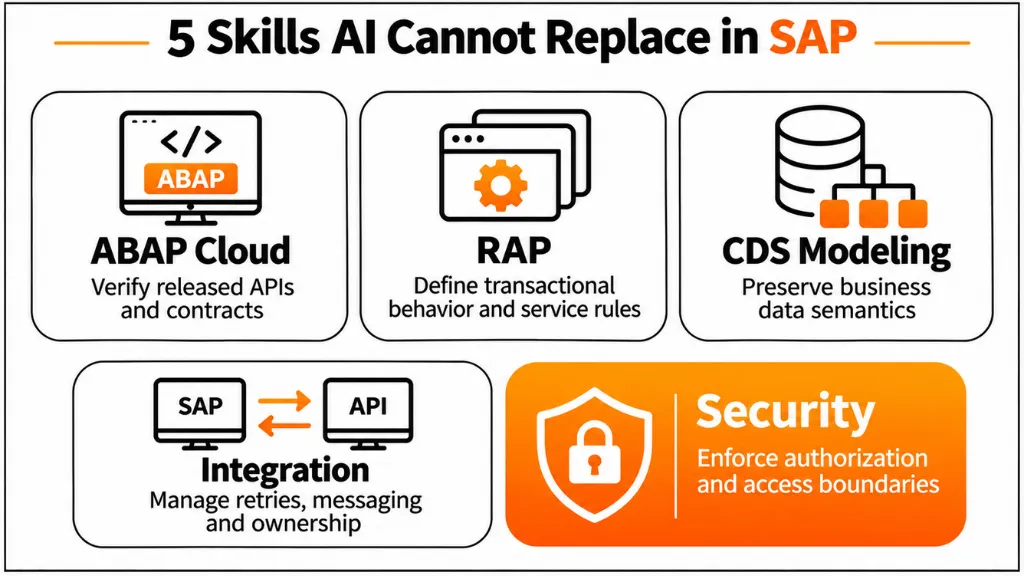
- ABAP Cloud
- RESTful ABAP Programming Model (RAP)
- Cloud Application Programming Model
- Cloud integration and application extensions
Furthermore, SAP BTP knowledge supports modern development approaches and clean-core strategies.
Therefore, professionals interested in development, application integration, and cloud architecture can benefit from strengthening their BTP expertise.
3. SAP Business AI and Joule
Over time, artificial intelligence has increasingly changed how organizations use SAP applications.
For example, SAP Business AI and the Joule copilot support activities involving information analysis, automation, and business decision-making.
To use these technologies effectively, SAP professionals can develop the following skills:
- SAP Joule
- AI-assisted business processes
- Generative AI fundamentals
- AI integration
- Intelligent agents and copilots
- Prompt optimization
Even so, using AI tools is only part of the required skill set.
More importantly, SAP’s research emphasizes that professionals must also know how to evaluate AI-generated results, validate information, and determine whether recommendations make sense within a business context.
4. SAP ABAP on HANA and Technical Development
Despite the growing adoption of automation and cloud technologies, technical development remains important.
At the same time, SAP ABAP on HANA supports the development and customization of business logic, while SAP HANA and system administration knowledge remain relevant to enterprise technology environments.
In particular, important technical capabilities include:
- ABAP development
- SAP HANA knowledge
- System configuration
- Data integration
- Technical administration
- Security and authorization
As a result, professionals interested in programming and system-focused responsibilities can build on these technical foundations.
5. SAP Finance and Controlling (FICO) Skills
Similarly, finance remains an important functional area within SAP environments.
Consequently, organizations require professionals who understand financial transactions, general ledger processes, cost centers, budgeting, and reporting.
In particular, SAP Finance and Controlling skills are relevant for individuals with accounting, finance, or commerce backgrounds.
Furthermore, combining finance knowledge with SAP S/4HANA and analytics can strengthen a professional’s ability to support financial operations and reporting.
6. SAP Supply Chain and Procurement Skills
Furthermore, SAP supply chain and operations modules remain valuable because businesses continue to focus on procurement, inventory management, production, and sales processes.
For instance, relevant SAP modules include:
- SAP Materials Management (MM)
- SAP Sales and Distribution (SD)
- SAP Production Planning (PP)
- SAP Extended Warehouse Management (EWM)
As a result, these areas support processes involving purchasing, sales orders, production planning, and warehouse activities.
In this way, professionals with operational knowledge can develop SAP skills that align with their industry experience.
7. SAP SuccessFactors and SAP Ariba
Meanwhile, human resources and procurement are also adopting cloud-based enterprise solutions.
For example, SAP SuccessFactors supports HR-related processes, including recruiting and employee experience, while SAP Ariba focuses on sourcing and supplier relationships.
As a result, knowledge of these platforms can support careers involving HR technology, procurement processes, cloud applications, and business transformation.
In addition, AI is influencing these areas, particularly through skills intelligence, workforce planning, and personalized career development.
8. SAP Analytics, Automation, and Cloud Integration
Today, modern SAP careers increasingly require knowledge of data, reporting, automation, and connected business systems.
More specifically, relevant capabilities include:
- SAP Analytics Cloud
- Data modeling and visualization
- Predictive analytics
- Business intelligence
- Workflow automation
- Cloud integration
- Data governance and compliance
In practical terms, these capabilities include data analysis, reporting, automation, and connected business systems.
Therefore, these skills are particularly useful for business analysts, integration specialists, technical consultants, and solution architects.
Which Top SAP Skills in 2026 Offer the Best Career Opportunities?
To understand these differences, different SAP skills can be connected to different professional career paths.To make these differences clearer, the following comparison summarizes career areas discussed in the supplied research.
| SAP skill | Key expertise | Related career opportunities |
|---|---|---|
| SAP S/4HANA | ERP implementation and business processes | Functional Consultant |
| SAP BTP | Application development and integration | BTP Consultant |
| SAP Business AI | Joule, AI tools, and automation | AI-focused SAP roles |
| SAP ABAP on HANA | Development and technical customization | Technical Consultant |
| SAP FICO | Financial processes and reporting | Finance Consultant |
| SAP MM, SD, PP, EWM | Procurement, sales, and operations | Supply Chain Consultant |
| SAP SuccessFactors | HR processes and cloud applications | HR Technology Consultant |
| SAP Analytics Cloud | Analytics, dashboards, and forecasting | SAP Business Analyst |
How Are Modern SAP Skills to Learn in 2026 Changing Enterprise Careers?
In fact, AI and automation are changing the responsibilities of SAP professionals rather than simply removing the need for SAP expertise.
As a result, repetitive activities such as data processing, reporting, monitoring, and routine analysis can increasingly be supported by intelligent systems.
Consequently, professionals can spend more time on business process optimization, solution architecture, integration, stakeholder management, and strategic decision-making.
From Traditional SAP Skills to Modern SAP Careers
SAPinsider describes a shift from traditional technical specialists toward professionals who coordinate business processes and AI-driven solutions.
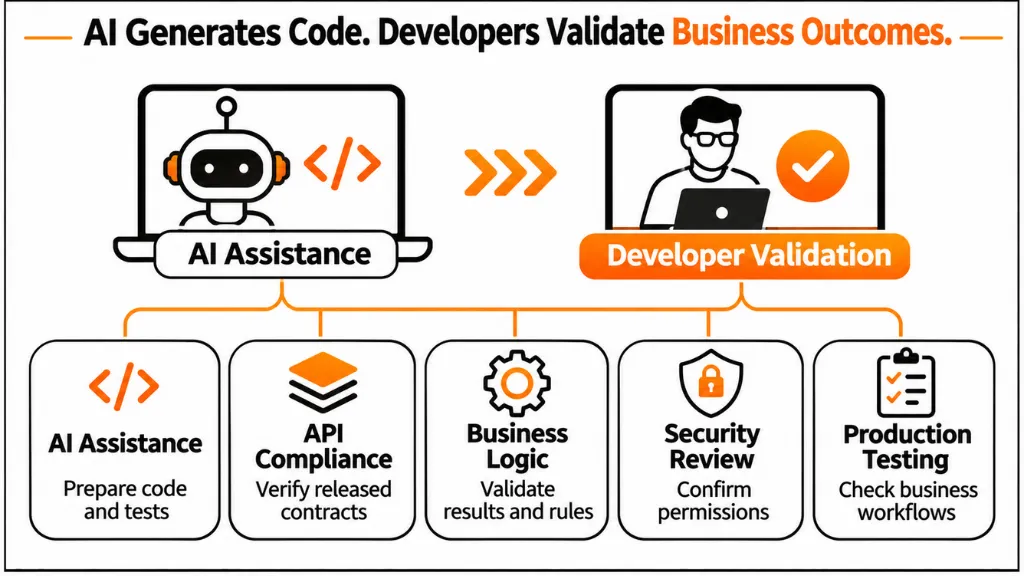
At the same time, the modern SAP professional needs to understand how intelligent tools can support business goals while maintaining appropriate human oversight.
This includes evaluating AI-generated configurations, checking compliance requirements, and ensuring that automated results match business logic.
Why Human Judgment Matters in Modern SAP Skills
In particular, SAP’s November 2026 article identifies three particularly important capabilities for early-career professionals:
Judgment: Understanding problems, evaluating assumptions, and interpreting AI-generated recommendations.
Trustworthiness: Checking information, validating data, and communicating uncertainty rather than accepting results without verification.
Rapid learning: Using workplace assignments and feedback to improve decisions and develop professional expertise.
Ultimately, these skills become increasingly important as AI accelerates routine work.
How to Develop the Top SAP Skills to Learn in 2026
Building a successful SAP career requires a focused learning approach.A clear understanding of the top SAP skills to learn in 2026 can help professionals choose relevant training and prepare for changing enterprise technology requirements.
Therefore, rather than trying to master every available module, professionals can begin with one specialization and develop related technologies according to their career goals.
Step 1: Choose the Right SAP Skill for Your Career
Select an SAP area that matches your educational background and professional interests.
Finance graduates may prefer SAP Finance, while individuals interested in procurement or logistics can explore supply chain modules. Professionals who enjoy programming may choose technical development or integration.
Step 2: Develop SAP S/4HANA Skills for 2026
Understanding S/4HANA and its business applications can help professionals prepare for modern SAP implementations and migration projects.
Step 3: Learn SAP BTP and Cloud Integration Skills
SAP BTP, API management, and cloud integration are increasingly relevant as businesses connect SAP with other enterprise applications.
Step 4: Learn AI and Automation Fundamentals
SAP professionals can build awareness of Joule, intelligent workflows, and AI-assisted business processes.
The objective is to understand practical business applications rather than learning AI terminology alone.
Step 5: Improve Business and Communication Skills
SAP professionals frequently need to understand requirements, explain solutions, communicate with stakeholders, and support implementation activities.
These responsibilities require technical understanding alongside analytical and communication skills.
Step 6: Continue Learning and Updating Skills
SAP technologies continue to evolve. Professionals can strengthen their expertise through training, certifications, practical experience, and ongoing learning.
In-Demand SAP Skills Comparison and Career Growth in 2026
| Competency area | Traditional focus | Evolving focus |
|---|---|---|
| SAP consulting | Configuration knowledge | Business process improvement |
| Development | Customization and coding | Cloud applications and modern development |
| Analytics | Reporting | Predictive insights and decision support |
| Integration | System connectivity | Cloud and API-based integration |
| Automation | Repetitive task execution | Intelligent workflows and exception handling |
| HR technology | Employee data management | Skills intelligence and workforce planning |
| Professional development | Module-specific expertise | SAP, cloud, AI, and business knowledge |
Is Learning SAP Skills Still a Good Career Choice in 2026?
SAP remains a career option for professionals who are prepared to develop skills that match changing enterprise requirements.
AI can automate selected activities, but SAP projects still involve understanding organizational requirements, analyzing processes, designing solutions, supporting implementation, and evaluating business outcomes.
For beginners, choosing a suitable SAP module is an important starting point.
For experienced professionals, adding relevant knowledge of S/4HANA, SAP BTP, integration, analytics, or automation can support career development.
Training and certification can contribute to professional development, but practical experience, communication, and problem-solving remain important.
Frequently Asked Questions About Top SAP Skills in 2026
1. Which SAP skill should I learn first in 2026?
SAP S/4HANA is a useful starting point because it supports important enterprise business functions. The most suitable specialization also depends on your educational background, interests, and career goals.
2. Will AI replace SAP professionals?
AI can automate some repetitive SAP tasks, but SAP projects continue to require business understanding, configuration knowledge, problem-solving, communication, and human judgment.
3. Is SAP BTP important for future SAP careers?
Yes. SAP BTP supports application development, integration, data, analytics, and extensions. These capabilities are relevant to modern cloud-based SAP environments.
4. Which SAP modules offer strong career opportunities?
The supplied research highlights SAP S/4HANA Finance, SAP BTP, SAP Business AI, ABAP on HANA, and supply chain-related modules as important skill areas.
5. Do beginners need technical knowledge to learn SAP?
Not every SAP career requires programming knowledge. Functional areas such as Finance, Sales and Distribution, and SuccessFactors may suit professionals with business-related backgrounds, while technical development roles generally require more programming expertise.
6. How is AI changing SAP careers?
AI is supporting automation, data analysis, workflow improvement, and decision-making. SAP professionals are increasingly expected to understand how these capabilities fit into business processes.
7. What skills should SAP consultants develop for the future?
SAP consultants can strengthen their expertise through S/4HANA, SAP BTP, cloud integration, analytics, business process optimization, automation, and communication skills.
8. Is SAP certification enough to secure a job?
Certification alone does not guarantee employment. Practical knowledge, problem-solving, business understanding, and communication skills are also important.
Final Thoughts
The top SAP skills to learn in 2026 reflect major changes in enterprise technology. SAP S/4HANA, SAP BTP, Business AI, cloud integration, analytics, and automation are becoming important areas of professional development.
Moreover, foundational SAP knowledge continues to matter. Professionals who understand business processes and can apply modern technologies appropriately are better prepared for evolving SAP responsibilities.
Therefore, whether entering the SAP industry or building on existing experience, the most practical approach is to choose a relevant specialization, develop complementary skills, and continue learning as enterprise requirements change.