
A custom enhancement works today but creates upgrade problems tomorrow. You discover it during an S/4HANA upgrade. The transport fails because a modified SAP object changed.
This situation is becoming common as SAP customers move toward SAP S/4HANA Cloud and modern extension approaches. Traditional customization methods that worked well in ECC environments can create long-term maintenance challenges when organizations need faster innovation cycles and frequent upgrades.
This is where SAP Clean Core Levels become important.
SAP Clean Core Levels A, B, C & D provide a structured way to evaluate extensibility choices in SAP S/4HANA. Each level represents a different approach to custom development, released APIs, extensions, and modifications. Understanding these levels helps SAP teams choose an extensibility approach that supports clean core principles without limiting necessary business functionality. For SAP architects, developers, and transformation leaders, understanding these levels helps answer a critical question:
What Are SAP Clean Core Levels, and Why Do They Matter?
The SAP Clean Core level concept is SAP’s framework for evaluating how closely an extension follows clean core principles.
The goal of a clean core is not to eliminate all custom development. SAP recognizes that enterprises still need differentiation. The objective is to ensure extensions are created using approaches that reduce technical debt and protect future upgrades.
Earlier SAP extensibility discussions often focused on a simple question:
“Is this customization clean or not?”
That approach was difficult for real enterprise landscapes because SAP systems contain years of development, integrations, and business-specific requirements.
A large S/4HANA system may include:
- New SAP BTP applications
- ABAP Cloud extensions
- Classic ABAP developments
- User exits
- BAdIs
- Legacy custom objects
- Older modifications
The SAP Clean Core levels provide a more detailed classification.
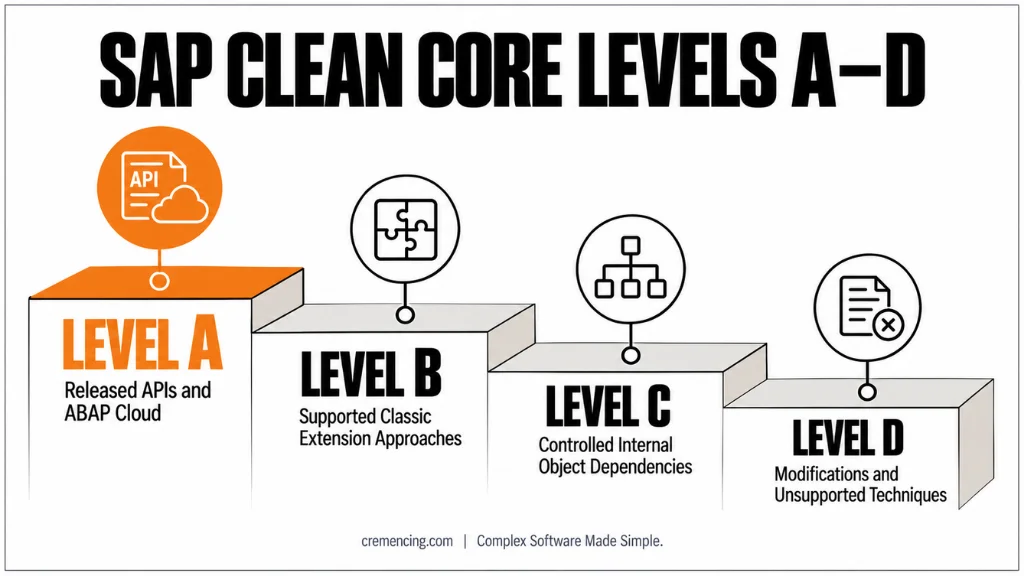
The four levels are:
| Level | Extension Approach | Clean Core Alignment |
| Level A | Released APIs, ABAP Cloud, SAP BTP extensions | Highest alignment |
| Level B | Classic APIs and supported frameworks | Recommended when Level A is not possible |
| Level C | Internal SAP objects with controlled risk | Conditionally clean |
| Level D | Modifications and non-recommended techniques | Not clean core |
The key principle is simple:
The closer your extensions are to Level A, the easier your SAP system becomes to upgrade, maintain, and evolve.
Why SAP Clean Core Levels Matter for S/4HANA Extensibility
Many SAP teams make the mistake of treating clean core as a restriction. It is actually an architectural decision framework.
A clean core strategy helps organizations:
- Reduce dependency on SAP internal objects
- Avoid upgrade conflicts
- Improve extension governance
- Move suitable scenarios to SAP BTP
- Adopt SAP-recommended APIs
- Reduce unnecessary customizations
For example, consider two approaches:
Traditional approach
A developer modifies SAP standard behavior directly because the requirement needs a quick solution.
Short-term result:
- Requirement delivered quickly S/4HANA extensibility
Long-term impact:
- Upgrade testing becomes harder
- SAP objects may change
- Regression risks increase
Clean Core approach
The team evaluates:
- Is there a released SAP API?
- Can the requirement run as a side-by-side extension?
- Can ABAP Cloud support the requirement?
- If not, what is the lowest-risk extension option?
This decision process is exactly where SAP Clean Core levels help.
Understanding SAP Clean Core Levels A, B, C & D
The four levels represent different extension quality and risk categories.
A practical way to think about them:
- Level A = Build the future
- Level B = Use approved existing approaches
- Level C = Manage legacy requirements carefully
- Level D = Plan remediation
The classification depends on the technologies, APIs, and objects used inside the extension.
SAP evaluates extensions based on factors such as:
- Whether SAP officially releases the interface
- Whether SAP supports the extension technology
- Whether upgrades can detect and manage changes
- Whether the extension remains independent from SAP standard code
SAP Clean Core Level A Explained: The Preferred Extension Approach
Therefore, SAP Clean Core Level A represents the highest level of alignment with SAP’s clean core strategy.
At this level, extensions use only publicly released SAP APIs and stable extension points. These extensions are designed to remain independent of SAP’s internal implementation, which helps reduce upgrade risks. SAP recommends Level A as the preferred approach for new development because it provides the strongest foundation for long-term system stability. Level A extensions typically follow two patterns:
1. Side-by-Side Extensions on SAP BTP
In this approach, developers build applications outside the S/4HANA core using SAP Business Technology Platform (BTP).
Common examples:
- Custom approval applications
- Industry-specific applications
- AI-powered business solutions
- External workflow applications
- Data-driven extensions
The extension communicates with SAP S/4HANA through released APIs.
Example:
A company needs a custom supplier risk scoring application. Instead of modifying SAP S/4HANA supplier management processes:
- Data is extracted through approved APIs
- The application runs on SAP BTP
- Results are sent back through supported interfaces
The S/4HANA core remains unchanged.
2. On-Stack Extensions Using ABAP Cloud
For requirements that must run inside S/4HANA, SAP recommends the ABAP Cloud development model. ABAP Cloud restricts developers to released objects and APIs.
This prevents developers from creating dependencies on SAP internal objects.
Examples include
- Released CDS views
- Released classes
- Released APIs
- Supported extension points
The advantage: The extension follows SAP’s upgrade-safe development model.
SAP Clean Core Level B Explained Using Classic APIs Safely
Many SAP customers have existing investments in traditional ABAP development. Not every requirement can immediately move to Level A. This is where SAP Clean Core Level B becomes relevant.
Level B allows extensions that use classic APIs and established SAP frameworks that are considered stable enough for customer development. These may include technologies such as classic APIs, BAPIs, user exits, BAdIs, and established frameworks where appropriate. The important difference:
Level B is not the same as unrestricted classic ABAP development. The extension should still follow SAP recommendations.
Example Scenario
A company has an existing sales process enhancement. The requirement:
“When a sales order is created, trigger an additional validation.”
Possible approaches:
Poor approach:
Modify SAP standard code.
Result:
- Upgrade conflicts
- Difficult testing
- Higher maintenance effort
Better Level B approach:
Use:
- Supported BAdI
- Classic enhancement framework
- Stable SAP API
Result:
- Lower upgrade impact
- Controlled customization
- Better maintainability
SAP Clean Core Level C Explained: Managing Necessary Legacy Dependencies
SAP Clean Core Level C exists because SAP understands that many enterprise systems contain years of custom development.
A complete replacement of every extension is not always practical. Level C covers extensions that access SAP internal objects that are not officially released for customer use but may still be required for specific legacy scenarios.
These extensions are considered conditionally clean because they introduce higher upgrade dependency compared with Levels A and B. SAP provides mechanisms such as object change information to help customers identify possible impacts during upgrades.
Example Scenario
An organization has a custom warehouse process developed years ago.
The development:
- Uses internal SAP objects
- Cannot easily move to released APIs
- Supports critical business operations
Immediately replacing it may create unnecessary business disruption.
The practical approach:
- Identify the Level C dependency
- Monitor SAP changes
- Evaluate upgrade impact
- Create a future remediation plan
Level C does not mean “delete everything immediately.”
It means:
Understand the risk and manage it intentionally.
SAP Clean Core Level D Explained: The Highest Technical Debt Risk
SAP Clean Core Level D represents extensions that do not follow clean core principles.
These developments typically include:
- SAP standard modifications
- Direct database table updates
- Use of explicitly non-recommended objects
- Unsupported enhancement techniques
These approaches create strong dependencies between custom code and SAP internal functionality.
Example Scenario
A developer changes SAP standard code because an enhancement point was not available.
The solution works.
However, during an S/4HANA upgrade:
- SAP delivers changed standard objects
- The modification conflicts
- Testing effort increases
- Additional fixes are required
This is the main problem Level D creates. The goal should be to gradually move Level D extensions toward higher clean core levels.
SAP Clean Core Levels Comparison Table
The following table helps SAP architects decide which approach fits different extension scenarios.
| Clean Core Level | Extension Approach | Typical Technologies | Upgrade Risk | Recommended Usage |
| Level A | Fully compliant extensions | SAP BTP, SAP Build, ABAP Cloud, released APIs | Lowest | Preferred approach for new development |
| Level B | Approved classic extension approach | Classic APIs, BAdIs, stable frameworks | Low to Medium | Use when Level A cannot meet requirements |
| Level C | Conditional extensions using internal objects | Internal SAP objects, legacy dependencies | Medium to High | Use only when necessary and monitor impact |
| Level D | Non-clean extensions | Modifications, unsupported techniques, direct table changes | Highest | Avoid and plan remediation. |
How SAP Teams Should Move From Lower Levels Toward Clean Core
Most organizations will not immediately reach Level A. Large SAP landscapes contain years of development history.
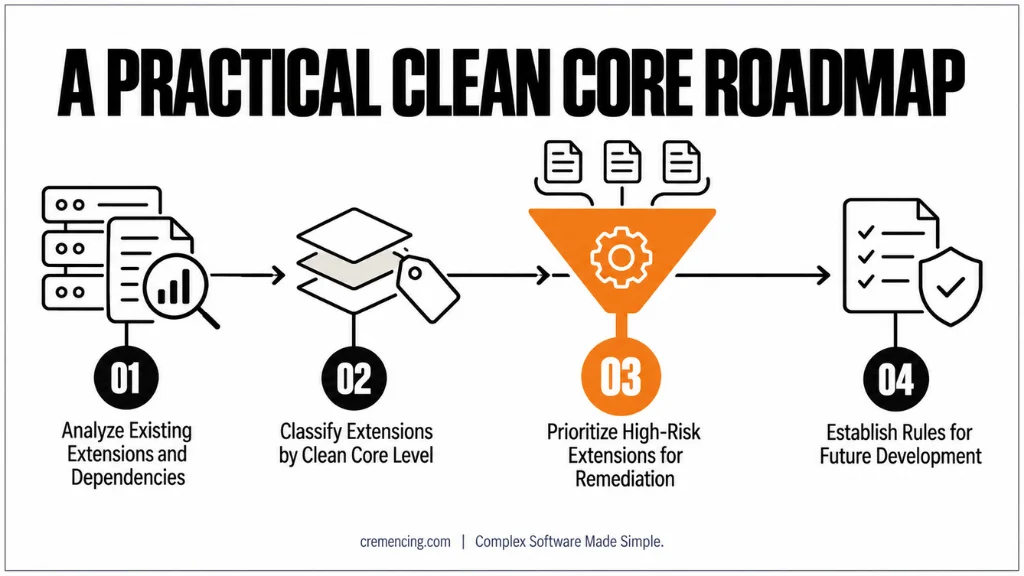
A realistic roadmap:
Step 1: Analyze Existing Extensions
Inventory:
- Custom objects
- Enhancements
- Modifications
- Interfaces
- Dependencies
Tools such as SAP Readiness Check, ABAP Test Cockpit (ATC), and SAP Cloud ALM capabilities can support analysis activities.
Step 2: Classify Extensions by Clean Core Level
Each custom object should be evaluated:
| Extension Type | Target Level |
| New BTP application | Level A |
| ABAP Cloud development | Level A |
| Supported BAdI implementation | Level B |
| Internal SAP object dependency | Level C |
| Modification | Level D |
Step 3: Prioritize High-Risk Extensions
Not every Level C or Level D object requires immediate replacement.
Prioritize based on:
- Upgrade impact
- Business importance
- Maintenance cost
- Frequency of change
Step 4: Establish Future Development Rules
New projects should define:
- Allowed extension technologies
- API approval process
- Clean Core review checkpoints
- Development standards
This prevents technical debt from returning. Clean Core is not only a development standard. It is also a modernization strategy.
Conclusion
SAP Clean Core Levels A, B, C, and D give SAP teams a practical way to evaluate extensions based on their impact on upgrade stability, technical debt, and long-term maintainability. The goal is not to eliminate customization. It is to make deliberate decisions about where and how custom logic should live.
For new development, teams should aim for Level A wherever released APIs, ABAP Cloud, or SAP BTP extensions can meet the requirement. Level B provides a controlled option when established classic extension mechanisms remain necessary, while Levels C and D require closer attention because they introduce greater dependency and upgrade risk.
The most effective Clean Core strategy starts with visibility. Inventory existing extensions, classify them, prioritize the highest-risk dependencies, and establish clear rules for future development. That approach allows organizations to reduce technical debt gradually without disrupting critical business processes.
Ultimately, Clean Core is not a one-time cleanup project. It is an ongoing architectural discipline that helps SAP teams build extensions today without creating unnecessary upgrade problems tomorrow.
Frequently Asked Questions
1. What are SAP Clean Core Levels A, B, C, and D?
SAP Clean Core Levels A, B, C, and D classify extensions based on how closely they follow SAP clean core principles. Level A represents the highest alignment using released APIs and modern extension approaches, while Level D represents extensions with the highest dependency on SAP internal objects or modifications.
2. What does SAP Clean Core Level A mean?
SAP Clean Core Level A represents extensions built using SAP-recommended approaches such as ABAP Cloud, SAP BTP side-by-side extensions, and released APIs. These extensions minimize dependency on SAP internal implementation and provide the strongest upgrade stability.
3. What is SAP Clean Core Level B?
SAP Clean Core Level B refers to extensions that use approved classic extension mechanisms such as supported APIs, BAdIs, and established SAP frameworks. It provides a controlled approach when a Level A extension is not practical.
4. What is the difference between SAP Clean Core Level B and Level C?
The main difference is the level of dependency. Level B uses supported extension approaches, while SAP Clean Core Level C involves dependencies on SAP internal objects that require additional monitoring and future planning.
5. What does SAP Clean Core Level D mean?
SAP Clean Core Level D represents extensions that do not follow clean core principles, such as SAP modifications or unsupported technical approaches. These extensions often create higher upgrade and maintenance risks.
6. Are SAP Clean Core 4 levels only relevant for S/4HANA Cloud?
No. The SAP Clean Core 4 levels concept applies to SAP S/4HANA transformation strategies across cloud and on-premise environments. However, SAP S/4HANA Cloud environments enforce stricter extension restrictions compared with traditional systems.
7. How do SAP teams decide which Clean Core level to use?
SAP teams should evaluate business requirements first, then select the appropriate extension method. New developments should generally target Level A, while existing Level C and Level D objects should be reviewed based on business value and upgrade impact.
8. Can existing SAP customizations be converted to higher Clean Core levels
Yes. Organizations can gradually move extensions toward higher Clean Core levels by replacing modifications, adopting released APIs, redesigning applications on SAP BTP, and moving suitable developments toward ABAP Cloud.


2 Responses