
Introduction
SAP S/4HANA implementation cost has no single honest answer, and it’s wider-ranging than most vendors admit upfront. For example, small-scope deployments start around $100,000–$300,000, mid-market projects commonly land between $500,000 and $2 million, and large or heavily customized enterprise rollouts routinely clear $5 million. Ultimately, your real number comes down to three choices: how you deploy, how much you customize, and how ready your data actually is before migration starts.
However, there’s no single honest answer to “what does SAP S/4HANA implementation cost,” but there is a real range, and it’s wider than most vendors will tell you upfront. For example, small-scope deployments start around $100,000–$300,000, mid-market projects commonly land between $500,000 and $2 million, and large or heavily customized enterprise rollouts routinely clear $5 million. Ultimately, your real number comes down to three choices: how you deploy, how much you customize, and how ready your data actually is before migration starts.
In the end, your real number comes down to three choices: how you deploy, how much you customize, and how ready your data actually is before migration starts. Ultimately, SAP S/4HANA implementation cost depends on your business complexity, data quality, deployment choices, and project scope. If you underestimate those factors early, you can face missed deadlines, scope creep, and unexpected budget overruns later.
What Is SAP S/4HANA Implementation Cost?
SAP S/4HANA implementation cost is the overall investment needed to migrate or develop your ERP system on the next-generation platform. It covers a lot more than software licenses.
A full cost structure will generally incorporate:
- Software licensing or subscription (cloud vs on-premise)
- Cloud hosting or infrastructure.
- Implementation partner fees
- Migration of data and integration of systems.
- Custom development and testing.
- Change management and training.
- Continued support and maintenance.
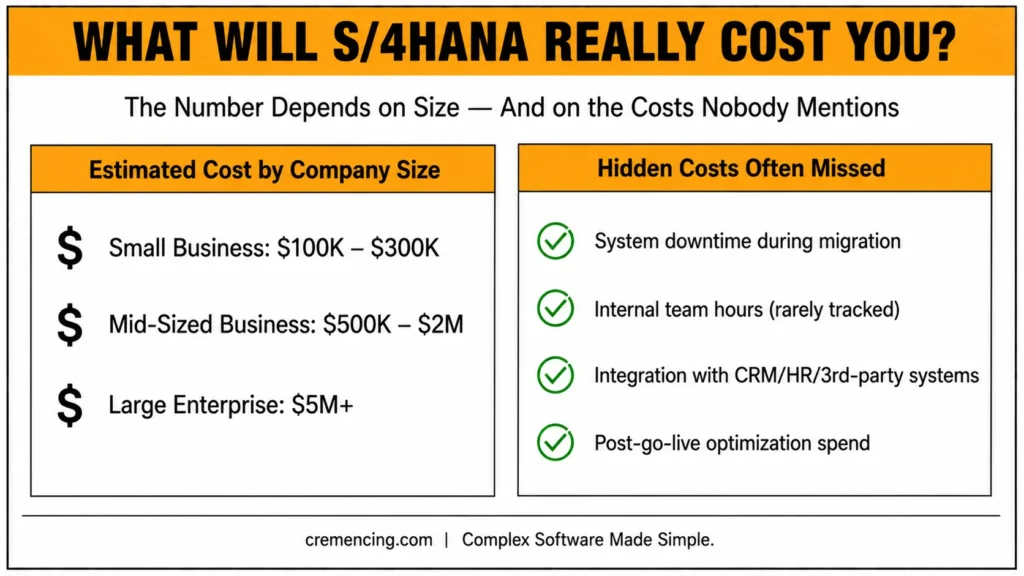
For small businesses, costs may start around $100,000–$300,000. Mid-sized businesses tend to spend between $500,000 and 2 million, with larger businesses being able to spend over 5 million depending on the complexity.
Those are just some surface figures the actual cost will be determined by how your project is implemented.
What Drives SAP S/4HANA Implementation Cost at Each Stage
Step 1: Business Assessment & Planning
The companies review their existing SAP environment, business processes, and objectives before any technical work takes place.
This stage includes:
- System audits
- Identifying obsolete processes
- Defining project scope
- Choosing deployment type (cloud, on-premises, hybrid)
Any lack of proper planning would tend to result in budget overruns in the future. Investing time initially helps companies save a considerable amount of money on rework. Moreover, taking a detailed look at where S/4HANA migration costs actually land in 2026 can help businesses plan their budgets more effectively.
SAP S/4HANA Implementation:
- Assessment & Planning — scope definition, deployment model selection
- Migration Approach — Greenfield, Brownfield, or Selective Data Transition
- System Design & Setup — architecture, configuration, customization (largest cost lever)
- Data Migration — volume, quality, and cleanup work (most underestimated)
- Testing & QA — unit, integration, and user acceptance testing
- Training & Change Management — typically 10–15% of total project spend
- Go-Live & Support — ongoing costs that continue past project closeout.
Step 2: Selecting the appropriate Migration Approach
Three major methods exist, and they have varying effects on cost:
Greenfield (New Implementation)
Build from scratch. Expensive initial investment, but less polluting.
Brownfield (System Conversion)
Convert the existing SAP system. Less expensive and has legacy complexity.
Selective Data Transition
The middle ground between economics and flexibility.
Generally, however, greenfield projects tend to be more expensive upfront but can deliver greater long-term effectiveness, whereas brownfield projects are often less expensive initially but may require further optimization later.
| Approach | Upfront Cost | Timeline | Best Fit |
| Greenfield (New Implementation) | Highest | Longest (12–24 months typical) | Organizations wanting a clean break from legacy customization and processes |
| Brownfield (System Conversion) | Lowest upfront | Fastest (6–18 months typical) | Organizations wanting to preserve existing configuration and minimize disruption |
| Selective Data Transition | Moderate | Moderate | Organizations needing to modernize specific processes/entities without a full rebuild |
Step 3: System Design and Set-up
This step involves the construction of your system architecture.
Key activities:
- Business process redesign
- SAP module configuration
- Interlinking with other systems.
- Custom development (if required)
One of the largest cost drivers is customization. The further you are from using typical SAP processes, the greater the cost of implementation. Deciding between side-by-side and in-app extensibility.
Step 4: Data Migration
The process of migrating data out of the old systems is very complicated and is mostly undervalued.
Costs depend on:
- Data volume
- Data quality
- Number of systems involved.
- Cleaning and validation processes.
Moreover, migration costs may rise by 30–50 percent of the total migration cost because of rework and testing.
Step 5: Testing & Quality Assurance
Furthermore, before your system goes live, thorough testing will ensure that it is operating as intended.
This includes:
- Unit testing
- Integration testing
- User acceptance testing (UAT).
Organizations that hurry this step tend to waste a lot of money dealing with after-launch problems.
Step 6: Training and Change Management
The most appropriate system cannot work without the adoption of the system by the users.
Training costs include the following:
- Employee onboarding sessions
- Documentation
- Change management programs
Companies usually spend between 10 and 15 per cent of overall project expenditure on training.
Step 7: Go-Live & Support
As soon as the system is implemented, the ongoing support commences.
This includes:
- Performance monitoring
- Bug fixes
- Continuous improvements
Post-go-live costs are not to be overlooked—they may affect your long-term ROI.
Is SAP S/4HANA Implementation Cost Worth It? Benefits & ROI
On the other hand, greenfield projects tend to be more expensive upfront but can deliver greater long-term effectiveness. In contrast, brownfield projects are often less expensive initially but may require further optimization later.
Operational Efficiency
- 20–30% faster business processes
- Automation of reduced manual tasks.
Real-Time Insights
- On-the-fly reporting and analytics.
- Better decision-making speed
Cost Reduction
- Reduced IT maintenance expenses (cloud, in particular).
- Reduced hardware dependency
Revenue Growth
- Quick reaction to changes in the market.
- Improved customer experience
Compliance & Risk Reduction
- Better financial transparency
- Improved data security
Depending on the implementation strategy and adoption levels, companies usually can get ROI within 2-4 years.
Top 5 Misunderstandings That Drive Up SAP S/4HANA Implementation Cost
1. Underestimating Project Scope
Most business ventures are built on a small budget but increase in scope during the project. This leads to delays and cost overruns.
2. Over-Customization
Trying to re-create all of the legacy processes makes them more complex and more expensive.
Best practice:
Where feasible, adopt standard SAP processes.
3 Ignoring Data Quality
Soiled or unstable data results in costly migration challenges.
4. Weak Change Management
When users do not accept the new system, productivity will be affected, affecting ROI.
5. Selecting the Wrong Implementation Partner.
The presence of a novice partner may cause the project to be delayed and costly.
Surreptitious Costs The Majority of Companies Overlook
Licensing and implementation dominate SAP S/4HANA discussions, yet hidden costs often create the biggest budget surprises.
Downtime Costs
In the migration process, downtime of the system may interfere with operations and income.
Internal Resource Allocation
Hundreds of hours will be spent by your internal team to help support the project. This indirect expense is hardly ever computed.
Integration Complexity
The unforeseen costs are the connection of SAP S/4HANA with CRM, HR, and third-party systems.
Compliance Adjustments
Implementation may involve changes in regulations that would necessitate further customization.
Post-Implementation Optimisation
Following go-live, companies usually put additional investments in order to enhance the performance of the system.
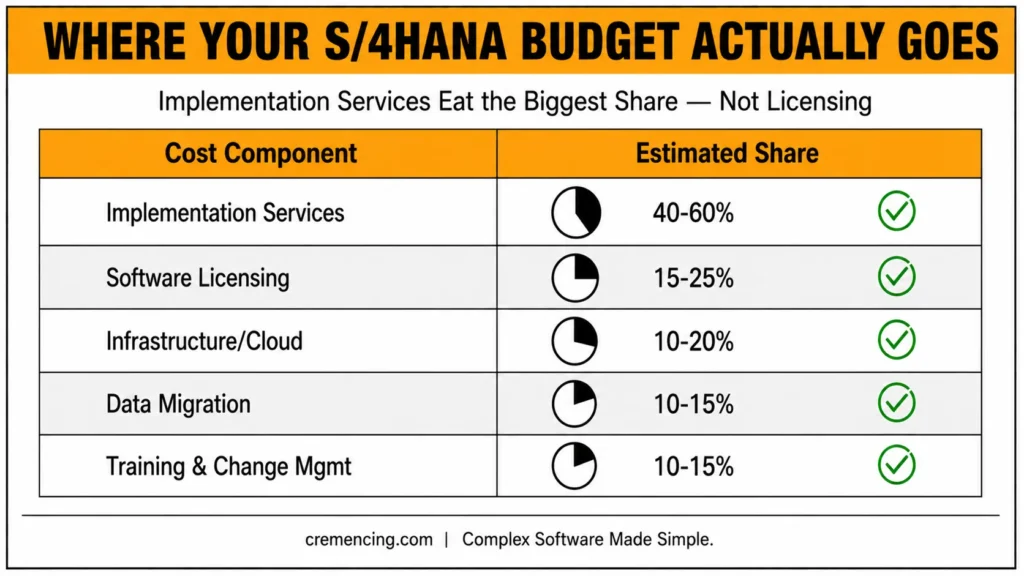
SAP S/4HANA Cost Breakdown Table
| Cost Component | Estimated Share |
| Software Licensing | 15–25% |
| Implementation Services | 40–60% |
| Infrastructure/Cloud | 10–20% |
| Data Migration | 10–15% |
| Training & Change Mgmt | 10–15% |
| Support & Maintenance | Ongoing |
This table indicates why implementation services comprise most of the total cost.
Conclusion
The SAP S/4HANA implementation cost is not just a number; it’s a strategic investment. Firms that do it with proper planning, realistic budgeting, and appropriate partners reap high returns. Rushers and those who do not consider the complexity can be slowed down, resulting in a gradual increase in the costs incurred.
It is all about knowing where your money is spent and making wise choices at all levels.
With proper planning, SAP S/4HANA can revolutionize your operations, enhance efficiency, and create long-term value that, even at the cost of the initial investment, will far outweigh the initial investment.
FAQ:
1. How much would the SAP S/4HANA price be for mid-sized firms?
It usually costs between $500,000 and 2 million, depending on the complexity and customization.
2. Does SAP S/4HANA cloud lead to lower costs as compared to on-premises?
However, cloud minimizes infrastructure expenditures but might include regular subscription expenses.
3. How long would it take to be implemented?
Depending on the size and scope of the company, it takes 6 to 18 months to complete the project.
4. Which is the largest cost factor?
The highest cost drivers are implementation services and customisation.
5. Is it possible to save costs?
Yes, it can be enhanced to have less customization, higher data quality, and the appropriate migration strategy.





2 Responses