
Introduction
Retail has been ranked as one of the operationally most complex industries in the planet and one of the most unforgiving. The consequence of a single wrong demand forecast can put you in a position to have unsold inventory worth $2M. Any supplier lag in high season may cost you customer loyalty that you may have taken years to develop. And legacy ERP systems, which were developed in a slower time, can no longer keep pace.
It is precisely on this basis that major retail brands are moving to SAP S/4HANA not as an ordinary IT upgrade but as a fundamental reinvention of how their supply chains think, react, and compete.
This post will explain what SAP S/4HANA actually does to the operations of retailers, how the top brands are implementing it, the ROI they are getting, the pitfalls to avoid, and one critical angle most implementation manuals completely ignore. This is the playbook you need to evaluate a migration or be already mid-project.
What is SAP S/4HANA in Retail and Why Now?
SAP S/4HANA is the next-generation ERP suite of SAP, which is based wholly on the SAP HANA in-memory database. In contrast to traditional ERPs that handle transactions in batch cycles, S/4HANA processes data in real time—i.e., inventory levels, demand signals, supplier statuses, and financial positions are always up-to-date, always accurate, and always available.
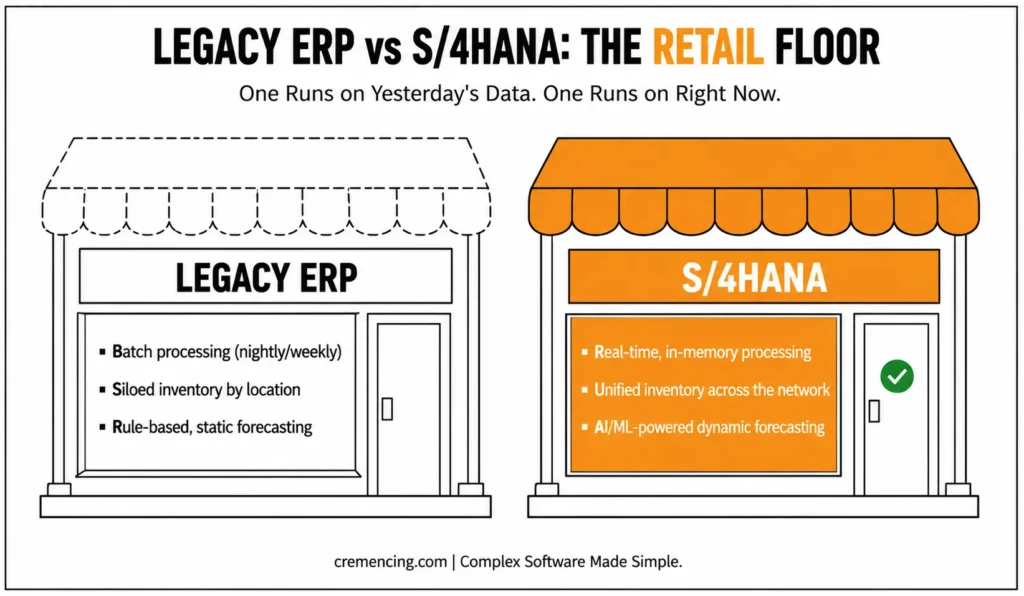
In the case of retail in particular, this is important as retail supply chains are not linear. They are dynamic, multi-node networks and where one changes, a viral product moment, a port delay, or a competitor markdown can propagate across all functions within hours.
The differences between S/4HANA and legacy SAP or other ERPs:
| Capability | Legacy SAP ERP landscape | SAP S/4HANA Retail |
|---|---|---|
| Transaction processing | Transactional processing with varying batch and online processes | High-performance transactional processing on SAP HANA |
| Inventory visibility | Often dependent on system landscape and integrations | Retail inventory capabilities with integrated supply-chain processes |
| Demand planning | May rely on external/planning solutions or legacy planning processes | Can integrate with modern planning capabilities such as SAP IBP |
| User experience | SAP GUI and other interfaces depending on deployment | SAP Fiori is widely used for role-based experiences |
| Deployment | Traditionally on-premise | On-premise and cloud deployment optioopportunity butproduct edition |
The answer to why now is simple: SAP has set the end of 2027 as the deadline for mainstream maintenance of SAP Business Suite 7 core applications, including SAP ERP 6.0. SAP also offers optional extended maintenance through the end of 2030. Delaying the move does not simply mean missing a performance opportunity; it also leaves retailers with less time to plan, migrate, test, and modernize their supply chains.
How the Leading Retail Brands Realize SAP S/4HANA: The Real Process.
Most organizations lose or win where implementation is concerned. The technical implementation is the simple part. The more work is organizational.
Step 1: Clarify the Business Case Preceding the Technical Scope.
The largest implementation failures begin when IT takes centre stage in the conversation rather than operations. The retail leadership must identify what success means in business terms: the lower the stockout rate, the faster the replenishment cycles, the lower the carrying costs, and the more unified the omnichannel inventory. The results are motivators to all the downstream technical decisions.
Step 2: Choose the right deployment path.
There are three deployment models of SAP S/4HANA, which include cloud (RISE with SAP), on-premises, and hybrid. Retailers can consider RISE with SAP when they want a managed cloud transformation. However, organizations with specific regulatory, operational, integration, or customization requirements may choose a different deployment approach.
Step 3: Run a Fit-to-Standard Analysis
Before making anything custom, conduct a fit-to-standard workshop. The retail functionality of SAP S/4HANA merchandise management, replenishment, allocation, promotion planning, etc. covers most of the out-of-the-box needs of most retailers. Each customization increases the implementation expense, maintenance overhead,, and the complexity of upgrades. Use standard where possible; customize where it is a real competitive differentiator.
Step 4: Migrate Data Surgically.
Data migration is one of the highest-risk workstreams in many S/4HANA programs because inaccurate master data, incomplete mappings, and unvalidated transactional data can create operational problems after cutover
Step 5: Train to adopt, not to simply work.
The finish line is not going live. SAP Fiori gives many users a new way to interact with SAP beyond the traditional interfaces that store operations, buying teams, and supply-chain planners have relied on for years. However, role-based training, hands-on practice, and process-specific learning drive stronger user adoption than classroom training alone.
Benefits & ROI: What Retail Brands are Really Experiencing.
References: SAP benchmarking reports, Deloitte retail ERP surveys, IDC retail technology surveys.
In addition to the metrics, three structural benefits can be observed for retailers operating S/4HANA at scale:
- Store, DC, and e-commerce Unified inventory visibility between stores, DCs, and e-commerce—able to see accurate available-to-promise and reduce overselling.
- Promotion planning that links marketing choices to replenishment and supplier orders, doing away with the lag that leads to stockouts during promotions.
- Financial consolidation on a real-time basis over retail organizations and geographies such that CFOs have live P&L and not a lagging report.
Here the compounding effect is important. All the capabilities support one another. Greater demand indicators enhance replenishment. Better replenishment reduces markdowns by keeping inventory closer to actual demand. Declining markdowns enhance margin. The ROI is not a straight line; it is curvy.
| Retail capability | S/4HANA Retail role | Additional architecture to consider |
|---|---|---|
| Merchandise management | Core retail ERP processes | Retail master data and configuration |
| Store inventory | Inventory and store processes | Fiori store applications |
| Demand planning | Supports integration with planning processes | SAP IBP where required |
| Omnichannel availability | ERP inventory/fulfillment foundation | SAP CAR Inventory Visibility/OAA |
| POS integration | Receives/coordinates retail transaction data | POS integration architecture |
| Warehouse fulfillment | Integrates supply and fulfillment processes | SAP EWM or external WMS |
| Customer-facing commerce | Provides ERP business-process foundation | Commerce platform + integration layer |
Retailers should also review their broader S/4HANA migration strategy before deciding which legacy data, customizations, and integrations should move forward.
Errors that retail brands make when implementing SAP S/4HANA.
Mistake 1: Lifting and Shifting Customizations of Legacy Systems.
The last and costliest error in S/4HANA migrations is to re-create all the old customizations in the new system. Legacy ERP environments often contain 15+ years of workarounds that teams created to overcome limitations in the old system. During an S/4HANA migration, teams should review these workarounds and determine whether standard S/4HANA capabilities can replace them. Audit all customizations to ensure current relevance and then migrate it.
Mistake 2: Not investing enough in change management.
Change management is regularly underfunded by 50% or more by implementation budgets. The technology works. Human adoption is what does not work. Those retailers who manage change as a communication process as opposed to a structured behaviour-change program continue to record low post-go-live performance compared to the benchmarks projected.
Mistake 3: Going Live on all modules at the same time.
Big-bang implementations (where all modules are implemented simultaneously) are risky in retail since retail operations do not cease with system transitions. Gradual implementation, with core finance and inventory as the first areas affected, allows time for the teams to stabilize before introducing complexity.
Mistake 4: Overlooking Integration Debt.
SAP S/4HANA sits at the center of a retail technology ecosystem that includes POS systems, e-commerce platforms, WMS, demand-planning tools, and loyalty platforms. Retailers should design the integration architecture from day one rather than treat it as a post-implementation task. Otherwise, unresolved interfaces can create data gaps and undermine the visibility that S/4HANA aims to provide.
For complex POS, WMS, e-commerce, and third-party integrations, SAP Integration Suite can provide the integration layer needed to connect S/4HANA with a broader application landscape.
Omnichannel Inventory Intelligence
Integrating SAP S/4HANA with SAP Customer Activity Repository can provide a near-real-time inventory view and support omnichannel availability and sourcing scenarios. The exact capabilities depend on the CAR components, source systems, integrations, and configuration used
The modern customer of the retail chain is not interested in whether the item is found in store inventory or warehouse inventory. They desire to purchase it, take it, or refund it – by whatever means is most convenient. The old ERP systems maintained these inventory pools apart, which gave rise to the operational fiction that each channel was autonomous.
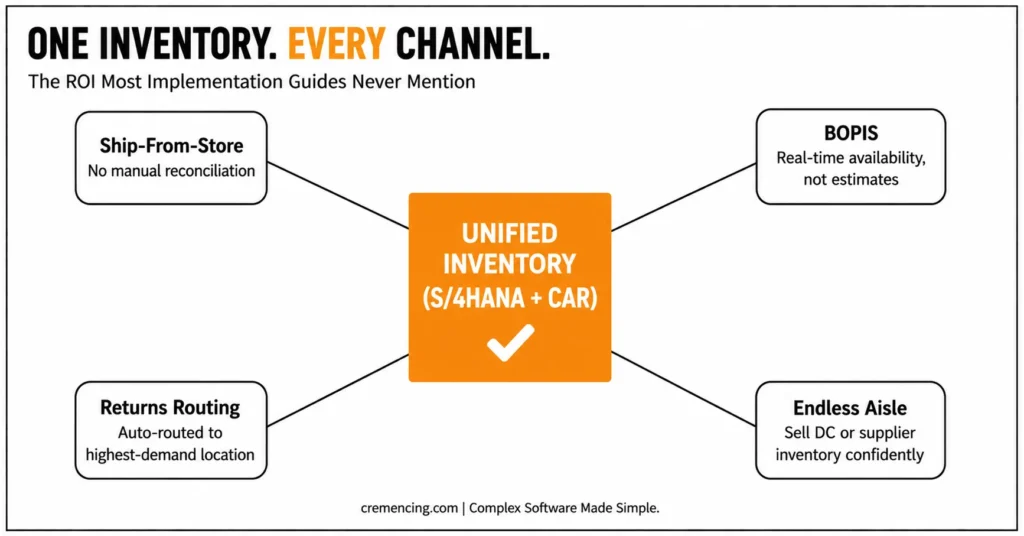
Integrating SAP S/4HANA with SAP Customer Activity Repository (CAR), will result in the creation of a unified inventory view across all channels. This enables:
- Ship-from-store delivery without a manual inventory reconciliation.
- Order products online and pick up in store (BOPIS) with real-time availability, not estimated availability.
- Returns routing intelligence – automatic routing of returned inventory to the most demanded location.
- Endless aisle capabilities – enabling store associates to sell DC inventory or supplier inventory with confidence.
Retailers implementing S/4HANA without switching on omnichannel inventory intelligence are missing out on the most customer-facing ROI. This is where brand loyalty is one of the operations that can be won or lost at the operational level and it is the ability that can distinguish between brands using S/4HANA as an ERP upgrade and brands using it as a competitive weapon.
Conclusion:
Consumer demands on legacy infrastructure that was never designed to meet are reshaping retail. Same-day delivery, precise cross-channel availability, real-time advertising, and dynamic partner collaboration are no longer premium features anymore; they are the minimum requirements any brand would have in order to keep loyal customers.
It is SAP S/4HANA in retail where these capabilities become operationally possible. Not because the software is magic but because it eradicates the data lag, the siloed inventory, the batch-processed decisions, and the isolated supplier relationships that prevent retailers from performing at the speed now that the market requires.
Brands that have this right are not merely operating cleaner back offices. They are making more informed purchasing choices, maintaining leaner inventory slots, providing more reliable customer experiences, and reacting to market disruption quicker than other organizations still operating on legacy ERP. Teams evaluating the integration layer should also distinguish SAP Cloud Integration from the broader SAP Integration Suite because the two terms describe different scopes.
FAQ:
1. What is the average duration of an SAP S/4HANA retail implementation?
In the case of a phased implementation of mid-size retailers (5 50 locations), the implementation process typically lasts 12 18 months. C
2. What’s the difference between SAP S/4HANA and RISE with SAP?
SAP S/4HANA is the ERP software. RISE with SAP is a cloud-managed subscription model, which combines the software, infrastructure, migration tools and support into one contract.
3. Does SAP S/4HANA interface with the current retail technology (POS, e-commerce, WMS)?
Yes, but integration should be an intended plan. SAP provides standard connectors to popular platforms ( Salesforce Commerce Cloud, Manhattan WMS, and popular POS systems), and SAP Integration Suite supports custom integrations.
4. Is SAP S/4HANA suitable for mid-market retailers, or only for enterprises?
S/4HANA has long been enterprise-positioned. SAP has taken significant steps to take it down-market with RISE with SAP and industry editions that are preconfigured.
5. What does SAP S/4HANA do with seasonal demand spikes in retail?
The AI-based demand planning (through SAP Integrated Business Planning, or IBP) of S/4HANA is particularly aimed at high-variance demand patterns.
6. Can SAP S/4HANA Retail integrate with SAP EWM?
Yes. SAP documents integration between SAP S/4HANA Retail and Extended Warehouse Management for processes including cross-docking and flow-through goods distribution.
7. Is SAP Fiori required for SAP S/4HANA Retail?
SAP Fiori is the primary modern user-experience approach for many S/4HANA processes, including retail store and inventory scenarios. However, the exact UI available depends on the application, release, and deployment.
8. How should retailers prepare for supply-chain disruption during S/4HANA migration?
They should map critical supply and fulfillment dependencies, validate inventory and master data, test POS/WMS/e-commerce integrations, define availability and sourcing rules, and establish monitoring and fallback procedures before cutover.