
Introduction
A mismatched choice between SAP staff augmentation vs outsourcing doesn’t fail loudly it fails slowly, in scope creep nobody flagged, in knowledge that walked out the door with a contractor, and in a “fixed-price” outsourcing deal that quietly ballooned once the S/4HANA migration hit its third change request. By the time an IT manager realizes staff augmentation should have replaced an outsourced engagement (or vice versa), the budget and the timeline have usually already absorbed the damage.
That’s the real stakes behind a question people ask casually: staff augmentation or outsourcing? In 2026, with SAP landscapes routinely spanning S/4HANA on-prem, S/4HANA Cloud, and BTP extensions in the same program, the two models aren’t interchangeable fallbacks; they carry genuinely different cost structures, control trade-offs, and risk exposure depending on what you’re actually building.
This guide breaks the decision down the way IT managers and SAP decision-makers actually have to make it: project by project, not as a one-time policy call.
What Is SAP Staff Augmentation vs Outsourcing?
On a high level, both models set out to solve the same problem: giving you access to the right SAP expertise when you need it. But the mode of operation, and the degree of control you can maintain, vary greatly.
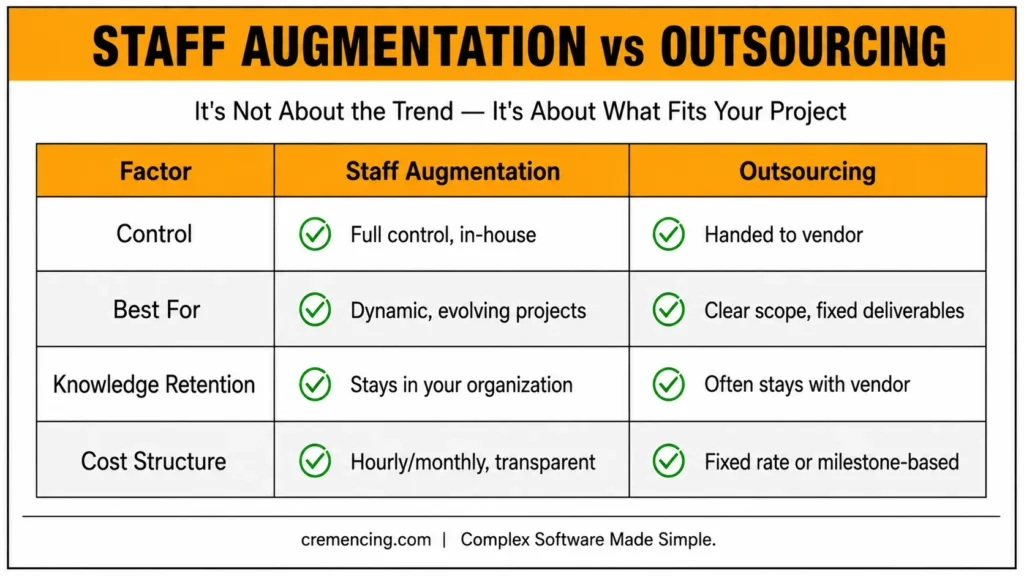
SAP staff augmentation is a dynamic type of hiring in which you bring on external professionals to work temporarily within your company. These professionals work under your management; they follow your processes, and they become an integral part of your work processes. It is basically a kind of continuation of your in-house team.
Companies frequently turn to this model when they already possess a good internal SAP environment but require expert services on certain tasks, e.g., development, migration, or support.
| Factor | SAP Staff Augmentation | SAP Outsourcing |
|---|---|---|
| Who directs day-to-day work | Your internal team/PM | The vendor’s delivery lead |
| Best-fit project shape | Iterative, evolving scope (BTP extensions, Fiori builds, ongoing support) | Defined scope, fixed deliverables (migrations, upgrades, cutover projects) |
| Pricing model | Hourly/monthly, usage-based | Fixed-price or milestone-based |
| Where knowledge lives after the engagement | Stays with your internal team | Largely stays with the vendor |
| Internal PM overhead | Higher — you manage the resource | Lower—vendor manages delivery |
| Risk ownership | Shared/internal | Shifted toward vendor |
| Typical landscape fit | S/4HANA Cloud, BTP, ongoing enhancements | S/4HANA on-prem migrations, well-scoped upgrades |
On the other hand, outsourcing transfers responsibility to a third-party vendor. You do not control individuals; you allocate whole projects or functions. The vendor takes care of the delivery and scheduling, as well as the allocation of resources; this allows your internal team to concentrate on strategic priorities.
Whereas staff augmentation provides you with a level of control, outsourcing provides you with convenience. The choice is in determining the equilibrium between these two aspects.
A decision between SAP Staff Augmentation and outsourcing.
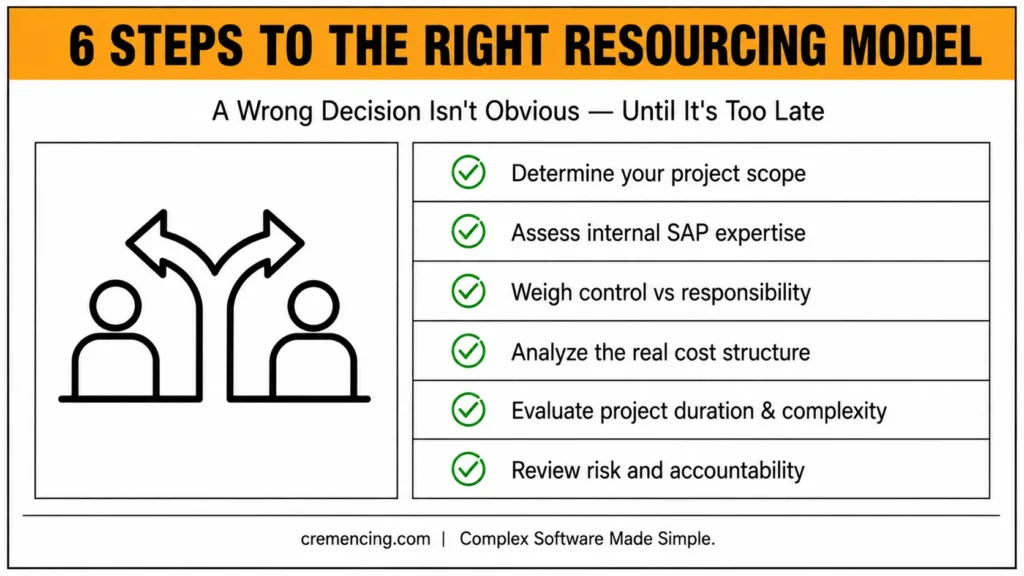
Step 1: Determine Your Project Scope.
You must have a sense of what you are attempting to do before settling on a model.
Outsourcing can be effective when your project has a clear scope, deliverables, and when the project has predictable timelines. Moreover, Vendors flourish in orderly situations where expectations are determined.
But when your project is dynamic, like continued growth or innovation projects, staff augmentation is more flexible. It enables you to change fast without renegotiation of contracts.
Step 2: Assess Internal Expertise.
The ability of your internal team is significant in this decision.
When you already have SAP professionals on board who will be able to manage and guide external resources, then staff augmentation becomes a natural fit. It builds your team without depriving control.
However, when your organisation does not have SAP expertise or bandwidth in project management, outsourcing will ease the burden. The supplier offers technical expertise as well as delivery management.
Step 3: Think control vs. responsibility.
This is among the most crucial trade-offs.
Under staff augmentation, processes, priorities and execution remain under your full control. It best suits companies wishing to have direct control and conformity to company standards.
Outsourcing hands over the responsibility to the vendor. On the one hand, this helps to minimize internal workload, but on the other hand, it also implies the lack of direct control over the daily activities. The choice would have to rely on the level of involvement you wish to have in execution.
Step 4: Cost Structure Analysis.
The cost part is misconstrued in this comparison.
Staff augmentation is typically based on hourly or monthly charges. It might appear to be more costly in the short term, but it is more transparent and flexible. You pay only for the resources you consume.
Outsourcing is usually priced either at a fixed rate or a milestone rate. This may make budgeting easier, but other concealed costs may occur when changes in the scope of the project occur.
The lowest price in most instances is not the most cost-effective. Value delivered should be the true focus.
Step 5: Evaluate the Durations and Complexities of the Project.
Short-term, well-spaced projects may be a good fit with outsourcing.
Staff augmentation is more valuable with long-term or complex projects, particularly those needing constant changes. It enables you to be consistent and change with time.
SAP BTP augmentation is a better option because projects involving the implementation of SAP S/4HANA transformations or custom extensions often require continuous collaboration.
The decision is even more significant in 2026 when SAP ecosystems grow increasingly complex with the introduction of platforms such as SAP S/4HANA and SAP BTP.
Step 6: Review Risk and Accountability.
Outsourcing companies tend to assume greater responsibility regarding delivery. This will minimize
your risk but will depend more on the vendor.
Staff augmentation spreads risk in different ways. As you are in charge of the team, accountability is in-house. This will provide you with a greater level of control as well as a greater level of responsibility. The most important thing to make a correct decision is to understand your risk tolerance.
Benefits & ROI of Choosing the Right Model
The correct decision to make between staff augmentation and outsourcing can really make a difference in the outcomes of your project.
Cost-wise, companies that match the model with the project requirements tend to save on unnecessary expenses by 2030. This is based on the fact that there are no delays, there is minimal rework, and there is better utilization of resources.
Staff augmentation enhances operational flexibility. Teams have the ability to scale up and downscale resources depending on demand, and the resources are effectively utilised. This is particularly useful in dynamic SAP environments.
On the other hand, outsourcing enhances the speed and efficiency of clearly defined projects. Vendors introduce organised procedures, ready-made models, and specialized knowledge that can speed up delivery.
The other key advantage is focus. In outsourcing, the internal teams are able to focus on strategic projects while external partners take up the implementation. With augmentation, organizations retain full alignment with internal goals and processes.
Finally, ROI requires making the appropriate model to the appropriate context, not the universal application of a particular model.
The typical errors to be avoided.
A major error that companies make is to select them based on cost only. This tends to result in short-term savings but long-term inefficiencies.
Unclear project scope is the other typical problem. Outsourcing agreements are quite complex without stated objectives, and augmented teams can remain directionless.
Organizations also do not recognise the significance of communication. Both in the case of augmented staff or outsourced vendors, alignment and collaboration must be essential in making the difference.
Lastly, a good number of companies do not create governance. Both models may result in confusion and inefficiency unless they are clearly owned and have performance metrics.
Underlying Decision Factors that the Majority of Companies Overlook.
The majority of comparisons between staff augmentation and outsourcing are based on the cost and control, however, they fail to consider deeper aspects that drive success.
One of these is knowledge retention.
In staff augmentation, knowledge remains in your organization since the external professionals work hand in hand with your staff. This develops capacity in the long term.
In outsourcing, the knowledge may tend to be in the hands of the vendor. Though this is faster in delivery, it may, over time, become addictive.
Cultural alignment is another aspect that has been ignored. Augmented staff becomes a part of your team culture, and the collaboration process will be easier. The process and communication methods used by outsourced teams might not be compatible, which could cause friction unless managed effectively.
In both models, scalability is also different. Gradual scaling can be achieved through staff augmentation, whereas outsourcing may demand larger upfront commitments. These factors are able to be known to avoid expensive errors and enhance overall performance.
Conclusion
The decision of SAP staff augmentation or outsourcing in 2026 is not about picking a trend but making a strategic choice that suits your business needs.
Staff augmentation offers you flexibility, control and long-term ability building. Efficiency, speed, and a lower level of operation burden are benefits of outsourcing.
The correct decision will be based on the scope of the project, internal capabilities, and the level of involvement you wish to have. A major error that companies make is to select them based on cost only.
As soon as you are well aware of these factors, you will be able to avoid costly mistakes, as well as create a model that will support not only performance, but also growth.
FAQ:
1. Which is more cost-effective: staff augmentation or outsourcing?
It is based on your project. Staff augmentation is flexible and outsourcing offers predictable pricing in fixed scope projects.
2. What is the time to select SAP staff augmentation?
When you want to be flexible, to take control and to be constantly collaborating with your internal team.
3. Does outsourcing perform better with large SAP projects?
Outsourcing is an effective approach that suits well-defined and structured projects with well-defined deliverables.
4. Am I able to use both models together?
Yes, a hybrid strategy (i.e. outsourcing some tasks and adding more people to current teams) is used by many companies.
5. What can I do to minimize outsourcing risks?
Through establishing well-defined contracts, performance measurement, and frequent correspondence with the vendor.
6. Does staff augmentation work for SAP BTP and Fiori extension projects specifically?
Yes because BTP and Fiori work tends to iterate quickly; staff augmentation is often a better fit than fixed-scope outsourcing for these work streams, even when the core S/4HANA landscape is otherwise outsourced.
7. What happens to project knowledge when an outsourcing engagement ends?
Knowledge typically stays concentrated with the vendor unless the contract explicitly requires documentation handover and knowledge-transfer sessions; this should be negotiated up front, not assumed.





One Response