
Introduction
A developer opens a ticket: “Pull the last 30 days of customer orders into a report.” Traditionally, that’s an hour of writing SELECT statements against the right CDS views, handling date logic, and making sure the output matches SAP’s formatting standards — longer if it’s a junior developer still learning where the relevant tables live. With Joule ABAP code generation, that same request becomes a natural-language prompt, and a draft ABAP program comes back in seconds instead of an hour.
That doesn’t mean the developer’s job disappears — it means the job shifts from writing boilerplate to reviewing, validating, and governing what an AI assistant produces. This guide covers how SAP Joule’s ABAP code generation actually works step by step, what it can and can’t be trusted to do unsupervised, and the governance gaps most teams haven’t thought through yet — because “the code compiles” and “the code belongs in production” are two very different bars.
Transformative Impact of SAP Joule in ABAP Engineering
SAP Joule represents a paradigm shift from manual syntax drafting to intent-driven architectural design. Deeply integrated into modern development environments like ABAP Development Tools (ADT) in Eclipse and SAP Business Application Studio (BAS), Joule acts as an inline pair-programmer specifically trained on enterprise-grade SAP metadata, CDS views, and RESTful Application Programming (RAP) models.
Rather than generating generic code fragments, it generates Clean Core-compliant ABAP Cloud artifacts directly within S/4HANA (Cloud and Private Edition) and SAP BTP.
What Is Joule ABAP Code Generation?
SAP Joule ABAP code generation brings an AI capability into SAP’s ecosystem, generating, explaining, and optimizing ABAP code from natural language promptsIt also forms part of SAP’s wider AI assistant strategy for SAP Business AI, and it integrates into development environments such as SAP Build and S/4HANA
In simple terms:
Developers write requirements in natural language first.
SAP Joule provides hints for coding in ABAP.
Developers then develop and deploy it to SAP systems.
As a result, this saves manual coding for repetitive tasks and shortens the time to market in business scenarios such as SAP S/4HANA.
Joule’s ABAP code generation is currently rolling out as part of SAP’s broader Business AI strategy, integrated into supported development environments. Availability, exact capabilities, and licensing requirements vary by SAP BTP subscription and S/4HANA release — teams should confirm current access and scope through their SAP account team or the SAP Business AI documentation before planning adoption timelines.
| Aspect | Manual ABAP Development | Joule-Assisted Development |
|---|---|---|
| Initial draft time | Hours, written line by line | Minutes, from natural language prompt |
| Boilerplate code | Written manually each time | Auto-generated from prompt |
| Code explanation/docs | Manual documentation effort | AI-generated explanation available |
| Developer review requirement | Standard code review | Standard code review + AI-output validation |
| Skill requirement to start | Strong ABAP syntax knowledge needed upfront | Business logic clarity + ABAP review skill |
| Production readiness | Developer-authored, ready per team’s usual process | Draft only — requires validation before deployment |
Core capabilities:
- Generation of ABAP code from prompts
- Explanation and documentation of the code
- Suggests error detection and correction
- Optimization of existing ABAP logic
[sibwp_form id=1]
SAP Joule ABAP Code Generation
SAP Joule integrates its AI capabilities into ABAP development through a structured workflow. It is not a replacement for developers; it is a help to the developer.
Step 1 – Developer enters natural language requirement
The developer writes the requirement, rather than the code:
Example:
“Write an ABAP Report to get last 30 days Customer Orders”.
Joule is the guy that reads the intent behind the business.
Step 2: AI processes SAP data structures
SAP Joule maps:
- Tables
- CDS views
- Existing ABAP artifacts
- Business context
This guarantees generated code conforms with SAP standards.
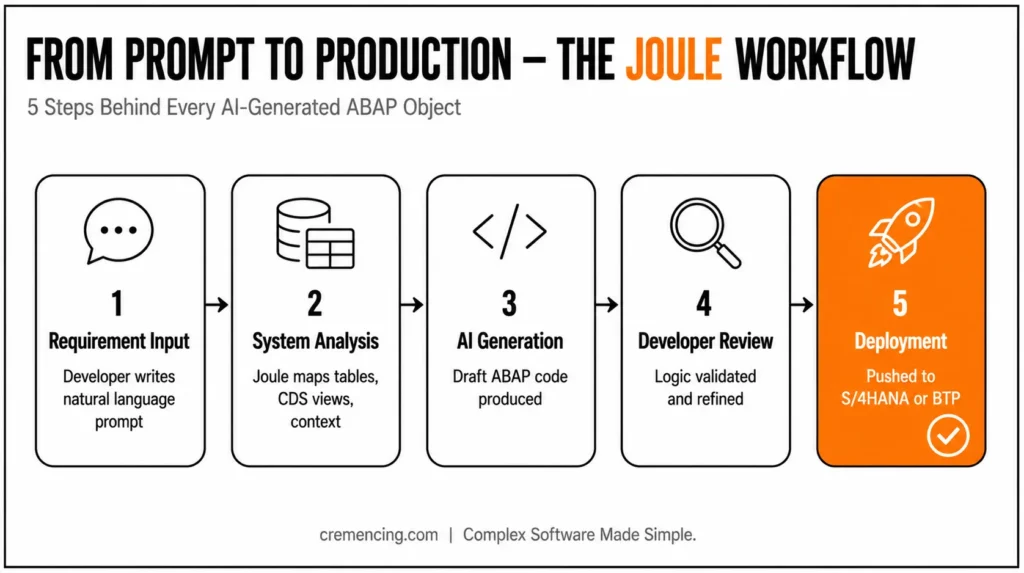
Step 3 – Generating ABAP code
Joule generates:
- Structured ABAP programs
- Select queries
- Class methods
- Error handling blocks
Optimized select statements are examples of output, as opposed to generic loops.
For example, a prompt like “Write an ABAP Report to get last 30 days Customer Orders” might generate a draft along these lines (illustrative — actual Joule output will vary and requires developer validation):
SELECT vbeln, erdat, kunnr, netwr
  FROM vbak
  WHERE erdat >= @( sy-datum - 30 )
  INTO TABLE @DATA(lt_orders).
This is a starting draft, not production code — developers still need to confirm they’re using the right CDS view or table for the current system’s data model, add proper error handling, and validate the selection logic against actual business rules before this goes anywhere near a transport.
Step 4: Developer review and refinement
Developers:
- Validate logic
- Adjust business rules
- Add performance improvements
AI output is not definitive; it’s a starting point.
Step 5 – Deploy in the SAP environment
Once validated:
- S/4HANA or SAP BTP is deployed with code
- Seamlessly integrated with CI/CD pipelines
- Improved for runtime performance
Process Flow Table
| Step | Activity | Output |
| 1 | Requirement input | Natural language prompt |
| 2 | System analysis | Data mapping |
| 3 | AI generation | ABAP code draft |
| 4 | Review | Optimized logic |
| 5 | Deployment | Production-ready code |
Benefits and ROI of Joule ABAP Code Generation
Overall, SAP Joule is revolutionizing measures of productivity in enterprise development settings.
Key benefits:
- 40–60% faster development cycles
- Reduced manual coding work
- Up to 30% less debugging time
- AI identifies typical ABAP problems at an early stage
- Improved code consistency
- Standardized SAP-compliant structure
- Reduced the time for junior developers to get onboarded
- Natural language reduces the learning curve for ABAP
- Increased velocity for SAP deliveries
- Faster sprint completion
ROI Impact Example
| Metric | Before AI | With SAP Joule |
| Feature development time | 10 days | 5–6 days |
| Bug fixing effort | High | Reduced by 25–35% |
| Documentation time | Manual | Auto-generated |
| Developer productivity | Baseline | +45% improvement |
Joule ABAP Code Generation: Mistakes and Best Practices
SAP Joule increases efficiency, but if used incorrectly can create problems.
Common mistakes:
- Predictive ABAP: The peril of uncritical reliance on AI’s output
- Can cause logic to be inefficient or redundant
- Breaks the golden rule of the system
- Leads to non-optimal use of CDS or tables
- Similarly, skipping code review
- Needs human validation for AI
- Using vague prompts
- Writes code that is not correct or complete
Best practices:
- Always test-generate ABAP first in the sandbox
- Use structured prompts (business logic specific)
- Mix AI-generated content with SAP Clean Core principles
- Provide training for teams on AI-guided development workflows
Governance of Joule ABAP Code Generation
Moreover, in most of the articles on SAP AI, there is a lack of content.
People talk about “code generation speed” for most discussions about SAP Joule. But challenges are greater with actual enterprise deployments. AI-assisted coding is changing skill priorities across the board; see how Python is also reshaping ABAP careers in 2026.
Governance Gaps in Joule ABAP Code Generation
In production SAP environments:
- Who owns the code that is created by AI?
- How will compliance be monitored?
- What is the tracking of AI contributions in audits?
The real issue is that there is no ABAP governance model for AI.
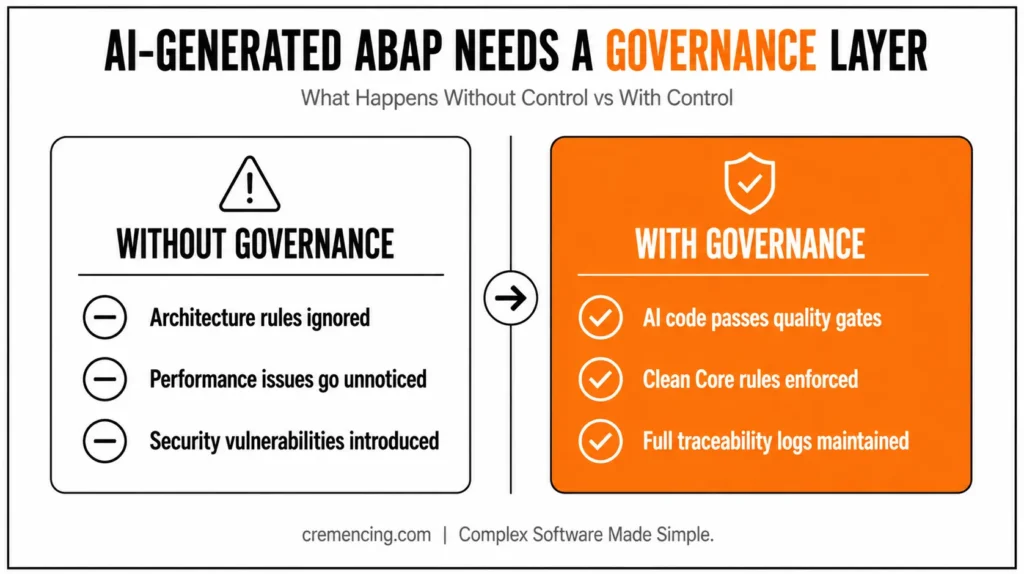
Without governance:
- Architecture rules may not be considered by AI-generated logic
- There can be a lack of awareness of performance problems
- Security vulnerabilities can be added
Control model recommended for enterprise:
- ABAP quality gates must be passed by AI-generated code
- SAP Clean Core validation rules must be enforced
- All traceability logs should be maintained for every AI-created object
This governance layer plays an essential role in production systems.
Conclusion
SAP Joule’s ABAP code generation doesn’t eliminate the work ABAP developers do — it moves where that work happens. Less time goes into writing boilerplate SELECT statements and repetitive logic; more time goes into validating what Joule produces, catching cases where generated code doesn’t account for a specific business rule or system quirk, and making sure AI-generated objects pass the same quality gates as everything else in production.
The teams likely to run into trouble aren’t the ones using Joule — it’s the ones treating “the code compiled and ran” as equivalent to “the code is production-ready and governed.” Without ownership rules for AI-generated code, without Clean Core validation applied consistently, and without traceability logs tying generated objects back to the prompts and developers who approved them, Joule’s speed advantage turns into an audit and maintenance liability instead. Adopt the workflow, but build the governance layer around it from day one — not after the first incident makes it necessary.
FAQs
What is SAP Joule in ABAP Development?
SAP Joule is essentially an AI copilot designed to assist, explain, and optimize ABAP code with natural language prompts. In other words, it acts as a coding companion rather than a replacement for developers.
2. Does SAP Joule mean ABAP developers are no longer required?
No, not at all. Instead, it assists developers by automating repetitive coding tasks. However, human validation is still required before any code reaches production.
3. Does SAP Joule produce production-ready ABAP code?
Not immediately. Rather, it produces draft code that developers must review, optimize, and test first. Therefore, treating AI output as final code without validation can introduce serious risks.
4. What is the productivity gain of using SAP Joule?
Overall, it saves coding time, reduces boilerplate logic, and accelerates debugging. As a result, teams often report faster documentation and smoother sprint completion as well.
5. Does SAP Joule work reliably in enterprise SAP systems?
Yes, but only when paired with proper governance. Specifically, this means enforcing code review processes and Clean Core principles. Otherwise, enterprises risk introducing untracked or non-compliant code into production.
6. Can SAP Joule generate ABAP code for custom Z-tables and Z-programs?
Joule’s code generation maps natural language prompts to known data structures, including custom objects where developers have properly documented them and made them accessible to the tool. Coverage of custom Z-objects likely depends on how well teams have catalogued those objects in the system — teams should verify this against their specific landscape rather than assuming full custom-object support out of the box.
7. Does using SAP Joule for ABAP development affect Clean Core compliance?
Not automatically in either direction — AI-generated code can be Clean Core-compliant or not, depending on what it produces and whether teams enforce validation rules before deployment. Governance processes (quality gates, Clean Core checks) matter just as much for AI-generated code as for manually written code.
8. How does SAP Joule handle sensitive or regulated data in generated code?
This depends on organizational governance and data handling policies rather than being inherent to the tool itself. Teams working with regulated or sensitive data should confirm how prompts, generated code, and any data references are handled, logged, and secured before using Joule in those contexts.
9. Is SAP Joule’s ABAP code generation available for both S/4HANA on-premise and cloud?
Availability varies and should be confirmed against SAP’s current documentation and licensing for the specific release and deployment model in question, since AI-assisted development features often roll out differently across on-premise and cloud scenarios.
10. What skills should ABAP developers build to work effectively with SAP Joule?
Beyond core ABAP knowledge, developers benefit from strong requirement-writing skills (clear, structured prompts produce better output), code review discipline for evaluating AI-generated logic, and familiarity with Clean Core and governance principles — since the developer’s role shifts toward validation and architecture judgment rather than only hand-writing code.
Resources
An Overview of SAP Business AI





One Response