
Introduction
ABAP development is no longer just structured business logic; it’s transforming into an AI-powered engineering discipline. SAP AI ABAP development on SAP BTP is changing the way enterprise-level applications are designed, developed, and deployed in 2026.
However, “AI writes your ABAP code now” is the pitch most 2026 SAP content leads with but it’s the wrong headline. In fact, the interesting story isn’t that generative AI can draft ABAP classes and CDS views faster than a developer typing them by hand. Instead, it’s what happens to that generated code six months later: nobody documented why it was structured that way, Clean Core compliance wasn’t checked at generation time, and as a result, three teams have quietly built the same logic three different ways because none of it went through an approval gate.
In short, that’s the gap IT managers and SAP architects are actually running into as ABAP AI development moves from demo to production in enterprise landscapes built on S/4HANA Cloud and BTP: essentially, the tooling got fast before the governance caught up.
This guide therefore covers how ABAP AI development actually works end to end. However, its real focus is the part most guides skip: what separates an AI-generated prototype from a production-grade, auditable SAP application.
What is ABAP AI development in 2026?
ABAP AI development in 2026 is the process of utilizing AI capabilities within the context of SAP ABAP and SAP Business Technology Platform (BTP) to aid in the creation, optimization, and deployment of enterprise-level applications.
Enterprise ABAP development has reached a historic inflection point: AI is no longer just a chat interface but an integrated architectural layer. Industry benchmarks reveal that developer teams utilizing Joule for Developers—powered by SAP’s proprietary SAP-ABAP-1 foundation model reduce code writing and unit testing cycles by 20% to 25% while keeping the core untainted. It is a solution that is very much part of SAP’s modern ecosystem, particularly with platforms such as SAP BTP Overview.
Rather than manually typing each line, developers utilize AI systems that:
- Understand business requirements in natural language
- Present architecture patterns that are suggested for use with SAP.
- Use a wizard to create ABAP code.
- Optimize performance and security
Core idea:
- ABAP = business logic engine (basis for ABAP applications)
- AI = development accelerator
- BTP = Scalable execution layer
These are combined to create a contemporary SAP application development stack.
The working of ABAP AI development works with SAP AI and BTP
AI-driven ABAP development is carried out through a pipeline process. It isn’t random code generation; it’s context-aware enterprise development.
Step 1 – Business requirement interpretation with AI
For example, developers enter requirements such as the following
“Generate a supplier invoice validation report with anomaly detection.”
SAP AI interprets:
- Business object (invoice)
- Validation rules
- Tables/CDS views that are the source of the data
Step 2 – SAP ABAP code generation with the help of AI
SAP AI generates:
- ABAP classes
- CDS views
- Data retrieval logic
- Error handling structures
This helps to save a lot of boilerplate code.
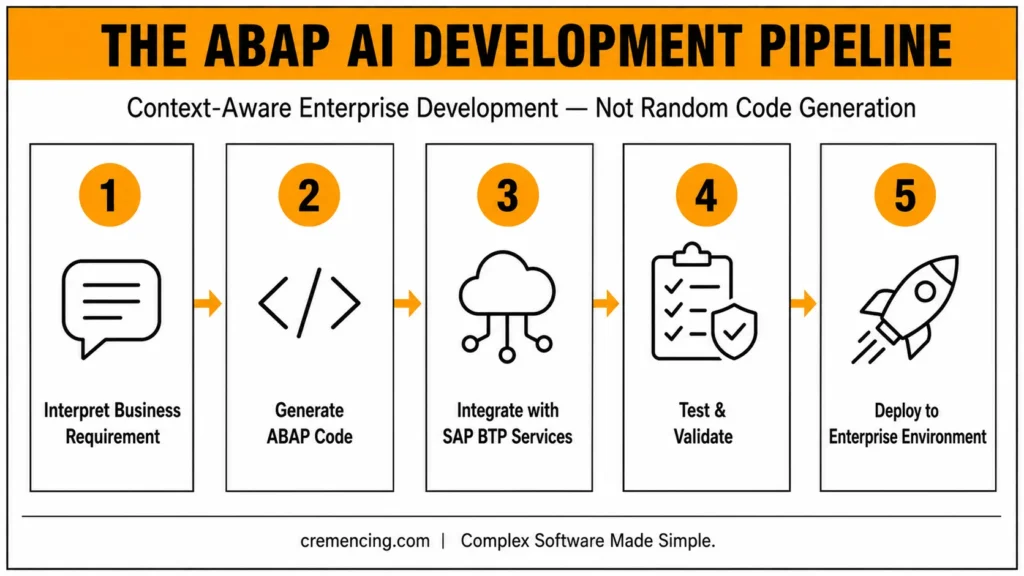
Step 3 – Integrating with SAP BTP services
The developers adapt logic according to the recommendations.
SAP BTP services are used to enhance generated ABAP logic:
- SAP HANA Cloud as a data processor
- SAP Integration Suite for APIs
- Build Apps for UI extension with SAP
Step 4 – Testing and validation
AI assists in:
- Unit test generation
- Performance checks
- Security validation
Step 5 – Deploy to enterprise environment
The final application is deployed into:
- SAP S/4HANA cloud or hybrid systems
- Pipelines in CI/CD with SAP BTP.
- Setting up dashboards to track performance
Workflow
| Stage | SAP AI Role | Developer Role |
| Requirement | Interpretation | Validation |
| Code generation | Full draft creation | Review |
| Integration | Suggest APIs | Connect services |
| Testing | Auto test cases | Refinement |
| Deployment | Pipeline support | Approval |
ABAP AI Development: Production-Readiness Checklist
Before AI-generated ABAP ships to production, first confirm:
- ✅ Code passed through a defined AI code approval gate (not just a peer review of style)
- ✅ Output validated against Clean Core rules — no direct core modifications
- ✅ Extensibility built on RAP (Business Objects/behavior definitions), not ad hoc classes
- ✅ Generated APIs are SAP-released, not internal/undocumented endpoints
- ✅ Unit tests generated by AI have been reviewed by a developer, not auto-accepted
- ✅ Performance benchmarking run before deployment, not discovered after go-live
ABAP AI development benefits & ROI
Measurable enterprise value of AI-driven ABAP development.
Key benefits:
- 50–70% faster development cycles
In fact, AI can save a lot of manual coding time. - Up to 40% decrease in bug rates.
ABAP is a language that offers safe patterns, but AI suggests them. - New developers will be able to onboard faster.
Less reliance on experience with deep ABAP knowledge - Improved system scalability
BTP is compatible with cloud-native extensions. - Higher delivery consistency
Conformance to a standardized system of SAP architecture.
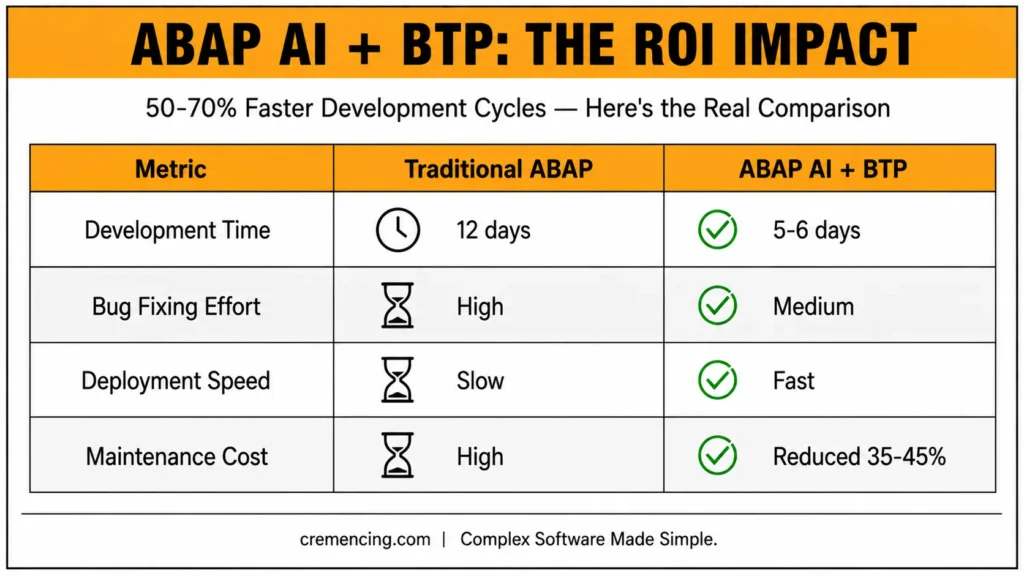
ROI impact comparison
| Metric | Traditional ABAP | ABAP AI + BTP |
| Development time | 12 days | 5–6 days |
| Bug fixing effort | High | Medium |
| Deployment speed | Slow | Fast |
| Maintenance cost | High | Reduced by 35–45% |
Other things that people often get wrong and do right.
Despite the use of AI, SAP teams frequently struggle with implementation.
Common mistakes:
- Relying too heavily on AI-generated ABAP code
Can cause inefficient code - Ignoring SAP Clean Core principles
Consequences of upgrade problems. - Bad BTP architecture design
Causes integration complexity - Skipping performance tuning
AI code still requires fine-tuning.
Best practices:
- Treat ABAP results generated by AI as non-validated!
- Only use SAP-released APIs
- Adopt Clean Core architecture rules
- Distinguish between ABAP and BTP logic.
- Introduce code governance for AI-generated code.
Real enterprise ABAP AI: What do competitors lack?
Most of the articles just point to “AI generates ABAP faster.” However, there are greater issues in real enterprise environments.
The current lack of reality: Hybrid ABAP + AI + BTP governance model
Enterprises don’t only write code, they maintain code:
- Compliance
- Auditability
- System performance
- Cross-cloud integration
AI-generated ABAP is not necessarily enterprise architecture compliant.
Without governance:
- Repeating logic is found in systems.
- Slowdowns and performance issues are not discovered
- Security vulnerabilities increase
Enterprise-grade solution:
A good framework for ABAP AI should contain:
- AI code approval process.
- SAP Architecture validation layer
- BTP integration standards
- Performance benchmarking gates
This is the difference between prototypes and production-quality SAP applications, which is why developers are adopting SAP AI.
Conclusion
The AI-vs-traditional-ABAP framing misses the actual inflection point in 2026. After all, it’s not whether AI can generate ABAP code faster it clearly can but whether your organization has a governance layer in place before that code reaches production. Ultimately, SAP AI, ABAP, and BTP working together is a development accelerator; however, Clean Core validation, RAP-based extensibility, and an AI code approval gate are what turn that accelerator into something audit-safe and maintainable at enterprise scale.
As a result, teams that skip the governance layer will ship faster in month one and pay for it in technical debt by month six. By contrast, teams that build the approval gate first will look slower at the start, yet they’ll be the ones still shipping cleanly a year in.
Teams that skip the governance layer will ship faster in month one and pay for it in technical debt by month six. Teams that build the approval gate first will look slower at the start and be the ones still shipping cleanly a year in.
It takes more than just adopting AI, though, for it to be a success. In fact, even ABAP code generated by AI can lead to long-term technical debt if the architecture, governance, and Clean Core aspects are not taken into account.
Going forward, coding is out of the picture; intelligent, AI-assisted engineering in structured SAP environments is the name of the game. For more, read our blog on What Makes ABAP a Unique Programming Language
FAQ
1. What is ABAP AI Development in SAP?
It is the ability to utilise AI tools for generating, optimizing, and handling ABAP code in SAP systems.
2. What is the support does SAP BTP to develop an ABAP AI?
SAP BTP offers cloud services, APIs, and integration tools to extend AI-generated ABAP applications.
3. Is the ABAP developer becoming obsolete due to AI?
No, AI helps developers by handling repetitive tasks, but human validation is necessary.
4. Will ABAP AI be production-ready in 2026?
Yes, if it is used in conjunction with good governance and SAP architecture conventions.
5. What skills are required to develop ABAP AI?
ABAP knowledge, understanding of SAP BTP, API integration skills, and development workflows with the help of AI.
6. Does ABAP AI development replace the need for SAP ABAP developers to know CDS and RAP?
No, AI-generated code still needs a developer who understands CDS views and the RAP model to review, validate, and correct it.
7. What’s the risk of using AI-generated ABAP code without a governance process?
Without an approval gate, teams risk duplicated logic across systems, undiscovered performance issues, and security gaps. The code may run, but it isn’t necessarily architecture-compliant or maintainable long-term.
8. Can AI-assisted ABAP development work with SAP Clean Core principles?
Yes, but only if AI-generated extensions are built through RAP-based, side-by-side extensibility rather than direct core modifications. Clean Core compliance has to be enforced as part of the review process, not assumed.