

Introduction
In 2026, SAP developers with BTP skills earn significantly more than ABAP-only peers as demand surges. This shift is exactly why the ABAP to BTP transition has become the SAP ecosystem’s most talked-about career move. It isn’t hype — it’s a direct result of SAP’s Clean Core policy, which is actively discouraging new custom ABAP development in favor of side-by-side extensibility on SAP BTP. Experienced developers who understand this shift early are positioning themselves for the most in-demand roles, while those who wait risk becoming specialists in a shrinking segment.
What’s Next in ABAP to BTP Transitions
SAP now integrates Joule AI into ABAP Cloud to automate legacy code refactoring.
Clean core enforcement is expanding rapidly across all S/4HANA Cloud deployments.
Developers can now deploy hybrid runtimes using Edge Integration Cell on BTP.
Furthermore, SAP AI Core brings unified artificial intelligence directly into BTP development.
Including these current updates keeps your career guide ahead of modern architecture trends.
What Is SAP BTP, and Why Is the ABAP to BTP Transition Happening?
Before exploring the ABAP to BTP transition further, it’s worth understanding what BTP actually is.
SAP Business Technology Platform is SAP’s all-encompassing cloud application development, integration, data management, and AI services platform. It is not in S/4HANA; it’s on top of S/4HANA, and that is the whole point.
For decades, custom SAP development has meant writing ABAP inside a running ERP system. It did, but it caused an issue: the more you customize SAP, the more costly and complex it is to upgrade, and the harder it is to migrate it to S/4HANA. SAP’s solution to this issue is the Clean Core approach—ensure that the core S/4HANA is kept as close to standard as possible and move all custom logic to BTP via APIs and events.
This is not the way forward. It’s the current SAP policy, and it’s actually changing the direction of development budgets today.
| High customizations break | Traditional ABAP (ECC/S/4HANA Core) | SAP BTP |
| Deployment | Inside ERP system | Cloud-native, outside core |
| Language | ABAP | CAP (Node.js/Java), Python, ABAP Cloud |
| Integration style | Direct system calls | API/event-driven |
| Upgrade impact | High — customizations break | High — coupled to core |
| AI/ML capabilities | Limited | Native (SAP AI Core, Joule) |
| UI development | SAP GUI, BSP | SAP Fiori, SAP Build Apps |
| Career trajectory | Maintenance-focused | New development, innovation |
Practical result: S/4HANA migrators are cutting custom ABAP budgets and increasing BTP spend. Those switching now enter a market with high demand but few experienced developers.
How Experienced Developers Approach the ABAP to BTP Transition
The ABAP professional has the good news that the transition doesn’t begin from scratch. Skills like core development thinking (data modelling, debugging logic, understanding business processes, working with SAP APIs etc.) are transferable. The toolchain and deployment paradigm changes.
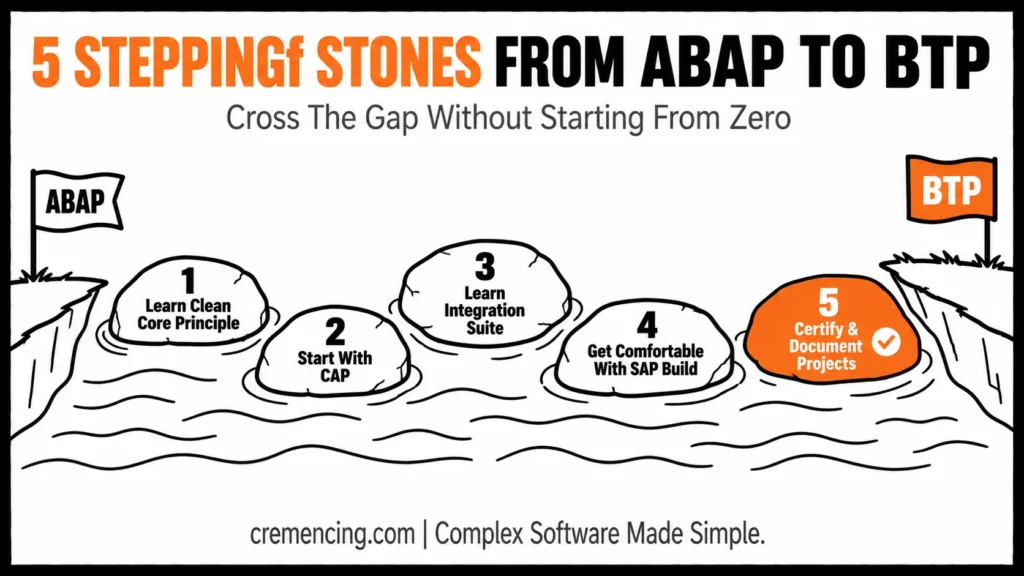
Step 1: Get to know the Clean Core Principle
Understand the purpose of BTP before writing a line of BTP code. The SAP’s Clean Core strategy specifies four extensibility options: Key User Extensibility, Developer Extensibility, Side-by-Side Extensibility (BTP), and Classic Extensibility (legacy ABAP). BTP is currently in the Side by Side category and is SAP’s preferred way forward for any custom application logic, integration, or UI development.
Knowing where BTP fits in the extensibility model enables you to make architectural decisions — not just code. That’s the kind of decision-making that makes BTP developers more than just BTP configuration technicians in the eyes of hiring managers.
Step 2: Get Started With SAP Cloud Application Programming Model (CAP)
The initial framework that ABAP developers should learn on BTP is CAP. It supports data modeling, service exposure, and business logic, the same conceptual area that ABAP developers are familiar with. CAP is available for both API types–Node.js and Java–and is integrated natively with SAP HANA Cloud, S/4HANA APIs, and SAP Fiori.
There’s a learning curve, but it’s very manageable. After 4-8 weeks of practical work, ABAP developers generally report that CAP concepts become second nature to them, as the problem-solving pattern (defining entities, exposing services, processing events) is familiar to them, even if the syntax and/or tooling are new.
Step 3: Learn SAP Integration Suite for Connectivity
The majority of BTP projects are about linking systems together: S/4HANA and third-party systems, legacy systems and cloud services, and custom BTP apps and external APIs. The main tool for this is SAP Integration Suite (previously Cloud Platform Integration), which is one of the most in-demand BTP skill areas in the job market today.
If you have already been working with IDOCs, BAPIs, and RFC connections then you already know the concepts of integration well. It’s a logical extension of that skill: Understanding that knowledge and bringing it to ABAP integration background and Integration Suite, and very few candidates have that combination of skills today.
Step 4: Get Comfortable With SAP Build Portfolio
BTP’s low-code/no-code layer is SAP Build, which includes app development (SAP Build Apps), process automation (SAP Build Process Automation), and work zone configuration. This is somewhat counterintuitive for ABAP developers first. Low-code tools are not the tools where experienced developers want to spend time.
But, this is the truth: More and more, enterprise BTP projects are becoming more and more about SAP Build, as it enables business users to be involved in the development. Pro-code developers, who are familiar with CAP and Integration Suite and low-code developers, who are familiar with SAP Build, can design end-to-end solutions and ensure the business stakeholders understand how to implement them. The complete BTP ability requires the top rates in the market.
Step 5: Step Up and Record Project Experience
The BTP certifications with the highest hiring manager recognition in 2026:
- C_BTP_2408 – SAP Certified Associate – SAP BTP Developer
- SAP Certified Developer: SAP Integration Suite (or C_CPI_15 certification)
- SAP Certified Associate: Cloud Application Programming Model (C_CAPM_2412)
- C_BUILD_APPS — SAP Build Apps Associate
Complement certifications with projects in the sandbox. SAP BTP provides a free trial account that has access to most core services. Develop a real application, be it a CAP application to a mock S/4HANA API or an Integration Suite iFlow between two external services and then share it in your portfolio or GitHub profile.
Treat certification codes as a starting reference — always confirm the current code and syllabus on SAP’s official Training and Certification portal, since naming conventions and versions update yearly.
https://cremencing.com/sap-joule-abap-code-generation-how-ai-changes-abap-development-in-s-4hana-2026/
- Learn Clean Core principles first
- Start with CAP for data modeling and services
- Add SAP Integration Suite for connectivity
- Get comfortable with SAP Build for low-code collaboration
- Certify + document one live sandbox project
The Financial Value of the ABAP to BTP Transition
The financial case for the ABAP to BTP transition is one of the strongest arguments for making the move now.
The impact of BTP skills on salary is already quantifiable and is increasing due to the 2027 ECC deadline, which is accelerating migration throughout the market.
| Role | ABAP-Focused Salary (2026) | BTP-Focused Salary (2026) |
| SAP Developer (3–5 yrs) | $85,000 – $105,000 | $110,000 – $135,000 |
| Senior SAP Developer (5–10 yrs) | $110,000 – $135,000 | $145,000 – $175,000 |
| SAP Integration Specialist | $100,000 – $125,000 | $140,000 – $168,000 |
| SAP BTP Architect | $155,000 – $185,000 | $190,000 – $230,000+ |
| Freelance/Contract (daily rate) | $600 – $900/day | $950 – $1,400/day |
Data is based on compensation data from LinkedIn Salary, Dice and SAP community compensation surveys across North America and Western Europe.
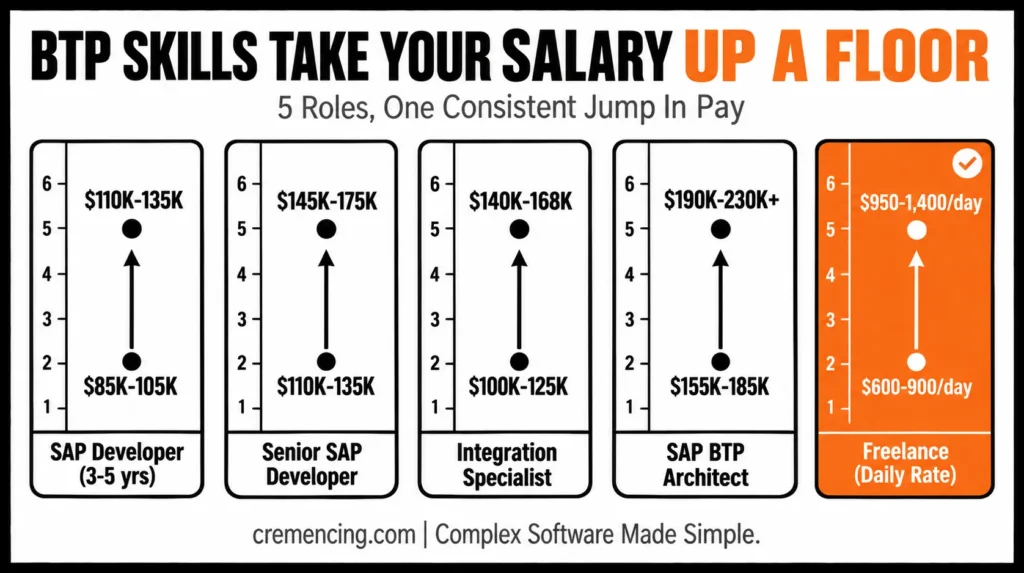
In addition to base pay, BTP skills offer opportunities that pure ABAP skills do not – AI integration projects (SAP AI Core, Joule development), cloud-native architecture roles and cross-platform integration work that crosses SAP and non-SAP systems. These are the most exciting and technically challenging enterprise IT projects today with the biggest budgets.
ABAP Cloud: The Bridge in Your ABAP to BTP Transition
All the BTP transition guides encourage ABAP developers to learn CAP, become certified and build projects. Few of them touch on the most strategic tool that will help experienced ABAP professionals in making this transition: ABAP Cloud.
ABAP Cloud is not the old ABAP. It is a modern subset of ABAP, designed to be cloud ready and to be used on the SAP BTP ABAP Environment and S/4HANA Cloud. It follows the same syntax used by ABAP developers but applies some restrictions to the object set to ensure adherence to Clean Core, eliminating the most complex, monolithic, and difficult-to-add and upgrade patterns found in legacy ABAP (such as direct table access and system changes).
ABAP Cloud: The Bridge in Your ABAP to BTP Transition
The impact on experienced ABAP Developers is huge with 3 reasons:
One, the learning curve is significantly less compared to switching to CAP/Node.js. You are writing ABAP – and a disciplined, cloud-ready version of ABAP at that! This means that you can contribute to BTP projects more quickly than developers with other backgrounds.
Second, there is actually a higher demand for the skills of ABAP Cloud compared to CAP—the number of developers who know the ins and outs of the ABAP language and also understand the Clean Core constraints is very few. As companies move to S/4HANA Cloud, the need for ABAP Cloud experts arises to refactor legacy custom code and make it cloud-compliant.
Third, ABAP Cloud is the logical transition from your current skill set to a complete BTP skill profile. Jump-start into BTP projects with ABAP Cloud. Continue to build on your CAP, Integration Suite and SAP Build expertise as you accumulate project experience. The benefit of this sequencing is that you’ll be in the market more quickly than you might be if playing with a completely new language stack. Generate ABAP code automatically using SAP’s AI assistant.
The transition approach outlines a clear path: ABAP → ABAP Cloud → CAP + Integration Suite → Full BTP Architecture. Most developers try to jump from ABAP to CAP directly, but that jump stalls them. The bridge exists. Use it.
Conclusion
The ABAP-to-BTP shift isn’t about abandoning ABAP — it’s about sequencing the right skills in the right order. ABAP Cloud gives experienced developers a low-friction entry point before CAP, Integration Suite, and full BTP architecture. The developers who start now, with one certification and one documented sandbox project, will have real project experience by the time the 2027 ECC deadline pushes demand to its peak — putting them ahead of the developers who wait to be forced into the transition.
Ultimately, the ABAP to BTP transition rewards developers who move early, not those forced into it later.
FAQ
Will ABAP Skills Become Obsolete After the ABAP to BTP Transition?
Not outmoded, but, rather, more and more specialized. For a long time, ABAP will continue to be relevant to maintain existing custom code in ECC and S/4HANA on-premises systems. However, the development of “clean” new ABAP objects (not on ABAP Cloud) is on a downward trend, as the adoption of clean core is on the rise.
How Long Does the ABAP to BTP Transition Realistically Take?
Overall, a skilled ABAP developer with a solid understanding of business processes can be productive on BTP in 3-6 months with a laser focus — namely, certifications, sandbox projects, and ideally some exposure to a live BTP project.
Is SAP BTP applicable across all industries or just specific industries?
BTP is cross-industry; however, the highest adoption is in the manufacturing, retail, utilities, and financial services sectors, which, in turn, have complex SAP landscapes and extensive migration activity to S/4HANA.
What is the difference between SAP BTP and RISE with SAP?
Essentially, RISE with SAP is a commercial offering, meaning it is a bundled subscription comprising S/4HANA Cloud, BTP services, and managed infrastructure.
Do I need to know CAP before learning ABAP Cloud?
No — ABAP Cloud uses familiar ABAP syntax with Clean Core restrictions, making it a faster entry point than CAP for experienced ABAP developers.
Can I use SAP BTP without migrating to S/4HANA Cloud first?
Yes — BTP operates alongside on-premise S/4HANA and ECC systems via APIs and events, so migration to S/4HANA Cloud isn’t a prerequisite for starting BTP work.
What’s the risk of not transitioning to BTP as an ABAP developer?
Reduced access to new development projects, as organizations increasingly restrict new custom ABAP work under Clean Core policies, shifting new builds to BTP.
Is SAP BTP the same as SAP Cloud Platform?
SAP Cloud Platform was rebranded as SAP Business Technology Platform (BTP), which now encompasses a broader set of integration, data, and AI services.
How does ABAP Cloud differ from Key User Extensibility?
ABAP Cloud is a Developer Extensibility option requiring coding skills, while Key User Extensibility allows business users to make limited configuration-level changes without code.
What happens to existing custom ABAP code after the 2027 ECC deadline?
Existing ECC custom code continues running until end-of-maintenance, but new development is expected to shift toward ABAP Cloud and BTP under Clean Core guidance.