
Introduction
Gartner says that fewer than half of supply chain decisions are based on accurate and timely data. Allow that to sink in a bit. The procurement departments are rearranging stock according to the inventory from a day and a half ago. Logistics managers are routing deliveries based on the past week’s carrier ratings. The finance departments are projecting demand based on figures that are not true anymore.
This is the unseen expense of supply chain data latency – the difference between when something happens in your supply chain and when your team can actually act on it. In a volatile market, that difference is not going to slow you down. It costs you money, customer confidence and competitive advantage.
What you will learn in this post is what supply chain data latency is, why it occurs, how leading operations teams are eradicating it and what quantifiable outcomes they are achieving. No fluff – just a workable framework you can begin to use.
Data Lag and Decision Velocity Shift
Recent industry research from McKinsey reveals that 90% of supply chain leaders experienced operational disruptions due to unaddressed data gaps. A Deloitte study further shows that 60% of supply chain leaders struggle with planning and forecasting because of unreliable data. This poor forecasting leads directly to a 20% to 30% loss in business profitability. Consequently, Gartner notes that companies are adopting AI agents and real-time orchestration to fix latency issues and automate complex workflows.
Supply chain data latency: What Is Supply chain data latency and Why Does It Matter?
Supply chain data latency refers to the delay between an actual event in your supply chain and when that information can reach someone who can act on it. It is not necessarily a technology issue. It’s an operational and organizational one.
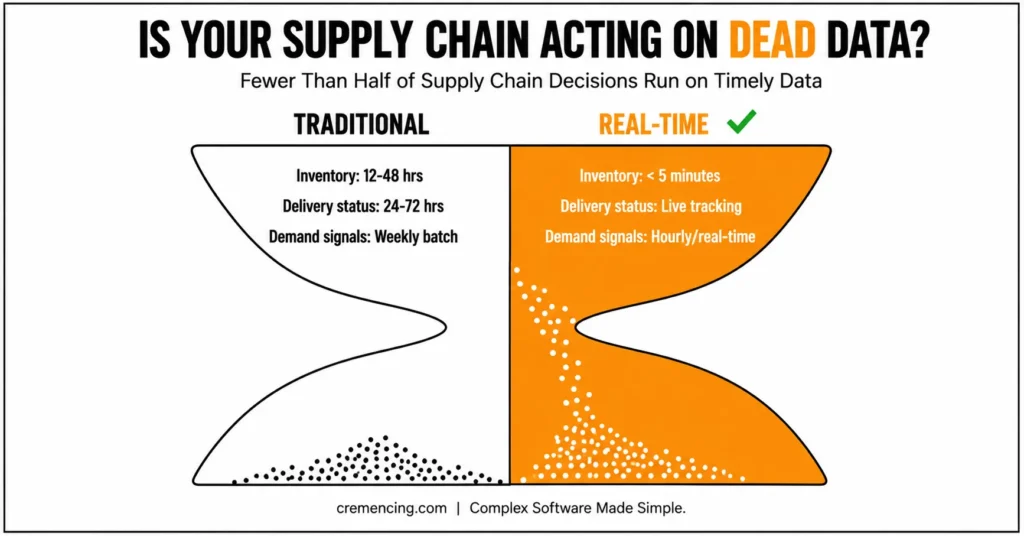
Latency manifests itself on all the layers:
- Some suppliers export weekly or monthly batches of exports, rather than live feeds.
- ERPs that are run overnight do not update in real time but rather in sync.
- Manual data entry that develops hours or days of lag.
- Isolated tools that do not communicate with other tools.
- Spreadsheet processes where changes are sent out through email chains.
At the time that stale supply chain data gets to a decision-maker, the situation has already passed. One of the shipments was delayed. Warehouse capacity. One of the suppliers darkened out. Making decisions on dead data is not only ineffective, but also actively damaging.
| Data Type | Traditional Latency | With Real-Time Tools |
| Inventory levels | 12–48 hours | < 5 minutes |
| Supplier delivery status | 24–72 hours | Live tracking |
| Demand signals | Weekly batch | Hourly or real-time |
| Logistics & carrier data | End of day | Continuous |
| Financial reconciliation | Monthly | Daily or on-demand |
The mechanism of how Real-Time Supply Chain Visibility functions: Step by Step.
It is not a matter of one software to close the latency gap. It’s an organized change in the flow of data within your organization.
Step 1: Map Your Data Sources and Find the Lag.
Start with a data audit. Examine all systems providing supply chain decisions – ERPs, WMS platforms, supplier portals, logistics APIs, spreadsheets. On all of them, record the frequency of that information being updated as well as how long it takes the information to reach a decision-maker. Latency unknown to most organizations is discovered.
Step 2: Unify Systems with a Central Data Layer.
Unlinked systems are the greatest offender. The integration middleware or a supply chain control tower pulls information out of all sources into a single layer – doing away with the manual handoffs and delays of information between tools. One of the sources of truth. No longer version conflicts.
Step 3: transitioning to Batch Processing to Event-Driven Updates.
Conventional ERPs operate overnight jobs. Event-driven architecture (a change in one system (a port scan, a delivery confirmation)) is necessary to achieve real-time visibility everywhere else. This is the architectural change, which does indeed seal the latency window.
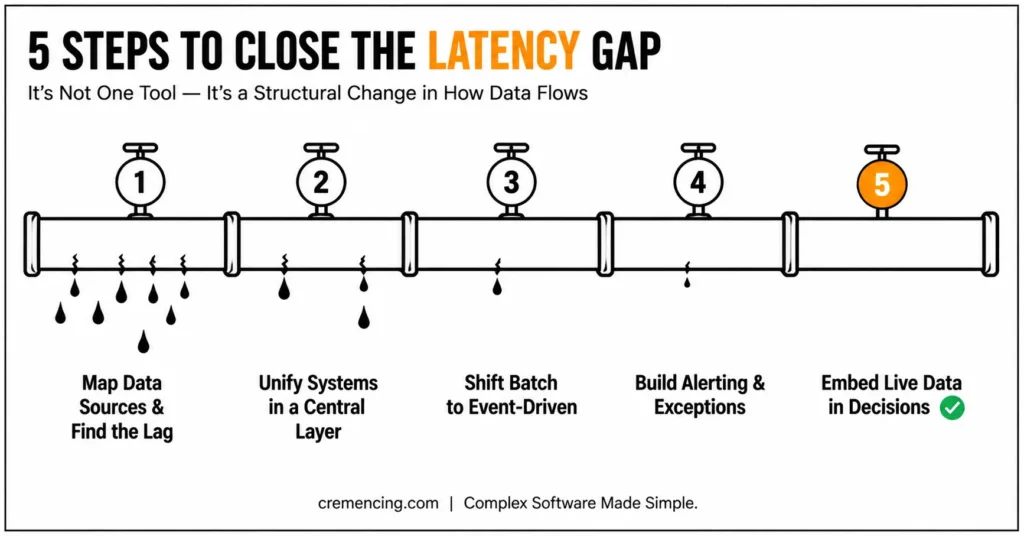
Step 4: Construct Alerting and Exception Management.
The data in real-time can only be useful when the appropriate individual receives the data at the right time. Establish threshold-based alerts on critical trigger points: low inventory (below safety stock), a supplier has not met a milestone, a spike in freight costs. Exception management allows your team to be focused on what should be addressed, rather than manually searching your dashboards.
Step 5: Integrate Live Data into Day to Day Decision Making Processes.
This last step is cultural. Live data must be a standard input – incorporated in morning standups, linked to procurement approval flows, and normalized as the baseline of all decisions. When a person calls and does not check up-to-date information, that is a process gap that should be bridged.
Benefits and ROI What actual benefits and ROI Real-Time Supply Chain Data Provides.
| Benefit | Quantified Outcome | Source |
| Inventory reduction | 20–30% lower carrying costs | McKinsey |
| Forecast accuracy | Up to 50% improvement | Gartner |
| Supplier on-time delivery | 15–25% increase | Deloitte |
| Order fulfillment speed | 40% faster processing | IDC Research |
| Disruption cost reduction | Up to 35% lower | PwC |
In addition to the figures, three strategic results are not reflected on a spreadsheet:
- Risk being proactive – identifying supplier problems before they turn into stockouts.
- Swift demand response – changing procurement in advance of the peaks or crases.
- Better supplier relationships – visibility, which fosters trust and cooperation in solving problems.
Major pitfalls that Teams when Trying to resolve Supply Chain Data Latency.
Majority of supply chain teams are aware of the fact that they have a data problem. It is the manner in which they attempt to remedy the situation.
Mistake 1: Purchasing More Dashboards, without repairing the Data Pipeline.
A beautiful dashboard constructed out of 24-hour-old data is still 24-hour-old data. The visualization tools do not correct latency, integration does. Get the pipeline sorted out and then add reporting on top.
Mistake 2: You Think Your ERP to Be Enough.
ERPs are designed to keep records as opposed to real time signal processing. The majority can be set to synchronize after a specified time interval – although configurable does not necessarily imply real-time default. Check your ERP configurations and do not think that it is streaming live data downstream.
Error number 3: Assuming That This is a One-Time IT Project.
The data infrastructure in the supply chain requires continuous governance. As your supplier base grows and systems change, pipelines drift. Designate ownership – a lead on the data steward or supply chain analytics – to ensure the data is always of high quality.
Error 4: Neglecting Supplier-Side Latency.
You can have ideal internal data flows and still be handling dead data in case your suppliers deliver batch files on a weekly basis. The most challenging and least addressed part is supplier onboarding to share real-time data. Begin with your 10 largest suppliers (volume) by number.
The Angle Most Competitors Are Missing: Dark Data in Your Supply Chain.
Majority of supply chain material is aimed at lowering latency in systems that are already in place. However, there exists a second lesser-known issue, the dark data.
Dark data refers to supply chain data that is collected by your organization, but is never analyzed or acted upon. It coexists in email chains, PDF invoices, carrier call logs, hand inspection reports, and warehouse floor notes. According to IBM research, organizations store up to 80 percent of their data- but analyze only about 20 percent of that data.
In the case of supply chain teams, typical dark data sources can include:
- Informal communications with suppliers (emails, calls, chat logs)
- Receiving and quality inspection forms that are paper based.
- Carrier exception states that it does not enter a TMS.
- Spot pricing in history, which is in the format of local spreadsheets.
- Records of customer complaints that do not have any connection with order or shipment information.
Firms that are mining and unlocking this data – by means of AI-powered document parsing and OCR or NLP – are exposing the supply chain signals which were otherwise invisible. Here, organisations are developing the second generation of supply chain intelligence.. When you have already addressed the issue of structured data latency, dark data is your new target.
Conclusion:
Supply chain data latency has always been a problem. The only thing that has changed is the cost which has become very expensive. As supply chains grow increasingly complex and markets change faster, acting on outdated data costs you more.
Organizations that are gaining may not always be those that have the largest budgets. They are the ones that have made a conscious choice to seal the latency divide – by integrating systems, removing manual processes, and building a culture where teams consult current data before making any major decision.
Our implementation support services help organizations close this latency gap with real-time system integration.
The tools exist. ROI is recorded. The path is clear. Start with a latency audit. Name your three best lag points. Repair the pipeline in front of the dashboard. And bring your top suppliers along with you. The quality of your supply chain decisions is as good as the data behind them – and, as of today, that data may already be dead.
FAQ: Supply Chain Data Latency
1. What is the cause of supply chain data latency?
The most prevalent causes include; batch-processing ERPs, disconnected supplier portals, manual data entry, and siloed tools. The issue is magnified by organizational practices such as the use of weekly reports in lieu of live dashboards.
2. How is data latency different from a supply chain disruption?
An event is a disruption, such as a supplier going offline, a port shutdown, a demand spike. Latency measures the speed with which you become aware of and act on that event. High latency does not add the disruption, but it amplifies the effect they have to a great extent. Your early warning system is to reduce latency.
3. What is a doable timeframe to lessen supply chain data latency?
You can achieve quick wins – enabling real-time ERP sync, linking logistics APIs – within 4-8 weeks The implementation of a full control tower can take 3-6 months.
4. Do smaller businesses need real-time supply chain data?
Yes – perhaps more so than large businesses. Smaller organizations do not have as much buffer inventory and do not have as many resources to absorb the cost of bad decisions.
5. What do I do to measure the supply chain data latency in my organization?
Conduct a latency audit: in each key data source, document when an event occurs and compare it to when your decision systems reflect that event.
6. What technologies are most effective at reducing supply chain data latency?
Integration middleware, IoT sensors, API-based supplier connections, and control tower platforms are among the most effective, since they replace manual and batch processes with continuous, event-driven data flow.
7. Is real-time supply chain data the same as real-time supply chain visibility?
Not exactly. Real-time data means information updates instantly, while real-time visibility means that data is also accessible, understandable, and actionable by the right decision-makers at the right time.
8. How does supply chain data latency impact customer experience?
High latency leads to inaccurate delivery estimates, stockouts, and delayed responses to disruptions, all of which directly affect customer trust and satisfaction.
9. Can you fully eliminate supply chain data latency?
Not entirely — some latency is inherent to physical logistics processes. However, organizations can reduce it to near-real-time levels through system integration, automation, and supplier collaboration.
10. Who should own the responsibility of reducing data latency in a supply chain organisation?
A dedicated data steward or supply chain analytics lead should own this responsibility, working across IT, procurement, and logistics teams to ensure data pipelines remain accurate and current.