
Introduction
By the time most SAP integration teams get around to reading their own maintenance notices, the clock has usually already started. SAP has confirmed that mainstream maintenance for PI/PO ends December 31, 2027 no extension by default, no grace period, just a fixed date after which security patches, bug fixes, and regulatory updates (including e-invoicing format changes many finance teams depend on) stop arriving. Extended maintenance exists, but it runs out in 2030 and comes at a materially higher licensing cost than most budgets have planned for.
For a platform that’s quietly routed order data, financial transactions, and customer records between SAP and third-party systems for two decades, that’s not a distant IT housekeeping item it’s a forced architecture decision with a hard deadline. Teams that treat this as “just re-point the interfaces” tend to discover mid-migration that mappings, custom adapters, and orchestration logic built up over years don’t translate cleanly to a modern iPaaS, and that the real bottleneck isn’t the target platform it’s the inventory and testing work nobody scoped for.
What Is SAP PI/PO?
PI/PO itself is really two products under one name: Process Integration (PI), the original ESB-style message broker, and Process Orchestration (PO), which added BPM and human workflow (BPEL-based) capability on top. Most installations today run PO since SAP consolidated new licensing around it years ago. If your team still calls it “XI” internally, that’s a sign the installation predates several major version jumps, and the interface inventory step below matters even more.
Key features include:
- Integration Broker: Relates heterogeneous systems.
- Message Transformation: Transforms the data formats to suit the requirements of the receiving system.
- Orchestration: Specifies the process flows among applications.
- Monitoring and Alerts: Tracks monitors integration errors and performance.
| Component | Function |
| Integration Engine | Forwards messages between the SAP and non-sap systems. |
| Enterprise Services Repository | Manages and stores service definitions. |
| Adapter Framework | Offers interfaces with various protocols and systems. |
| Monitoring Dashboard | Tracks message flow, errors and performance. |
Following 20 years, the architecture of PI/PO is no longer up to date, and migration is the only way to keep operations at the required level.
How to Replace SAP PI/PO – Step-by-Step Process.
PI/PO Migration at a Glance
- Most common failure point: incomplete interface inventory, not the target platform choice
- Hard deadline: Dec 31, 2027 (mainstream) · Dec 31, 2030 (extended, higher cost)
- Time remaining (as of this reading): check against today’s date; do not rely on “18 months”; it changes monthly
- 5-step path: Assess interfaces → Choose platform → Design strategy → Migrate & test → Monitor post-migration
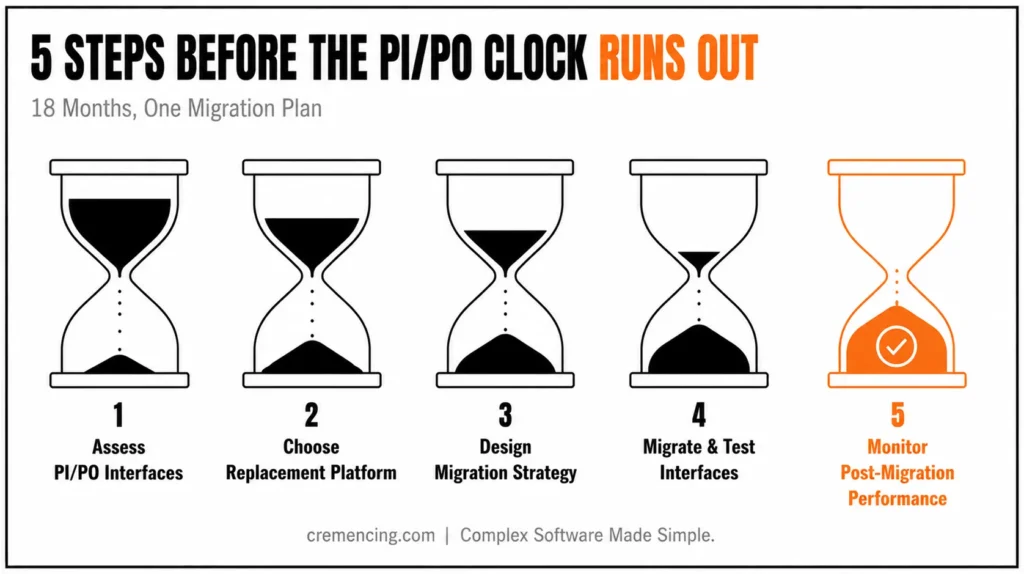
Step 1: Assess Your SAP PI/PO Interfaces
- Take a list of all existing interfaces and workflows.
- Determine custom adapters, mappings, and orchestration flows.
- Evaluate business-critical integrations
Step 2: Choose a Platform to Replace SAP PI/PO
The choices are: SAP Integration Suite, cloud-based integration solutions, or a hybrid. Consider:
- Interoperability with prevailing SAP and third-party applications.
- APIs, REST/SOAP, and event-based integrations.
- Security, scalability and monitoring abilities.
| Criteria | SAP Integration Suite | Third-party iPaaS (e.g., Boomi, MuleSoft) | Hybrid (Integration Suite + iPaaS) |
|---|---|---|---|
| SAP-native connectivity | Native, prebuilt SAP content packages | Requires connectors, often less current | Best of both, more to govern |
| Licensing model | Bundled with BTP consumption | Separate vendor contract | Two contracts to manage |
| Clean Core alignment | Purpose-built for it | Neutral — depends on implementation | Depends on split |
| Non-SAP ecosystem reach | Adequate, SAP-centric | Broader, mature non-SAP connectors | Widest reach |
| Migration effort from PI/PO | Lower (similar mapping concepts) | Higher (different paradigm) | Mixed |
Step 3: Design Your SAP PI/PO Migration Strategy
- Decide between “lift-and-shift” vs. reimplementation
- Make early migration business-critical interfaces.
- Consider rolling out in stages to reduce disturbance.
Step 4: Migrate SAP PI/PO Interfaces and Test
- Redo integration logic on the new platform.
- Carry out intensive unit and integration testing.
- Ensure data integrity and error-processing.
Step 5: Monitor Performance After SAP PI/PO Migration
- Measure performance and error rates after migration.
- Hone-tune mappings, transformations and orchestration rules.
- Introduce governance in order to control changes in the future.
ROI and other benefits of replacing SAP PI/PO
The benefits of migrating to a modern platform of integration are measurable:
- Less Maintenance Expenses: The old PI/PO systems are very expensive to maintain.
- Better Agility: Ability to onboard new applications and services faster.
- Improved Security: New platforms offer effective security measures.
- Operational Efficiency: Real-time monitoring and automation reduce manual intervention
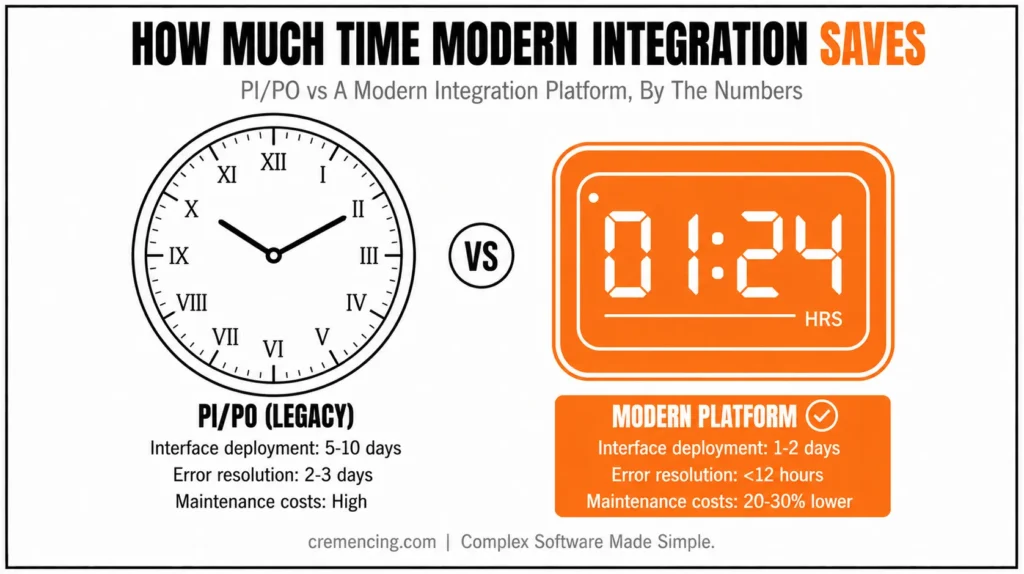
| Metric | PI/PO (Legacy) | Modern Integration Platform | Improvement |
| Interface Deployment Time | 5–10 days | 1–2 days | 80–90% faster |
| Error Resolution Time | 2–3 days | <12 hours | 75% faster |
| Maintenance Costs | High | Lower | 20–30% savings |
| Business Agility | Moderate | High | Significant |
By replacing PI/PO, not only compliance is guaranteed but also organizations are positioned towards growth and digital transformation.
Typical errors and the best practices.
Despite the existence of a developed migration plan, companies do not always have an easy time:
Common Mistakes:
- Missing to inventory all interfaces, resulting in missed dependencies.
- Selecting a bad integration platform without considering the need.
- Misjudging testing time of complicated workflows.
- Not considering change management and staff training.
Best Practices:
- Complete interface audit before migration.
- Prioritize critical business workflows in phased rollout
- Implement rigorous testing and validation for each interface
- Educate train staff about the functionality of the new platform and monitoring software.
- Create governance to govern future integrations and customizations.
Neglected Opportunities Competitors Miss.
Most organizations are only geared towards compliance and fail to realize other advantages:
- API-First Integration: The new platforms are able to integrate with cloud applications faster.
- Event-Driven Architecture: Provides real-time automation of processes.
- Analytics & Monitoring: In-built dashboards provide information on integration performance.
By taking advantage of these opportunities, the migration is not only smooth but it also enhances efficiency and scalability in its operations.
Conclusion
SAP PI/PO has 20 years of solid track record of linking the enterprise systems but the 18-month deadline to replace it cannot be compromised. With the help of a stepwise migration strategy, including system assessment, the selection of the appropriate platform, a plan to get to the next phase, and performance monitoring, organizations can maintain continuity and compliance.
By avoiding some pitfalls, adopting the best practices, and exploring some untapped opportunities such as API first integrations and real- time monitoring, businesses can not only replace PI/PO, but also modernize their integration landscape. The ROI is real: it increases deployments, minimizes errors, enhances security, and increases business agility.
Start planning your SAP PI/PO replacement now to be on time, mitigate risk, and position your enterprise to grow in the future.
Frequently Asked Questions
Q1: What is the reason why SAP PI/PO is being replaced?
There is reaching end-of-life of SAP PI/PO and end of support; therefore, migration is necessary to prevent disruption of the system.
Q2: What are the time limits that organizations have to substitute PI/PO?
Companies have 18 months after the official declaration of end-of-support to move critical integrations.
Q3: Are the existing interfaces reused on the new platform?
Yes, interfaces can frequently be refurbished, but certain mappings and orchestrations might require redesign to suit modern platforms.
Q4: What is the risk of migration delay?
Some of the risks are system downtime of the system, failed integrations, compliance problems, and an increase in the cost of maintenance.
Q5: What are the suggested modern platforms to use instead of SAP PI/PO?
It is typically advised to use SAP Integration Suite, which is a cloud-based middleware solution, or hybrid integration platforms based on business needs.
Q6: Is SAP PI/PO the same as SAP XI?
SAP XI (Exchange Infrastructure) was the earlier name for what became PI, then PI/PO after Process Orchestration was added. If your landscape is still referred to internally as “XI,” it likely predates several upgrade cycles and warrants an especially thorough interface audit before migration.
Q7: Can we keep running PI/PO past 2027 if we don’t migrate in time?
Technically, yes, the software doesn’t stop functioning on the deadline. What stops is SAP’s obligation to patch it: no security fixes, no regulatory updates (including e-invoicing format changes), and no bug fixes, which is a growing compliance and security exposure the longer it continues.
Q8: Does migrating off PI/PO mean we have to move to SAP Integration Suite specifically?
No. SAP Integration Suite is the SAP-recommended successor, but organizations also migrate to third-party iPaaS platforms or hybrid setups, depending on how much of their integration landscape is SAP-to-SAP versus SAP-to-non-SAP.
Resources
Overview of SAP Integration Suite
SAP PI/PO End-of-Support Guidelines
Best Practices of Integration by Gartner





One Response