Is IDoc Still Worth Learning in 2026?
Even in 2026, IDoc in SAP ABAP remains irreplaceable. Even though modern S/4HANA projects favour API-based, OData-based, and event-based integration, thousands of ECC and on-premise S/4HANA landscapes continue to use logistics, finance, and master data exchanges. With expertise in IDoc monitoring, debugging, extensions, and reprocessing, experts support legacy integrations and make informed decisions in the transition to modern integrations.
What makes this question more pointed than it would have been even two or three years ago is SAP’s own Clean Core push. Clean Core asks teams to keep the digital core as close to standard as possible and to build extensions and integrations outside of it wherever feasible. For a while, that left a lot of developers assuming IDoc was being quietly phased out alongside other “classic” technologies.
SAP has since clarified the picture: IDoc has been formally placed under Clean Core’s Level B extensibility classification, meaning it sits alongside other documented, supported classic APIs rather than in the deprecated bucket. Therefore, IDoc is not a temporary band-aid while a migration project gets in front of you; instead, it remains a known and acceptable member of the integration toolkit where needed, and SAP will ensure that it stays stable on upgrades. Moreover, in 2026, IDoc in SAP ABAP is still an indispensable tool.
Modern S/4HANA projects are more likely to benefit from APIs, OData, and event-based integration, although thousands of ECC and on-premise S/4HANA landscapes are still receiving IDoc-based EDI, logistics, finance, and master data. As enterprises move to modern integration practices, IDoc monitoring, debugging, extensions, and reprocessing experts are helping to support legacy integrations and to make informed decisions.
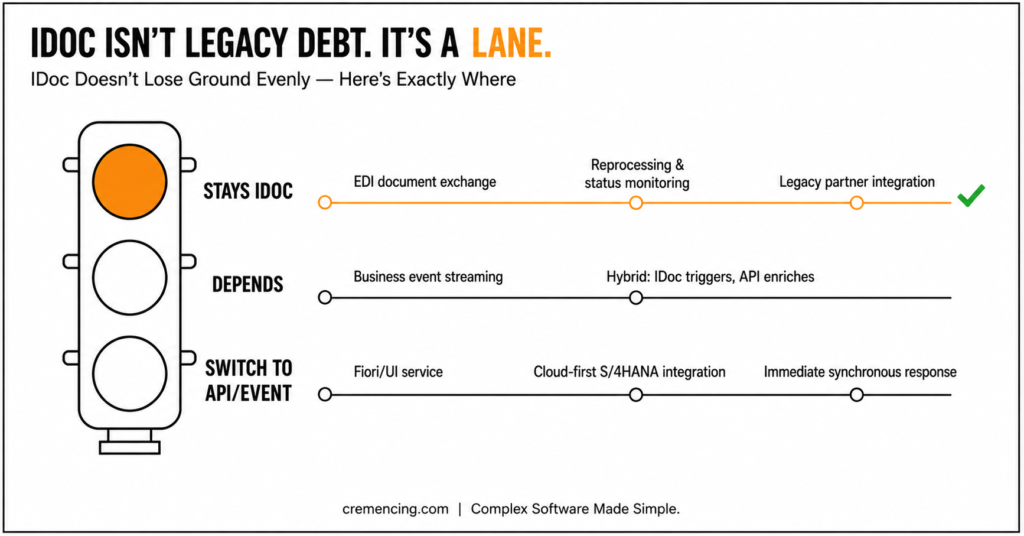
IDoc in SAP: Side-by-Side Comparison Table
| Requirement | Old Way | New Way |
| EDI document exchange | IDoc | IDoc |
| Asynchronous business document processing | IDoc | IDoc |
| Reprocessing and status monitoring required | IDoc | IDoc |
| Immediate synchronous response required | IDoc | BAPI / RFC / API |
| Fiori or UI service | IDoc | OData / RAP service |
| Cloud-first S/4HANA integration | IDoc | Released API / Event / Integration Suite |
| Legacy partner integration | IDoc | IDoc |
| Custom business event streaming | IDoc | Event-based integration |
It’s worth pausing on what this table is actually telling you: IDoc doesn’t lose ground evenly. It holds its position firmly wherever asynchronous processing, audit trails, and mature reprocessing tooling matter, and it gives way specifically where synchronous responses or cloud-native, event-driven patterns are the better fit. That’s a much more nuanced reality than the “IDoc vs. API” framing usually suggests the two aren’t really competing for the same jobs.
Treating IDoc in SAP as the Only Integration Tool
In ECC and early S/4HANA, IDoc was the primary mechanism for integrating SAP with partners. Developers relied on control records, data records, and status records, and evelopers often implemented extensions via custom segments, user exits, or implicit enhancements. Debugging involved tracing messages through WE02/WE05, WE19 testing, and BD87 reprocessing.
CALL FUNCTION ‘IDOC_INBOUND_SINGLE’
EXPORTING
OBJECT_TYPE = ‘DELVRY05’
IDOC_DATA = lt_idoc_data
EXCEPTIONS
OTHERS = 1. ” Generic error handling
Example: Triggering a single IDoc inbound (S/4HANA 1909+ compatible)
While effective, this approach assumed all integrations required IDoc. It ignored newer asynchronous event models, real-time APIs, and clean-core development patterns. Developers often faced complex partner profile management, unclear error handling, and repetitive reprocessing logic.
This is also where most of the real-world pain shows up. Partner profiles (WE20) and ports (WE21) tend to accumulate over the years as partners change systems, teams reuse message types for purposes nobody documents and “temporary” custom segments become permanent fixtures nobody wants to touch. None of that is a flaw in IDoc itself — it’s what happens when an integration pattern is the only tool in the box for a decade. A developer who only learns the happy-path syntax will be lost the first time a partner profile is misconfigured or a segment definition drifts out of sync between sender and receiver. Explore these IDoc SAP ABAP interview questions to understand common interview topics and real-world scenarios.
Using IDoc Where It Still Wins
Today, IDoc remains indispensable for:
- Asynchronous document exchange requiring audit trails.
- EDI transactions with partners maintaining older interfaces.
- Reprocessing scenarios with detailed status codes.
- Integration scenarios where ALE logic, partner profiles, and monitoring are crucial.
” Example: Extend INVOIC01 IDoc with a custom segment
DATA: ls_segment TYPE z_invoic_custom.
ls_segment-field1 = lv_value1.
APPEND ls_segment TO lt_idoc_custom_segments.
CALL FUNCTION ‘IDOC_EXTENSION_ADD’
EXPORTING
BASIC_TYPE = ‘INVOIC01’
SEGMENT_DATA = ls_segment
EXCEPTIONS
OTHERS = 1.
Example: IDoc extension in SAP ABAP (S/4HANA 1909+ required)
Where IDoc in SAP Fits Today
Developers now combine IDoc knowledge with modern patterns. APIs, OData, and event-based services handle real-time integration, while IDoc manages asynchronous, batch, and partner-dependent scenarios. Debugging is now more structured: WE02 → WE20 → Process Code → Function Module → WE19 → Reprocess in BD87.
IDoc Status Codes You’ll Actually See
| Status | Meaning | Typical Next Step |
|---|---|---|
| 51 | Application document not posted (error) | Check error segment in WE02, fix data, reprocess via BD87 |
| 53 | Application document posted successfully | No action — informational |
| 64 | IDoc ready to be transferred to application | Usually auto-processed; check background job if stuck |
| 68 | Error — no further processing | Investigate via WE19 simulation before manual reprocessing |
One pattern worth knowing if you’re modernizing rather than replacing: many teams now pair an IDoc or its successor event with a follow-up OData call to enrich a thin payload. A typical business-partner change, for instance, might fire as a lightweight event carrying just an ID, with a separate API call pulling the full address or master data details afterwards. The result keeps the audit trail and asynchronous reliability IDoc is known for while routing the heavier data-fetching through a released, upgrade-safe API. It’s a useful middle ground for teams under pressure to modernize without a full rip-and-replace of working interfaces.
It’s also worth knowing that monitoring itself has evolved alongside the technology. For newer, API-based interfaces, SAP increasingly points teams toward the Application Interface Framework (AIF) for unified error handling and business-friendly monitoring. IDoc’s own monitoring stack—WE02, BD87, and standard reprocessing—is older, but it’s also deeply familiar to functional consultants who’ve worked with SAP for years, which in practice often means faster issue resolution simply because more people in the room already know how to read it..
That familiarity is itself a reason IDoc skills retain value even as the wider integration architecture modernizes around them. Explore What Makes BAPI the Most Powerful Integration Tool.
Migration Checklist
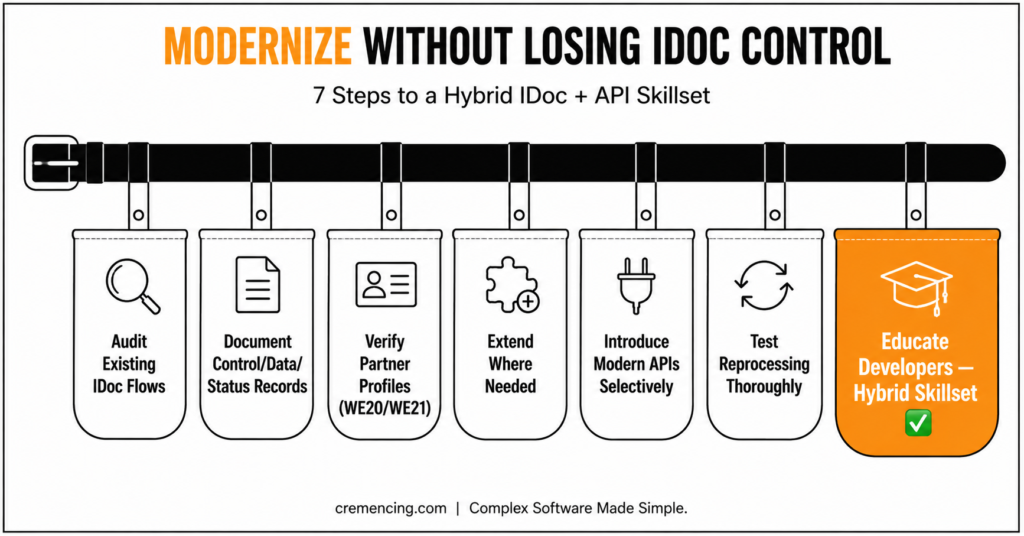
How to Modernize Without Losing IDoc Control
- Audit existing IDoc flows: Identify active ALE/EDI connections.
- Document control, data, and status records: Map to business objects.
- Verify partner profiles: WE20, WE21 configurations.
- Extend or enhance where needed: Custom segments, BAdI, or user exits.
- Introduce modern APIs selectively: For new synchronous or cloud-first services.
- Test reprocessing thoroughly: WE19 foreground, BD87 batch.
- Educate developers: Maintain hybrid skillset: IDoc + API/Events.
Before running through that checklist on a live landscape, it helps to know where each interface is likely to land on SAP’s clean-core extensibility scale. Interfaces using only released APIs and standard extension points sit at the cleanest end; IDoc-based interfaces using documented classic technology sit a notch below that but are still considered safe; interfaces poking directly at SAP-internal objects or relying on modifications sit at the riskiest end and are the ones that should actually be prioritized for rework. R
unning an honest audit against that scale, rather than assuming “IDoc equals legacy debt equals must replace,” tends to produce a far more realistic and far less expensive migration roadmap.
Conclusion
IDoc in SAP ABAP remains a critical skill in 2026. It supports asynchronous business document flows, partner-specific EDI, status monitoring, reprocessing, and auditing. Developers who understand the IDoc lifecycle, extensions, debugging, and partner configuration stay indispensable, even as APIs and events become standard for cloud-first integration. The modern ABAP developer combines IDoc mastery with API judgment, ensuring seamless hybrid landscapes.
None of this means IDoc is standing still, though. SAP continues to invest in tooling around it rather than away from it migration assessment reports now flag which IDoc-based interfaces have a sensible event or API successor and which genuinely don’t, and Clean Core ATC checks are starting to surface IDoc usage in the same governance conversations as custom code and modifications.
That’s a meaningful shift: IDoc is being managed as a first-class citizen of the integration landscape, with the same scrutiny and lifecycle planning applied to it as anything else, rather than being left to age quietly in the background until something breaks. Clean Core ATC checks are starting to surface IDoc usage in the same governance conversations as custom code and modifications.
For developers, the practical takeaway is to stop treating “IDoc” and “API/event” as a binary career choice. The interfaces that will matter most over the next few years are the hybrid ones: an inbound IDoc that triggers an event, an event that gets enriched through an OData call, and a legacy EDI partner sitting alongside a brand-new BTP integration flow.
Frequently Asked Questions
Q1: What is an IDoc in SAP ABAP?
An IDoc (intermediate document) is a structured container for business data used in SAP-to-SAP or SAP-to-non-SAP integration, storing control, data, and status records.
Q2: How do I debug IDocs in SAP ABAP?
Use WE19 to simulate, WE02/WE05 to monitor, follow process codes, and trace to the inbound/outbound function module.
Q3: Can I extend IDocs without modifying SAP standards?
Yes, using custom segments, enhancement BAdIs, or user exits. (Next up: BAdI vs User Exit vs Enhancement Point in SAP ABAP)
Q4: Which t-codes are essential for IDoc management?
WE02, WE05 (display), WE19 (test), BD87 (reprocess), WE20 (partner profile), WE21 (ports).
Q5: Is IDoc obsolete in S/4HANA?
No. It remains essential for legacy interfaces, EDI, and asynchronous processes. However, APIs and events are increasingly used for cloud-first and real-time requirements. Furthermore, SAP has confirmed this by classifying IDoc under its Clean Core extensibility framework rather than its deprecated technology list.
Q6: What is ALE in SAP ABAP?
ALE (Application Link Enabling) facilitates distributed SAP system integration using IDocs for asynchronous document exchange.
Q7: How do IDoc extensions differ from enhancements?
Extensions add custom segments; enhancements modify or populate data via BAdIs or user exits.
Q8: Are IDoc skills still tested in interviews?
Yes, IDoc in SAP ABAP interview questions often cover debugging, extensions, ALE, partner profiles, and reprocessing.