Can the database do this before my code even sees it? ” In the old ECC days, ABAP developers never had to ask that question, and it didn’t matter. You could write good reports, joins, ALV, BAPIs, enhancements, and forms using simple internal table logic, and that was enough. Not anymore. On SAP NetWeaver 7.50+ and SAP S/4HANA 1909+, ABAP for SAP HANA 2.0 asks for something different: knowing when your logic should stay in ABAP and when it should move closer to the database. Get this wrong, and your “correct” code turns into the slowest part of the system, and you won’t even know why
Why ABAP for SAP HANA 2.0 Changes the Developer Role
ABAP for SAP HANA 2.0 turns a good ABAP developer into a stronger one by changing the unit of thinking. You stop writing ABAP that pulls large data into memory first. You design Open SQL, CDS, and AMDP so the database processes set-based logic before ABAP receives the result.
This is why SAP ABAP on HANA jobs often expect more than normal report writing. A developer who understands HANA-ready ABAP can review custom code, reduce data movement, build reusable data models, and explain performance choices to technical and functional teams.
The key is not to replace ABAP with database code everywhere. The key is to know the boundary. ABAP still owns orchestration, business flow, UI handling, validations, authorizations, and integration calls. SAP HANA should handle set-based data processing when the logic fits SQL, and the result volume can shrink before reaching the application server.
Classic ABAP, But Not HANA-Ready
A good classic ABAP developer often writes correct code that still wastes HANA’s strengths. The old style reads many rows from the database into an internal table, loops in ABAP, calculates totals, and deletes unwanted records later. That style may work in a small ECC test system, but it becomes expensive when production data grows.
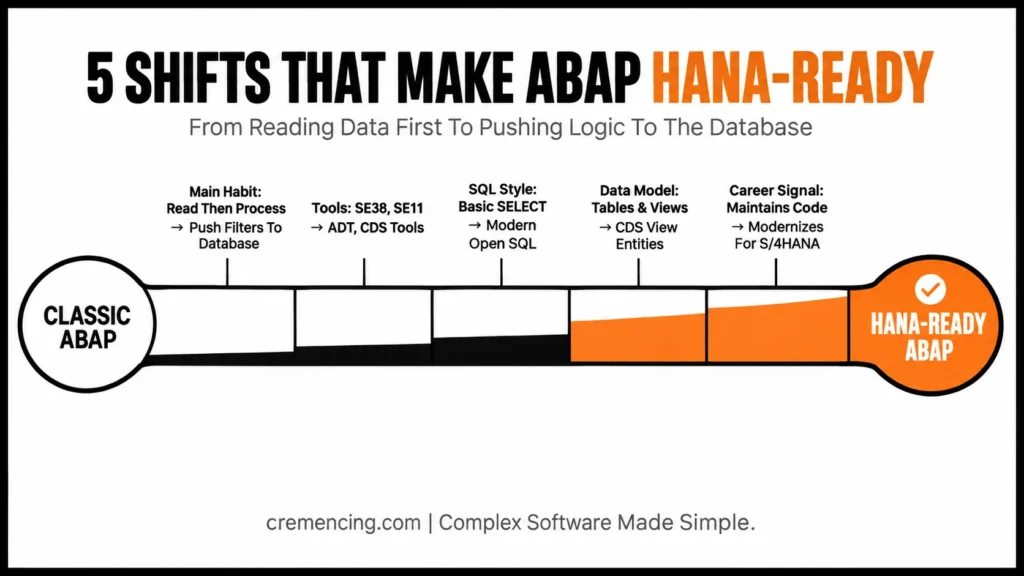
Old ABAP vs. Modern HANA-Optimized ABAP
| Comparison Point | Old Way | New Way |
|---|---|---|
| Main Habit | Read data first, process later in ABAP | Push filters, joins, grouping, and calculations closer to SAP HANA |
| Main Tools | SAP GUI, SE38, SE80, SE11 | ADT, CDS tools, SQL console, debugger, profiler |
| SQL Style | Basic SELECT, then internal table logic | Modern Open SQL with joins, expressions, aggregation, and host variables |
| Data Modeling | Tables and SE11 views | CDS views, CDS view entities, associations, annotations |
| Complex DB Logic | ABAP loops and nested reads | AMDP or CDS table functions when SQLScript is justified |
| Performance Check | Runtime guess, SAT, ST05 after issue | Trace early, compare row counts, check pushed-down operations |
| Career Signal | “Can write ABAP reports” | “Can design HANA-aware ABAP that scales on S/4HANA.” |
| Certification Path | ABAP basics first | ABAP basics + SAP HANA concepts + CDS + AMDP + performance tools |
| Interview Focus | ALV, BDC, BAPI, exits | Open SQL, CDS, AMDP, code pushdown, ST05, SQL Monitor |
| Job Value | Maintains classic code | Modernizes custom code for S/4HANA and HANA-backed systems |
Here is a simple old-style example. The code selects flight rows, loops in ABAP, filters by currency, and sums seats in the application server.
REPORT z_old_abap_hana_style.
TYPES: BEGIN OF ty_flight,
carrid TYPE sflight-carrid, ” Airline carrier
connid TYPE sflight-connid, ” Flight connection
currency TYPE sflight-currency, ” Currency key
seatsocc TYPE sflight-seatsocc, ” Occupied seats
END OF ty_flight.
DATA lt_flights TYPE STANDARD TABLE OF ty_flight WITH EMPTY KEY. ” Raw database rows
DATA ls_flight TYPE ty_flight. ” Work area
DATA lv_total TYPE i. ” ABAP-side total
SELECT carrid,
connid,
currency,
seatsocc
FROM sflight
INTO TABLE @lt_flights. ” Reads all rows before business filter
LOOP AT lt_flights INTO ls_flight. ” Processes row by row in ABAP
IF ls_flight-currency = ‘USD’. ” Filter happens after database read
lv_total = lv_total + ls_flight-seatsocc. ” Sum happens in ABAP memory
ENDIF.
ENDLOOP.
WRITE: / ‘Occupied seats for USD flights:’, lv_total.
How to Validate Code Pushdown with ST05
- Trace the classic program.
- Record the SQL statement and rows returned.
- Run the optimized Open SQL version.
- Compare database calls.
- Compare rows transferred.
- Confirm that filtering and aggregation happen before data reaches ABAP.
| Area | Classic ABAP | HANA-Ready ABAP |
|---|---|---|
| Filtering | ABAP loop | Database |
| Aggregation | ABAP | SQL |
| Rows transferred | Many | Reduced |
| ABAP memory | Higher | Lower |
| Main technique | Internal tables | Code pushdown |
| Validation | Often after issue | ST05 during development |
Why Classic ABAP Practices Fall Short on HANA
This is not “bad ABAP” from an old ECC mindset. It is readable, easy to debug, and correct for small data sets. The limitation is that the database sends more rows than needed to the ABAP server.
On SAP HANA, the database is designed to process large sets of data efficiently. If the filter and aggregation can run in SQL, pushing that work to the database reduces data transfer and ABAP memory usage. That matters in custom reports, interfaces, analytics, and S/4HANA migration work.
The old approach also hides the real performance issue. A developer may optimize the loop, sort the internal table, or replace a work area with field symbols while the higher cost remains the same: too much data is moved out of the database. That is why SAP ABAP on HANA tutorial content must teach design decisions, not only syntax.
The second old habit is treating CDS and AMDP as advanced topics that only specialists use. In modern S/4HANA systems, CDS is not optional knowledge for serious ABAP developers. It supports reusable data models, service exposure, analytics, Fiori elements, and clean data-access patterns. Understanding classic function modules in SAP ABAP helps developers decide when to modernize existing business logic.
The third old habit is using ST05 only after someone reports a slow program. ST05 is the SQL trace transaction used to inspect database calls made by ABAP programs. A HANA-ready developer uses tracing and row-count checks during development, not only during production firefighting.
ABAP for SAP HANA 2.0 Skills That Make You Hard to Replace
The new approach starts with a simple question: “Can the database reduce this data before ABAP receives it?” If yes, use modern Open SQL, CDS, or AMDP depending on the case. This is the core of ABAP for SAP HANA 2.0 development.
Here is the same example written with a HANA-ready Open SQL pattern.
REPORT z_new_abap_hana_style.
DATA lv_total TYPE i. ” Aggregated result from database
SELECT SUM( seatsocc )
FROM sflight
WHERE currency = @CONV sflight-currency( ‘USD’ ) “Filter runs in database
INTO @lv_total. ” Only total comes to ABAP
IF sy-subrc <> 0. ” Check whether result exists
WRITE: / ‘No matching flight data found.’.
RETURN.
ENDIF.
WRITE: / ‘Occupied seats for USD flights:’, lv_total.
This version sends the filter and aggregation to the database. ABAP receives one result instead of a full internal table. That is the practical meaning of code pushdown.
Modern Open SQL should be your first option when the logic is still readable in ABAP SQL. Use CDS when the data model should be reused by reports, services, analytics, or other CDS views. Use AMDP when the logic needs SAP HANA SQLScript and cannot be expressed cleanly with Open SQL or CDS.
CDS example
A CDS example gives you a reusable structure. It can model the filtered and grouped result once, then multiple consumers can reuse it.
@AccessControl.authorizationCheck: #NOT_REQUIRED
@EndUserText.label: ‘Occupied seats by carrier for USD flights’
define view entity ZI_FlightSeatUsd
as select from sflight
{
key carrid as CarrierId,
sum( seatsocc ) as OccupiedSeats
}
where currency = ‘USD’
group by carrid
Use AMDP only when you need database-specific logic. AMDP stands for ABAP Managed Database Procedures. It lets ABAP manage and call database procedures, while the implementation runs in SAP HANA SQLScript. Performance tuning is a big part of this see Open SQL vs Native SQL: Which one is silently wrecking your ABAP performance.
CLASS zcl_flight_amdp DEFINITION
PUBLIC
FINAL
CREATE PUBLIC.
PUBLIC SECTION.
INTERFACES if_amdp_marker_hdb. ” Marks class as HANA AMDP-enabled
TYPES: BEGIN OF ty_result,
carrid TYPE sflight-carrid, ” Carrier ID
occupied_cnt TYPE i, ” Aggregated seat count
END OF ty_result.
TYPES tt_result TYPE STANDARD TABLE OF ty_result WITH EMPTY KEY.
CLASS-METHODS get_usd_seats
RETURNING VALUE(rt_result) TYPE tt_result. ” Result returned to ABAP
ENDCLASS.
CLASS zcl_flight_amdp IMPLEMENTATION.
METHOD get_usd_seats
BY DATABASE PROCEDURE
FOR HDB
LANGUAGE SQLSCRIPT
OPTIONS READ-ONLY
USING sflight.
rt_result =
SELECT carrid,
SUM( seatsocc ) AS occupied_cnt
FROM sflight
WHERE currency = ‘USD’
GROUP BY carrid;
ENDMETHOD.
ENDCLASS.
When to Use Open SQL vs CDS vs AMDP
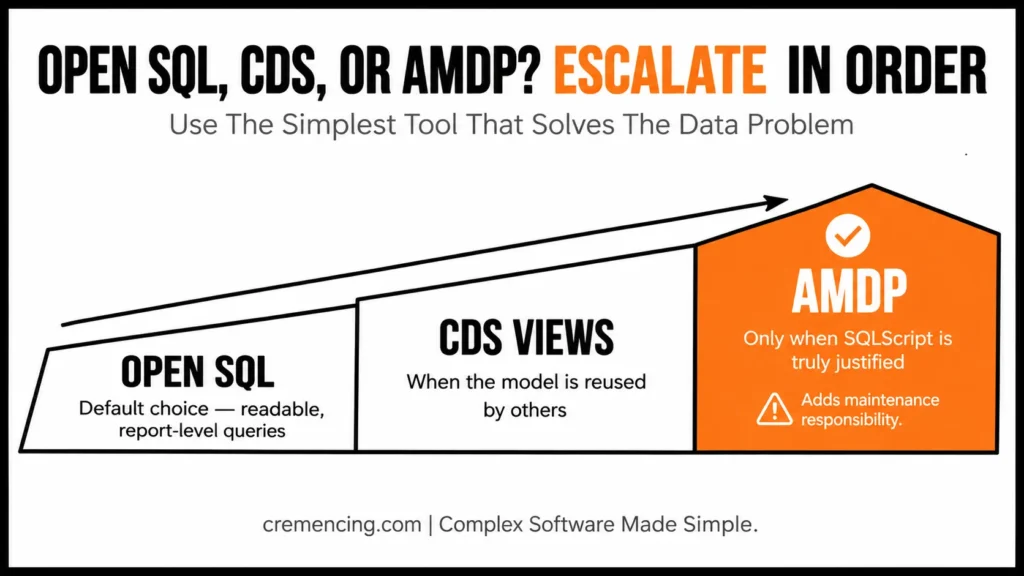
AMDP gives control when SQLScript is the right tool, but it also adds maintenance responsibility. You need ADT, AMDP debugging, AMDP profiling, SQLScript knowledge, and stronger test discipline. Do not move logic into AMDP just because it sounds advanced.
The developer who becomes hard to replace is not the one who uses CDS or AMDP everywhere. It is the one who can explain why Open SQL is enough in one case, why CDS is better in another, and why AMDP is justified only for database-heavy logic. That judgment is what SAP ABAP on HANA training should build.
Focus on the following concepts for ABAP on HANA SAP certification preparation: SAP HANA fundamentals, Open SQL enhancements, CDS data modeling, AMDP, code pushdown, performance analysis, and ADT tooling. Understanding modern ABAP development also requires strong knowledge of core concepts like function modules in SAP ABAP, which remain important for building reliable and professional SAP programs.
Migration Checklist — From Classic ABAP to ABAP on HANA
Use this checklist when upgrading your own skill set or reviewing old custom code for SAP HANA.
- Find reports that select large tables and process most logic in internal table loops. Check whether filters, joins, aggregation, and calculations can move into Open SQL or CDS.
- Replace SELECT * with field-specific selects. This reduces data transfer and makes intent clearer.
- Review nested SELECT inside loops. Use joins, FOR ALL ENTRIES carefully, or CDS models when the relationship is reusable.
- Build CDS views for data models that multiple reports, services, or analytics need. Do not create CDS views for every one-line query.
- Use AMDP only when Open SQL or CDS cannot express the logic cleanly. Keep SQLScript code isolated and tested.
- Learn ADT because CDS, AMDP, profiling, and HANA-oriented development rely heavily on Eclipse-based tooling.
- Trace before and after refactoring. Use ST05, SQL Monitor where available, and ADT profiling tools to check actual database calls.
- Prepare for SAP ABAP on HANA interview questions by explaining why you changed a design, not only what syntax you used.
This migration is not only technical. It is also a career shift. Classic ABAP proves that you can build. ABAP on HANA proves that you can redesign data access for modern SAP systems.
Conclusion
ABAP for SAP HANA 2.0 makes a developer more valuable because it changes how they design data access. A good developer can write correct ABAP. An irreplaceable one knows when to use open SQL, CDS, AMDP, ADT tools, traces, and code pushdown. Although CDS Views are central to HANA development, they still build upon concepts introduced in the SAP Data Dictionary.
Learn ABAP that is ready for HANA, not as a list of buzzwords. Reducing data early, modelling reusable data with CDS, using AMDP only when necessary, and demonstrating performance with tools should all be routine. That is the distinction between maintaining out-of-date custom code and leading modernization efforts for S/4HANA.
This shift pairs closely with upgrade planning practices for the HANA database layer
Frequently Asked Questions
1. What is ABAP for SAP HANA?
ABAP development using modern Open SQL, CDS views, AMDP, ABAP development tooling (ADT), and code pushdown is referred to as ABAP for SAP HANA 2.0. It is not a replacement for ABAP. It moves the data-heavy operations logic from the data source to a different location.
2. What is code pushdown in ABAP?
Code pushdown refers to the transfer of appropriate data processing from the ABAP application server to the SAP HANA database. Utilizing Open SQL filters, joins, grouping, and aggregation before moving on to CDS or AMDP is a good practice idea for the SAP ABAP on HANA tutorial.
3. When should I use Open SQL, CDS, or AMDP?
Use Open SQL for proper report-level queries, CDS for reusable data models, and AMDP for HANA SQLScript logic. This is more important than memorizing the syntax for the SAP ABAP on HANA training. Use the simplest tool to solve the data problem.
4. Is AMDP always better than ABAP logic?
No, AMDP is not always better than ABAP logic. Use AMDP when database-side SQLScript solves a data-heavy problem that Open SQL or CDS cannot express clearly. AMDP also needs ADT, SQLScript skills, testing, and performance validation.
5. What is the ABAP on HANA SAP certification?
ABAP on HANA SAP certification usually refers to certification paths that validate ABAP development knowledge for SAP HANA-based systems. Check SAP Learning for current exam availability, because certification codes and retirement dates can change.
6. What is the difference between a CDS association and a JOIN?
A JOIN combines data directly in the current CDS query. An association models a reusable relationship between CDS entities and can be followed through path expressions. Associations also require appropriate cardinality modeling, so they should represent the actual business relationship rather than simply replace every JOIN.
7. What is DCL in ABAP CDS?
DCL, or Data Control Language, defines authorization rules for CDS entities. It allows developers to restrict which records a user can read based on access conditions and authorization information. CDS access controls work alongside the classical ABAP authorization model.
8. Can I use CDS view entities in ABAP Cloud?
Yes, but the source and consumed repository objects must satisfy the applicable ABAP Cloud release and language-version rules. In restricted ABAP development, developers generally consume appropriately released APIs and CDS view entities rather than arbitrary unreleased SAP objects.