

SAP ABAP Developers who want a rewarding long-term career in 2026 need more than strong coding fundamentals. As SAP environments continue evolving from ECC toward S/4HANA, ABAP Cloud, RAP, CDS, and BTP-based extensions, developers need to expand their technical skills to stay relevant and move into higher-value roles.
The shift is technical, not cosmetic. Modern SAP development increasingly combines CDS view entities, RAP, released APIs, ADT, clean-core extension patterns, and BTP integration. SAP itself defines CDS, RAP, the cloud-optimised ABAP language, released interfaces, and ADT as core elements of the ABAP Cloud model.
That changes the career roadmap. The goal is no longer to collect as many transactions, function modules or legacy techniques as possible. It is to build enough classic ABAP depth to understand SAP’s transactional foundation, then add the modern skills required to develop upgrade-conscious applications and extensions across today’s mixed SAP landscapes.
It is essential to comprehend the SAP ABAP Developer’s Career Path in order to remain competitive. Developers need a structured roadmap covering ECC → S/4HANA → ABAP Cloud, including hybrid and API integration skills. Assuming long-term opportunities in SAP Labs, global corporations, and consulting roles, career advancement depends on adding value to core SAP processes and expanding the system with modernization tools.
Why SAP ABAP Developers Still Have a Strong Career in 2026
ABAP continues to be essential because SAP’s transactional core is built on it. Core logic, LUW handling, authorization checks, and system stability rely on ABAP objects. ABAP remains central to transactional business logic in SAP systems, while ABAP Cloud adds stricter language rules, released APIs, and lifecycle-stable extension contracts intended to reduce upgrade risk.
In ABAP Cloud development, custom code is restricted to supported language elements and released APIs or extension points instead of arbitrary access to SAP implementation objects. Classic extensibility remains technically available in applicable on-premises and private-cloud landscapes, but tighter coupling increases lifecycle and upgrade risk. In addition to maintaining the integrity of the data, this positions ABAP programmers as strategic architects for enterprise systems. Why Every Developer is Adopting SAP AI
Hybrid experience across ABAP, S/4HANA, APIs, and cloud-extension patterns can broaden the range of technical roles a developer can pursue. Compensation, however, varies substantially by country, industry, project responsibility, consulting model and seniority.
Experience matters: developers with five or more years of S/4HANA and ABAP Cloud experience are more likely to attain leadership roles and higher pay, while those focusing only on ECC legacy skills risk plateauing. For more insights into why ABAP remains powerful.
Step-by-Step ABAP Developers Career Roadmap
For SAP ABAP Developers, the most practical career path is to strengthen classic ABAP fundamentals first, then build S/4HANA and cloud-development expertise.
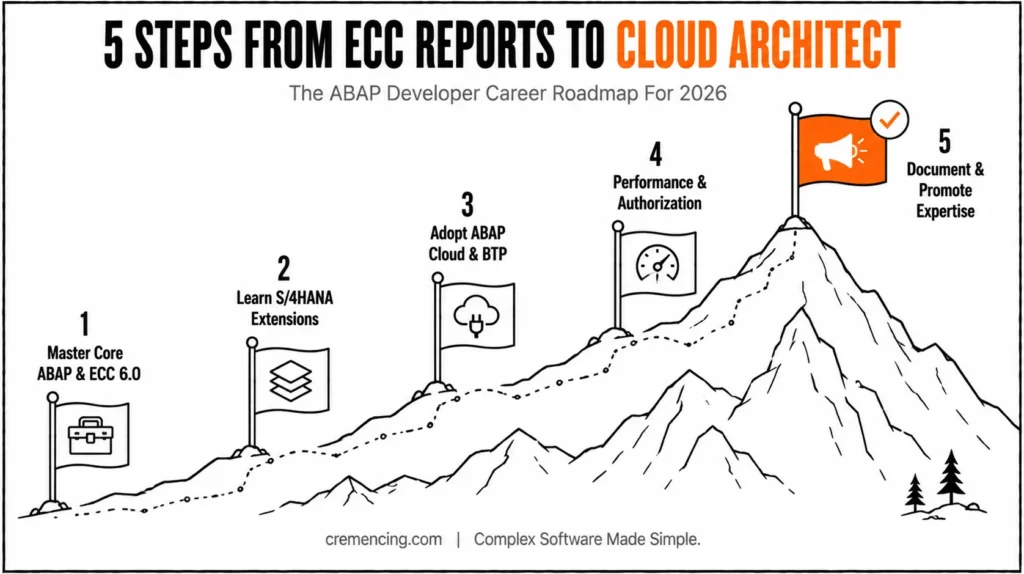
Step 1: Master Core ABAP and ECC 6.0
DATA lv_matnr TYPE mara-matnr.
DATA lv_desc  TYPE makt-maktx.

SELECT SINGLE
       m~matnr,
       t~maktx
  FROM mara AS m
  INNER JOIN makt AS t
    ON t~matnr = m~matnr
  WHERE m~matnr = '10000001'
    AND t~spras = @sy-langu
  INTO (@lv_matnr, @lv_desc).

WRITE: / lv_matnr, lv_desc.- Understand transactional logic, LUW, and authorisation checks.
- Learn ECC reporting, function modules, IDocs, and BAdIs.
- Establish a foundation for S/4HANA and hybrid development.
Step 2: Learn S/4HANA Extensions
@AccessControl.authorizationCheck: #CHECK
@EndUserText.label: 'Material with description'

define view entity ZI_Material
  as select from mara as m
    left outer join makt as t
      on  t.matnr = m.matnr
      and t.spras = $session.system_language
{
  key m.matnr as Material,
      t.maktx as MaterialDescription
}- CDS views provide semantic layers, access control, and analytics readiness.
- Learn RAP for transactional applications.
- Focus on upgrade-safe, clean core solutions.
Step 3: Adopt ABAP Cloud and BTP Integrations
DATA(lo_http_client) = cl_http_client=>create_by_destination(‘Z_PYTHON_SERVICE’).
lo_http_client->request->set_method( if_http_request=>co_request_method_post ).
lo_http_client->request->set_cdata(‘{“order”:”5001″}’).
lo_http_client->send( ).
lo_http_client->receive( ).
WRITE: / lo_http_client->response->get_cdata( ).
- Microservices in Python or Java can be integrated with ABAP.
- Build Fiori apps or API services side-by-side.
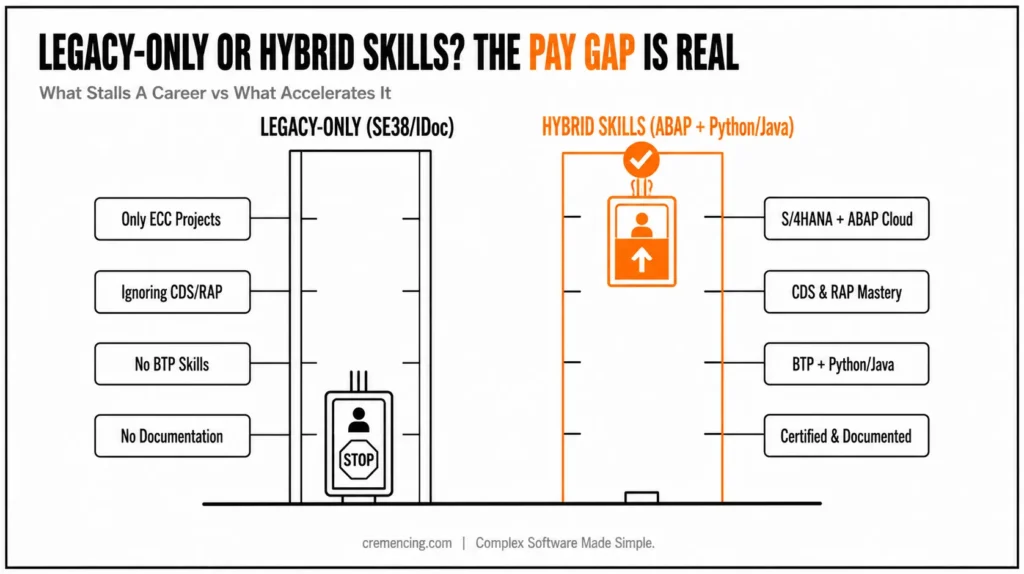
- Hybrid skills increase salary and leadership opportunities.
Side-by-side development also requires familiarity with the tooling used to build, test and deploy applications on SAP BTP.
Understand the Three Development Contexts
Modern SAP ABAP Developers need to understand more than traditional reports and function modules. An ABAP developer should be able to distinguish three environments before choosing an implementation technique:
| Development context | Typical approach | What the developer must understand |
|---|---|---|
| ECC / classic SAP ERP | Standard ABAP | Reports, enhancements, BAdIs, IDocs, RFCs, classic Open SQL and existing custom code |
| S/4HANA on-premise / Private Edition | Standard ABAP + ABAP Cloud where supported | Existing custom code plus CDS, RAP, released APIs, ATC and clean-core classification |
| S/4HANA Cloud / BTP ABAP Environment | ABAP Cloud | ADT, released APIs, CDS view entities, RAP, restricted language scope and cloud-compatible integration |
SAP explicitly distinguishes Standard ABAP from the ABAP for Cloud Development language version, with the latter restricting syntax and object access to support cloud-ready development.
A senior developer should therefore be able to answer a question more important than “Can ABAP do this?”:
“Is this object and technique released and appropriate for this extension model?”
That distinction is central to clean-core development. Python or Java becomes valuable when the architecture requires services outside the ABAP transactional layer.
Step 4: Expertise in Performance and Authorization
Do not reduce performance expertise to FOR ALL ENTRIES, ST22 and SM37. A senior ABAP developer should know how to determine whether a bottleneck is caused by SQL, ABAP execution, internal-table access, RFC calls, locks or workload characteristics before modifying the code.
Build practical competence with:
- ST05 for SQL and related trace analysis in classic/on-premise systems.
- SAT for ABAP runtime analysis.
- ST12 where available for combined ABAP/SQL investigation.
- SQLM for longer-running SQL usage analysis.
- ATC for static quality, S/4HANA readiness and cloud-readiness checks.
For internal tables, choose the table category according to the dominant access pattern. Standard-table key access is normally linear, sorted-table key access is binary, and hashed-table access uses hashing. SAP’s ABAP documentation explicitly distinguishes these behaviours.
Step 5: Write down your expertise and promote it.
- Maintain contributions in clean core, RAP, CDS, and BTP projects.
- Showcase hybrid skills and certifications.
- Use the portfolio for salary negotiation and career advancement.
How to Verify Career Progress
- Compare skills and experience using SAP Labs and global market benchmarks.
- Use LinkedIn and Glassdoor to measure ABAP developer salary by region.
- Track performance in modernization projects, cloud integrations, and hybrid roles.
SAP ABAP developers who combine technical depth with integration and architecture skills can take on broader responsibilities.
ABAP Skills to Maintain vs Skills to Add
| Skill | Maintain | Add/Deepen for 2026 | Why |
|---|---|---|---|
| Open SQL | ✓ | ✓ | Still fundamental, but modern syntax/data models matter. |
| Function modules/RFC | ✓ | Important for existing landscapes | |
| IDoc/BAdI | ✓ | Still common in legacy/integration work | |
| CDS view entities | ✓ | Current semantic data-modeling approach | |
| RAP | ✓ | Strategic transactional programming model | |
| ADT/Eclipse | ✓ | Primary development environment for ABAP Cloud | |
| Released APIs | ✓ | Required for lifecycle-stable ABAP Cloud development | |
| ATC | ✓ | ✓ | Important for modernization and cloud-readiness |
| BTP integration | ✓ | Supports side-by-side extension scenarios | |
| Python/Java | Optional | Optional | Useful when architecture requires non-ABAP services |
Mistakes That Stall ABAP Careers
- Only working on legacy SE38/IDoc projects.
- Ignoring CDS, RAP, and clean core paradigms.
- Avoid BTP hybrid skills, Java, or Python.
- Not documenting experience or earning certifications.
Conclusion
The most valuable SAP ABAP developers in 2026 will be those who can connect traditional ABAP expertise with modern S/4HANA and cloud development.
Modernizing professionals, cleaning up core compliance, and participating in cloud projects are the ones who can get better salaries, leadership, and global opportunities. A structured roadmap from ECC to S/4HANA to ABAP Cloud keeps your career future-proof, relevant, and strategically valuable. For more insights on ABAP developer salary.
Furthermore, developers who continually invest in their skills by acquiring new knowledge, such as learning RAP-based transactional apps, CDS for semantic modeling, and BTP integration skills, become important players in SAP transformation projects.
By being actively involved in SAP modernization projects, creating side-by-side Fiori applications, and showcasing your skills and expertise in hybrid integration, you are more likely to be sought after as a consultant or expert in-house.
Through documentation, relevant certificates, and keeping up to date with SAP Notes and community best practices, ABAP developers are able to maximize their career development, therefore their salary, and effectively lead complex S/4HANA projects with confidence.
The ABAP career path for 2026 is not just about coding; it’s about strategic positioning, ABAP modernization leadership, and hybrid technical skills. Read more on ABAP Tutorial
Those who have deep knowledge of SAP transactions, as well as comprehensive cloud and orchestration skills, are likely to be the ones with the greatest influence on innovation, mentoring teams and enterprise architecture for years to come.
FAQs
Is ABAP a good career choice in 2026?
Yes, ABAP remains essential for SAP core and S/4HANA modernization. Hybrid skills improve pay and career prospects.
What is the ABAP developer roadmap for 2026?
ECC is the first step, followed by master S/4HANA extensions, ABAP Cloud, and BTP integrations. Include CDS, RAP, and API skills.
How do I move from ECC ABAP to S/4HANA Cloud?
Learn about CDS views, RAP objects, and the development of ABAP Cloud. Avoid direct table modifications; focus on released APIs.
ABAP career progression for hybrid roles?
Hybrid ABAP + Python/Java developers lead modernization and cloud projects, often earning higher salaries.
Is ABAP a good career choice?
Yes, especially when combined with S/4HANA, cloud extensions, and hybrid skills for modernization projects.
Is ABAP Cloud replacing classic ABAP?
No. ABAP Cloud is a restricted development model intended for cloud-ready, lifecycle-stable development. Standard ABAP remains relevant in ECC and applicable S/4HANA on-premise/private-edition scenarios, particularly for existing custom code.
Should an ABAP developer learn RAP in 2026?
Yes, if the goal includes modern transactional application development. RAP is SAP’s current programming model for building transactional services and business objects in ABAP Cloud.
Do ABAP developers still need to learn CDS?
Yes. CDS remains a core part of SAP’s modern ABAP data-modeling architecture. For new development, developers should specifically understand CDS view entities, which SAP recommends over obsolete DDIC-based CDS views.
Do ABAP developers need Python or Java?
Not necessarily. They are complementary skills rather than replacements for ABAP. Learn them when your role involves BTP services, external APIs, automation, AI workloads or side-by-side applications.
What is the biggest skill gap for an ECC ABAP developer moving to S/4HANA?
Usually the gap is architectural rather than syntactic: CDS, RAP, ADT, ATC, released APIs, clean-core principles and understanding which classic techniques remain appropriate in the target S/4HANA deployment model.