
ABAP is still used in critical batch jobs, reporting, IDocs, BAdIs, enhancements, and other areas of ECC 6.0 legacy systems. RAP, CDS views, and released APIs are now included in S/4HANA and ABAP Cloud, enabling developers to create upgrade-safe extensions while adhering to clean core rules. In order to guarantee data integrity, authorization enforcement, and upgrade compatibility, SAP’s transactional logic is still anchored in ABAP.
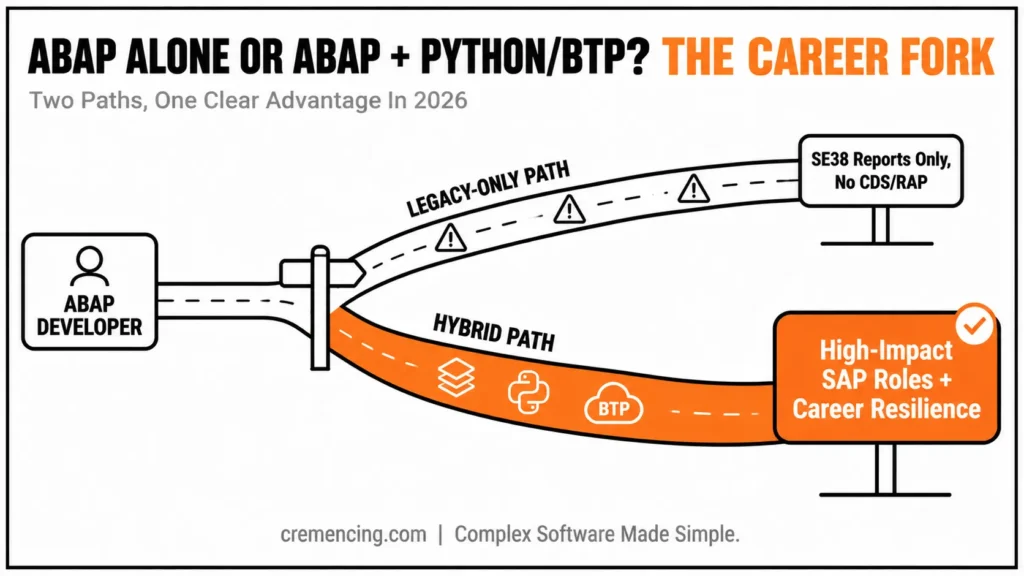
Instead of just maintaining legacy systems, learning ABAP today is about becoming a strategic link between SAP’s core logic and modern extensions like Python integration, SAP AI Core, and BTP orchestration. Using cutting-edge automation and analytics tools, SAP’s critical logic is managed by developers with ABAP expertise. In 2026, you’ll be prepared for high-impact SAP roles and career resilience with this hybrid skill set.
Why Learning ABAP In 2026 Remains The Secretly Powerful Career Weapon
Despite rapid enterprise cloud migration, ABAP expertise remains a critical high-value skill due to its transformation into ABAP Cloud and the ABAP RESTful Application Programming Model (RAP). As global enterprises face the 2027 mainstream maintenance deadline for legacy SAP ECC systems, the demand for developers who can execute Clean Core custom code remediation and build upgrade-safe S/4HANA extensions has surged.
Modern ABAP moves away from procedural modifications, using released APIs, Core Data Services (CDS), and OData endpoints to co-locate high-performance business logic directly alongside in-memory transactional data. This evolution allows ABAP developers to build side-by-side and in-app extensions that bridge legacy ERP operations with modern cloud platforms like SAP BTP, making them essential architects for enterprise digital transformations.
Why does this occur?
Because SAP’s transactional core is built on it, ABAP remains relevant. Business logic, LUW (Logical Unit of Work) management, and authorization enforcement are tightly coupled to ABAP objects.
Despite the proliferation of Python, JavaScript, and AI tools, neither S/4HANA’s upgrade-safe guarantee nor ABAP’s deep system hooks are available. S/4HANA clean core principles discourage modifying standard logic or tables. Instead, developers rely on released APIs, CDS views, and RAP/BOPF behavior definitions for extensions.
| Skill Area | Classic ABAP Focus | Modern 2026 Focus |
|---|---|---|
| Development | Reports, enhancements, function modules | RAP, APIs, cloud-ready extensions |
| Data | ABAP SQL, DDIC tables | CDS view entities, semantic models |
| UI/API | Dynpro, classic interfaces | OData, RAP services, Fiori |
| Extensibility | Modifications/enhancements | Released APIs and Clean Core |
| IDE | SAP GUI/SE80 | ADT in Eclipse |
| Integration | RFC, IDoc, traditional interfaces | APIs, BTP services, event/integration patterns |
| Deployment | Traditional transports | Cloud-compatible lifecycle and supported development models |
| Career value | Maintenance and existing landscapes | Modernization + new development + integration |
This ensures upgrade compatibility and data consistency while allowing external integrations to extend SAP’s capabilities without touching core objects. ABAP’s evolution has preserved backward compatibility while supporting modern integration points.
Data preprocessing, orchestration, and artificial intelligence are handled by Python, JavaScript, or other external tools. As the foundation for SAP applications, ABAP maintains transactional integrity. Having a working knowledge of ABAP ensures that modernization efforts preserve both business continuity and technical integrity.
ABAP continues to safeguard transactional integrity, acting as the backbone for SAP applications. Having a working knowledge of ABAP ensures that modernization efforts preserve both business continuity and technical integrity. For more, read our blog on the SAP BTP environment.
Step-by-Step Guide to Strengthen Your ABAP Skills
In 2026, maintaining a balance of skilled ABAP developers will require a systematic method that bridges fundamental knowledge and cutting-edge S/4HANA and ABAP Cloud features.
This detailed guide covers how to use CDS views for semantic modelling, investigate RAP and BOPF for transactional applications, integrate Python or other external services for automation, and practice performance and authorization checks. For more insight into what makes ABAP a unique programming Language.
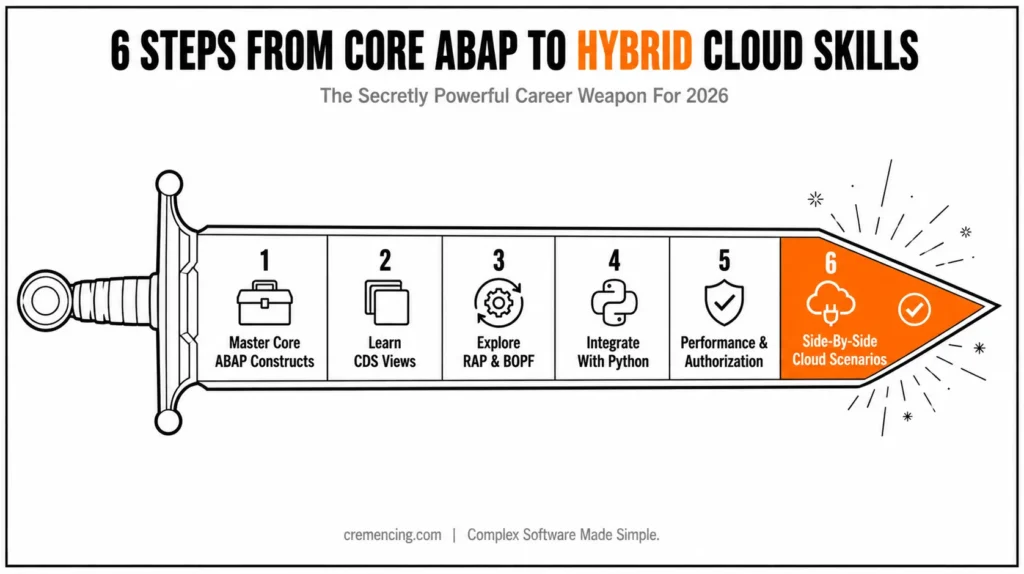
Step 1 — Master Core ABAP Constructs
DATA lv_matnr TYPE mara-matnr. ” Material number
DATA lv_desc TYPE makt-maktx. ” Material description
CHOOSE A SINGLE MATRIX
INTO (lv_matnr, lv_desc)
MARIA FROM
JOIN makt ON makt~matnr = mara~matnr
WHERE mara~matnr = ‘10000001’.
WRITE: / lv_matnr, lv_desc.
- Understand table joins, modularization, and ABAP SQL.
- Critical for ECC and S/4HANA core development.
Step 2 — Learn CDS Views for S/4HANA
The name of the @AbapCatalog.sqlView is “ZCDS_MATERIAL.”
@AccessControl.authorizationCheck: #CHECK
define view Z_CDS_MATERIAL as select from mara
{
key matnr,
maktx
}
- CDS views provide semantic layers, access control, and SAP Fiori readiness.
- Required for S/4HANA 2022+ projects.
- Supports analytics, OData services, and integration with BTP.
Step 3 — Explore RAP and BOPF Extensions
Create behavior definitions and service bindings for transactional applications.
Handle Create/Update/Delete operations via RAP framework.
Allows side-by-side extensions with ABAP Cloud.
Example: Create a RAP service exposing a business object for Fiori apps without modifying standard logic.
Step 4 — Integrate with Python for Automation
DATA(lo_http_client) = cl_http_client=>create_by_destination( ‘Z_PYTHON_SERVICE’ ).
lo_http_client->request->set_method(
if_http_request=>co_request_method_post ).
lo_http_client->request->set_header_field(name = “Content-Type” and value = “application/json”)
lo_http_client->request->set_cdata(‘”order”:”5001″‘) is the method.
lo_http_client->send( ).
receive( ) from lo_http_client
WRITE: / lo_http_client->response->get_cdata( ).
Automation, AI scoring, and orchestration are all handled by Python.
ABAP ensures transactional consistency.
Ideal for hybrid SAP modernization projects.
Step 5—Practice Performance and Authorisation Checks
- After doing database operations, check sy-subrc.
- Use SELECT … FOR ALL ENTRIES for bulk processing, but with proper performance tests.
- Ensure authorization objects are evaluated.
- Test batch jobs in SM37 and analyze dumps in ST22.
- Trace performance with SAT/SE30 for optimization insights.
Step 6 — Expand ABAP for Side-by-Side Cloud Scenarios in
- Use communication arrangements for external API calls.
- Apply OAuth/XSUAA tokens when integrating with SAP BTP services.
- Utilize the appropriate HTTP response codes to guarantee error handling.
- Use Python or Node.js for pre/post-processing while ABAP maintains SAP core integrity.
How to Confirm Your ABAP Knowledge
- Validate reports and function modules in SE38/SE80.
- Utilizing SQL Console, examine CDS views within ADT.
- Monitor batch jobs via SM37.
- Debug runtime issues with SE24/SE30/ABAP Trace.
- Examine the performance metrics for API calls and heavy SELECT statements.
Not sure which ABAP skills still matter? Get the 2026 ABAP Career Skills Checklist and see which technologies to learn next.
Mistakes That Bring Skills Gaps Back:
ABAP skills can quickly become outdated when developers rely only on legacy practices and avoid modern SAP development methods. For example, modifying standard objects, depending heavily on RFCs, or skipping CDS and RAP can create technical and skill gaps.
Likewise, ignoring ABAP Cloud, BTP integrations, authorization checks, and performance testing can limit a developer’s ability to work on modern SAP projects. Therefore, keeping your skills aligned with current SAP development practices is essential for long-term career growth.
- Modifying standard tables or ignoring fundamental principles that are clean.
- Not learning CDS/RAP and only using legacy SE38 reports.
- Overusing RFCs for external Python calls without API contracts.
- Ignoring ABAP Cloud, S/4HANA Cloud, or BTP integrations.
- Neglecting authorization checks or performance testing.
Conclusion
ABAP’s career value in 2026 does not come from staying stuck in the past. It comes from understanding how SAP development has changed.
Classic ABAP still matters because enterprises continue to operate large SAP landscapes. At the same time, modern projects increasingly depend on CDS, RAP, released APIs, ABAP Cloud, and BTP integration. SAP’s current development model is moving toward clearer boundaries, supported interfaces, and upgrade-stable extensions rather than unrestricted modifications.
In 2026, ABAP remains a covertly potent career weapon. It ensures upgrade-safe development, clean core compliance, and transactional integrity. In enterprise SAP projects, combining ABAP, S/4HANA Cloud, RAP, CDS views, and Python/BTP integration produces a hybrid skill set that is highly valued. For more insight, read our blog on ABAP developer salary.
Maintain SAP’s essential logic while automating AI workflows. Lead modernization initiatives with upgrade-safe designs. Side-by-side extensions for cloud and hybrid architectures that connect core SAP. Ensure your career’s viability by acquiring cross-functional skills in high demand. In 2026, ABAP expertise will include strategic system ownership, guiding SAP transformation, and safe integration of modern technologies. By currently mastering ABAP, you can design, modernize, and secure enterprise SAP landscapes while remaining highly marketable.
FAQs
Why Learn ABAP in 2026?
ABAP is essential for S/4HANA core, transactional integrity, and upgrade-safe extensions. Combining ABAP with Python or BTP integrations prepares you for modern SAP roles.
Is ABAP still relevant in 2026?
Yes, ABAP remains core to SAP transactional logic, CDS/RAP-based extensions, and modern, clean core systems. It supports both ECC and S/4HANA projects.
How do I start ABAP Cloud?
Use Eclipse with ADT, connect to S/4HANA Cloud, create a simple CDS or RAP object, and explore released APIs for clean core development.
Is ABAP still worth learning in 2026?
Yes. ABAP remains important for SAP development, especially when combined with modern technologies such as CDS, RAP, released APIs, ABAP Cloud, and BTP integration.
Should ABAP developers still learn traditional ABAP?
Yes. Traditional ABAP remains useful when working with existing SAP landscapes. However, developers should also learn modern development approaches so they can support both existing systems and newer S/4HANA projects.
What should an ABAP developer learn after mastering the basics?
After learning core ABAP, focus on ABAP SQL, CDS, RAP, released APIs, object-oriented programming, performance optimization, authorization, and ABAP Cloud. Then, add BTP and integration skills to expand your development capabilities.
Is RAP replacing traditional ABAP development?
No. RAP provides a modern framework for building transactional applications and services, but strong ABAP fundamentals are still essential. Learning both gives developers a broader skill set for modern SAP projects.
How can ABAP developers avoid skill gaps in 2026?
Developers should continuously update their knowledge instead of relying only on legacy tools and techniques. Learning CDS, RAP, ABAP Cloud, APIs, BTP integration, security, and performance testing can help keep their skills relevant.