
ABAP vs Python is increasingly a career-defining question for SAP developers. Currently, ECC 6.0 landscapes still rely heavily on classic ABAP for reports, therefore forms, user exits, IDocs, RFCs, and support automation. In contrast, SAP S/4HANA introduces ABAP Cloud, RAP, clean core enforcement, and BTP side-by-side extension opportunities.
Meanwhile, python now manages orchestration, AI calls, data preprocessing, batch automation, testing utilities, and other aspects of ABAP. However, python does not replace ABAP inside SAP’s transactional layer.
However, ABAP remains the language of business logic, authorization checks, LUW consistency, and update tasks. Instead, Python extends SAP outside the transactional core, letting developers integrate AI, APIs, and external services efficiently.
Therefore, in 2026, knowing both allows a senior SAP developer to architect hybrid solutions safely.
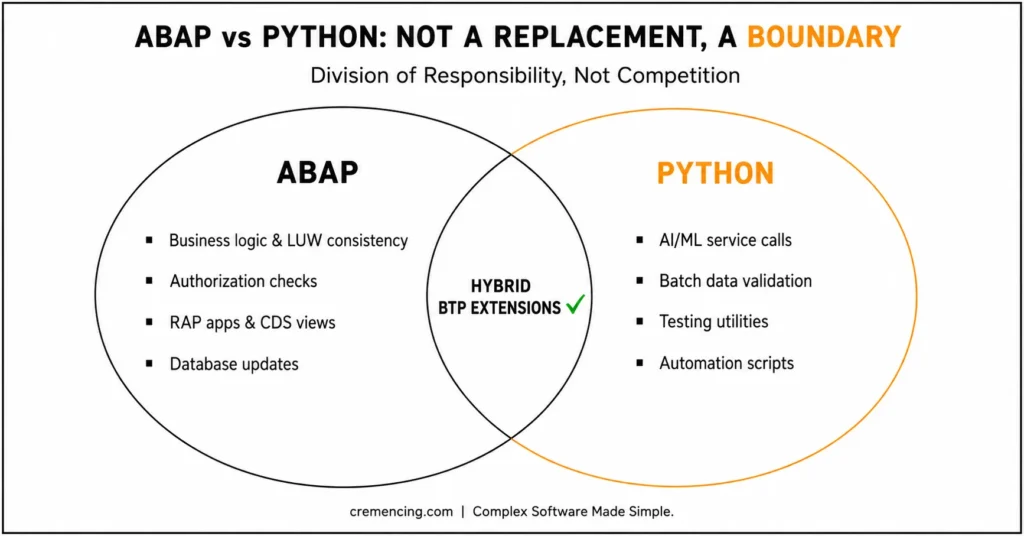
Specifically, Python fits: automation, testing, AI service orchestration, data validation, batch jobs. ABAP should handle SAP business logic, transaction consistency, authorisation, RAP apps, CDS views, BAdIs, and upgrade-safe extensions.
Meanwhile, Python fits: automation, testing, AI service orchestration, data validation, batch jobs, and side-by-side BTP apps.
ABAP vs Python today is a division of responsibility, not a replacement debate.
Emerging Role of Python in SAP AI Architectures
Recent enterprise surveys show that 75% of SAP organizations now actively utilize AI, with 44% deploying autonomous AI agents that rely on Python-driven middleware. Furthermore, 84% of software developers use AI and automation tooling, while 62% of enterprises experiment with AI agents for side-by-side tasks. By building side-by-side extensions on SAP Business Technology Platform (BTP), teams decoupled custom code to achieve zero-impact S/4HANA upgrades. Consequently, combining Python’s AI-orchestration capabilities with clean-core ABAP has quickly become a primary technical strategy for modernizing enterprise landscapes.
ABAP vs Python: Side-by-Side Comparison
| Feature | Old Way | New Way |
| Main skill profile | Classic ABAP developer | ABAP developer with API, BTP, and Python awareness |
| SAP release fit | ECC 6.0 and classic S/4HANA custom code | S/4HANA, ABAP Cloud, and side-by-side extensions |
| Integration style | RFC, IDoc, file, SOAP, custom tables | Released APIs, OData, events, HTTP, SAP Integration Suite |
| Python role | Rare local script or desktop utility | Automation, AI, data validation, external service layer |
| ABAP role | Owns all logic inside SAP | Owns SAP state, rules, checks, and clean extension points |
| Debugging | restricted to SM37 and ST22 dumps | Advanced: ADT debugger + API logs + Python logs |
| Testing | Classical unit tests in ABAP | Python unit tests for external services, mock SAP payloads |
| Career risk | Deep but narrow SAP stack | Broader technical profile, integration authority |
| Upgrade readiness | Custom code tightly coupled | Uses released APIs, ABAP Cloud, and clean core standards |
ABAP vs Python: Career Expansion
In the ABAP vs Python era, earlier ABAP developers needed extensive knowledge of SE38, SE11, SE37, SM59, ST22, SM37, user exits, BADIs and the exact tables supporting SAP business logic. Nonetheless, this approach couples business logic with technical integration, causing upgrade and support issues. That deep knowledge still matters in ECC 6.0 and private S/4HANA projects.
However, unmanaged custom code in S/4HANA is penalized, especially when developers copy SAP logic instead of using released APIs. In contrast, Python provides side-by-side expansion, helping ABAP developers automate repetitive tasks, invoke AI/ML services, and orchestrate API calls without touching core SAP logic.
Moreover, this allows the ABAP developer to focus on transactional integrity. As a result, Python handles external computations or cross-system flows. For more insight, read our blog What makes ABAP Unique
ABAP vs Python Integration Scenarios
Batch Processing
In this ABAP vs Python scenario, ABAP handles document posting while Python pre-validates datasets or aggregates large CSV/Excel files for upload.
AI and ML Calls
This is a classic ABAP vs Python split: for predictive order scoring, ABAP initiates an HTTP call to a Python AI service that returns results to CDS views or logs.
Testing Utilities
Here, ABAP vs Python roles blend well — Python scripts can simulate batch RFC calls in staging or generate sample payloads for ABAP testsPython scripts can simulate batch RFC calls in staging or generate sample payloads for ABAP tests.
Event-Driven Automation
In this ABAP vs Python pattern, Python services are called by SAP event triggers (like the creation of a sales order) via cloud events without violating SAP’s clean core rules.
ABAP vs Python Code + Limitations
Traditionally, this ABAP vs Python integration relied on direct HTTP calls and SM59 destinations. This approach couples business logic with technical integration, causing upgrade and support issues.
REPORT zold_abap_python_bridge.
DATA TYPE REF TO if_http_client FOR lo_http_client. ” Classic HTTP client
DATA: type string for lv_payload. “Python JSON for”
DATA lv_response TYPE string. ” Response text
DATA lv_subrc TYPE sy-subrc. ” Return code
“salesOrder”: “5000000010” is the value of lv_payload.
Method for calling:
cl_http_client=>create_by_destination
EXPORTING
destination = ‘Z_PYTHON_SCORE_API’
IMPORTING
client = lo_http_client
EXCEPTIONS
Others equals 1.
lv_subrc = sy-subrc.
IF lv_subrc <> 0.
WRITE: / ‘HTTP destination could not be created’.
RETURN.
ENDIF.
lo_http_client->request->set_method(
if_http_request is greater than co_request_method_post).
lo_http_client->request->set_header_field(
name = ‘Content-Type’
value = ‘application/json’ ).
lo_http_client->request->set_cdata(
data equals lv_payload).
lo_http_client->send( ).
receive( ) from lo_http_client
Lo_http_client->response->get_cdata = lv_response
WRITE: / lv_response.
ABAP vs Python Limitations of This Old Approach:
- First, hard-coded HTTP destinations
- Also, mixed business and technical logic
- Additionally, no formal API contracts
- Troublesome during upgrades or endpoint changes
- Only ST22 or SM37 can be used for debugging.
Code + Advantages
ABAP Cloud encourages ownership separation: ABAP owns SAP state and business logic; Python handles orchestration, AI, or batch utilities.
Additionally, using released APIs, HTTP destinations, and communication arrangements ensures clean core compliance.
CLASS zcl_python_ai_client DEFINITION
In the end, the public will create the public.
PUBLIC PARTY.
INTERFACES if_oo_adt_classrun.
ENDCLASS.
Implementation of the zcl_python_ai_client class.
METHOD if_oo_adt_classrun~main.
TYPE REF TO if_http_destination FOR DATALO_DESTINATION.
DATA TYPE REF TO if_web_http_client FOR lo_client.
DATA lo_request TYPE REF TO if_web_http_request.
DATA lo_response TYPE REF TO if_web_http_response.
DATA type string for the lv_payload.
DATA type string for lv_result.
lv_payload = ‘{“material”:”TG11″,”plant”:”1010″}’.
lo_destination = cl_http_destination_provider=>create_by_url(
i_url = ‘https://python-api.example.com/check’ ).
lo_client = cl_web_http_client_manager=>create_by_http_destination(
lo_destination ).
lo_request = lo_client->get_http_request( ).
lo_request->set_header_field(
i_name = ‘Content-Type’
i_value = ‘application/json’ ).
lo_request->set_text(
i_text is equal to lv_payload).
lo_client->execute = lo_response
if_web_http_client=>post ).
lv_result = lo_response->get_text( ).
out->write( lv_result ).
ENDMETHOD.
ENDCLASS.
Python is reshaping the skillset, but ABAP for HANA 2.0 is still what makes developers irreplaceable on core SAP systems
Advantages:
- Definable API contract
- SAP isolates ABAP logic.
- Python can be tested independently
- API management and HTTP logs allow for traceability.
- Safe for upgrades in S/4HANA Cloud
Performance and Authorization Tips
- For smooth ABAP vs Python performance, use asynchronous calls when Python services run for a long time.
- Leverage ABAP parallel processing (RFC, batch jobs) with careful locking
- Use communication arrangements for token handling instead of embedding credentials
- Always verify authorization objects for API calls, especially with BTP or external services
Migration Checklist
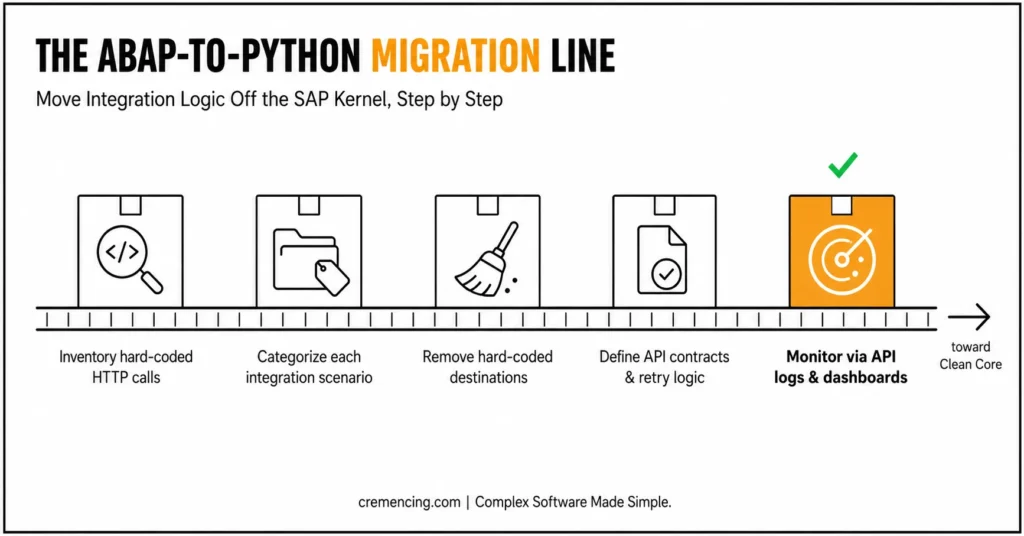
- As part of your ABAP vs Python migration, keep track of ABAP code that calls files, RFCs, external scripts, or direct extracts.
- Beginning with SE38, SE37, SM37, and ST22
- Categorize each scenario: SAP-core logic, integration logic, AI/data prep, automation, testing.
- In ECC 6.0, fix destinations and get rid of URLs that are hard-coded.
- Adopt released APIs for S/4HANA Cloud extensions and side-by-side Python services.
- Move Python to an approved runtime or SAP BTP; scripts should never be run directly on ABAP servers.
- Define API contracts: payload, response, retry logic, timeout, and HTTP status handling.
- Add ABAP validations: empty response, authorization, malformed JSON.
- Add Python unit tests simulating SAP payloads and error conditions.
- Provide developers with Python fundamentals for reading, testing, and mocking, not for AI development in its entirety.
- Monitor and audit: Use SMICM logs, API management, and SAP AI Core dashboards for integration health.
Conclusion:
ABAP vs. Python is not about replacement—it’s about division of responsibility.
Overall, business rules, LUW consistency, authorization checks, and database updates are all safely handled within the SAP core by ABAP, which remains the language of SAP transactional integrity. Meanwhile, Python manages orchestration, automation, artificial intelligence, data services, API integrations, further side-by-side extensions and cloud-native services, specifically for SAP BTP. Developers in 2026 who combine clean core ABAP, BTP extensions, released APIs, and Python integration skills will lead hybrid SAP projects efficiently.
As a result, they will be able to design systems in which ABAP ensures that business-critical operations are secure and upgrade-safe, and Python enables agility in external data processing, predictive analytics, and automation workflows. Furthermore, this combination also allows teams to adopt event-driven architectures, integrate AI models, and execute batch or parallel operations without compromising SAP stability.
Ultimately, understanding where each language fits is essential for SAP careers that are secure for the future. Developers should maintain the clean core of SAP, write upgrade-safe ABAP, and use Python for tasks outside the SAP kernel. In turn, this method makes it easier to maintain, reduces technical debt, and makes it possible for ABAP specialists and Python developers to work together to create innovative SAP solutions. By strategically embracing both languages, SAP landscapes remain scalable, maintainable, and in line with contemporary enterprise architecture.
FAQs
1. Need to connect ABAP with Python?
ABAP connects to Python via HTTP, RFC, files, or middleware.ECC uses SM59; S/4HANA prefers released APIs or ABAP Cloud HTTP clients.
2. What programming language should you learn after ABAP?
Python is most useful for AI, automation, and BTP.
JavaScript/TypeScript fits SAPUI5/CAP projects.
Careers in clean core ABAP are improved by Python.
3. XSUAA BTP Service Implementation for Custom Python APP?
In this ABAP vs Python setup, use XSUAA for secure token-based access.
ABAP developers only need to know scopes, principal propagation, and communication arrangements.
4. XLS file in background?
For this ABAP vs Python use case, avoid ad hoc Python scripts for Excel.
Use server-safe ABAP parsing or a controlled Python service on BTP.
Automation in Python can go beyond what ABAP can do by itself.
5. Can Python replace ABAP in SAP?”
No.Core transactions, updates, authorization, and CDS/RAP logic are all handled by ABAP. Python complements SAP for orchestration, AI, and automation.
6. Is ABAP better than Python?
Generally, ABAP is stronger for transactional SAP logic; Python excels at external service orchestration, batch, AI, and automation tasks. ABAP vs Python is boundary-dependent.
7. Does learning Python affect ABAP job security?
No — ABAP vs Python is complementary, not competitive. ABAP remains essential for core SAP transactions, while Python skills add versatility for automation and AI integration.
8. Is Python required for SAP BTP development?
Not strictly, but for ABAP vs Python projects involving BTP, Python is increasingly preferred for orchestration, testing, and AI service calls alongside ABAP Cloud.
9. How much Python should an ABAP developer learn?
For most ABAP vs Python hybrid roles, developers need enough Python to read, test, and mock API responses — not full application development skills.
10. Will Python eventually replace ABAP entirely in SAP?
Unlikely. The ABAP vs Python relationship is built on division of responsibility — ABAP owns transactional integrity, while Python handles orchestration and automation outside the core.