
Introduction
When it comes to SAP hiring skills 2026, the job market is not decelerating—it is dividing. On the one hand, the professionals who have traditional SAP functional or technical expertise are seeing their salaries level off. On the other hand, a smaller group with one specific, high-need capability is demanding a salary that is 30-45 per cent beyond the average of the SAP market and has multiple competing offers and less time to search for jobs.
That skill is SAP S/4HANA migration expertise, specifically the ability to design, lead, and execute ECC-to-S/4HANA transformations at the enterprise level.
As SAP ceases mainstream support of ECC in 2027, all organisations with old versions of SAP are now facing an imminent migration decision. They require individuals who have done it previously. And there are fewer of them now.
Here, you will learn what this skill set entails, how to develop it systematically, how much it will fetch in the market, and how to position it on your resume to stand out to hiring managers who will pay a premium for it.
S/4HANA Migration Skill Demand
Enterprise demand for SAP talent is shifting heavily toward specialized S/4HANA migration expertise as organizations transition away from legacy ECC systems. Hiring managers prioritize professionals skilled in executing transformations using the SAP Activate methodology, analyzing custom code compatibility through the SAP Readiness Check, and orchestrating data extraction via the SAP S/4HANA Migration Cockpit.
Beyond technical execution, top-tier compensation goes to specialists who can facilitate Fit-to-Standard workshops to enforce standard processes and manage complex cutover activities. Mastering these transition tools alongside structural concepts like the Universal Journal (ACDOCA) differentiates senior practitioners, enabling enterprise teams to minimize transition risk, preserve data integrity, and accelerate cloud adoption timelines.
What SAP Hiring Skills 2026 Really Demand: S/4HANA Migration Expertise.
You must first find out what the hiring managers actually mean by listing it in a job description because S/4HANA experience is a loose term that means very different things in different levels. Understanding this distinction is central to navigating SAP hiring skills 2026 successfully.
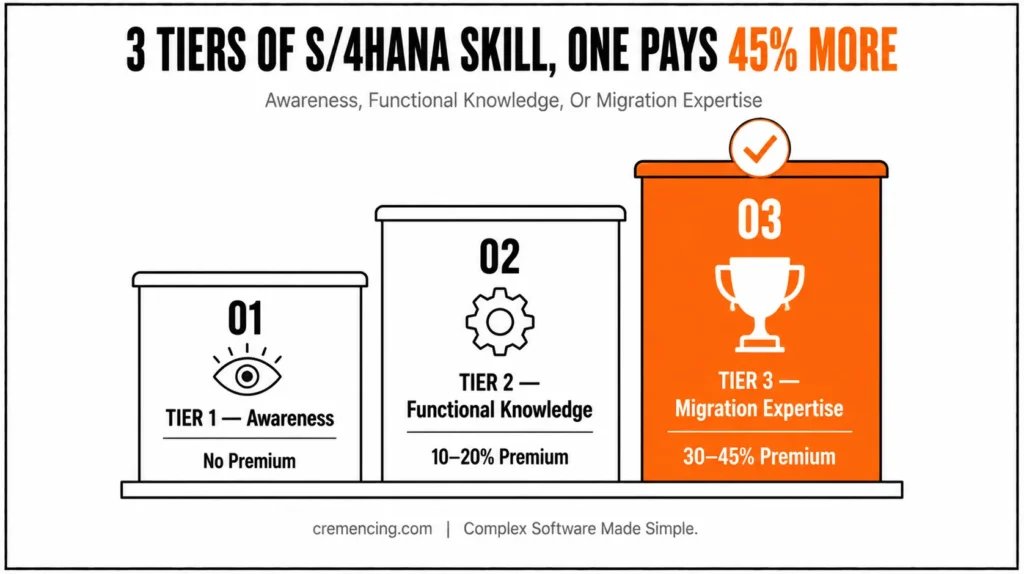
The market has three levels of S/4HANA knowledge:
| Tier | What It Covers | Market Value |
| Tier 1 — Awareness | Knows S/4HANA exists and has some basic differences with ECC. | Entry-level, no premium |
| Tier 2 — Functional Knowledge | Can set up and utilize S/4HANA modules (FI, MM, SD, etc.) | Moderate premium (10–20%) |
| Tier 3 — Migration Expertise | Is capable of design migration strategy, manage Fit-to-standard, leading the cutover, and migrating data. | Top-dollar (30–45% premium) |
Hiring managers are seeking Tier 3 candidates, paying the highest dollar. This implies that candidates who comprehend the following:
- Technical and functional differences of ECC and S/4HANA (simplified data model, Universal Journal, material ledger)
- Migration strategies – Greenfield, Brownfield, and Selective Data Transition (SLT/LTMC).
- Tooling of data migration: SAP Migration Cockpit, LTMC, and BODS.
- Fit-to-Standard workshop facilitation
- Cutover planning and implementation.
- Post-go-live hypercare management
When your resume lists S/4HANA experience but shows only module configuration, you are in Tier 2. The applicants with the best offers have Tier 3 depth, and this post will demonstrate how to achieve that.
SAP Hiring Skills 2026: Build Expertise Step-by-Step.
It is not a trick that you develop during the weekend. Nevertheless, when it comes to SAP hiring skills 2026, this is a skill you can develop in an organised manner over 6-12 months with the proper sequence of learning and applied experience.
Step 1: Learn S/4HANA architecture and data model
Begin at the base. The main architectural distinction of S/4HANA over ECC is the Universal Journal (table ACDOCA) – a single source of truth replacing dozens of separate financial tables. The conceptual basis on which all other things are based is understanding why this is important and how it alters how data passes through the system.
Resources: SAP Learning Hub, openSAP free courses (especially SAP S/4HANA: An Introduction), and SAP official documentation of the architecture.
Don’t skip this step. Applicants who are capable of articulating the differences in architecture in a business situation, not only with technical terminology but also immediately in interviews.
Step 2: Become certified in the appropriate modules.
Certification is an indication of minimum knowledge to potential employers who are going through hundreds of resumes. Migration-oriented roles in 2026 with the highest ROI in their certifications are the following:
- C_ACTIVATE15 – SAP Certified Associate: SAP Activate Project Manager.
- C S 4 FTR 2021 – SAP Certified Application Associate: Finance in SAP S/4HANA.
- C4HANA 2023 – SAP S/4HANA Financial Accounting Associate.
- C BW 4 HANA 27 – For professionals migrating to analytics with S/4 HANA.
The certification of the SAP Activate methodology is specifically of high value as it shows the knowledge of processes, i.e. how migrations are organized and managed, rather than just the knowledge of the technical configuration.
Step 3: Get Hands-On With Migration Tooling
A technical interview cannot pass on theoretical knowledge of migration approaches. You must have practical acquaintance with the very instruments:
- SAP Migration Cockpit – the main data migration tool in S/4HANA projects.
- LTMC (Legacy Transfer Migration Cockpit) – to migrate legacy data.
- SAP Readiness Check — an assessment tool that is deployed at the beginning of each ECC migration.
- Simplification Item Catalogue—the main source of what evolves between ECC and S/4HANA.
Treat SAP Readiness Check output as your starting checklist, not a formality — it flags custom code impacts, simplification items, and add-on compatibility issues specific to your system, and citing specific findings from a Readiness Check report in an interview signals real project exposure rather than textbook knowledge.
SAP provides trial access to the trial systems through SAP BTP trial accounts and partner sandbox environments. When your employer is implementing SAP, push to take part in internal migration initiatives to any degree; even data cleansing provides you with legitimate project experience you can refer to.
Step 4: Build Fit-to-Standard Facilitation Skills
This is the ability that distinguishes the Tier 2 and Tier 3 applicants—and it is the least technical of them all. Fit-to-Standard workshops are where business stakeholders and SAP consultants decide which standard SAP processes to adopt and which legacy customisations to continue using. The individual who can facilitate these workshops must possess not only knowledge of SAP processes, but also have business communication skills.
Actual real fit-to-standard agendas. Follow up on these sessions in case you have access. Develop the skill to discuss the need to adopt standard processes as the means of reducing TCO—and to overcome the organisational resistance that inevitably comes with the process of stakeholder disinvestment in legacy processes.
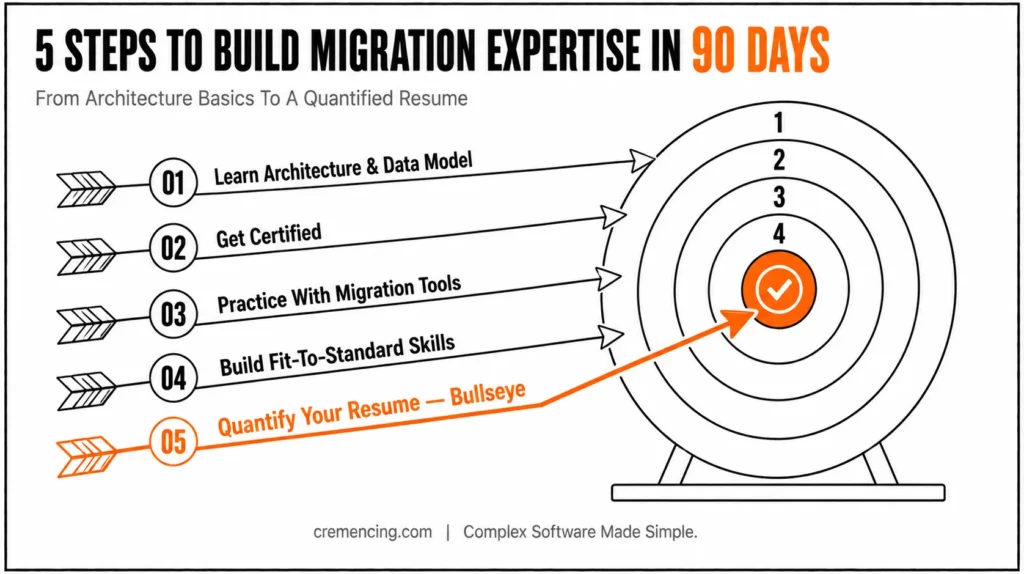
Step 5: Match SAP Hiring Skills 2026 Expectations.
You should have project exposure, internal, consulting, or sandbox-based, which you can record on your resume by the time you have finished Steps 1–4. The trick is in quantification:
- Did not support the S/4HANA migration project.
- Yes: Contributed to ECC-to-S/4HANA brownfield migration on behalf of an 8-entity manufacturing client; supported data migration of 2.3M material master records using SAP Migration Cockpit; assisted with cutover planning with a 72-hour go-live window.
Specificity is an indication of real experience. Flowery wording is an indicator of resume padding—and hiring managers at this level are all too aware of the distinction at first glance.
Tier 3 Checklist
- Can explain Universal Journal (ACDOCA) impact in business terms
- Holds at least one Activate-methodology-aligned certification
- Has hands-on time in Migration Cockpit / LTMC, not just reading about it
- Has facilitated or shadowed a Fit-to-Standard workshop
- Can quantify past project scope: entities, users, records, timeline
SAP Hiring Skills 2026: What This Skill Is Worth in Salary.
Salary data confirms exactly what SAP hiring skills 2026 trends are pointing to:
| Role | Average Salary (US, 2026) | With S/4HANA migration expertise. |
| SAP Functional Consultant | $95,000 – $115,000 | $130,000 – $155,000 |
| SAP Project Manager | $110,000 – $135,000 | $150,000 – $185,000 |
| SAP Technical Consultant (ABAP) | $100,000 – $125,000 | $138,000 – $165,000 |
| SAP Solution Architect | $140,000 – $170,000 | $185,000 – $220,000+ |
| SAP Basis / Infrastructure | $90,000 – $110,000 | $125,000 – $150,000 |
Ranges based on Robert Half Technology, Dice, and LinkedIn salary data 2026.
Independent contractors’ day rates of S/4HANA migration specialists in consulting range between $900 and $1,500, as the 2027 ECC deadline nears and organizations scramble to find experienced resources.
The gap between supply and demand is not a myth but a fact. Even SAP has stated that there is a lack of certified S/4HANA professionals worldwide. Your chance is that scarcity.
Top Resume Mistakes That Ignore SAP Hiring Skills 2026 Trends.
Mistake 1: Leading With Tools Rather Than Outcomes.
Experience in SAP MM, SD, FI, WM, PP will tell a hiring manager nothing about what you have delivered. Start with business results, reducing costs, improving cycle times, meeting go-live schedules, etc., and allow the tool list to reinforce that story.
Mistake 2: ECC experience is listed as S/4HANA experience.
It is the quickest method to lose trust with a technical interviewer. ECC and S/4HANA are purposefully distinct systems. In case you do not have a lot of experience with S/4HANA, state it as accurately as you can, and complement it with your certification progress and what you are doing to bridge the gap. Veracity and proven initiative is better written than exaggeration that falls apart when questioned.
Error 3: Neglecting the SAP Activate Methodology.
Numerous skilled SAP consultants established their careers based on ASAP methodology. ASAP is retired. SAP Activate is the latest framework that applies to all S/4HANA implementations. When your resume continues to use ASAP without also using Activate, what you are signalling to the hiring managers is that your methodology knowledge is one version behind.
Mistake 4: No Quantification on Project Entries.
Descriptions of projects that are not numbered are unmemorable. Each project entry on your SAP resume must respond to: How large was the client? How many users? How many entities? What was the duration of the project? Which particular contribution did you make? What was the consequence? Numbers provide credibility and allow your experience to be similar among candidates.
SAP Hiring Skills 2026 Go Beyond Tools:
The majority of SAP career information is related to technical certifications, knowledge of tools, and methodology knowledge. That’s all necessary. But there is one more thing that purely technical applicants lack, and that is expert knowledge of the business processes in the industry.
SAP is a business system. Those people who best configure it are those people who are aware of the business issue which needs to be solved, not just the technical configuration that is required to solve the business problem.
Someone who can say I have implemented S/4HANA implementations in consumer goods retail in three continents, and I understand how promotional pricing cascades through the replenishment and financial close process’ is categorically different from someone who can configure the same modules without that business context.
This implies that your career development plan must operate on two parallel tracks:
- Technical track—certifications, tooling, methodology, and knowledge of architecture.
- Industry track: deep knowledge of one or two verticals (retail, manufacturing, utilities, professional services)
Hiring managers at enterprise clients and at the very top of the consulting firm hierarchy—Deloitte, Accenture, IBM, and Capgemini—are actively seeking SAP professionals who can speak business fluently and configure technically. Such a blend is uncommon. It is also the mix that attracts the highest pay and the most exciting work.
When you are in the early days of your SAP career, it is important to select your industry vertical with care and develop your domain knowledge in addition to your SAP technical skills. This dual approach reflects where SAP hiring skills in 2026 is heading. When you are in the middle of your career
Conclusion:
SAP hiring skills in 2026 make one thing clear: the expertise in SAP S/4HANA migration is one of the most evident prospects in enterprise technology careers at the moment.The demand is fixed and immovable, the supply is short, the premium is real, and the deadline that drives it: SAP ECC end of support in 2027.
The skills required to hire an SAP person in 2026 are being defined by one question: Has this individual successfully delivered an S/4HANA migration, or is he or she still working towards it? The professionals who are already in Tier 3 are filling in the best positions very fast.
The disconnect between the market and where you are, the distance between the market and where you are, will be bridged as more professionals upskill; i.e., the time to develop this expertise is now rather than after the next performance review. Explore What Senior Employers Actually Ask.
The Tier 3 criteria in this post have you audit your current resume against them. Determine the particular gaps. Create a 90-day strategy that will help you to leave where you are and move to where the hiring managers are actively searching.
Get the appropriate certification on your profile. Report on your project experience numerically. And select an industry vertical to possess.
FAQ
Is SAP Hiring in 2026 a Good Career Bet as AI Tools Emerge?
Yes- and a main reason is the ECC-to-S/4HANA migration wave. AI tools are transforming the configuration and utilization of SAP systems, albeit not to the point of eliminating the skills necessary to migrate, integrate, and govern enterprise SAP environments.
In SAP Hiring, What’s the Timeframe to Become a Serious Migration Expert?
An existing SAP ECC professional with focused effort, in terms of certifications, hands-on tools access, and active involvement in a project, can develop credible S/4HANA migration skills within 9-18 months. Individuals unfamiliar with SAP altogether must expect to take 2-3 years to achieve Tier 3 depth.
In SAP Hiring 2026, Which Modules Are Most Sought-After?
The greatest volume demand area is S/4HANA Finance (FI/CO) since all migrations touch the financial data model.
Following finance, the demand growth of SAP Supply Chain (MM, SD, EWM) and SAP S/4HANA for manufacturing is also experiencing strong growth in demand, driven by reshoring trends in manufacturing and investment in retail supply chains.
Do I have to be employed by an SAP partner to gain migration experience?
Not necessarily. SAP internally running end-user organisations are proactively staffing their migration projects—and internal project experience is legitimate and appreciated.
How do I negotiate a greater salary specifically around S/4HANA migration abilities?
Prepare to negotiate salary with market data—specific salary levels that Dice, LinkedIn Salary, and Robert Half would offer you based on your role, location, and level of experience.
Does S/4HANA migration expertise transfer across industries, or is it industry-specific?
The core technical skills — data model knowledge, migration tooling, cutover planning — transfer across industries. However, the highest-paying roles combine this technical expertise with deep knowledge of one industry vertical’s specific processes.
Is Greenfield or Brownfield migration experience more valuable to hiring managers?
Both are valued, but Brownfield and Selective Data Transition experience are often seen as more technically demanding since they require navigating existing customizations and legacy data, which tends to command a stronger premium.
Can a functional consultant become a Tier 3 migration expert, or is this a technical-only path?
Functional consultants are well-positioned for this path, since Fit-to-Standard facilitation and business process knowledge are core Tier 3 skills. Technical depth in tools like the Migration Cockpit supplements this rather than replaces it.
How important is SAP Activate certification specifically compared to module-level certifications?
SAP Activate certification demonstrates process and methodology knowledge — how migrations are structured and governed — which many module-level certifications don’t cover, making it a differentiator for Tier 3 roles.
What happens to SAP career prospects after the 2027 ECC deadline passes?
Demand for migration expertise specifically may soften somewhat once the bulk of ECC-to-S/4HANA migrations are complete, but skills in S/4HANA optimization, continuous innovation cycles, and Clean Core maintenance are expected to remain in demand.