If you’re prepping for ABAP interview questions for 5 years of experience, you already know the basics: building reports, writing BAPIs, handling BADIs, and surviving production incidents. You know the transaction codes and the table names. However, then the interviewer asks, “Walk me through a performance problem you hit in a real project and how you solved it in ABAP code.”
This guide covers ABAP interview questions for 5 years of experience in the structure senior SAP employers actually use: technical depth first, then scenario judgment, then ECC-vs.-S/4HAN awareness. Every section includes what the interviewer hears in a strong answer versus a weak one.
Why RAP Now Anchors Clean Core ABAP Development
SAP describes RAP as essential to ABAP Cloud. It’s the model for building clean-core, cloud-ready apps on BTP, S/4HANA Cloud, and S/4HANA. RAP standardizes development around ABAP Core Data Services. It also uses the extended ABAP language and business services within Eclipse-based ADT.
RAP supports transactional Fiori apps, OData services, and web APIs. Job postings from 2025–2026 increasingly list RAP alongside CDS and Clean Core. These now appear as baseline requirements, not specialisations. Availability still depends on the SAP product edition and deployment model.
“ABAP Interview Questions for 5 Years: What Interviewers Expect”
Most candidates preparing for ABAP interview questions for 5 years of experience focus on definitions. Instead, senior-level interviewers don’t want definitions; they want judgment. Specifically, they want to hear why you chose a BAPI over a direct INSERT, why you used a hashed table instead of a sorted one, and what broke the first time you deployed something to production.
The gap between a mid-level and a senior ABAP candidate isn’t knowledge breadth. It’s the ability to explain trade-offs under constrained performance vs. maintainability, OOP encapsulation vs. RFC compatibility, and legacy ECC patterns vs. clean ABAP guidelines in S/4HANA.
Three things interviewers test at the 5-year mark that they don’t test at 2 years:
Performance ownership is not just “I used FOR ALL ENTRIES,” but “I ran ST05, found 4,000 unnecessary reads, and replaced the loop with a JOIN.”
Additionally, enhancement architecture is not just “I know BADIs,” but “I chose an explicit BADI over a user exit because the project was on EHP6 and we needed multiple active implementations.”
Finally, ECC-to-S/4HANA transition awareness means the ability to name what changes, what breaks, and what disappears when a system moves to HANA.
How ABAP Interview Questions for 5 Years Are Structured
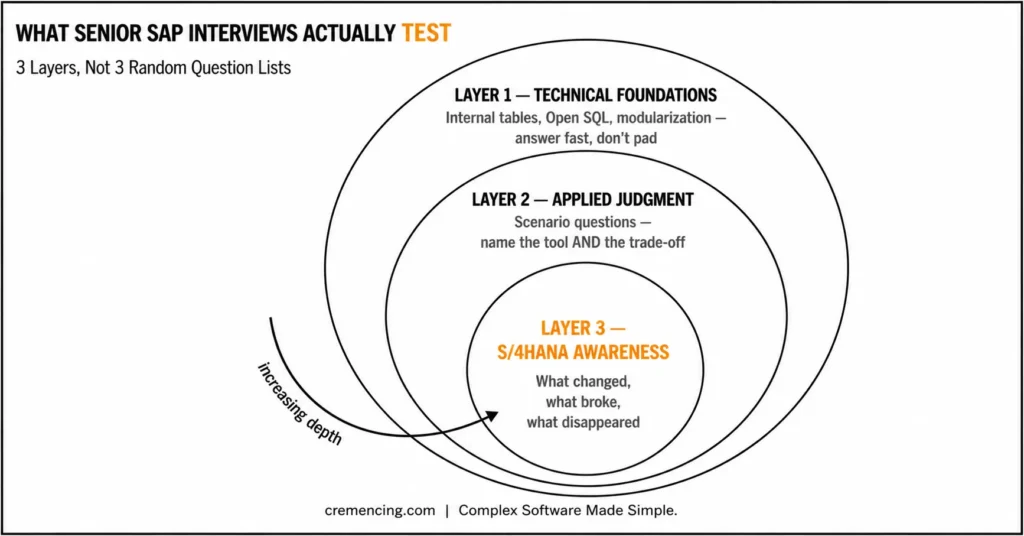
Most ABAP interview questions for 5 years of experience get asked across three structured layers. Understanding the structure lets you calibrate answer depth instead of over-explaining basics.
Layer 1 — Technical foundations (first 15 minutes):The interviewer confirms you actually know the language. Here, expect questions on internal table types, Open SQL vs. native SQL, modularization options, and visibility sections in OOP. Since these are screening questions, answer them concisely — don’t pad.
Layer 2 — Applied judgment (middle 20–30 minutes): This is where most candidates lose points. Questions become scenario-based: “Given this requirement, what would you build and why?”Specifically, correct answers name the tool, justify the choice against alternatives, and mention at least one risk or limitation. In contrast, weak answers just name the tool.
Layer 3 — S/4HANA and modern ABAP awareness (last 10–15 minutes): Likewise, for any role touching S/4HANA, the interviewer checks whether you understand what changed. For instance, CDS views replace classic aggregation, AMDP handles code pushdown, SELECT * is deprecated on large HANA tables, and clean ABAP guidelines apply throughout. Still, you don’t need to be an expert — you simply need to demonstrate awareness and direction.
Table-handling questions like this are where most ABAP interview questions for 5 years of experience begin.
Q1. “HASHED vs SORTED Table: A Common ABAP Interview Question for 5 Years of Experience”
This question tests whether you actually understand how ABAP internal tables are stored in memory,, not just the names.
| Table Type | Access Method | Key Constraint | Best For |
| STANDARD | Linear scan or index | Duplicates allowed | Small tables: insertion order matters |
| SORTED | Binary search (index access) | Duplicates allowed by default | Range reads, partial key access |
| HASHED | Hash function (key only) | A unique key mandatory | Single-record lookups on large volumes |
” ── HASHED table: fastest for single-key READ TABLE ──────────
DATA: lt_customers TYPE HASHED TABLE OF kna1

                   WITH UNIQUE KEY kunnr.     " Unique key required

READ TABLE lt_customers

  WITH TABLE KEY kunnr = '1000001'  " O(1) hash lookup — no BINARY SEARCH needed

  ASSIGNING FIELD-SYMBOL(<ls_customer>).

" ── SORTED table: correct for range-based reads ──────────────

DATA: lt_items TYPE SORTED TABLE OF vbap

               WITH NON-UNIQUE KEY vbeln posnr.

LOOP AT lt_items

  WHERE vbeln = '4500001234'         " Uses binary search on sorted key

  ASSIGNING FIELD-SYMBOL(<ls_item>).

  WRITE: / <ls_item>-matnr.

ENDLOOP.
What to say: “I use HASHED when I need single-record READ TABLE on a large dataset and the key is always fully specified. I use SORTED when I need range-based LOOP AT WHERE on a partial key. Using READ TABLE … BINARY SEARCH on a STANDARD table is what I’d flag in a code review as a performance risk.”
Handling BAPI return codes correctly is another area ABAP interview questions for 5 years of experience always cover.
Q2. “BAPI Return Codes: ABAP Interview Question Senior Developers Get Asked”
That’s because most junior developers ignore the RETURN table until something breaks in production.On ECC, I check what version we’re on if EHP4 or above, BAdIs.
DATA: lt_return  TYPE TABLE OF bapiret2,   " BAPI return messages

      ls_header  TYPE bapisdh1,            " Sales order header

      lt_items   TYPE TABLE OF bapisditm,  " Line items

      lv_order   TYPE bapivbeln-vbeln.     " Created order number

" ── Populate header and items before the call

ls_header-doc_type   = 'TA'.

ls_header-sales_org  = '1000'.

ls_header-distr_chan = '10'.

ls_header-division   = '00'.

" Call the BAPI

CALL FUNCTION 'BAPI_SALESORDER_CREATEFROMDAT2'

  EXPORTING

    order_header_in = ls_header

  IMPORTING

    salesdocument   = lv_order     " Order number if creation succeeds

  TABLES

    return          = lt_return    " Always check this — don't skip

    order_items_in  = lt_items.

" ── Check for errors before committing

IF line_exists( lt_return[ type = 'E' ] ) OR

   line_exists( lt_return[ type = 'A' ] ).

  ROLLBACK WORK.                   " Undo everything — BAPI doesn't do this automatically

  " Log errors or raise exception

ELSE.

  COMMIT WORK AND WAIT.            " AND WAIT ensures commit is synchronous

ENDIF.
What interviewers watch for: Whether you check the RETURN table before calling COMMIT WORK, and whether you know that Therefore, BAPIs don’t auto-commit — the caller owns the commit/rollback decision. enhancement framework,
Enhancement framework choices come up in almost every set of ABAP interview questions for 5 years of experience.
Q3. “Enhancement Framework: A Key ABAP Interview Question for 5 Years Experience”
” BAdI: the modern choice (ECC EHP4+ and all S/4HANA)
” Use GET BADI to retrieve the active implementation
DATA: lo_badi TYPE REF TO badi_sd_sales_order_change.
GET BADI lo_badi.
” Call a method defined in the BAdI interface
CALL BADI lo_badi->check_sales_order
EXPORTING
is_header = ls_vbak. ” Pass header data for validation
The decision table interviewers expect you to know:
| Enhancement Type | When to Use | S/4HANA Compatible |
| User Exit (FORM routines) | Legacy ECC, no alternatives | Deprecated pattern |
| Customer Exit | ECC systems, limited extensibility | No new ones in S/4HANA |
| Classic BAdI | ECC EHP1–EHP3 | Works but superseded |
| Kernel BAdI / Enhancement Spot | ECC EHP4+ and all S/4HANA | Preferred |
What to say: “On any S/4HANA project, I go straight to the Enhancement Spot / Kernel BAdI combination. Otherwise, on ECC, I check what version we’re on — if EHP4 or above, BAdIs. Below that, I look for existing customer exits before touching user exits because user exits are form-based and can’t have multiple active implementations.”
Performance debugging like this comes up constantly in ABAP interview questions for 5 years of experience.
Q4. “Performance Debugging — A Scenario-Based ABAP Interview Question for 5 Years”
Strong answer structure:
- First, run ST05 (SQL Trace) — not SE30 — to identify the exact SELECT statements hitting the database and their read counts.
- Next, check for missing secondary indexes using SE11 on VBRP. For example, VBRP’s primary key is MANDT-VBELN-POSNR. If you’re selecting by FKART or ERDAT, you need a secondary index.
- Check whether the SELECT uses SELECT * instead of a field list. On S/4HANA, SELECT * on a wide table like VBRP transfers unnecessary columns from HANA to the application server.
- Replace an OPEN CURSOR loop with a JOIN or a CDS view in S/4HANA to push the aggregation to the database layer.
” ── BEFORE: reading full table, looping in ABAP
SELECT * FROM vbrp INTO TABLE lt_vbrp
WHERE fkdat BETWEEN ‘20240101’ AND ‘20240131’. ” No index on FKDAT by default
” ── AFTER: select only required fields, use index-aware WHERE ─
SELECT vbeln posnr matnr netwr fkdat ” Named fields only
FROM vbrp
INTO TABLE @DATA(lt_vbrp_optimized)
WHERE fkdat BETWEEN ‘20240101’ AND ‘20240131’
AND vkorg = ‘1000’. ” Add org field if secondary index covers it
Testable, mockable code design is a newer but increasingly common theme in ABAP interview questions for 5 years of experience.
Q5. How do you write a testable ABAP class that external callers can mock?
This tests whether you understand dependency injection — the Clean ABAP principle that lets you swap real implementations for test doubles in ABAP Unit.
” ── Interface — the seam that makes mocking possible
INTERFACE zif_billing_reader.
METHODS: get_invoices
IMPORTING iv_customer TYPE kunnr
RETURNING VALUE(rt_bills) TYPE ztt_billing.
ENDINTERFACE.
” ── Real implementation
CLASS zcl_billing_db_reader DEFINITION.
PUBLIC SECTION.
INTERFACES zif_billing_reader.
ENDCLASS.
” ── Consumer class receives the dependency via constructor
CLASS zcl_billing_processor DEFINITION.
PUBLIC SECTION.
METHODS: constructor
IMPORTING io_reader TYPE REF TO zif_billing_reader.
METHODS: process_invoices
IMPORTING iv_customer TYPE kunnr.
PRIVATE SECTION.
DATA: mo_reader TYPE REF TO zif_billing_reader.
ENDCLASS.
CLASS zcl_billing_processor IMPLEMENTATION.
METHOD constructor.
mo_reader = io_reader. ” Injected — not hardcoded to DB class
ENDMETHOD.
METHOD process_invoices.
DATA(lt_bills) = mo_reader->get_invoices( iv_customer = iv_customer ).
” Process lt_bills…
ENDMETHOD.
ENDCLASS.
In the ABAP Unit test, you pass a mock implementation of zif_billing_reader that returns controlled data no database hit, no transport dependency. This is what Clean ABAP-compliant code looks like at the senior level.
ECC vs S/4HANA: ABAP Interview Questions for 5 Years
Every senior role in 2025–2026 touches S/4HANA migration in some form. Interviewers use this section to find developers who’ve actually worked on migrations versus those who’ve only read about them.
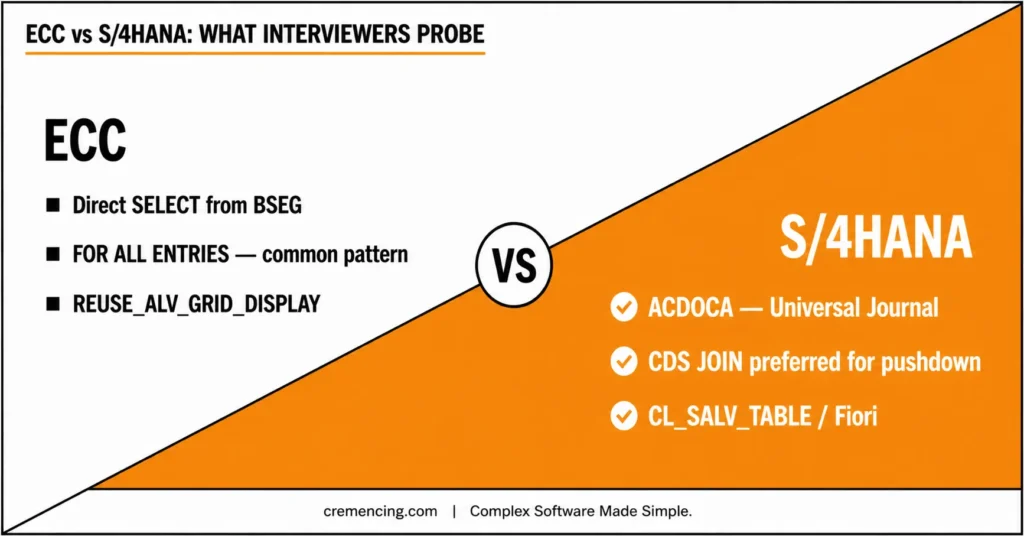
| Topic | ECC Behavior | S/4HANA Change |
| Aggregation tables (BSEG, BSID) | Full tables, direct SELECT | Replaced by Universal Journal (ACDOCA) — direct BSEG queries return zero rows |
| SELECT * on wide tables | Functionally fine, just slow | Against Clean ABAP guidelines; HANA transfers all columns to AS even when unused |
| FOR ALL ENTRIES | Common pattern, works | Still works but CDS JOIN is preferred for pushdown |
| Classic ALV (REUSE_ALV_GRID_DISPLAY) | Standard pattern | Works but deprecated; use CL_SALV_TABLE or Fiori |
| User exits | Available | No new user exits; use enhancement spots. |
| Pooled/cluster tables | Direct SELECT | Migrated to transparent queries mostly unchanged, but T-code behaviour differs |
The question interviewers actually ask: “Your report SELECTS from BSEG directly with a WHERE on BUKRS and BELNR. What happens after migration to S/4HANA?”
This exact scenario is one of the most common ABAP interview questions for 5 years of experience. The correct answer: BSEG still exists as a compatibility view in S/4HANA, but its data source is ACDOCA (the Universal Journal).
Direct SELECTs work, but performance differs because the view has overhead. For new development, query ACDOCA directly or use the standard CDS views like I_JournalEntry. OOP-specific questions senior interviews cover
Clean Core and RAP: The 2026 Shift in ABAP Interviews
The SAP hiring landscape has shifted noticeably heading into 2026, and simply knowing S/4HANA is no longer enough for ABAP interview questions for 5 years of experience. Companies now expect developers to operate comfortably within SAP’s Clean Core approach, meaning the pure “ABAP-only” specialist is gradually giving way to professionals who move between traditional development and cloud-based extension work on SAP Business Technology Platform (BTP).
Expect a direct question like: ‘Where would you build a custom pricing extension in an S/4HANA Cloud project — inside the core, or on BTP?’ The strong answer names Clean Core constraints and RAP/BTP as the default, not a fallback.
Since directly editing SAP’s standard code used to create long-term maintenance headaches, organizations are steering developers toward building custom functionality separately on BTP, while keeping the core system untouched. This has pushed the RESTful ABAP Programming Model (RAP) from a nice-to-have into something most job postings simply assume you already know, alongside CDS views and OData.
When to Use Which Tool — What Interviewers Want to
This is where ABAP interview questions for 5 years of experience get harder — no competitor page answers the “when NOT to” question, and interviewers value candidates who know tool limits.
| Requirement | Right Tool | What to Avoid |
| Expose logic to external system synchronously | RFC-enabled Function Module | Classes they can’t be RFCs |
| Asynchronous data exchange between SAP systems | IDoc + Message Type | BAPI for async BAPIs are synchronous |
| Custom field validation in standard SD transaction | Kernel BAdI / Enhancement Spot | Modifying standard SAP code directly |
| High-volume report on S/4HANA | CDS View + SALV or Fiori | SELECT * loops with ABAP-side aggregation |
| Unit-testable business logic component | OO class with injected interface dependency | FORM routines — can’t be test-doubled |
| Mass data load from legacy system | BAPI with batch commit | Direct INSERT into SAP tables bypasses business logic |
| ALV output with sortable columns and layout variants | CL_SALV_TABLE (S/4HANA) | REUSE_ALV_GRID_DISPLAY — legacy, no Fiori compatibility |
- ST05 before SE30 for SQL performance issues
- BAdI/Enhancement Spot over user exits on EHP4+ and S/4HANA
- BSEG → ACDOCA awareness for any financial reporting question
- Dependency injection via interface for testable ABAP Unit code
- RAP/BTP as default for new custom logic, not core modification
Conclusion
ABAP interview questions for 5 years of experience test one thing above everything else: whether you make decisions or just execute them. Any developer at this level can write a SELECT statement. What separates senior candidates is explaining why you used ST05 before SE30, why you chose a BAdI over a user exit on that specific project, and what changed in your code when the system moved to S/4HANA.
Prepare each technical concept with a real scenario attached to it. That’s the answer that closes offers.
Also you can read more for 3 years of experience Ace ABAP Interview Questions for 3 Years of Experience Like a Pro
Frequently Asked Questions
Q1. What ABAP topics do interviewers focus on for 5 years of experience?
Interviewers focus on performance tuning, enhancement framework selection, OOP design, and ECC-vs-S/4HANA differences. ABAP interview questions for 5 years of experience always test judgment over memorized definitions. At 5 years, you’re expected to justify design choices not just name them. Prepare scenario answers covering SELECT optimization, BADI selection, and at least one migration-related code change you’ve made.
Q2. Is ALV still asked about in senior ABAP interviews in 2025?
Yes — both classic and OO ALV come up regularly. Know REUSE_ALV_GRID_DISPLAY for ECC and CL_SALV_TABLE for S/4HANA. Interviewers asking SAP ABAP interview questions for 5 years of experience expect you to explain the difference, handle layout variants, and attach user command events.
Q3. How should I explain ECC-to-S/4HANA differences in an interview?
Lead with a concrete example, not a definition. Say which table changed (BSEG → ACDOCA), which pattern was deprecated (FOR ALL ENTRIES → CDS JOIN), and what you did differently. Interviewers want evidence you’ve lived through a migration, not that you’ve read a migration guide.
Q4. Are RFC and IDoc questions still common in senior ABAP interviews?
Yes, especially integration-heavy roles. Know the difference between synchronous RFC, asynchronous RFC, and transactional RFC (tRFC). For IDocs, understand the partner profile (WE20), message type, and inbound/outbound process codes. At the senior level, expect scenario questions: “Your tRFC failed — how do you diagnose and reprocess it?”
Q5. What performance tools does a senior ABAP developer need to demonstrate?
(Stack Overflow [abap] tag) ST05 (SQL Trace) for database-level query analysis, SE30/SAT (ABAP Runtime Analysis) for application-server-level profiling, and the ABAP SQL Monitor (transaction SQLM, S/4HANA only) for aggregated query statistics across all users. Knowing which tool to reach for first — ST05 for slow reports, SAT for CPU-heavy loops — is itself a senior-level signal.
Q6. Should I prepare OOP ABAP for a 5-year experience interview?
ABAP is no longer optional at the senior level. BAdI implementations, CL_SALV_TABLE, RAP behavior classes, and ABAP Unit test classes are all OOP constructs. Prepare inheritance, interfaces, polymorphism, and constructor constraints. For S/4HANA roles, also prepare dependency injection via a constructor. Interviewers increasingly ask candidates to demonstrate testable code design.
Do interviewers expect hands-on RAP experience at 5 years, or just awareness?
Awareness is typically sufficient if you haven’t worked on a greenfield S/4HANA Cloud project yet — but you should be able to explain what RAP is for and why it replaces classic development patterns in Clean Core scenarios.
What’s a common mistake candidates make when answering enhancement framework questions?
Naming only one option (usually BAdI) without explaining when a user exit or customer exit would still be relevant on older ECC systems — senior interviewers want the full decision tree, not just the modern answer.
How technical should my answer be when asked about SELECT * performance?
Specific enough to name the actual cost (unnecessary column transfer from HANA to the application server) rather than a generic “it’s slower” — cite a real table and scenario if you have one.
Is it a red flag if I haven’t personally done an ECC-to-S/4HANA migration?
Not necessarily — but you should still be able to explain what changes (like BSEG to ACDOCA) conceptually, even if your hands-on experience is limited to greenfield S/4HANA work.