

Introduction:
An S/4HANA transformation can start with a technically sound system and still move in the wrong direction if the roadmap does not connect business priorities with technical decisions. For instance, choosing a migration approach before assessing data quality, custom code, business processes, integrations, and future architecture can create decisions that become expensive to reverse later. As a result, organizations may face avoidable rework, delays, and higher transformation costs.
That is why an S/4HANA strategic roadmap should do more than define migration dates. Instead, it should establish how the organization will assess its current landscape, select the right transformation approach, define the future-state architecture, prioritize business outcomes, and control execution as requirements change.
In this article, we examine the core elements of an S/4HANA strategic roadmap, from current-state assessment and migration strategy to architecture, execution, governance, and roadmap drift. Ultimately, the goal is to show where transformation plans commonly lose direction and what decision points organizations should establish before execution begins.
S/4HANA Strategic Roadmap Information
S/4HANA strategic roadmap is a structured transformation via how an organization transitions from legacy ERP into SAP S/4HANA in a concerted, value-driven manner.
This is not just a project plan. This is a business and IT alignment framework that defines:
- Migration or transformation approach:
- New Implementation — a fresh SAP S/4HANA implementation, commonly associated with a greenfield approach
- System Conversion — conversion of an existing SAP ERP system to SAP S/4HANA, commonly associated with a brownfield approach
- Selective Data Transition — selective migration and transformation of data, configuration, and processes
Key Roadmap Considerations
An effective S/4HANA roadmap ensures strategic adoption while eliminating complexity and increasing business resilience, ultimately resulting in improved performance over the long term. Without this alignment, organizations risk executing in silos and incurring costly rework downstream.
Therefore, a strategic roadmap should connect business outcomes, transformation scope, architecture, data, integrations, custom development, and execution governance rather than treating each area as a separate workstream.
For example, a finance-led transformation may prioritize faster close cycles and standardized processes. By contrast, a manufacturing organization may place greater emphasis on plant operations, supply chain integration, master data, and shop-floor connectivity. The roadmap should translate those priorities into technical and program decisions.
More importantly, the roadmap should establish decision points before implementation begins. These include the transformation approach, target deployment model, data strategy, integration architecture, custom-code treatment, process redesign scope, rollout sequence, and governance model.
Roadmap Decisions for a Successful SAP Transformation
| Roadmap Decision | What to Assess | Why It Matters |
|---|---|---|
| Transformation approach | New implementation, system conversion, or selective data transition | Determines how much of the existing landscape is retained or redesigned |
| Deployment model | On-premises, Private Edition, or Public Edition | Changes available capabilities, responsibilities, and implementation approach |
| Data strategy | Data quality, historical data, migration scope, retention | Prevents migration issues from becoming late-stage project blockers |
| Custom code | Usage, business criticality, remediation effort | Identifies applications that need remediation, redesign, or retirement |
| Integration architecture | APIs, SAP Integration Suite, external systems, interfaces | Prevents integration dependencies from appearing late in the project |
| Business process scope | Processes to retain, redesign, standardize, or retire | Connects technical transformation with business value |
| Rollout strategy | Big bang, phased, regional, or template-based rollout | Determines how transformation risk and organizational change are managed |
| Governance | Decision owners, quality gates, scope control, roadmap reviews | Helps prevent roadmap drift after project kickoff |
SAP’s current transformation guidance recognizes multiple transition approaches, including new implementation, system conversion, and selective data transition. However, the appropriate approach depends on factors such as the current system, data quality, business-process requirements, custom code, future architecture, and the desired level of transformation. Therefore, organizations should assess these factors before selecting a transition approach.
Before selecting a migration approach, organizations should assess their current landscape, business priorities, data, integrations, and custom code. A complete SAP S/4HANA upgrade playbook can help structure this assessment.
S/4HANA Strategic Roadmap Process Explained
Step 1 — Align to Business Strategy
Step 1 of the roadmap is to align transformation goals with business priorities.
Key activities include:
- Articulating business drivers (cost, agility, compliance)
- Defining transformation outcomes
- Aligning leadership expectations
As a result, it ensures that the roadmap is not IT-led but instead driven by business priorities.
Second 2—Current State Assessment
Organizations analyze how their current SAP Landscape
This includes:
- Legacy system analysis
- Process inefficiencies mapping
- Technical debt identification
This step helps reveal the hidden complexity that drives your migration design.
Step 3 – Future State Architecture Design
It describes the future shape of the enterprise in terms of the organization post S/4HANA.
Key decisions include the following:
- Cloud vs on-premises and hybrid models
- System consolidation strategy
- Integration architecture, including SAP Integration Suite, SAP Cloud Integration, APIs, and other required integration technologies
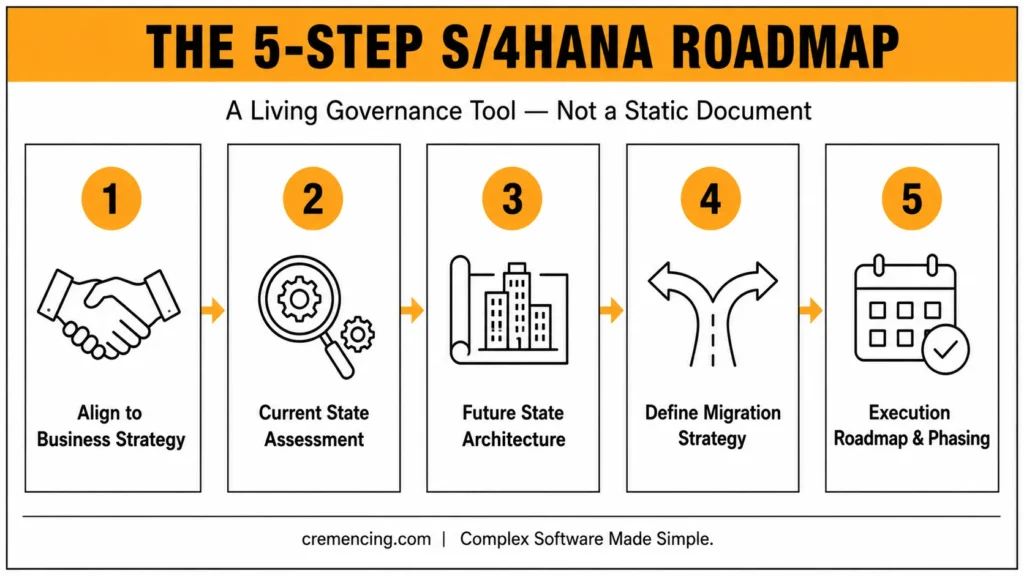
Step 4 — Define a Strategy for Migration
This step outlines the process of migration:
- Greenfield (fresh implementation)
- Brownfield (system conversion)
- Selective data transition
Each option has different effects on cost, timeline, and risk.
Step 5 — Execution Roadmap and Phasing
Last step breaks down strategy into execution phases.
Includes:
- Wave-based rollout planning
- Prioritization of modules (Finance, Supply Chain, etc.)
- Timeline and resource allocation
Ultimately, it helps enable a controlled transformation rather than relying on a high-risk big-bang approach. Custom development should also form part of the roadmap from the beginning. Organizations should evaluate Clean Core S/4HANA extensibility and determine which requirements belong in the core and which should use alternative extension approaches.
Advantages & Return on Investment of Strategic Roadmap for S/4HANA
A clear roadmap provides tangible enterprise value.
Cost Optimization Impact
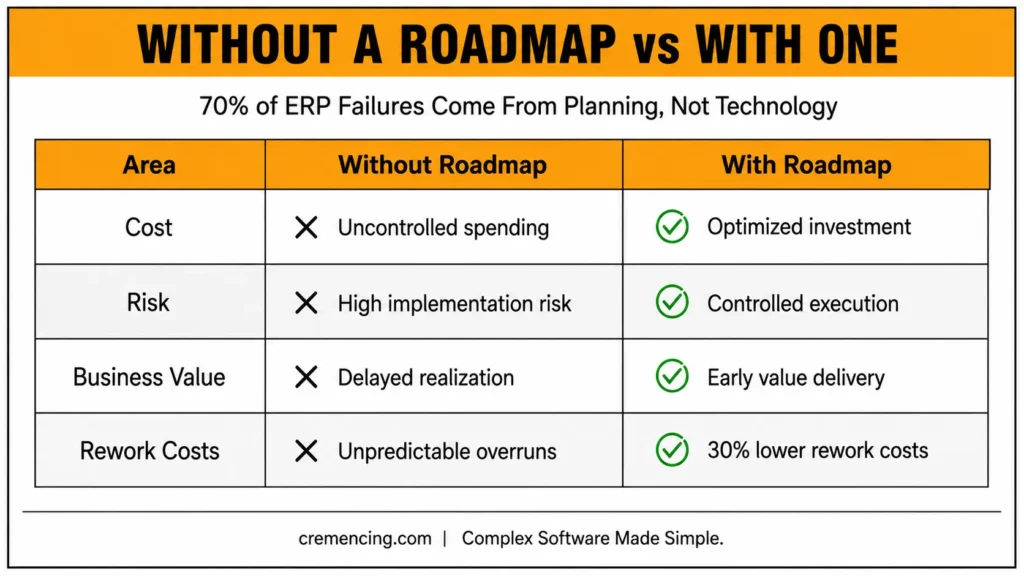
- 30% lower transformation rework costs
- 20–35% lower long-term maintenance costs
- Lower integration and system redundancy expenses
Operational Efficiency Gains
- Furthermore, organizations can accelerate process automation across both finance and supply chain operations.
- Improved reporting and real-time analytics
- Reduced dependency on legacy systems
Strategic Business Impact
- Clean data models = better decision-making
- Improved scalability for future growth
- Stronger digital transformation alignment
| Area | Without Roadmap | With Roadmap |
| Cost | Uncontrolled spending | Optimized investment |
| Risk | High implementation risk | Controlled execution |
| Business Value | Delayed realization | Early value delivery |
Common Mistakes And Best Practices
However, many organizations misfire because they view S/4HANA as a technical upgrade to the IT system rather than an enterprise-wide transformation.
Common Mistakes
- Starting implementation without business alignment
- Ignoring process redesign opportunities
- Underestimating data complexity
- Selecting the migration approach too early
- Poor stakeholder communication
Best Practices
- Before designing the technical design, define the business outcome
- In-depth system & process auditing
- If possible, use phased transformation instead of a big-bang rollout
- Bring business users on board from day 1
- Incorporate flexibility into a roadmap for change
What Your Competitors Are Not Talking About
It’s largely about migration steps/a technical model in anything to do with S/4HANA content. But they ignore one of the most important failure factors:
Roadmap drift after project kickoff
In many enterprises:
- Have an initial roadmap, but only implement it in working code
- Business priorities change mid-project
- Technical teams continue outdated assumptions
- Scope expands without governance control
That gives rise to a type of failure without notice where
- Budget increases without ROI increase
- Timeline extends repeatedly
- Business value gets delayed indefinitely
Key insight:
The S/4HANA Strategic Roadmap should not be a static planning document; it needs to function as a living governance tool. Lacking continual identity and roadmap validation, projects—even those that are well-crafted—fail in execution.
Once the strategic direction is established, the execution model also needs clear phases, ownership, and governance. The SAP Activate methodology provides a useful framework for structuring S/4HANA implementation activities.
Conclusion
The S/4HANA Strategic Roadmap is more than a migration plan. It connects business priorities with transformation scope, architecture, data, integrations, custom development, and execution governance. Without this alignment, organizations can face uncontrolled costs, disjointed execution, repeated rework, and delayed business value.
More importantly, the roadmap should continue to evolve throughout the transformation. Business priorities can change, technical assumptions can become outdated, and new requirements can expand the scope. Therefore, regular roadmap reviews and clear governance are essential to keep the transformation aligned with its original business objectives.
In the end, successful S/4HANA implementation depends not only on the technology selected but also on how strategically the transformation is planned and governed. A well-designed, continuously validated roadmap helps organizations control risk, maintain direction, and turn S/4HANA adoption into measurable business value.
FAQs
Yes. The current FAQs have the right topics, but several answers are too short, grammatically awkward, or overly generic. Since this is an SAP strategy article, the FAQs should give a useful answer without becoming mini-sections.
Here is a stronger final version:
What is a Strategic Roadmap for S/4HANA?
An S/4HANA strategic roadmap is a structured plan that connects business objectives with the technical, data, architecture, migration, and governance decisions required for the transformation.
Why is an S/4HANA strategic roadmap important?
An effective roadmap helps organizations identify risks early, control transformation costs, prioritize business outcomes, and keep technical decisions aligned with long-term business goals.
What are the phases of an S/4HANA migration roadmap?
The main phases typically include current-state assessment, business and technical strategy, future-state architecture, migration planning, execution, and governance. The exact sequence can vary depending on the transformation approach and landscape.
What causes S/4HANA projects to fail?
Common causes include poor business alignment, incomplete current-state assessment, underestimated data and custom-code complexity, weak governance, unclear ownership, and roadmap changes that are not properly controlled.
How long does an S/4HANA transformation take?
The timeline varies significantly based on system complexity, data volume, custom development, integrations, business-process changes, and rollout strategy. A transformation can take several months or extend beyond two years for large, complex enterprises.
What are the main S/4HANA transformation approaches?
Organizations generally consider new implementation, system conversion, or selective data transition. The appropriate approach depends on the existing SAP landscape, business requirements, data, custom code, and desired level of transformation.
How do you choose the right S/4HANA migration approach?
Start by assessing the current SAP system, business processes, data quality, custom code, integrations, and future-state requirements. Then compare how each transformation approach supports the organization’s business and technical objectives.
What should an S/4HANA strategic roadmap include?
A strong roadmap should cover business objectives, transformation scope, deployment model, data strategy, custom-code treatment, integration architecture, process redesign, rollout planning, timelines, ownership, and governance.
How can organizations prevent S/4HANA roadmap drift?
Organizations can reduce roadmap drift by establishing clear decision owners, governance checkpoints, scope controls, measurable business outcomes, and regular roadmap reviews. This allows teams to adjust the plan when priorities or technical requirements change.
What is the difference between an S/4HANA roadmap and a migration plan?
A migration plan focuses primarily on how and when the technical transition will happen. In contrast, a strategic roadmap connects the migration with business objectives, architecture, data, processes, governance, and the organization’s longer-term transformation strategy.





3 Responses