
Introduction
We planned this migration properly” is the sentence every stalled SAP S/4HANA program manager says right before explaining a 30% budget overrun. It’s not a lie — the plan usually was reasonable, the timeline was reviewed, the resources were allocated. The problem is that SAP S/4HANA migration costs don’t blow up because of bad planning. They blow up because planning, by design, can only account for what’s already known.
The real cost drivers — undocumented ECC dependencies, custom objects nobody remembers building, integration touchpoints that only surface once testing starts — live in the parts of the legacy system that no planning phase fully maps. This article breaks down exactly where that hidden cost comes from, why it survives even disciplined planning, and what a cost control framework needs to catch it before it compounds.
This article disaggregates why SAP S/4HANA migration costs go out of control even in well-constructed programs. You will learn:
- The point where cost leakages occur in SAP projects.
- The more obscure dependencies, the more effort it takes to execute.
- Why even with all the planning, do migrations go bankrupt?
- Practical means of managing cost before its increase.
Knowledge of these patterns can assist businesses in avoiding budget overruns before their inception.
What SAP S/4HANA Migration Costs Really Entail.
SAP S/4HANA migration costs do not include licensing, or infrastructure. They contain a very broad spectrum of latent and apparent layers of costs.
Core components include:
- System conversion and technical upgrades.
- Bespoke code enhancement and refinement.
- Migration and validation of data.
- Rework of integration between systems.
- Regression and testing cycles.
- User training and change management.
Indirect costs are underestimated by the majority of enterprises, primarily rework and prolonged testing. It is in these concealed layers that budgets creep up.
| Cost Category | Visibility in Initial Budget | Typical Risk of Underestimation |
|---|---|---|
| Licensing & infrastructure | High | Low |
| System conversion (technical) | High | Low-Medium |
| Custom code remediation | Medium | High |
| Data migration & validation | Medium | Medium-High |
| Integration rework | Low | High |
| Regression/testing cycles | Low | High |
| Training & change management | Low | Medium |
Why Migration Costs of SAP S/4HANA Go Out of Control.
Step 1: Complexity Discovery Hidden System.
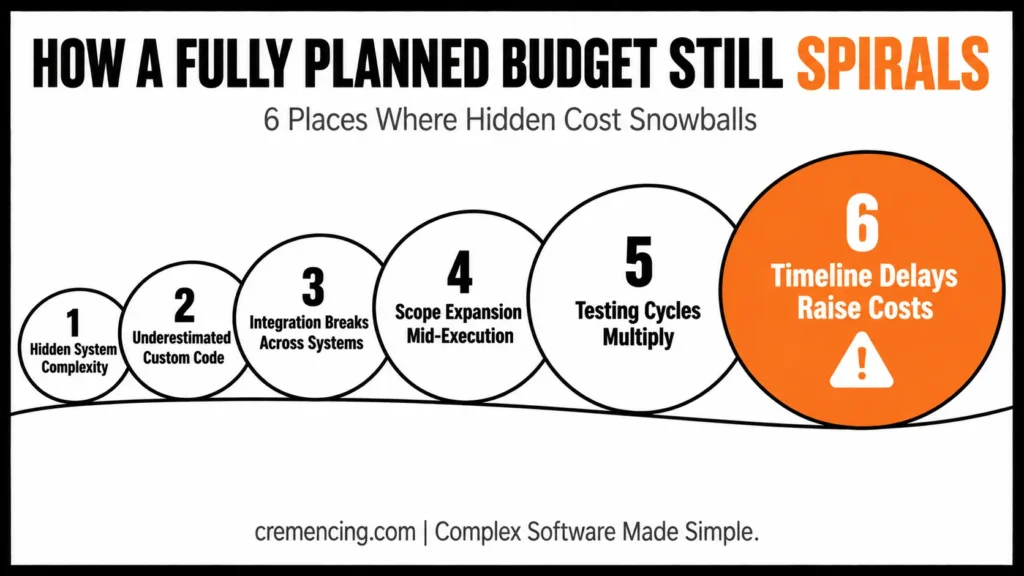
The heritage SAP ECC systems are usually unpredictable with their dependencies during migration. These augment SAP S/4HANA migration costs early in implementation.
Step 2: Underestimated Custom Code Impact.
The number of custom objects needing redesign or replacement is in the thousands, which introduces unexpected effort.
Teams should quantify custom code impact early using the Custom Code Migration app (or ABAP Test Cockpit / ATC for on-premise systems), which flags which custom objects are still used, which are obsolete, and which will break under S/4HANA’s simplified data model. Counting custom objects by RICEFW category (Reports, Interfaces, Conversions, Enhancements, Forms, Workflows) gives a far more defensible impact estimate than a generic object count — teams that skip this step routinely discover “orphan” custom code mid-project that nobody scoped for.
Step 3: Integration Breaks Across Systems
There must be changes to third-party systems and APIs, which adds time and cost
Step 4: Scope Expansion in the Process of Execution.
Business teams tend to demand further modifications as soon as the project commences.
Step 5: Testing Cycles Multiply.
Interrelated system changes make regression testing grow exponentially.
Step 6 Timeline Delays Increase Resource Costs.
Long periods of time directly add costs of consulting and infrastructure.
Cost Impact and ROI Breakdown.
Enterprises usually incur the following costs: When the SAP S/4HANA migration costs exceed the plan, they usually incur:
- 20-35% budget overrun in an average project.
- Increase in testing effort by 50% or more.
- Extension of the average timeline by 3-6 months.
- Greater reliance on outside SAP consultants.
ROI is affected in three important ways:
- Delayed go-live decreases the realization of business value.
- Additional resources raise the operational burn rate.
- Rework decreases transformation efficiency in general.
Minor setbacks add up with time to huge financial disparities.
Typical Problems that Make SAP S/4HANA Migration Costs.
- Disregard the system dependencies of legacy systems.
- Before migration, hidden ECC dependencies are not completely mapped.
- Considering migration as a mere technical upgrade.
- Business process redesign is not taken seriously most of the times.
- Poor scope control
- Other requirements are appended regardless of cost-impact analysis.
- Weak testing strategy
- Lack of test coverage results in costly repairs in future.
- Absence of real time tracking of costs.
- Deviations in the budget are normally realized at a very late time
What are the most SAP cost guides?
The majority of the content is based on the initial budgeting with neglecting cost inflation during the execution phase.
What you may not realize:
- Increase in costs during integration testing cycles.
- Delay latency due to inconsistencies in data.
- Rework due to a lack of full mapping of the system.
- Scope expansion induced by business users.
- Late-stage architecture adjustments
These are the actual impetus to uncontrolled SAP S/4HANA migration costs.
Step-by-step Cost Control Framework.
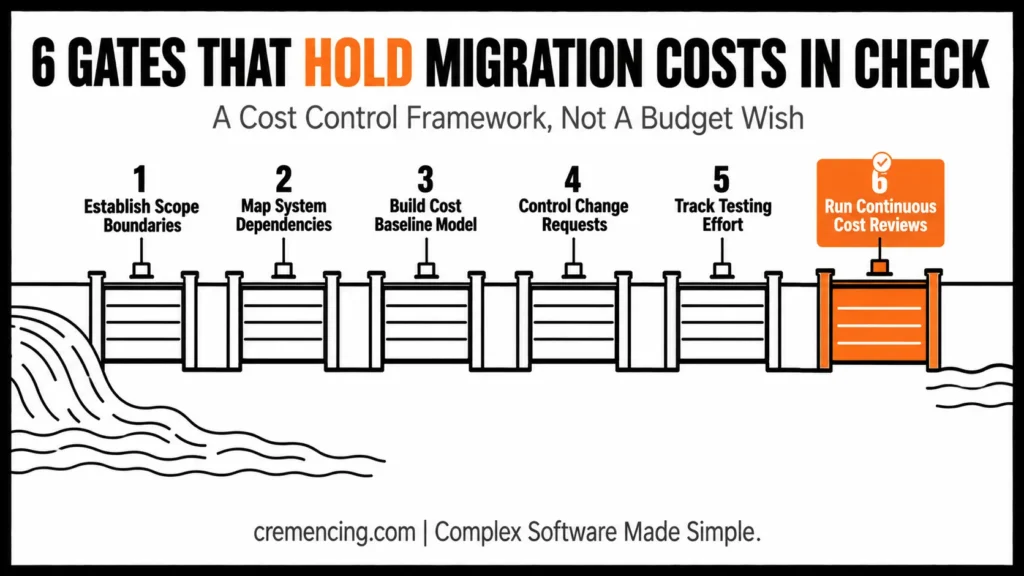
Step 1: Establish Realistic Scope Boundaries.
Migration of the lock before technical implementation starts.
Step 2: Map System Dependencies.
Determine all cross-module and external system dependencies
This is where SAP Readiness Check earns its place in the framework — it surfaces simplification item relevance, add-on compatibility, and custom code impact in one report, giving you a dependency map before technical work starts rather than discovering dependencies mid-conversion.
Step 3: Build Cost Baseline Model
Develop a distinct base-point of all categories of migration costs.
Step 4: Control Change Requests
Assess all change requests on cost implications.
Step 5: Track Testing Hard work.
Monitor testing cycles and avoid redundant cycling.
Step 6: Run Continuous Cost Reviews
Carry out weekly cost variance analysis.
SAP S/4HANA Cost Control Checklist
- Lock scope before technical work starts
- Run SAP Readiness Check to map dependencies early
- Assess custom code via Custom Code Migration app / ATC, by RICEFW category
- Baseline cost by category (see table above)
- Score every change request for cost impact before approval
- Track testing cycles — flag redundant/repeated cycles
- Run weekly cost variance reviews, not phase-end reviews
Advantages of SAP S/4HANA Migration Cost Control.
Effective cost management will yield quantifiable returns:
- 25-40 per cent decreasing budget overruns.
- Reduced project implementation schedules.
- Reduced reliance on third-party consultancy.
- Enhanced ROI of SAP transformation.
- Reduced operational disruption
Cost discipline has a direct impact on the success rate of projects.
Conclusion
Planning fails to prevent SAP S/4HANA migration cost overruns for a simple reason: it can only budget for what’s already visible, and the biggest cost drivers — undocumented custom code, integration dependencies, testing cascades — aren’t visible until execution starts surfacing them. That’s not a planning failure; it’s a planning limitation, and the fix isn’t a better upfront estimate. It’s continuous dependency tracking, RICEFW-level custom code assessment, and weekly cost variance reviews that catch drift while it’s still small.
If you approved your migration budget based on a single upfront estimate with no ongoing variance tracking, the overrun isn’t a risk — it’s already in motion. Cost control needs to start on day one of execution, not the day the first overrun report lands.
FAQ
Why do SAP S/4HANA migration costs grow in the course of execution?
Since concealed dependencies and scope changes surface after the project starts.
Which cost driver is the largest in the migration of SAP?
One-off code fixes and integration tweaking.
Is SAP migration cost-effective?
Yes, strict scope control and dependency mapping.
And why do the costs of testing get so high?
Due to the effect of changes on various interlaced modules of SAP.
What can be done to lower the costs of migration?
The scope control, dependency tracking, and early change request management are used to control the scope, track dependencies, and address change requests at an early stage.
Does moving to SAP S/4HANA Cloud avoid the cost overruns described here?
Not entirely — Cloud implementations avoid some legacy-conversion risk (custom code, ECC dependencies) but introduce their own cost drivers, like fit-to-standard gaps and side-by-side extension development. The specific risks shift; the discipline needed to control them doesn’t.
How early should custom code impact assessment happen in a migration project?
Ideally before the project is formally scoped or budgeted — running a Custom Code Migration app / ATC scan during the assessment phase, not after conversion begins, is what prevents the “thousands of unexpected objects” scenario.
What’s the difference between scope creep and legitimate change requests during migration?
Legitimate change requests are evaluated against cost and timeline impact before approval; scope creep is when requirements get added without that evaluation. The distinction isn’t the request itself — it’s whether it went through cost-impact review.
Can SAP Readiness Check alone prevent migration cost overruns?
No — it’s a strong starting map of dependencies and complexity, but it’s a point-in-time assessment. Costs still grow if dependency tracking and change control aren’t sustained through execution.
Who should own cost control during an SAP S/4HANA migration — IT or the business?
Neither exclusively. Cost control works best as shared ownership: IT tracks technical dependencies and testing effort, while business stakeholders own scope discipline and change-request prioritization.
Resources
https://help.sap.com
https://www.sap.com/products/erp/s4hana.html
https://community.sap.com




2 Responses