If your SAP team needs maximum process standardization and SAP-managed upgrades, SAP S/4HANA Cloud Public Edition is usually the stronger fit. If your transformation depends on broader functional scope, existing investments, deeper configuration, or a more flexible transition path, SAP S/4HANA Cloud Private Edition deserves closer consideration.
That distinction matters because “public vs private cloud” is not simply a hosting decision. The two SAP offerings differ in implementation options, functional scope, extensibility, upgrade cadence, and operational responsibility. SAP’s current offering comparison makes those differences explicit.
For CIOs, SAP architects, and transformation leaders, the real question is therefore not which cloud model is more modern. It is which operating model matches your business processes, technical landscape, and ability to standardize.
This guide compares SAP S/4HANA Cloud Public Edition and Private Edition through that lens, with particular attention to digital maturity, customization, migration options, upgrade governance, and long-term transformation risk.
Why Enterprise Leaders Must Consider the Public vs Private Cloud Debate
Your decision to deploy S/4HANA will define your enterprise’s operating model for the next 10 years. It influences:
- How fast you can innovate
- The tech debt you will take to the next one
- How predictable your IT spend is
- How readily accessible SAP’s future roadmap is
Most significantly, it shapes whether S/4HANA is an enabler of growth or just a new system for doing the same old things.
Executives who underestimate this choice often realize the mistake too late — when changing course is costly and painful.
A high-level overview of SAP S/4HANA public cloud vs private cloud strategic context is vital for leaders to ensure decisions about technology are built on actual capability, not what they wish it were.
Understanding SAP S/4HANA Public Cloud
Understanding SAP S/4HANA Public Cloud
SAP S/4HANA Public Cloud is for businesses that demand the speed, value, and pared-down simplicity of ERP in a cloud model.
Key Characteristics:
- Software-as-a-Service (SaaS) delivery
- Two software upgrades per year, managed by SAP
- Strive to adhere closely to standard SAP best practices.
- Limited customisation, high configurability
- Faster implementation timelines
Public cloud removes responsibility from internal IT, shifts it to SAP – reducing operational overhead while enabling faster innovation.
Key benefits for S/4HANA Public Cloud (Strategic):
Reduced Time-to-Value: Implementations happen faster, so you realize value earlier.
Reduced Upfront Cost: By paying for subscription-based pricing, CapEx is out the window, and cost management is in.
Always Up-To-Date. New features, regulatory changes, and enhancements are implemented with no additional effort on your part.
Clean core by design: the script is resistant to heavy modification, meaning it will not break your system once the next update.
Where Public Cloud Can Cause Friction:
- Insufficient flexibility to accommodate different pathways of maturation
- Constraints for complex legacy integrations
- Upgrade fatigue from the high frequency of upgrades
- Organisational resistance to standardisation
This is where digital maturity comes into play.
Understanding SAP S/4HANA Private Cloud
SAP S/4HANA Private Cloud provides more control and flexibility, with the same cloud infrastructure advantages.
| Dimension | Public Edition | Private Edition |
|---|---|---|
| Tenancy | Multi-tenant, SaaS | Single-tenant, dedicated |
| Commercial program | GROW with SAP | RISE with SAP |
| Upgrade control | SAP-managed, 2x/year, fixed schedule | Customer-controlled timing |
| Customization | Configuration within standard scope (clean core) | Deep customization and extension supported |
| Legacy/complex integration | Limited | Well-supported |
| Best-fit digital maturity | High | Low–Medium (transitional) |
| Typical cost profile | Lower upfront, predictable subscription | Higher operational cost, more control over spend timing |
Key Characteristics:
- Single-tenant environment
- Greater freedom in customisation
- Customer-controlled upgrade timing
- Supports complex integrations and extensions
- Often part of RISE with SAP
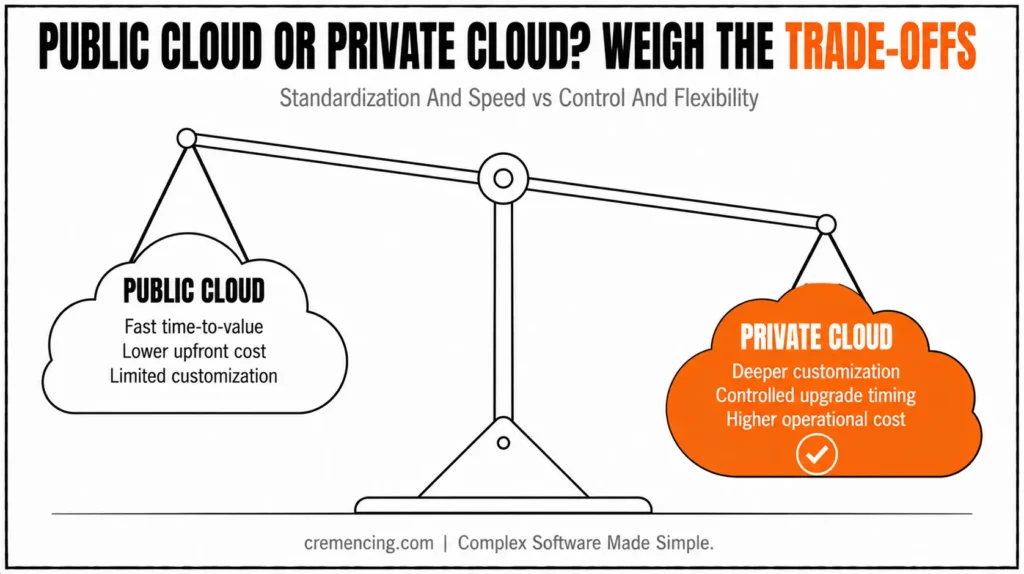
Private cloud often appeals to larger organizations with complex environments or regulatory demands.
Strategic Advantages of S/4HANA Private Cloud:
- Business process continuity: Keep existing business processes despite any platform changes.
- Managed Change: Changes can be coordinated with firm’s readiness.
- Integration choices: Overall solutions that are compatible with codebases having a lot of third-party dependencies.
- Less Risk of Impact: Great for high-pressure tasks where failure is not acceptable.
Trade-Offs Executives Must Consider:
- Higher overall cost of ownership
- Chances of incurring legacy debt
- Slower adoption of innovation if governance is poor
Private cloud provides freedom — but without discipline, that freedom could hinder transformation goals.
Digital Maturity: The Missing Yardstick
The biggest differentiator between public cloud and private cloud adoption is digital maturity – not organisation size or sector.
Digital maturity reflects:
- Process standardisation
- Data governance discipline
- Change management capability
- Cloud operating experience
- Business–IT alignment
Low Digital Maturity: Stabilise Before You Optimise
Common challenges:
- Highly fragmented processes
- Heavy customisation
- Limited process ownership
- Reactive IT operations
Best-Fit Deployment Model: Private Cloud (initially)
- Gradual process harmonisation
- Risk-controlled modernisation
Public cloud may cause friction in less mature enterprises.
Medium Digital Maturity – Balance Control Versus Standardisation
Characteristics:
- Partially standardised processes
- Growing integration ecosystems
- Improving governance models
Best-Fit Deployment Model: Private Cloud – With Options or Hybrid Selective Approach
- Reduce custom code
- Introduce Fit-to-Standard practices
- Prepare for eventual public cloud adoption
This strategy balances transformation speed with organizational preparedness.
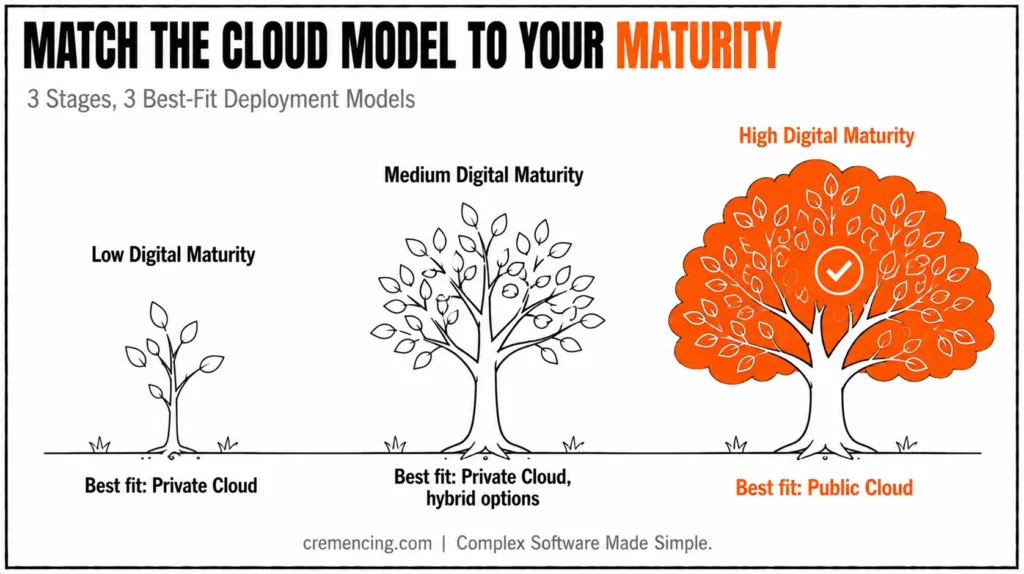
High Digital Maturity: Realize Agility and Innovation
Characteristics:
- Strong process ownership
- Standard-first mindset
- Effective change management
- API-driven architectures
Best-Fit Deployment Model: SAP S/4HANA Public Cloud
- Faster innovation cycles
- Lower operational overhead
- Strong alignment with SAP’s roadmap
Standardisation becomes an advantage, not a barrier.
Fit-to-Standard as the Deciding Capability
Fit-to-Standard Adoption – Success depends more on Fit-to-Standard adoption than deployment model.
- Organisations refusing to standardise fare poorly in both models:
- Public cloud: Structural limitations
- Private cloud: Legacy complexity replicates
Executives should assess:
- Willingness to adapt processes
- Governance around exceptions
- Long-term upgrade discipline
Fit-to-Standard maturity often predicts public cloud success.
Cost-Savvy: Short-Term and Long-Term Reality
Public Cloud:
- Lower upfront cost
- Predictable subscriptions
- Lower upgrade and maintenance burden
Private Cloud:
- Higher operational costs
- Operational responsibility depends on the contracted service model and managed services arrangement
- Potential escalation of support costs over time
The least-expensive upfront option is not always the most cost-effective long-term, especially if technical debt accumulates.
Common Executive Pitfalls to Avoid
- Opting for public cloud without organisational preparedness
- Opting for a private cloud without a clean-core plan
- Treating deployment choice as permanent instead of evolving
- Ignoring change management and adoption
Successful Organizations:
- Assess digital maturity honestly
- Match deployment decision to business capability
- Treat cloud adoption as a journey, not a switch
- Revisit decisions as maturity evolves
Final Thought:
Match the Cloud to the Business, Not the Buzz
- Public cloud: Rewards disciplined, standardised, agile work
- Private cloud: Pays for control, complexity management, phased evolution
The correct choice resonates with where your organisation is today — and supports what it will become tomorrow.
Next Steps
- Assess your true digital maturity
- Review process standardisation readiness
- Connect cloud and outcomes
- Align cloud strategy with business results
A clear-eyed decision today will avert costly course corrections later.
FAQs
What are the key differences between SAP S/4HANA public cloud vs private cloud?
- Public cloud: Standardisation and fast innovation
- Private cloud: Control and flexibility
Is SAP S/4HANA a public cloud for large enterprises?
Yes, if digitally mature and predisposed to utilize standard processes
Can we move from private cloud later?
Yes, many businesses adopt private cloud as a step toward liberal cloud adoption
Which type of deployment is more economical?
Public Edition generally emphasizes standardized processes, SAP-managed operations, and frequent SAP-managed upgrades. Private Edition provides a broader functional scope and greater configuration and extensibility flexibility. The better choice depends on process requirements, existing investments, transformation readiness, and the required operating model.
How does digital maturity reflect in options for deployment?
Digital maturity defines readiness for standardisation, change velocity, and constant innovation
Is SAP Cloud ERP the same as SAP S/4HANA Cloud Public Edition?
Yes — SAP has repositioned Public Edition under its broader “SAP Cloud ERP” branding since 2025. The product and functionality haven’t changed, just the marketing name.
What is GROW with SAP?
It’s SAP’s commercial and delivery program bundling Public Edition with implementation methodology, tools, and a fixed-scope approach — the Public Edition counterpart to RISE with SAP.
Can you customize SAP S/4HANA Cloud Public Edition at all?
Yes, through in-app extensibility and configuration, but not through core code modification — that constraint is what keeps the “clean core” intact for future upgrades.
Does Private Edition support the same Fiori/UX experience as Public Edition?
Largely yes; Private Edition runs on the same underlying S/4HANA technology stack, though older or heavily customized landscapes may retain more classic GUI elements alongside Fiori.