
Introduction
Six months after budget approval, finance, supply chain, and HR still describe the ERP project goals differently. This misalignment often occurs when teams treat a NextGen ERP implementation as a technical migration. The project also requires significant business change.
Project teams typically discover this gap during SAP S/4HANA fit-to-standard workshops. Unresolved decision rights and unclear scope can delay design sign-off. They can also increase change requests and project costs.
This article outlines ten implementation principles. The principles cover governance, partner selection, scope control, fit-to-standard strategy, and compliance. They can help SAP architects, program managers, and decision-makers structure a cloud-native, AI-enabled ERP program. The goal is to reduce late-stage surprises and create a clearer path to go-live.
Why NextGen ERP Implementation Programs Fail
- Real-time decision-making with embedded AI
- Mobile-first and cloud-native architecture
- Modular structure for flexible implementation
- IoT and analytics integration
- ESG compliance and sustainability tracking
NextGen ERP refers to cloud-native, modular, and AI-enabled ERP platforms. These platforms provide real-time transactional and analytical data through a single data model.
Within the SAP portfolio, SAP S/4HANA, SAP S/4HANA Cloud, and SAP Business Technology Platform (SAP BTP) provide core platforms for extensions and integrations. Compared with SAP ECC, these platforms place greater emphasis on standard processes and embedded analytics. They also support release-driven innovation. As a result, SAP programs require different approaches to governance and delivery.
Most failures do not originate in the technology itself. They often result from decision latency, unclear ownership, uncontrolled customization, and late compliance requirements. Organizations that carry ECC-era practices into an S/4HANA program can recreate legacy-system challenges on a modern platform.
Examples include heavy modifications and lengthy process-by-process negotiations with departments. These practices can increase project costs and complexity. SAP ECC 6.0 mainstream maintenance is currently scheduled to end in 2027. Optional extended maintenance runs to 2030. This timeline creates an external deadline for organizations planning their transition. Weak governance can make the resulting challenges more costly.
The scope of a NextGen ERP implementation now extends beyond finance and logistics. Typical programs may include embedded AI capabilities such as Joule and intelligent document processing. They may also include IoT data from plant systems, ESG reporting, and mobile access through SAP Fiori.
Each capability adds integration and data-quality requirements. For this reason, the principles below start with governance. They then move into scope, process design, and configuration.
10 Principles for a Successful NextGen ERP Implementation
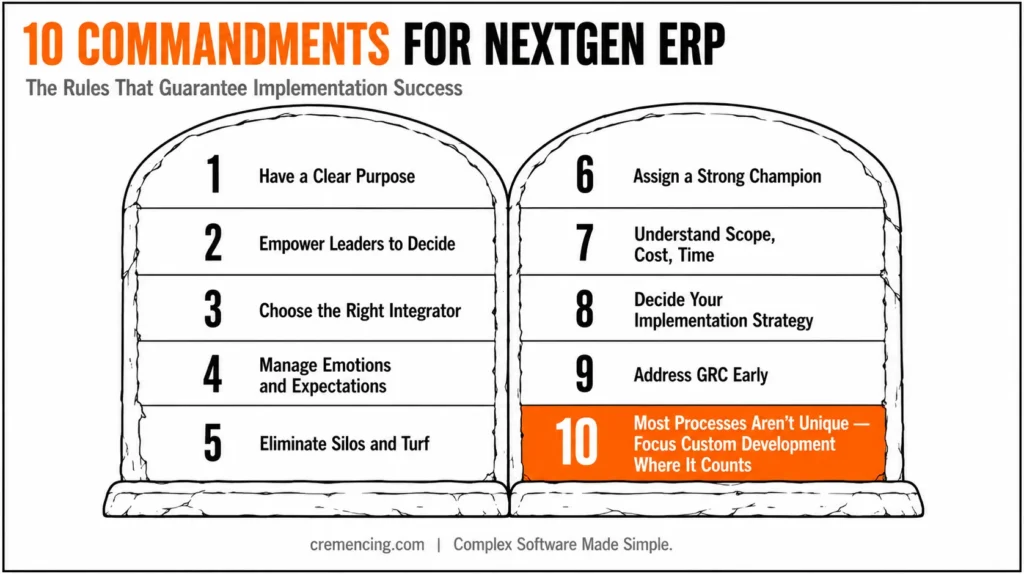
1. Define a Measurable Purpose and Communicate It Company-Wide
A business case for an SAP S/4HANA implementation should focus on quantifiable outcomes such as a shorter financial close, reduced manual reconciliation, improved inventory visibility, or faster order-to-cash cycles. In SAP Activate terms, teams establish this purpose during the Discover and Prepare phases and then use it as the reference point for every scope decision in Explore and Realize. If department heads cannot explain in their own words why the organization is investing in the program, the steering committee has a communication problem that will surface later as resistance during fit-to-standard workshops.
A practical test is to ask five people from different functions to state the top three program objectives and compare the answers. Divergent answers indicate that the business team wrote the business case for approval rather than execution, and correcting it costs far less at this point than after the team signs off on the design.
2. Give Process Owners Real Decision Rights
Each end-to-end process, such as procure-to-pay, order-to-cash, record-to-report, and hire-to-retire, needs a named business process owner who can approve design decisions without escalating every question to the steering committee. Centralized approval creates queues, and queues are particularly damaging during the Explore phase, when teams must make dozens of fit-to-standard decisions within a few weeks. Process owners in finance, supply chain, and HR should therefore have documented authority to decide between standard processes and extensions within agreed cost and timeline boundaries.
Decision rights should also include an escalation path with a defined response time. Programs that specify, for example, a 48-hour turnaround for design questions maintain workshop momentum, while programs without this rule tend to accumulate open items that teams revisit during testing.
3. Select the System Integrator Carefully and Manage Accountability Contractually
The system integrator (SI) influences delivery quality as much as the ERP product does, so selection should examine references in comparable industries, experience with the specific SAP release and deployment model, and demonstrated organizational change capability. The statement of work should define deliverables per SAP Activate phase, roles on both sides, acceptance criteria, and how change requests are estimated and approved. Ambiguity in responsibilities for data cleansing, integration testing, or cutover rehearsals is a frequent cause of disputes in the final months of a program.
Accountability also depends on transparency. Requiring regular reporting through a shared tool such as SAP Cloud ALM gives the customer independent visibility into requirements, test progress, and open defects instead of relying only on status reports produced by the partner.
4. Manage Expectations and Team Dynamics Deliberately
ERP programs create sustained pressure on business teams, which continue to run daily operations while contributing to design, testing, and training. Frustration typically increases when priorities change without explanation, when teams delay responses, or when employees learn about decisions indirectly. A regular communication rhythm, including weekly program updates and monthly steering reviews with visible decisions and risks, reduces the friction that teams would otherwise manage informally and inconsistently.
Leaders should also set realistic expectations about what the standard system will and will not do. Users who expect the new system to replicate every existing report and workaround will judge the project by what it lacks, so early demonstrations of standard SAP Fiori applications help recalibrate expectations before teams finalize the design.
5. Address Silos and Organizational Politics Early
A unified data model exposes process differences and performance data across departments that previously worked with separate spreadsheets and local systems. Some managers may perceive this transparency as a loss of control, and the resulting resistance often appears as requests for exceptions, local extensions, or delayed approvals. Change management should therefore include stakeholder mapping in the Prepare phase, with specific attention to functions whose responsibilities will change most.
Executive sponsorship matters most in these situations. When conflicting requirements arise between business units, the sponsor should decide based on enterprise outcomes and document the decision in the design log so that the same argument does not reopen in later phases.
6. Appoint an Internal Champion and an Experienced Program Manager
The internal champion should understand business operations well enough to challenge process assumptions and understand system constraints well enough to recognize when a requested feature conflicts with the standard design. This person acts as the bridge between business owners and the delivery team and should have enough seniority to influence department heads. The program manager, in turn, manages timeline, budget, risks, and dependencies across workstreams such as data, integration, testing, and training.
Both roles need explicit backing from the executive sponsor and sufficient time allocation. A champion assigned at 20 percent of capacity while also running an operational department rarely provides the continuity that a multi-year program requires.
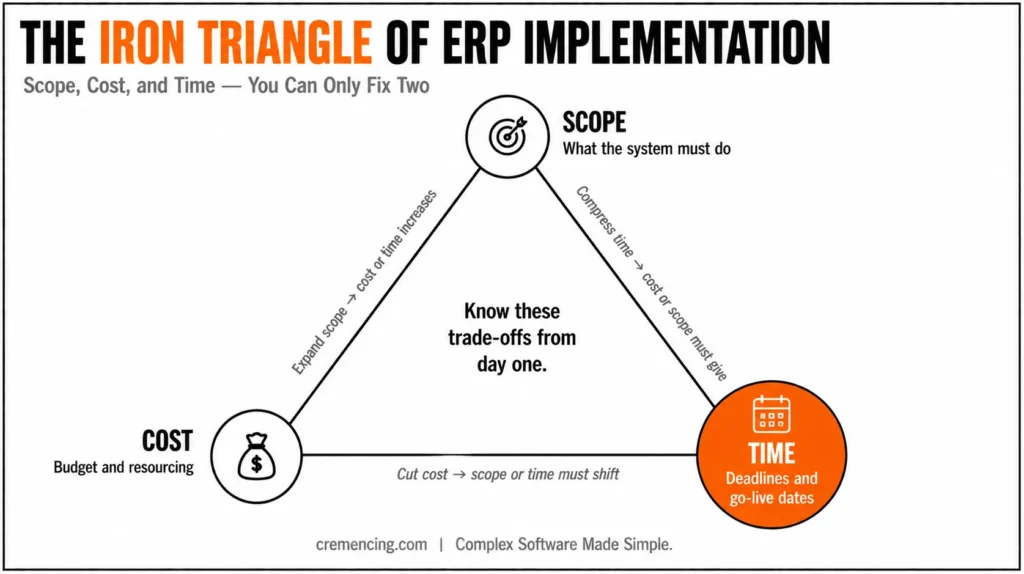
7. Understand the Trade-Off Between Scope, Cost, and Time
Every ERP program operates under the constraint that expanding scope increases cost, duration, or both, and leaders should understand this relationship at the beginning of the project. A formal change control process with impact assessments for effort, cost, and schedule prevents teams from expanding scope through informal requests during workshops. Each accepted change should identify what it replaces, delays, or adds to the budget.
For SAP S/4HANA implementation programs, scope creep frequently enters through custom reports, additional interfaces, and legacy data volumes that teams did not include in the original estimate.Tracking these categories separately in the change log makes trends visible to the steering committee before they affect the go-live date.
8. Choose the Right ERP Implementation Strategy
The implementation strategy determines how much of the standard SAP solution teams adopt and where they address differentiating requirements. In SAP Activate, teams discuss this decision during fit-to-standard analysis, where business teams review the delivered scope, including SAP Best Practices content, and document gaps against actual requirements. The table below summarizes the three approaches most commonly discussed in NextGen ERP programs.
| Approach | Description | Typical Use | Main Trade-Off |
|---|---|---|---|
| Fit-to-Standard | Adopt SAP standard processes with minimal deviation | Organizations prioritizing speed, lower cost, and upgrade compatibility | Business must adapt to standard process design |
| Fit-to-Purpose | Adapt selected processes where they provide competitive advantage | Companies with differentiating processes in areas such as pricing, logistics, or manufacturing | Higher design effort and ongoing extension maintenance |
| Fit-to-Template | Deploy a standardized global template with local adjustments | Multi-country groups requiring consistent processes and reporting | Requires strong template governance and local compliance handling |
Fit-to-Standard and the Clean Core Principle
A SAP clean core approach keeps the ERP system close to the SAP standard. It moves differentiating logic into side-by-side extensions on SAP BTP. It can also use in-app extensibility with released interfaces.
This approach preserves upgrade capability, especially in SAP S/4HANA Cloud. SAP applies quarterly or semiannual releases to the system. Custom code that uses unreleased objects can create upgrade challenges. Direct modifications to SAP standard tables can cause similar problems. These customizations often become major obstacles during later release upgrades.
Where SAP Custom Development Fits
SAP custom development remains relevant for requirements that standard functionality cannot cover, such as industry-specific pricing logic, specialized production scheduling, or integration with proprietary equipment. The design question is whether the requirement creates measurable competitive value and whether teams can implement it through a released extension point.
9. Include Governance, Risk, and Compliance in the Initial Design
Security roles, segregation of duties, audit trails, and approval workflows often enter the project schedule too late. This timing can force teams to redesign authorizations and processes shortly before go-live.
In SAP S/4HANA, business roles should be planned alongside process design. This includes SAP Fiori launchpad roles and PFCG role design. It also includes SAP Access Control or SAP Cloud Identity Access Governance. Teams can address segregation-of-duties conflicts during the design phase through role restructuring. Conflicts found after user acceptance testing may require compensating controls.
Industry regulations also influence system design. Financial reporting requirements can affect system processes and data structures. Tax compliance and data privacy obligations can create additional requirements. Industry-specific rules can also shape system design. Examples include pharmaceutical serialization and food traceability. These requirements can affect data models, workflows, and retention policies.
Documenting these requirements during the Explore phase allows teams to test them within standard scenarios.
10. Concentrate Customization on Differentiating Processes
Core processes such as procure-to-pay, order-to-cash, inventory management, and basic HR administration are similar across many industries. SAP delivers preconfigured content for these processes through SAP Best Practices.
Rebuilding these processes to match legacy behavior can consume significant budget. It rarely creates a competitive advantage. It also increases the testing and upgrade burden.
Teams should challenge every request to replicate an existing process. They should first ask whether the standard SAP process meets the underlying business objective.
The savings from this discipline should support the few processes that influence customer experience, margins, or operational efficiency. For example, a distributor may invest in advanced available-to-promise logic. A manufacturer may instead focus on production planning that reflects specific equipment constraints.
Validation and Best Practices
Validation should occur at defined checkpoints rather than during a single testing phase. During Explore, business owners confirm fit-to-standard results. They also approve the gap list. During Realize, the team runs iterative configuration and integration tests. These tests follow the approved requirements.
SAP Cloud ALM can manage requirements, test cases, and defect traceability. This approach connects each design decision to a corresponding test outcome.
Data migration needs its own validation track. Incorrect master data can affect every downstream process. The SAP S/4HANA Migration Cockpit supports structured loading of business objects. However, business teams remain responsible for data cleansing, ownership assignment, and reconciliation reports.
Multiple mock migrations provide evidence of cutover readiness. Each migration should include documented reconciliation results.
Integration testing should cover cross-system scenarios with external applications. Examples include banks, tax authorities, logistics providers, and IoT platforms. These scenarios can expose timing, format, and authentication issues. Isolated module tests may not reveal these problems.
End-user training should use realistic scenarios in a quality system. This allows users to practice the processes they will run after go-live.
Several current developments influence how programs are validated and later operated:
ESG and sustainability reporting: Emission and waste data require defined data sources and audit trails.
AI-supported workflows: Embedded AI in SAP S/4HANA requires testing of both functional results and data-quality dependencies.
Composable extensions: Side-by-side applications on SAP BTP need lifecycle, security, and monitoring ownership separate from the core ERP.
Cloud-first deployment: Release-driven updates require regression testing capacity after go-live, not only during the project.
Common Mistakes
Ignoring end-user training is a common cause of poor adoption. Users who do not understand new processes may return to workarounds and side spreadsheets. Teams should design training around specific roles and realistic data. Training should finish before cutover. Additional support should continue through the first closing cycle.
Underestimating data migration complexity can cause serious problems. Legacy data often contains duplicates, incomplete records, and inconsistent coding. Teams must resolve these issues before loading the data.
Skipping stakeholder alignment can lead to late design changes. These changes become more expensive as the project progresses. Choosing an ERP solution that does not match the organization can create another recurring problem. The solution should fit the organization’s industry, size, and deployment preference. Structured fit-to-standard demonstrations can help prevent this issue. These demonstrations should use realistic business scenarios.
Teams may also assume that processes will work because they work in the system. Operational trials can test whether users can execute the procedures effectively. Examples include month-end close simulations and warehouse dry runs.
Summary
A NextGen ERP implementation succeeds when teams establish governance, scope control, and process standardization before configuration begins. The ten principles in this article address common areas where SAP S/4HANA programs lose time and budget.
These areas include unclear purpose, slow decisions, weak partner accountability, and late compliance design. They also include unnecessary customization. Teams can apply these principles through SAP Activate and fit-to-standard workshops. A clean core strategy can further support this approach.
Together, these practices help create a system that can handle regular releases and new capabilities. They also reduce the need for repeated remediation.
Looking ahead, embedded AI, composable extensions on SAP BTP, and ESG reporting will continue to expand SAP platform capabilities. Organizations that keep their core standardized can adopt these capabilities with less effort.
Cremencing.com supports this approach through SAP custom development. The focus remains on the few processes that differentiate the business.
Call to Action
If you require professional custom SAP development or assistance with implementing your NextGen ERP, you can trust Cremencing. com is here to help.
We’re experts in creating custom-made modules, intelligent workflows, and industry or product-specific functionality, which mean your ERP continues to provide a return on investment, not a long list of expensive features.
Check our SAP Custom Development page or reach out to us now to get your project rolling.
Frequently Asked Questions (FAQs)
1. What is a NextGen ERP implementation?
A NextGen ERP implementation is the planning, configuration, and deployment of a cloud-native, modular ERP platform with embedded analytics and AI. In the SAP context it usually means SAP S/4HANA or SAP S/4HANA Cloud, supported by SAP BTP for extensions and integration.
2. What are the main phases of an SAP S/4HANA implementation?
SAP Activate structures an SAP S/4HANA implementation into six phases: Discover, Prepare, Explore, Realize, Deploy, and Run. Fit-to-standard analysis happens in Explore, configuration and testing in Realize, and cutover in Deploy, with continuous improvement handled in Run.
3. What does fit-to-standard mean in SAP?
Fit-to-standard is the SAP Activate approach in which business teams review delivered standard processes in a prepared system and record gaps against their requirements. It replaces traditional blueprinting and reduces unnecessary customization by making the standard solution the starting point of design.
4. What is a clean core in SAP S/4HANA?
A clean core means keeping the SAP S/4HANA system free from modifications and unreleased custom code, with extensions built through released APIs, in-app extensibility, or SAP BTP. This keeps upgrades manageable and makes cloud release cycles less disruptive for an SAP S/4HANA implementation.
5. How long does a NextGen ERP implementation take?
Duration depends on scope, deployment model, and data complexity. Mid-market cloud programs with standard scope often run six to twelve months, while multi-country transformations with heavy data migration commonly take eighteen months or longer. Scope discipline and decision speed usually influence duration more than system size.
6. Should SAP custom development be avoided in a NextGen ERP program?
SAP custom development should focus on processes that provide a competitive advantage and that standard functionality cannot support. When teams need extensions, they should use released APIs and side-by-side development on SAP BTP to protect the clean core and reduce the effort required for future release upgrades.
7. Why is governance, risk, and compliance planned early in an ERP implementation?
Early GRC planning avoids redesigning roles, workflows, and controls after testing has started. Authorization concepts, segregation of duties, and audit requirements influence process design, so including them in the Explore phase reduces rework and lowers the compliance risk at go-live.
8. Is NextGen ERP only suitable for large enterprises?
NextGen ERP is increasingly used by mid-market companies because cloud deployment reduces infrastructure cost and predefined SAP Best Practices content shortens implementation time. Smaller organizations still need disciplined scope control, data preparation, and clear ownership to achieve the expected benefits from their ERP implementation.