

Introduction
Most failed enterprise integration projects don’t fail because of bad code — they fail because no one agreed on how to make integration decisions before building the first iFlow. SAP Integration Solution Advisory Methodology (SAP ISA-M) exists to fix exactly that: a structured framework for choosing integration domains, styles, patterns, and technology in a consistent, repeatable way. This guide breaks down what ISA-M actually is, how real teams apply it, and the mistakes that undermine it when teams treat it as paperwork instead of design work.
SAP documents the full ISA-M framework on its official Integration Suite methodology page.
SAP Integration Solution Advisory Methodology (SAP ISA-M) is a methodology that exists for this very purpose. It was built internally by SAP and is now deployed with enterprise customers to make integration decisions that will scale.
In this guide, you will learn what SAP ISA-M really is, how real projects use it, what it gives your architecture that a seat-of-the-pants ad-hoc decision never can, and the mistakes teams make when they try to skip this step.
Automating SAP ISA-M
Modern SAP ISA-M has evolved from an offline spreadsheet framework into a fully automated Integration Assessment feature built directly within SAP Integration Suite. Furthermore, its technology mapping layer now natively incorporates modern architectures such as Edge Integration Cell, Advanced Event Mesh, SAP Business Data Cloud, and AI capabilities like Joule copilot. Adding these recent updates to your blog will ensure your content is fully up-to-date, highly practical, and accurate.
SAP Integration Solution Advisory Methodology
SAP Integration Solution Advisory Methodology is a recommended architectural framework from SAP that helps enterprise architects and integration teams make purposeful, consistent choices about how systems interact throughout hybrid and cloud landscapes.
It is not a tool you install. This is not a feature within SAP BTP. It is a methodology — which means it is the way you think and decide that sits above the technology, guiding every integration choice your team makes.
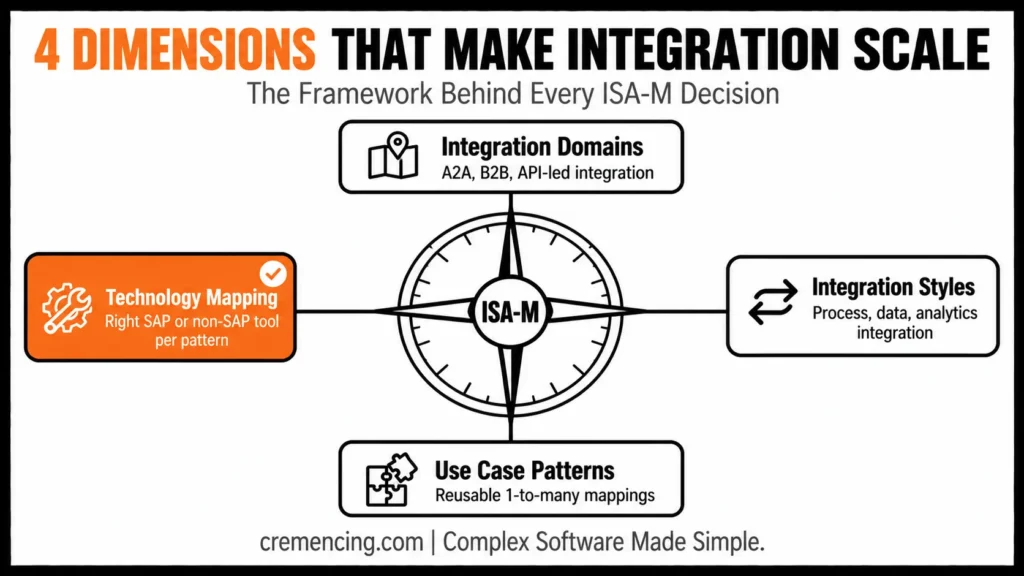
This framework is based on a four-dimensional approach:
| Dimension | What It Covers |
| Integration Domains | Business areas that require connecting, such as A2A, B2B, and API-led integration |
| Integration Styles | Integration types that we use to integrate the systems, such as process integration, data integration, and analytics integration |
| Integration Use Case Patterns | Reusable 1-to-9 mappings as referenced by specific typical business use cases |
| Technology Mapping | Best tools from both SAP and non-SAP to serve each pattern and domain |
No individual dimension alone holds value in SAP ISA-M. It is the mechanism by which these four dimensions interact to produce integration decisions that are consistent, documented, and repeatable organization-wide. Find out more.
How SAP Integration Solution Advisory Methodology Concepts Work in Practice
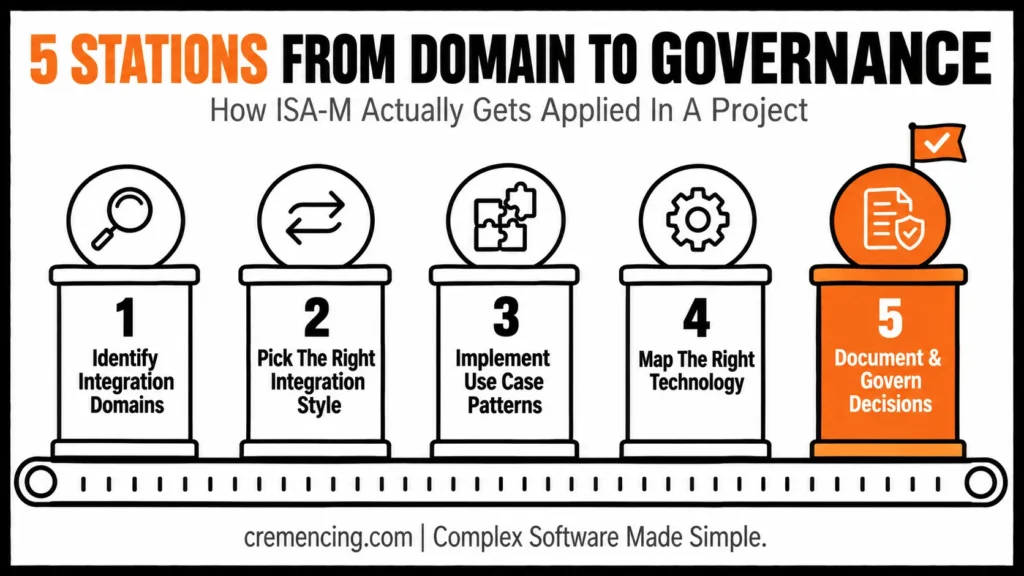
Step 1 — Identify your Integration Domains (ISA-M Approach)
Firstly, identify what integration domains will be impacting your landscape. SAP ISA-M describes these domains to represent the high-level integration business needs.
The primary domains are:
- Internal connections amongst your own landscape — A2A (Application to Application)
- B2B (Business to Business) — Connections with partners, suppliers, and customers outside the organization
- API-led Integration — Hosting and consuming services via managed APIs
- Data and Analytics Integration — Transporting and altering data for reporting and intelligence
The vast majority of enterprise projects span over two or three domains. Addressing them in advance avoids the trap of designing all integrations as if they have the same purpose.
Step 2 — Pick the Suitable Integration Type by Domain
SAP ISA-M advises associating each domain with the best-fitting integration style. Integration types explain how data and systems communicate with each other.
There are basically five different styles:
- Process Integration
- Data Integration
- Analytics Integration
- User Integration
- Thing Integration (for IoT scenarios, a type of data integration)
One of the costliest mistakes an integration project can make is using a style that does not fit the target domain because it requires rebuilding flows that are technically functioning but architecturally unsound.
Step 3 — Implement ISA-M Use Case Patterns
SAP ISA-M provides use case pattern libraries that map common business scenarios against proven integration approaches. Teams implement the pattern closest to their situation rather than designing from scratch.
This step saves design time, allowing teams to focus on implementation rather than rehashing architectural decisions.
Step 4 — Map Technology Using This Framework
Once you define domains, styles, and patterns, technology selection follows next. Teams match SAP BTP capabilities such as CPI, API Management, Event Mesh, and Integration Advisor to specific patterns instead of choosing them out of habit.
This ensures that every tool in your integration architecture has a documented justification for its presence.
Step 5 — Document and Govern the Decisions
Document all decisions for team-wide reference. SAP ISA-M generates a project integration architecture blueprint serving as the governance document for all integrations developed under the project.
Skipping this step often results in developers making independent decisions in silos, leading to a progressively harder-to-maintain landscape.
- Step 1: Identify integration domains (A2A, B2B, API-led, Data/Analytics)
- Step 2: Match each domain to an integration style
- Step 3: Apply proven use case patterns
- Step 4: Map technology to patterns (not habit)
- Step 5: Document and govern via blueprint
Business Benefits and ROI of This Framework
This SAP integration framework doesn’t just guide design — it directly impacts business outcomes.
SAP Integration Solution Advisory Methodology — The Business Case
The cost of poor integration architecture exceeds the cost of getting it right initially.
| Outcome | What Teams Actually See |
| Faster design decisions | Pre-defined patterns remove weeks of architectural discussions |
| Lower rework costs | Maintaining common patterns reduces the reconstruction of flows that feel out of place |
| Reduced vendor lock-in | Technology is mapped to patterns, not the other way around |
| Better project governance | Ensures visibility through the development process for leadership |
| Faster onboarding | New team members follow the framework instead of decoding undocumented decisions |
| Scalability without chaos | Patterns scale predictably, designed for scalability from the outset |
Teams using SAP ISA-M correctly see fewer integration incidents post go-live and reduced time-to-design for new scenarios.
Mistakes Teams Make With SAP ISA-M
Mistake 1 — Doing ISA-M as documentation, not design work
Some teams use ISA-M as a compliance exercise after decisions have been taken. The methodology is meant to guide decisions before they are made.
Mistake 2 — Not defining the domain and jumping to tools
Technology selection should follow the domain and style definition. Reversing this order defeats the methodology.
Mistake 3 — Applying the same integration style to all use cases
ISA-M helps teams avoid a common error: using process integration patterns in data integration scenarios.
Mistake 4 — Not using the blueprint throughout the project
ISA-M blueprints lose value if only architects refer to them. Governance requires team-wide usage.
Mistake 5 — Re-evaluating technology without re-evaluating patterns
When introducing new tools mid-project, patterns must be validated first to avoid architectural gaps.
Governance Layer Inside ISA-M
SAP ISA-M acts as a dynamic governance system, not a one-time design activity.
High-performing teams:
- Version the ISA-M blueprint alongside project evolution
- Analyze each integration scenario against existing patterns before development
- Evaluate technology changes for pattern impact
This creates a traceable audit trail of architectural decisions. New architects or leadership can quickly understand why specific tools were chosen.
ISA-M also establishes a common language across business and engineering stakeholders, bridging the gap between business requirements and IT implementation.
For instance, when a team introduces a new API management tool mid-project, ISA-M governance requires re-validating the relevant integration pattern first — not just documenting the new tool’s presence — to avoid silently breaking the domain-style-pattern alignment.
CTA BLOCK #1
Have you built an SAP integration strategy and are unsure where to begin with ISA-M? Download our free SAP ISA-M Domain Mapping Template to provide your team a framework to get started before the first iFlow is built. [Download the Free Template]
Conclusion
SAP ISA-M is essential for teams aiming to scale integration landscapes. It distinguishes between architectures that scale the business and those that create a maintenance tax.
The real value of SAP ISA-M isn’t the framework itself — it’s what it prevents: integration landscapes built from six months of uncoordinated shortcuts. Teams that map domains, styles, and patterns before choosing technology end up with architecture that scales; teams that skip straight to tool selection end up documenting decisions after the fact, when it’s too late to change course cheaply. The one habit that separates high-performing integration teams from the rest is simple: govern the blueprint continuously, not just at project kickoff.
The most valuable activity before writing a line of code is mapping integration domains using ISA-M. This makes all subsequent design, implementation, and governance faster, cleaner, and simpler.
FAQ
Q1: Is SAP ISA-M only relevant in large enterprise projects?
No. It is also relevant for mid-size implementations where multiple systems require standardized and maintainable connectivity.
Q2: Where can I find SAP ISA-M official documentation and resources?
SAP provides ISA-M content on the SAP Help portal and SAP Community, including whitepapers and domain mapping guides.
Q3: What is the relationship of SAP ISA-M with SAP BTP?
SAP BTP provides the technology. SAP ISA-M serves as the blueprint for determining how technology is employed across domains and scenarios.
Q4: How long does it take to implement SAP ISA-M for a project?
- Domain and style mapping: 1–3 days for focused architecture teams
- Complex enterprise pattern library & blueprint: 2–4 weeks
Q5: Can SAP ISA-M integrate with Non-SAP tools?
Yes. Patterns, domains, and styles are tool-agnostic and can govern integration landscapes using MuleSoft, Azure Integration Services, or other platforms alongside SAP tools.
Do I need SAP BTP to use ISA-M?
No — ISA-M is a methodology, not a BTP feature; it can guide integration decisions even in landscapes not yet on BTP, though BTP tools are commonly mapped as the technology layer.
Who should own the ISA-M blueprint within a project?
Typically enterprise architects or integration leads own it, but it should be referenced and updated by the wider development team, not kept siloed.
How is ISA-M different from a generic enterprise architecture framework like TOGAF?
ISA-M is SAP-specific and focused narrowly on integration decisions (domains, styles, patterns, technology), while TOGAF is a broader, vendor-agnostic enterprise architecture framework.
Can ISA-M be applied retroactively to an existing integration landscape?
Yes — teams can map existing integrations against ISA-M domains and patterns to identify inconsistencies and prioritize remediation, though it’s more effective when applied from project start.
What’s the biggest sign a team needs ISA-M?
Recurring, ad-hoc technology choices with no documented rationale — if new integrations are built based on developer familiarity rather than a domain-style-pattern fit, that’s the clearest signal.