

Introduction
Most SAP users and admins expect everything to work smoothly in the Fiori Launchpad TCode. In reality, that rarely happens. The Launchpad may fail to load, applications may disappear, or users may encounter authorization errors.
Even when the configuration appears correct, users can still get stuck without an obvious explanation. However, that is where the real challenge begins. The interface itself is rarely the root cause. Instead, the issue often comes from backend configuration, authorization roles, services, or how the Fiori Launchpad TCode is being used.
Moreover, troubleshooting becomes more complex because Fiori operates across multiple layers, including the frontend, backend, roles, catalogs, and services. As a result, a small issue in any one of these layers can prevent users from accessing applications correctly. For example, an authorization problem may appear as a missing application, while an inactive service can cause an application to fail during launch.
Therefore, administrators need to understand how these layers interact before applying a fix. Consequently, understanding how the Fiori Launchpad works makes it easier to identify the affected layer, determine the root cause, and resolve access problems more efficiently.
In this guide, you will learn how the Fiori Launchpad TCode works, why common access and authorization errors occur, and how to troubleshoot them step by step. The focus is not simply on configuration procedures but on understanding what needs to be checked, why an issue occurs, and how to identify the right solution. In this guide, you will understand the functionality of Fiori Launchpad T-code, access and error issues with it, and step-by-step troubleshooting for such errors. The emphasis here is on what actually needs to be clear, as opposed to configuration steps.
What Is Fiori Launchpad TCode In SAP
Basic SAP MI Fiori Launchpad Transaction Code in SAP GUI
The most common transaction is:
/UI2/FLP – Launch Fiori Launchpad
This enables the Launchpad from the SAP GUI directly. Commonly used as the standard SAP launchpad t-code.
As much as Fiori is web-based, backend configuration still depends a lot on SAP GUI. The above is the reason why Fiori Launchpad TCode in SAP for users and administrators matters.
However, in S/4HANA systems, this gets even higher as Fiori becomes the new default interface. With that, Fiori launchpad tcode in S4 HANA becomes a vital part of everyday operations.
There are various components on which Fiori Launchpad depends:
- Roles and authorizations
- Catalogs and groups
- OData services
- UI5 applications
Therefore, all these components are crucial, and if any one of them fails, the Launchpad may not function as expected
How the Fiori Launchpad TCode Works Step by Step
A step-by-step Fiori Launchpad TCode guide will assist in tracing where the issue exists.
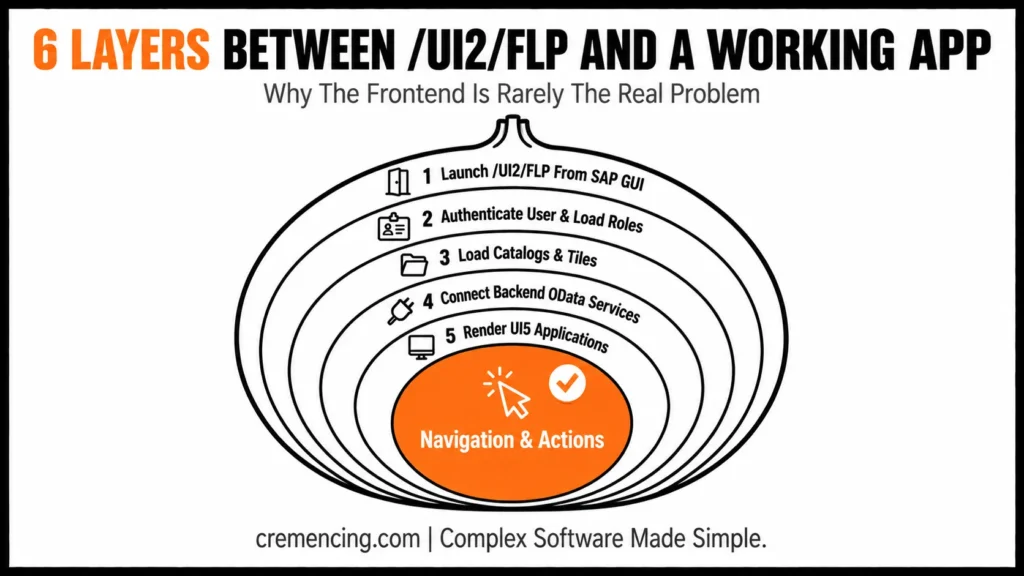
Step 1 – Fiori Launchpad from SAP GUI
The predefined Fiori launchpad tcode in the GUI:
Enter /UI2/FLP in SAP GUI
This will open the Fiori Launchpad in a browser
This is the entry point for all Fiori apps.
Step 2– Authenticated User and Roles Loaded
Once launched, the system:
- Validates user credentials
- Loads assigned roles
- Identifies available catalogues
Users will not see apps that are missing or incorrect.
Step 3- Load Catalogues and Titles
The system retrieves:
- Catalog definitions
- Assigned tiles
- Navigation targets
The step involves proper configuration of the Fiori app t-code and catalogues.
Step 4 — Connect the Backend Services
Each app requires backend services.
- OData services must be active
- System connections must be stable
If services break, apps don’t launch.
Step 5 – UI5 Rendering
They provide an application framework with controls that are known as Fiori apps, which are created using something template-oriented called UI5.
- UI5 components are loaded
- Data is fetched from the backend
When UI5 dependencies fail, apps might display errors.
| Problem | First check | Useful T-code/tool | What it tells you |
|---|---|---|---|
| Launchpad itself does not open | ICF/Launchpad service | SICF | Service availability/configuration |
| User gets an authorization error | Authorization trace | SU53 | Recent failed authorization check |
| App is missing. | Role/content assignment | PFCG | Roles and assigned launchpad content |
| Intent/navigation fails | Target resolution | /UI2/FLIA | Navigation/intent analysis |
| OData request fails | Gateway error | /IWFND/ERROR_LOG | Gateway-side request errors |
| The backend OData request fails | Backend Gateway log | /IWBEP/ERROR_LOG | Backend Gateway errors |
| Gateway runtime details needed | Application log | SLG1 | Detailed Gateway runtime logs |
| Technical catalog/tile administration | Launchpad administration | /UI2/FLPAM | Technical catalogues, tiles, target mappings |
| Business catalogue administration | Launchpad content administration | /UI2/FLPCM_CUST | Business catalog management |
Step 6 – Performing Navigation and Actions
Once loaded:
- Users interact with apps
- Navigation triggers backend logic
This brings us to the end of the Fiori app t-code from the GUI process.
Advantages and Return on Investment of Properly Using Fiori Launchpad T-Codes
Proper use of the T-code Fiori launchpad enhances technical performance and business efficiency.
Key Benefits
- Minimize navigation problems by as much as 40%
- Improve system reliability
- Enable faster troubleshooting
- Simplify user access
Operational Benefits
- Faster issue resolution
- Better control over app access
- Reduced dependency on manual support
Business Impact
- Improved user productivity
- Faster decision-making
- Higher adoption of Fiori
- Lower support costs
Organizations that have learned how the Fiori Launchpad transaction code works face fewer disruptions and enhanced stability of systems. Before troubleshooting individual applications, it helps to understand how Fiori Launchpad transactions differ from the broader Fiori architecture and application layers.
Reason for Not Working of Fiori Launchpad TCode
We have seen the most frequent issue as the Fiori Launchpad t-code not working.
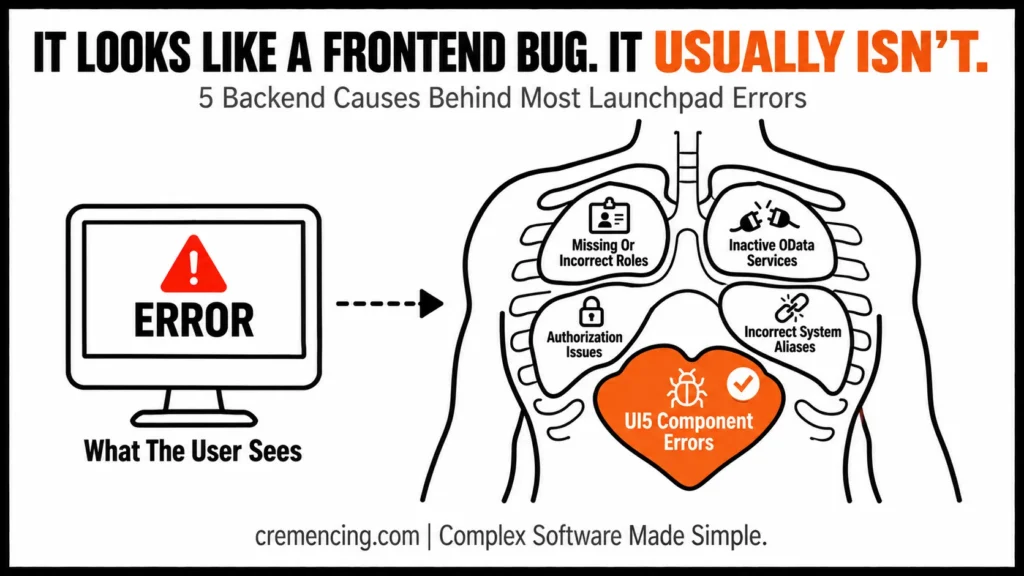
Common Causes
- Missing or incorrect roles
- Inactive OData services
- Authorization issues
- Incorrect system aliases
- UI5 component errors
Typical Symptoms
- Launchpad does not open
- Apps are missing
- Error messages appear
- Navigation fails
The distinction between the Fiori Launchpad’s content model and individual applications also matters when diagnosing why an app appears in one user’s Launchpad but not another’s.
Avoiding Common Mistakes and Exploring Best Practices
Learning from mistakes is critical to avoiding future problems.
Common Mistakes
- Launchpad problems are assumed to be frontend issues
- Ignoring backend service activation
- Misconfiguring roles and catalogues
- Another thing is that those abundances of roles are not tested with real end users
- Overlooking authorization objects
Best Practices
- Always validate roles using PFCG
- Check OData services regularly
- Monitor error logs
- Use consistent catalogue structures
- Test configurations before release
This is how it looks: Correct Fiori launchpad T-code in SAP.
Why Troubleshooting Mostly Goes Wrong
Many troubleshooting guides focus heavily on individual steps but overlook how the workstation and Fiori environment behave together. As a result, administrators may fix the visible error without addressing the underlying cause.
The problem is not simply knowing what an error means. Instead, effective troubleshooting requires understanding how the frontend, backend, browser, authorization roles, services, and system connections interact. For example, a missing application may appear to be a Launchpad issue, while the actual cause could be an authorization role or an inactive service.
Moreover, the same error can have different causes depending on the system setup and user context. Therefore, repeating the same configuration steps without checking system behavior can waste time and allow the problem to return.
What Most Teams Miss
- Relationship between frontend and backend
- Dependency on multiple services
- Role-based access complexity
Advanced Insight
Effective troubleshooting requires:
- Understanding system flow
- Identifying root causes
- Testing across layers
It helps in decreasing the occurrence of issues and increasing the stability of the system. Service to Troubleshoot Fiori Launchpad errors and enhance system performance
Our experts identify underlying factors, troubleshoot access problems, and optimize your SAP Fiori landscape.
Conclusion
Therefore, understanding how the Fiori Launchpad t-code functions is essential for effectively managing SAP Fiori environments. In most cases, access and error problems are not random. Instead, they often indicate misconfigurations involving roles, services, or system connections.
Moreover, a systematic troubleshooting methodology helps administrators identify the root cause more quickly. As a result, teams can resolve issues before they become recurring problems and affect users across the environment. Ultimately, effective Fiori administration is not just about knowing how to use the Launchpad. Rather, it requires understanding what happens behind the scenes and how different system components work together.
For this reason, it is also useful to understand the broader Fiori architecture before troubleshooting individual access issues. To learn more, read the SAP Fiori ecosystem explained, which covers the underlying structure of Fiori apps, the Launchpad, and user access.
FAQ Section
What is Fiori Launchpad T-code?
They are used to access the SAP Fiori Launchpad from SAP GUI.
Why is the Fiori Launchpad not working?
This can happen due to a lack of roles, services, or configuration issues.
What is /UI2/FLP used for in SAP?
/UI2/FLP launches the SAP Fiori Launchpad from an ABAP-based SAP system. It is an entry transaction, not a universal troubleshooting transaction.
Which T-code checks Fiori authorization errors?
Start with SU53 inspecting the user’s most recent authorization failure. Use PFCG to investigate the role and authorization configuration behind the access.
Which T-code checks Fiori Gateway errors?
Use /IWFND/ERROR_LOG on the Gateway/front-end side and /IWBEP/ERROR_LOG for applicable backend Gateway errors. SAP documents both as gateway troubleshooting tools.




One Response