

Introduction
As SAP landscapes grow more complex, SAP teams have a hard time keeping systems performing, available, and technically stable. Organizations with SAP ECC, SAP S/4HANA, and cloud-based SAP platforms need specific administration capabilities to ensure business applications are reliable. It is the responsibility of SAP Basis professionals who are responsible for the technical foundation that enables SAP applications, databases, integrations, and users to function as intended.
There are numerous teams that recognize SAP functional modules like Finance, Sales, and Materials Management, but not the technical layer that underpins these modules. This article defines the term “SAP technical operations,” discusses its role in enterprises, SAP system monitoring areas, SAP HANA responsibilities, and the skills demanded for modern SAP system monitoring professionals.
What Is SAP Basis, and Why Does It Matter?
SAP Basis is the technical layer that starts the operation, configuration, and maintenance of SAP systems. It is the backbone of the SAP application, ensuring it is installed, configured, monitored, optimized, managed, and resolved technically.
SAP Basis is a term that encompasses the middleware technologies, administration tools, and processes that are used to link SAP applications to the operating system and database. SAP system administration professionals focus on the SAP infrastructure layer, which connects the application layer to the infrastructure, to keep the systems running and behave as per the business requirements.
In general, business processes are configured by functional consultants, and the technical environment in which the processes run is handled by SAP system administration. For instance, an SAP Finance consultant can set up financial postings in SAP S/4HANA, while SAP Basis ensures that the application server, database connections, background jobs, and user access are necessary for the financial postings to run correctly.
In large enterprise environments, where multiple SAP landscapes are used, such as development, quality assurance, and production landscapes, SAP Basis plays an important role. These environments need to be maintained consistently through structured administration practices, transport management, monitoring, and security.
SAP Basis Full Form and Core Responsibilities
The SAP Basis full form is commonly understood as “Business Application Software Integrated Solution,” although SAP documentation typically uses “Basis” to describe the technical foundation and administration components of SAP systems rather than treating it as an official acronym.
SAP Basis responsibilities cover multiple technical areas that support the complete SAP system lifecycle. These responsibilities begin during system installation and continue through daily operations, upgrades, migrations, and optimization activities.
An SAP system monitor is responsible for activities such as:
- SAP system installation and configuration
- Client administration
- User and authorization coordination
- Transport management
- System monitoring
- Background job scheduling
- Performance analysis
- Software updates and patches
- Database administration coordination
- SAP system copies and migrations
Each responsibility directly affects business operations. A failed background job in SAP S/4HANA can delay financial processing, while incorrect transport management can introduce development errors into production systems. SAP Basis teams reduce these risks by maintaining technical control over the SAP environment.
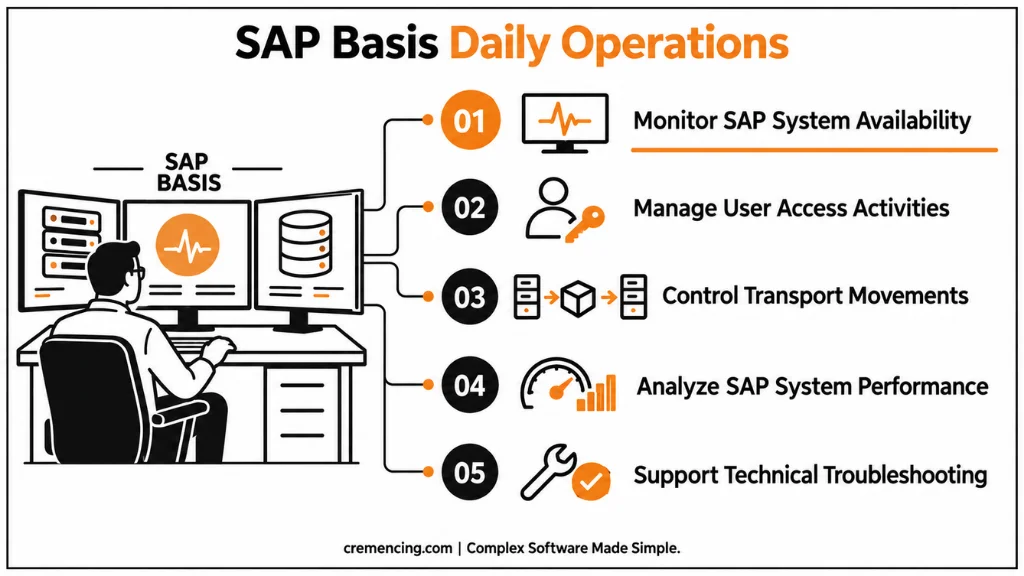
How SAP Basis Supports Enterprise SAP Landscapes
The technical flow between these environments is controlled by SAP technical operations. The change is stored in the development system, for example, for a custom report created by an ABAP developer. The transport process is managed by SAP system administrator and is used to move this object to the quality system for testing and finally into production after the object is approved.
This process needs coordination among developers, functional consultants, security teams, and infrastructure teams. Inconsistent system versions, failed transports, performance problems, or unwanted system changes are possible consequences of missing SAP technical operations processes.
SAP system administrators also enable integration of SAP systems with external platforms. In enterprise environments, SAP applications are typically integrated with other middleware, reporting applications, cloud, and third-party applications. Basis teams monitor technical communications, connections in the system, and infrastructure dependencies in order to ensure operational stability.
SAP Basis Architecture Overview
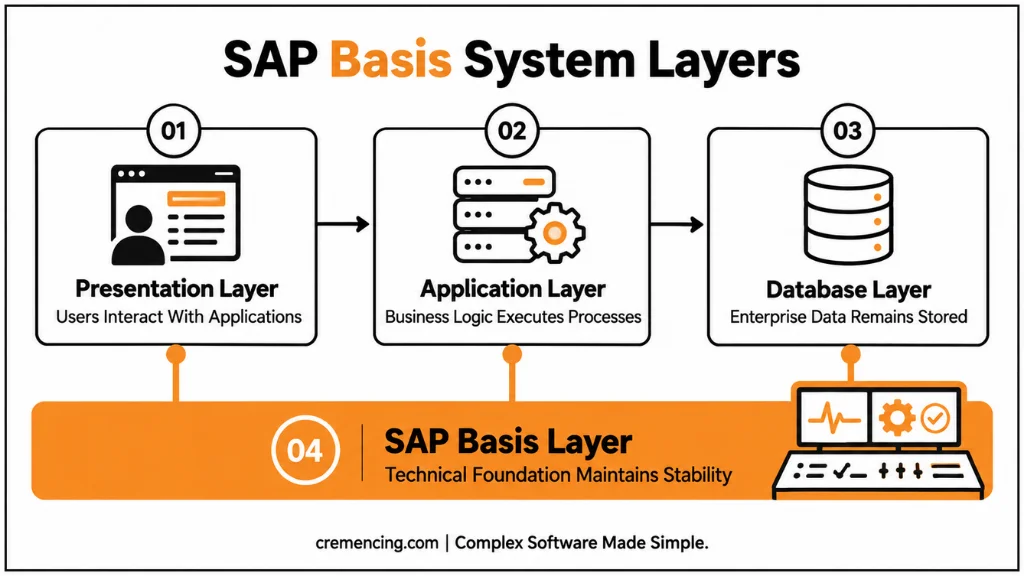
Understanding SAP Basis architecture requires looking at the different technical layers that allow an SAP system to operate. A traditional SAP architecture contains three major layers:
| Layer | Description |
| Presentation Layer | Provides the user interface through SAP GUI, browser applications, or SAP Fiori applications. |
| Application Layer | Executes SAP business logic through application servers and work processes |
| Database Layer | Stores SAP application data, configuration data, and transactional information |
The SAP Basis layer operates mainly around the application and technical administration components that connect these layers together.
The application layer contains SAP work processes responsible for handling different types of activities:
- Dialog work processes handle user transactions
- Background work processes execute scheduled jobs
- Update work processes and process database updates
- Enqueue work processes and manage locking mechanisms
- Spool work processes handle printing requests
SAP Basis administrators monitor these components to identify performance issues and maintain system stability. For example, if users experience slow transaction response times, SAP system administrator teams analyze system workload, database performance, memory utilization, and work process availability to determine the cause.
SAP Basis Modules and Key Administration Areas
SAP system professionals rely on a defined set of SAP transactions and tools to carry out daily administration activities across the areas described above. These tools give administrators visibility into system logs, work processes, background jobs, user access, and client configuration.
Some commonly used SAP Basis transactions include:
| Transaction | Purpose |
| SM21 | System log monitoring |
| SM50 | Work process monitoring |
| SM66 | Global work process overview |
| ST22 | ABAP dump analysis |
| SM37 | Background job monitoring |
| ST03N | Workload analysis |
| SU01 | User administration |
| SCC4 | Client maintenance |
These tools allow administrators to monitor system behaviour and troubleshoot issues before they impact business operations. For example, if a scheduled financial closing job fails, a Basis administrator may check SM37 for job status, analyze system logs using SM21, and review application errors through ST22 to identify the cause.
SAP Basis in SAP ECC and SAP S/4HANA Environments
To support SAP S/4HANA, SAP technical operations is responsible for system availability, technical configuration, monitoring, system updates, integration, and database coordination. In addition, Basis professionals are also responsible for HANA related activities that are needed in order to keep S/4HANA operations stable, thereby taking over their ECC activities in a database-focused role.
This change is most pronounced during migration projects. There are various aspects that organizations need to take into account when transitioning from SAP ECC to SAP S/4HANA, such as application compatibility, database migration, impact on custom code, technical downtime planning, etc. These activities are supported directly by SAP Basis teams, as they impact system availability and downstream business processes, such as SAP version upgrade, database migrations, system copies, SAP to SAP HANA conversion and cloud migrations.
SAP Basis and SAP HANA Administration
SAP Basis administration and SAP HANA administration have a relationship but are different. SAP system administrator is responsible for the administration of SAP application environments such as system configuration, monitoring, and transport management, and SAP HANA administration is limited to database administration functions like backup, monitoring, replication, and database administration.
In reality, in S/4HANA landscapes, these two tasks may overlap, as problems in the application layer may stem from the HANA database layer and vice versa. Before applying a fix, Basis administrators need to know if the problem is application processing, HANA database performance, or infrastructure resources.
Skills Required for Modern SAP Basis Professionals
The professionals are provided the technical knowledge of a SAP landscape administration, monitoring, and maintenance by SAP system administrator training. This is typically an organized path of learning, beginning with basic SAP system concepts and progressing over time to more advanced topics like SAP HANA administration, cloud operations, and SAP lifecycle management.
Before diving into SAP Basis, it is essential to grasp the meaning of SAP Basis and core administration concepts, which is a crucial starting point for novices. Usually, the training includes the concepts of SAP architecture, installation, user management, system monitoring, transport management, database connectivity, and troubleshooting.
After gaining experience, professionals typically build up their expertise in specialized fields like SAP HANA administration, SAP S/4HANA technical operations, SAP Cloud environments, and automation. In today’s world of enterprise SAP landscapes, cloud services and hybrid architectures have made the standard SAP Basis training, which is typically conducted in the administrative office, obsolete.
The SAP Basis certification validates knowledge of SAP technical administration concepts to help professionals. Practical experience, however, is also an essential part, since SAP Basis responsibilities include real-world scenarios that can only be learned by practical experience. A SAP Basis certification path generally focuses on areas such as
- SAP system architecture
- SAP installation and configuration
- User and authorization administration
- System monitoring
- Database management concepts
- Transport management
- SAP HANA administration
- SAP lifecycle management
Professionals preparing for SAP system administrator certification should combine training with hands-on practice. Working with SAP sandbox environments, monitoring tools, and real troubleshooting scenarios helps build the practical knowledge required for enterprise SAP operations. For experienced consultants, adding SAP HANA, SAP S/4HANA, and cloud administration skills can improve career opportunities because organizations are increasingly moving from traditional SAP landscapes toward modern platform-based environments.
This shift also reflects how the role itself is evolving. While traditional responsibilities such as system monitoring, transport management, and technical administration remain important, modern Basis professionals are expected to understand broader platform operations. The introduction of SAP HANA, SAP S/4HANA, SAP BTP, and RISE with SAP has changed the skill requirements for Basis professionals.
Moreover, many roles are moving beyond server-level administration into managing technical services, integrations, cloud environments, and system reliability. Organizations still require professionals who understand how SAP systems operate technically, and the future of SAP Basis is moving toward a combination of SAP administration, cloud operations, automation, and technical architecture skills.
Common SAP Basis Implementation Challenges
Managing SAP systems involves several technical challenges that require careful planning and continuous monitoring.
Performance Management
SAP performance issues can occur due to multiple factors, including application workload, database performance, infrastructure limitations, or incorrect system configuration. SAP Basis teams analyze different technical areas to identify performance bottlenecks, including work process utilization, database response times, memory allocation, background job execution, and system workload patterns. For example, if users experience slow transaction response times in SAP S/4HANA, Basis administrators must determine whether the issue is related to application processing, HANA database performance, or infrastructure resources.
System Monitoring and Availability
Enterprise SAP systems often support critical business processes such as financial transactions, supply chain operations, and reporting activities. Any system interruption can affect business operations. SAP system administrator teams use monitoring approaches to track system availability, failed background jobs, database health, application errors, and interface communication. Modern SAP environments increasingly use tools such as SAP Cloud ALM and automated monitoring solutions to improve visibility across complex landscapes.
Upgrade and Migration Management
SAP upgrades and migrations require careful technical planning because they affect system availability and business processes. SAP system administrator teams support activities such as SAP version upgrades, database migrations, system copies, S/4HANA conversions, and cloud migrations, coordinating closely with functional and infrastructure teams throughout each project.
Conclusion
SAP Basis remains the technical foundation that enables SAP applications to operate reliably across enterprise environments. From traditional SAP ECC landscapes to modern SAP S/4HANA and cloud-based platforms, Basis professionals continue to manage critical activities such as system administration, monitoring, transport management, performance optimization, and technical troubleshooting.
The role of SAP system administrator is evolving as organizations adopt SAP HANA, SAP BTP, and RISE with SAP. Modern Basis professionals are expected to combine traditional administration expertise with cloud knowledge, automation skills, and platform management capabilities. Organizations that invest in strong SAP Basis practices can maintain stable SAP operations while preparing their landscapes for future transformation initiatives.
Frequently Asked Questions
1. What is SAP Basis in SAP?
SAP Basis is the technical administration layer responsible for managing SAP system operations. It includes system configuration, monitoring, transport management, user administration, performance analysis, and technical troubleshooting across SAP ECC, SAP S/4HANA, and cloud-based SAP environments.
2. What is the SAP Basis full form?
SAP Basis is commonly described as a business application software integrated solution, although SAP generally uses the term Basis to refer to the technical foundation and administration components that support SAP applications.
3. What does an SAP Basis administrator do?
An SAP Basis administrator manages the technical operation of SAP systems. Responsibilities include installation, configuration, monitoring, transport management, system performance analysis, database coordination, user administration support, and troubleshooting technical issues.
4. Is SAP Basis different from SAP HANA administration?
SAP Basis and SAP HANA administration are related but focus on different areas. SAP Basis manages SAP application environments, while SAP HANA administration focuses on database operations such as backup, performance monitoring, replication, and database management.
5. Is SAP Basis still a good career option?
SAP Basis continues to be relevant as organizations maintain SAP landscapes and adopt SAP S/4HANA, cloud platforms, and hybrid environments. Modern SAP Basis professionals benefit from learning SAP HANA, cloud technologies, automation, and SAP platform operations.
6. What skills are required for SAP Basis training?
SAP Basis training typically covers SAP architecture, system administration, monitoring, transport management, user administration, database concepts, and troubleshooting. Modern training also includes SAP HANA, SAP S/4HANA technical operations, and cloud administration concepts.
7. What is the role of SAP Basis in SAP S/4HANA?
SAP Basis supports SAP S/4HANA by managing system availability, technical configuration, monitoring, upgrades, integrations, and database coordination. Basis professionals also support HANA-related activities required for stable S/4HANA operations.
8. What is the difference between SAP Basis and functional SAP modules?
SAP functional modules such as Finance, Sales, and Materials Management manage business processes, while SAP Basis manages the technical environment where those applications operate. Basis ensures that SAP systems remain available, secure, and technically stable.





2 Responses