

Introduction
A BTP project that fails in production doesn’t usually fail loudly. Instead, the problem may appear as a support ticket at 2 am, a Cloud Foundry app that hits its memory quota during month-end close, or an integration that silently drops records because nobody built in retry logic. By the time the team notices, however, the fix isn’t a simple code change; instead, it requires a re-architecture. As a result, re-architecting a live system can cost far more than getting the design right the first time.
Most SAP BTP developer guides teach you how to get an app running. Few teach you what happens six months later, when that app is carrying real transaction volume, real integrations to S/4HANA, and real users who don’t forgive downtime. That gap between “it works in the demo” and “it holds up in production” is where most BTP projects quietly break.
Why Bypassing SAP BTP Principal Propagation Silently Breaks Enterprise Security
A frequent architectural flaw in SAP Business Technology Platform (BTP) extensions occurs when developers route inbound HTTP traffic directly to backend services using technical service keys, rather than routing requests through the Managed Application Router (AppRouter) paired with principal propagation. While direct calls via client credentials succeed during local testing in tools like Postman, bypassing the entry AppRouter breaks user context inheritance.
This causes downstream Cloud Connector destinations to forward generic technical-user credentials to SAP S/4HANA instead of the authenticated named-user identity. Consequently, on-premises business logic and SAP ABAP authorization checks fail or mask true user accountability, producing security compliance gaps and unexpected HTTP 403 authorization failures in production runtime environments.
5 Mistakes On SAP BTP
SAP BTP projects can look successful during development but still run into serious problems after deployment. In many cases, the issue comes from design decisions that were overlooked early in the project. For example, poor architecture can create scalability problems, weak integration logic can cause failed transactions, and limited monitoring can make production issues difficult to trace.
Similarly, security gaps and poorly managed resources can affect both reliability and operating costs. So, before moving an SAP BTP application into production, it is important to understand the five mistakes that commonly create these problems.
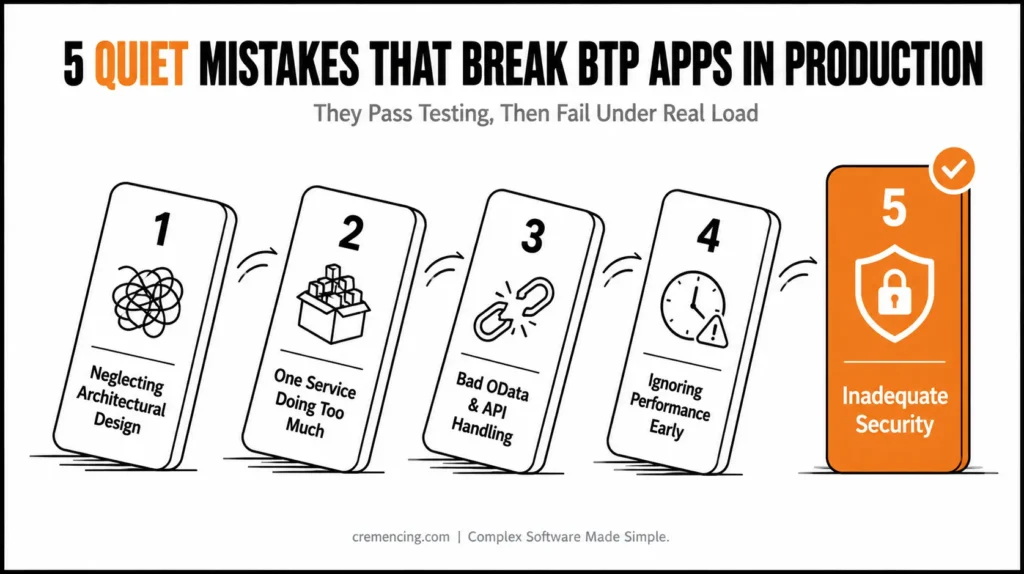
Error 1: Neglecting Architectural Design
A lot of developers dive right into coding without architecting.
What goes wrong:
- Tight coupling between services
- Difficult scalability
- Hard-to-maintain code
Real impact:
When your app grows big, even small changes involve heavy rewriting.
Fix:
- Use modular architecture
- Separate frontend, backend, and services
- Use CAP principles (Cloud Application Programming Model)
Error 2: One service is doing too much
In SAP BTP development, there is a common mistake that developers tend to make, which is adding too much logic to one service.
What goes wrong:
- Slow performance
- High memory usage
- Difficult debugging
Real impact:
The entire application can fail due to a single failure.
Fix:
- Break services into smaller microservices
- Use event-driven architecture
- Distribute workloads efficiently
Error 3: Bad Handling of OData and APIs
Developers either misuse APIs or make too many calls.
What goes wrong:
- Increased latency
- Network congestion
- Poor user experience
Real impact:
Apps feel slow and unresponsive.
Fix:
- Use batch requests
- Implement caching strategies
- Optimize API calls
Error 4: Ignoring Performance Optimization Early
So performance is a ‘next problem ’; in other words, later.
What goes wrong:
- Slow response times
- High server costs
- Poor scalability
Real impact:
Performance fixes are costly and complicated.
Fix:
- Monitor performance from the start
- Use logging and analytics tools
- Optimize database queries early
Error 5: Inadequate security
Security is often underestimated.
What goes wrong:
- Unauthorized access
- Data leaks
- Compliance issues
Real impact:
Security breakdowns can undermine trust and disrupt business.
Fix:
- Use role-based access control
- Implement authentication properly
- Secure APIs and endpoints
Table: SAP BTP Mistake → Fix
| Mistake | What Goes Wrong | Real Impact | Fix |
|---|---|---|---|
| Neglecting architectural design | Tight coupling, hard-to-maintain code | Small changes require heavy rewrites | Modular architecture, CAP principles |
| One service doing too much | Slow performance, high memory use | Single failure can crash the whole app | Break into microservices, event-driven design |
| Bad OData/API handling | Increased latency, network congestion | App feels slow and unresponsive. | Batch requests, caching, optimized calls |
| Ignoring performance early | Slow response, high server costs | Fixes become costly and complex later | Monitor from day one, optimize queries early |
| Inadequate security | Unauthorized access, data leaks | Breaks trust, disrupts business | RBAC via XSUAA, proper auth, secured APIs |
How Not to Do SAP BTP Developments
Mistakes are harder to come by when you follow a structured process.
Step 1: Plan Before You Build
- Define architecture clearly
- Choose the right services
- Understand integration points
Step 2: Use a modular approach
- Break your app into components
- Keep services independent
- Use reusable modules
Step 3: Optimize Data Handling
- Reduce unnecessary API calls
- Use caching where possible
- Structure data efficiently
Step 4- Reality Tests
- Simulate real user load
- Test edge cases
- Validate integrations
Step 5- Ongoing Monitoring and Improvement
- Use monitoring tools
- Track performance metrics
- Fix issues early
Advantages of correcting errors in SAP BTP Development
Often these errors are fixed, and you see results almost instantly, both visibly and numerically.
Faster Applications
Quick apps are faster to load and scale for many users.
Lower Costs
A good architect saves on cloud resources
Better User Experience
The result: Users work with smooth, responsive apps.
Easier Maintenance
Clean architecture makes updates simple.
Higher Scalability
Your app will scale without breaking. For more insights, read our blog on SAP BTP tools.
Mistakes caused by the developer’s common habits
It isn’t always knowledge gaps that result in mistakes at times, they are the quality of our habits.
Rushing development
Incomplete planning results in bad architecture.
Copy-pasting code
Causes logic and bug inconsistency
Ignoring documentation
Pushing out the core features/best practices
Avoiding testing
Problems appear only in production.
What most SAP BTP guides will never tell you
The majority of guides around SAP BTP focus on app building and rarely explain what happens when those apps enter a real production system. However, these guides often miss real-world challenges, such as supporting thousands of users, managing service levels, and handling heavy workloads. In practice, SAP BTP applications are rarely stand-alone. Instead, they need to connect reliably with systems such as SAP S/4HANA, external APIs, and third-party platforms. Moreover, each connection can introduce its own performance, security, and reliability challenges.
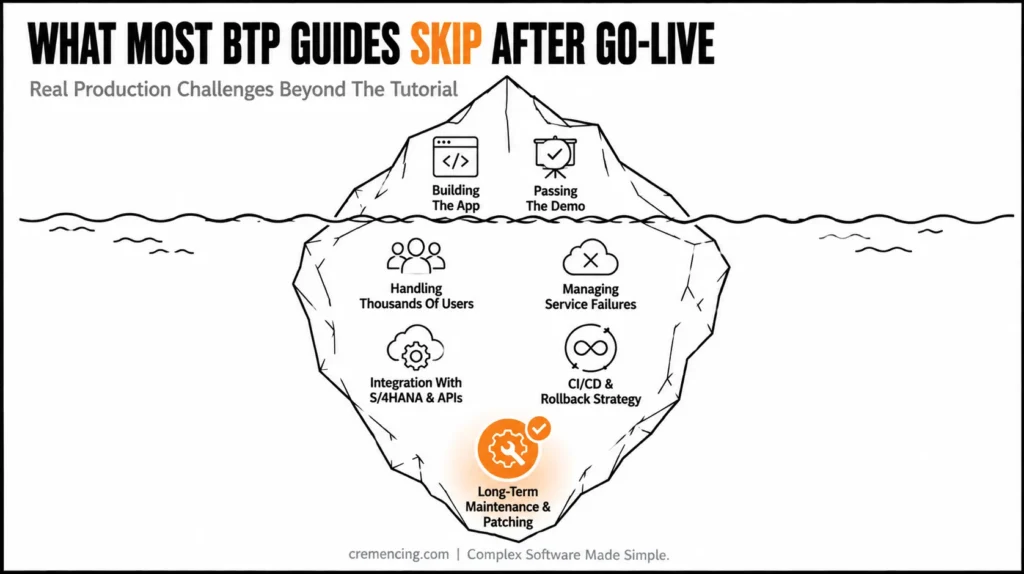
Real Production Challenges
- Handling thousands of users
- Managing service failures
- Scaling under load
Integration Complexity
During real SAP BTP development, apps do not work alone.
They connect with:
- SAP S/4HANA
- External APIs
- Third-party systems
Deployment Strategy
Most guides ignore:
- CI/CD pipelines
- Version control strategies
- Rollback mechanisms
Long-Term Maintenance
Apps need:
- Regular updates
- Performance tuning
- Security patches
Conclusion
The gap between a BTP app that works in a demo and one that survives production isn’t talent; it’s whether architecture, API handling, and security were treated as day-one decisions instead of cleanup work. Every mistake in this guide shows up the same way: fine in testing, expensive once real load and real integrations hit it.
None of these five mistakes announce themselves early. A tightly coupled service still runs a demo fine. An unbatched OData call still returns a response in dev. That’s what makes them dangerous the cost shows up months later, as a rewrite instead of a code review, and by then the team is fixing production instead of preventing it.
When you avoid these common pitfalls and follow a structured approach based on a modern SAP BTP developer guide, you will be creating applications prepared to scale in an efficient and secure manner.
The key to success in real SAP BTP development is not simply knowing how to build but how to build well. Put these lessons to work as soon as you can→ go from average dev to one who knows how to deliver production-ready solutions.
FAQ Section
Can I use SAP BTP with non-SAP systems?
Yes Integration Suite connects to third-party systems via REST, OData, and SOAP, not just SAP-to-SAP.AP BTP Development?
What is SAP BTP Development? Building enterprise applications on SAP’s cloud platform using its services, APIs, and tools.
What are the reasons SAP BTP projects fail in production? Mostly architectural flaws, performance gaps, or insufficient testing against real-world load.
How do I enhance my SAP BTP development skills? Follow a structured developer guide, work on real projects, and focus on performance and scalability early.
Is it hard to learn SAP BTP? The learning curve is steep at first, but consistent practice gets developers to proficiency fast.
SAP BTP services: what are the important features? Key services include CAP, SAP HANA Cloud, Integration Suite, and authentication services like XSUAA.
What’s the difference between Cloud Foundry and Kyma on SAP BTP? Cloud Foundry is a simpler, managed runtime; Kyma is Kubernetes-based for more control over containers and scaling.
Do I need SAP S/4HANA to use SAP BTP? No — BTP runs standalone, though most enterprise apps integrate with S/4HANA for data and transactions.
What is XSUAA and why does my BTP app need it? It’s BTP’s authorization service for role-based access and OAuth tokens — skipping it is a common security gap.
How much does running a production SAP BTP app typically cost? It varies by consumption, but unbatched calls and oversized services (Errors 2–3) are common cost inflators.
Development with SAP Business Technology Platform for application development enables developers to build enterprise applications on a cloud platform of SAP by making use of services and APIs as well as tools from their store.netbeans.com.
What are the reasons that SAP BTP Projects fail in production?
Generally, failures occur due to some architectural flaws, performance problems, or not adequate testing against real-world usage.
How do I enhance my SAP BTP Development skills?
Study a SAP BTP developer guide with structure, do practicals in real projects, and improve performance and scalability.
Is it hard to learn SAP BTP?
Its learning curve is high, but given constant practice, developers can be experts.
SAP BTP Services: What Are The Important Features
Key services include:
- CAP (Cloud Application Programming Model)
- SAP HANA Cloud
- Integration Suite
- Authentication services