Introduction
Most SAP teams treat Clean Core as a best practice they’ll get to eventually — something for the next sprint, the next budget cycle, the next system refresh. That assumption is what puts them at risk. By 2027, SAP Clean Core compliance stops being a recommendation and becomes a condition of staying supportable: firms running tailored or over-customized ERP systems will face upgrade delays, compliance gaps, and operational breakdowns they didn’t see coming.
Teams already behind aren’t behind because the concept is unclear — they’re behind because no one mapped what processes, configurations, or custom code actually need to change. This checklist closes that gap: what Clean Core requires, which areas to act on first, what compliance actually returns in ROI, and the mistakes and missed opportunities that separate teams who merely comply from teams who come out ahead.
Enforcing SAP Clean Core Compliance
Achieving Clean Core compliance requires systematic governance to decouple custom extensions from the SAP S/4HANA digital core. Organizations execute custom code audits using the ABAP Test Cockpit (ATC) and the Custom Code Migration app to identify non-compliant object references, such as unreleased SAP APIs or direct core table modifications.
To remediate these violations, enterprise development teams transition toward the ABAP Cloud programming model, implementing key user extensions, Developer Extensibility via RAP, or side-by-side extensions on SAP Business Technology Platform (BTP). Adopting these upgrade-stable extension frameworks minimizes system downtime, lowers long-term lifecycle maintenance costs, and ensures uninterrupted software updates across future SAP release cycles.
What Is SAP Clean Core Compliance?
SAP Clean Core is a framework and plan created to reduce the number of customizations in your ERP system, keeping the core software as close to SAP standard as possible. This strategy will guarantee the ease of upgrades, improvement of system stability, and adherence to the SAP roadmap of future releases.
Clean Core factors are important and consist of:
- Minimal Custom Code: Minimise custom ABAP, extensions and Z-reports that are not defined as SAP standards.
- Standard Processes First: Before doing any custom workflows, it is advisable to prioritize SAP standard processes before doing any custom workflows.
- Smooth Upgrades: Makes it easier to upgrade to SAP S/4HANA and subsequent upgrades.
- Compliance Assurance: Conforms to the Clean Core requirement of SAP in 2027.
| Component | Role |
| Custom Code Audit | Identify unnecessary customizations |
| Standard Process Alignment | Substitute customized work processes with the SAP standard. |
| Upgrade Readiness Check | Assure core system is in place to support future S/4HANA upgrades. |
| Continuous Monitoring | Monitor new developments and deviation of SAP standards. |
In practice, SAP enforces Clean Core mainly through the ABAP Cloud programming model. The ABAP Test Cockpit (ATC) with the Clean Core check variant, and the Custom Code Migration app (SYCM), are what SAP actually uses to flag non-compliant objects — direct table reads, calls to non-released BAPIs, and classic dynpro-based enhancements are the most common findings in a first audit.
A Clean Core approach minimizes risk, streamlines operations, and makes sure your SAP environment is agile.
How to Achieve SAP Clean Core Compliance: Step-by-Step Process
Here’s a structured approach to achieve Clean Core compliance:
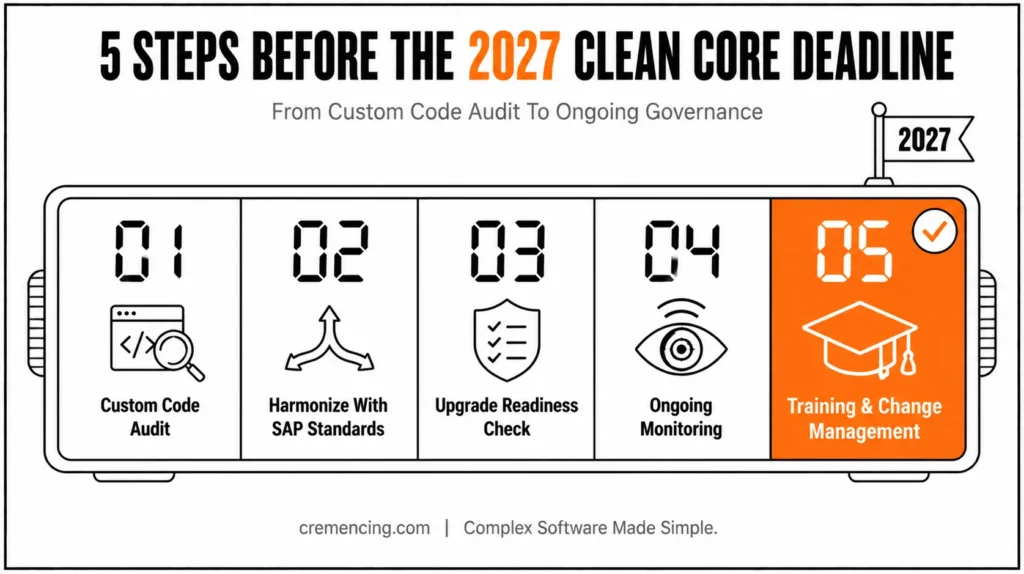
Step 1: Custom Code Audit
- List all custom objects: Z-programs, enhancements, reports
- Classify customizations: critical, optional, obsolete.
- Find out unnecessary or unproductive custom code.
Since this step relies heavily on your team’s ABAP proficiency, it’s worth ensuring your developers are up to date — check out this guide on the ABAP Certification Course in 2026 to understand what skills modern ABAP Cloud development actually requires.
| Common Violation | Why It’s Flagged | Compliant Alternative |
|---|---|---|
| Direct SELECT on standard tables | Bypasses SAP’s released interface layer | Use a released CDS view |
| Custom BDC / CALL TRANSACTION | Depends on UI internals that can change | RAP-based Business Object or released BAPI |
| Classic ALV (REUSE_ALV_GRID_DISPLAY) | Tied to SAP GUI, not Fiori-ready | Fiori Elements on a CDS/RAP model |
| Implicit BAdI in core objects | Modifies standard behavior unpredictably | Released BAdI under extensibility model |
Step 2: Harmonize Business Processes and SAP Standards
- Compare actual working processes to the typical SAP processes.
- Where feasible, substitute or streamline custom workflows.
- Record any justifiable variances.
Step 3: Upgrade Readiness Assessment
- Check compatibility with the recent release of SAP S/4HANA.
- Determine possible conflicts due to custom code.
- Develop gradual upgrade plans to reduce downtime.
Step 4: Ongoing Monitoring and Governance
- Automate new customizations monitoring.
- Put in place governance policies in case of any future extensions.
- Schedule regular Clean Core audits
Step 5: Training and Change Management
- Train IT and business users on Clean Core principles.
- Give instructions about what can be customized.
- Make the stakeholders aware of the compliance impact.
Benefits & ROI of SAP Clean Core Compliance
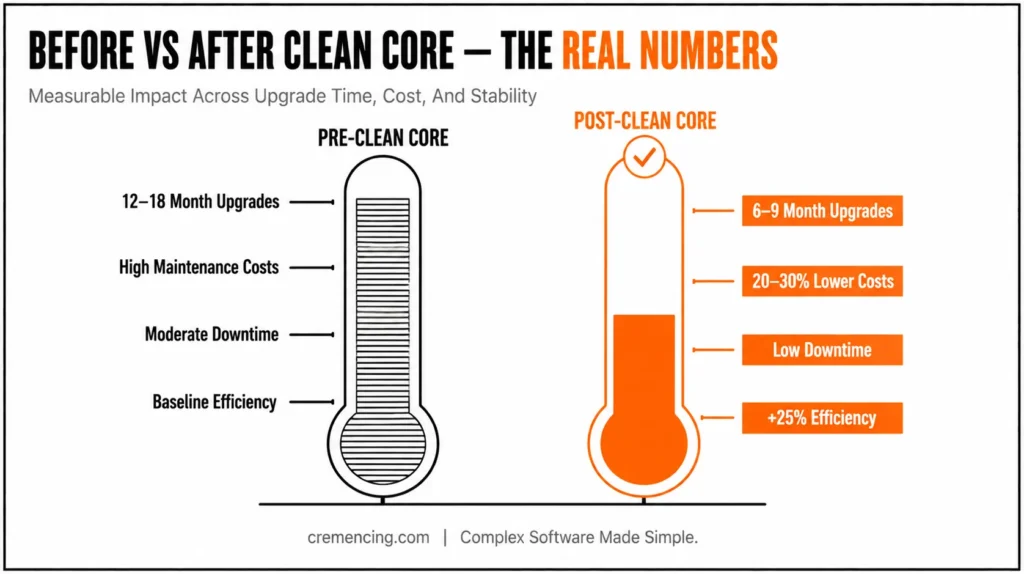
Clean Core compliance has measurable benefits:
- Quicker Upgrades: With less system complexity, there is a faster upgrade to SAP S/4HANA.
- Reduce Maintenance Costs: The number of customizations lowers the maintenance costs in the long term by 2030.
- Better Compliance: Compliant with the Clean Core requirement of SAP 2027.
- Increased System Stability: Reduced errors, downtime, and conflicts within the ERP environment.
- Operational Efficiency: Process efficiency enhances productivity in the various departments.
| Metric | Pre-Clean Core | Post-Clean Core | Improvement |
| Upgrade Time | 12–18 months | 6–9 months | -50% |
| Maintenance Costs | High | Moderate | -20–30% |
| System Downtime | Moderate | Low | -40% |
| Process Efficiency | Baseline | Optimized | +25% |
By proactively implementing Clean Core, organizations safeguard their ERP investment and achieve operational benefits beyond compliance.
Clean Core Compliance at a Glance
- Audit tool: ATC + Custom Code Migration app (SYCM)
- Target model: ABAP Cloud / RAP / released CDS views
- Applies first to: S/4HANA Cloud, then on-prem via extensibility guidelines
- Deadline: 2027
- First action: Run ATC’s Clean Core variant against your custom namespace this month
Common Mistakes in SAP Clean Core Compliance
Even when an organization has a detailed plan, it is possible to get into pitfalls:
Common Mistakes:
- Ignoring small customizations that build up over the years.
- Not following process standardization and instead adhering to convenience.
- Underestimating the need for governance and ongoing audits
- Not engaging business stakeholders in compliance decisions.
Best Practices:
- Intense, systemwide audits of custom code.
- Where feasible, standardize business processes.
- Introduce continued monitoring and governance equipment.
- Train staff to implement Clean Core principles on future developments.
Neglected Opportunities in Clean Core Compliance
Most of the SAP users are focusing on compliance without attention to other benefits:
- Workflow Optimization: Conformity to standard working processes can yield efficiency improvements.
- Potential of automation: Clean Core can be better incorporated into SAP AI and analytics tools.
- Cloud Readiness: Systems using Clean Core are simpler to move to cloud-based SAP solutions.
By using these opportunities, you can not only make your SAP landscape compliant but also future-ready.
Conclusion
SAP Clean Core compliance isn’t a single project with a finish line — it’s the operating discipline that determines how smoothly every future SAP upgrade, extension, and AI-driven feature lands in your system. Teams treating 2027 as a hard deadline, not a soft guideline, are auditing custom code now, aligning processes to SAP standard where it makes sense, and building governance that catches new deviations before they become next year’s audit finding. Teams that miss workflow automation and cloud-readiness alongside compliance are leaving ROI on the table that competitors will capture. Start with the audit — everything else in this checklist follows from knowing exactly what you’re carrying into 2027.
Frequently Asked Questions.
What Exactly Is SAP Clean Core Compliance?
Essentially, SAP Clean Core is a strategic framework designed to minimize customizations. Consequently, the ERP system stays closer to SAP standard, and as a result, upgrades become significantly smoother.
Why Has SAP Clean Core Compliance Become Mandatory by 2027?
First and foremost, SAP wants to stabilize its future release roadmap. Furthermore, without this deadline in place, companies would face upgrade delays and system instability. Therefore, taking timely action is absolutely essential.
Q3: Why does the process begin with a custom code audit?
To begin with, a custom code audit reveals which customizations are genuinely necessary and which are not. Subsequently, this assessment lays the groundwork for the harmonization and governance stages that follow.
Q4: Do all customizations need to be removed?
Not necessarily. However, only those customizations that are business-critical and approved under governance policies should be retained. Otherwise, unnecessary complexity may continue to build up over time.
Q5: What Are the Risks of SAP Clean Core Non-Compliance?
Undoubtedly, non-compliance can lead to system instability, higher maintenance costs, and restrictions on SAP support. Moreover, upgrades may also be delayed, which in turn affects overall operations.
Q6: What benefits do organizations gain from adopting Clean Core?
In addition to compliance, organizations gain measurable ROI through improved operational efficiency, cost savings, and greater system agility. As a result, the overall ERP investment becomes far more future-proof.
Q7: What common mistakes do companies typically make?
Typically, teams focus solely on compliance while overlooking other opportunities such as automation or cloud-readiness. Meanwhile, some organizations fail to maintain governance policies consistently, which eventually causes customizations to creep back in.
Q8: What best practices should be followed?
Ideally, organizations should adopt regular audits, thorough documentation, and ongoing monitoring. Additionally, training and change management should be built into the process so that the entire team stays aligned.
Q9: What opportunities do companies often miss?
Interestingly, many competitors stop at bare-minimum compliance. On the other hand, companies that also invest in workflow automation and cloud-readiness ultimately gain a much stronger long-term competitive advantage.
Q10: Where Should Your SAP Clean Core Compliance Journey Begin?
To start with, conduct a thorough custom code audit, then align business processes with SAP standards. Next, assess upgrade readiness, implement governance, and finally, onboard the entire team through training and change management. Ultimately, this step-by-step approach ensures smooth compliance well before the 2027 deadline.
Resources
SAP Clean Core Overview
SAP Community: Custom code management.
ERP Compliance Strategies