SAP cloud services play an important role in modern enterprise AI, ABAP development, and intelligent business applications. At SAP TechEd 2026, the focus moved beyond AI-assisted coding toward agent-led development, enterprise automation, and governed AI workflows. Held in Berlin from October 27–29, 2026, the event introduced important developments for SAP developers and enterprise technology professionals.
However, not every organization requires the same SAP cloud architecture. Some businesses need stronger integration between SAP and non-SAP applications, while others prioritize workflow automation, enterprise analytics, or AI-driven processes.
SAP’s 2026 developments across S/4HANA Cloud, Business Technology Platform (BTP), SAP Business Data Cloud, and Joule highlight the growing connection between cloud infrastructure and intelligent enterprise operations.
Moreover, SAP’s clean-core strategy emphasizes using standard functionality and supported extensions instead of introducing unnecessary customizations.
The central question is therefore straightforward:
Which SAP cloud services solve your business problems without creating additional technical complexity?
This guide examines the principal SAP cloud services, their responsibilities, and the factors organizations should evaluate before expanding their cloud environment.
SAP TechEd 2026: Start With Your Business Requirements
Before choosing additional SAP products, organizations should examine the business processes their existing systems already support.
For example, a manufacturing company may require purchasing, inventory management, supplier integration, reporting, and approval automation. Although these activities are connected, they do not necessarily belong to the same technical service.
SAP S/4HANA Cloud supports core ERP transactions. Meanwhile, SAP BTP services provide integration, application extension, automation, and other supporting capabilities.
Therefore, the first architectural decision should concern the business requirement rather than the product name.
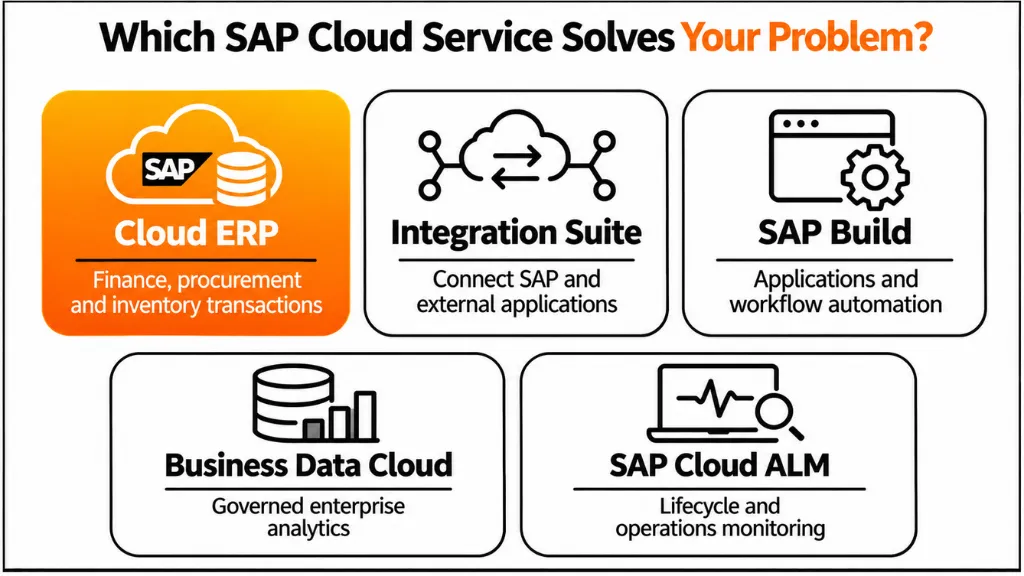
Match Business Requirements With SAP Cloud Services
| Business Requirement | Relevant SAP Service | Primary Responsibility |
| Finance, procurement, and inventory transactions | SAP S/4HANA Cloud | Core ERP operations |
| Connect SAP and third-party applications | SAP Integration Suite | Application and API integration |
| Develop custom applications and extensions | SAP Build and SAP BTP | Application development |
| Automate approvals and repetitive workflows | SAP Build Process Automation | Workflow automation |
| Manage cross-system enterprise data | SAP Business Data Cloud | Data and analytics foundation |
| Monitor applications and integrations | SAP Cloud ALM | Application lifecycle and operations |
| Support application database requirements | SAP HANA Cloud | Database and data processing |
These services address different technical responsibilities. Consequently, selecting a combination depends on the organization’s current architecture and planned business improvements.
SAP S/4HANA Cloud: Choosing the Right ERP Foundation
SAP S/4HANA Cloud provides the ERP foundation for business processes involving finance, procurement, inventory, and other operational activities.Among the available SAP cloud services, S/4HANA Cloud provides the core ERP capabilities needed to manage essential business operations.
However, SAP offers different deployment approaches, and the choice affects customization, integration, and maintenance responsibilities.
SAP S/4HANA Cloud Public Edition
SAP S/4HANA Cloud Public Edition provides standardized cloud ERP processes supported by SAP-managed software lifecycle activities.
Businesses considering this option should review available standard functionality before introducing custom development.
Furthermore, architects need to examine supported APIs, configuration options, and extension mechanisms.
The objective is to maintain essential business operations while avoiding unnecessary modifications to the ERP environment.
SAP S/4HANA Cloud Private Edition
SAP S/4HANA Cloud Private Edition offers greater flexibility for organizations that require a more tailored ERP environment.
It is particularly relevant to enterprises modernizing existing SAP landscapes while retaining specific business requirements.
Meanwhile, RISE with SAP continues to develop beyond its original cloud-migration focus.
SAP’s 2026 roadmap emphasizes AI-supported business transformation, managed integrations, and improvements to cloud operations.
Nevertheless, organizations should evaluate their existing systems, technical dependencies, and business processes before selecting a deployment model.
Why Clean Core Matters
The clean-core approach encourages businesses to minimize unsupported modifications to SAP applications.
Instead, organizations can use standard functionality, released APIs, and supported extension models.
For example, a custom supplier application may retrieve approved purchase-order information through a supported interface rather than modifying ERP core functionality.
As a result, businesses can preserve the responsibility of SAP S/4HANA for essential transactions while developing additional capabilities.
However, clean-core architecture still requires careful decisions about application ownership, integration, and maintenance.
SAP Cloud Services and BTP: Extending SAP Without Adding Unnecessary Complexity
SAP Business Technology Platform provides services for application development, integration, automation, data management, and AI-supported business solutions.
For organizations operating SAP S/4HANA, BTP can support functionality beyond standard ERP capabilities.
However, implementing BTP services without a clearly defined business requirement can increase architectural complexity.
Application Development and Side-by-Side Extensions
SAP BTP supports the development of applications that operate alongside SAP S/4HANA.
These applications can communicate with the ERP system through supported interfaces.
For example, an enterprise may develop an application to manage supplier exceptions while keeping the relevant purchasing transactions in SAP S/4HANA.
Furthermore, side-by-side development allows organizations to introduce new functionality without placing every requirement directly inside ERP.
Nevertheless, application teams must define authentication, authorization, data ownership, deployment, and ongoing support responsibilities.
SAP BTP Destination and Connectivity Services
SAP BTP Destination service can manage information about remote systems and relevant authentication configurations.
For supported private-network scenarios, SAP BTP Connectivity and SAP Cloud Connector may also be required.
Consequently, developers should assess the network and authentication requirements before selecting technical components.
Application credentials should not be embedded directly into application logic.
When SAP BTP Is Not Necessary
Not every business requirement needs a custom BTP application.
Some requirements can be met using standard SAP functionality, existing APIs, or process adjustments.
Similarly, certain extensions may be more appropriate within an ABAP Cloud development environment.
Therefore, organizations should evaluate the simplest supported architecture that satisfies the business requirement.
SAP Integration Suite: Connecting SAP and Non-SAP Systems
Integration becomes increasingly important when enterprises operate multiple applications.SAP cloud services such as Integration Suite help businesses connect different applications while maintaining consistent data exchange across enterprise systems.
SAP Integration Suite supports connectivity through application integration, API management, and event-driven capabilities.
However, not every application connection requires a complex integration architecture.
SAP Cloud Integration
SAP Cloud Integration supports communication between applications that use different interfaces, protocols, and data structures.
For example, an external logistics system may send shipment information that needs to be transformed before SAP S/4HANA processes it.
An integration flow can support message routing, transformation, and error handling.
Furthermore, teams must determine how business errors will be identified and corrected.
A technically delivered message does not always mean the corresponding business transaction has completed successfully.
API Management
API Management is relevant when organizations need centralized control over API access, traffic policies, and reusable API services.
However, an additional gateway may not be required for every internal application connection.
Architects should examine existing interfaces, authentication requirements, and operational responsibilities before introducing another layer.
Event-Driven Integration
Event-driven integration allows applications to respond when relevant business events occur.
For example, a downstream service may receive a notification after a change in shipment status.
Meanwhile, the receiving application can process the event independently according to its own requirements.
Nevertheless, event-driven integration does not eliminate duplicate messages, delays, or reconciliation responsibilities.
Managing Integration Failures
Business integrations need mechanisms for identifying unsuccessful or repeated transactions.
For instance, an SAP S/4HANA transaction might complete even though the sending system does not receive its response.
Repeating that request without checking the business result could produce duplicate activity.
Therefore, integration teams should implement suitable reconciliation, retry, and duplicate-prevention controls.
SAP Build Process Automation: Automating Business Workflows
SAP Build provides development and automation capabilities for enterprise applications and processes. Within the SAP cloud services portfolio, SAP Build Process Automation helps organizations reduce repetitive tasks and coordinate business workflows.
Within this portfolio, SAP Build Process Automation supports workflows, approval activities, business rules, and repetitive operational tasks.
However, automating an inefficient process does not automatically make it effective.
Automating Approvals and Routine Activities
Consider a supplier onboarding process that involves procurement, finance, and compliance approvals.
SAP Build Process Automation can support the coordination of these activities through structured workflows.
Additionally, automation can help organizations manage document-processing activities and operational exceptions.
SAP Document AI may complement document-heavy workflows by extracting and validating incoming information.
Nevertheless, employees may still need to review incomplete information or approve exceptions.
When to Choose SAP Build
Organizations should first examine whether standard SAP capabilities already support the required process.
If a workflow requires additional automation, SAP Build Process Automation becomes a relevant option.
Meanwhile, custom application requirements should be assessed separately from workflow automation.
SAP announced changes to the SAP Build portfolio in March 2026, including the retirement of SAP Build Apps as a standalone product.
Therefore, businesses planning new implementations should verify current product availability and contractual conditions.
SAP Business Data Cloud: Connecting Enterprise Data and AI
SAP Business Data Cloud addresses the challenge of enterprise information distributed across multiple applications and departments.
Finance, supply chain, manufacturing, and other functions frequently operate with different data sources and definitions.
Consequently, generating consistent reports and supporting AI applications can become difficult.
SAP Business Data Cloud provides a governed foundation for integrating SAP and non-SAP information.
Data Integration and Business Context
SAP Business Data Cloud supports enterprise data access for analytics and AI applications.
Furthermore, SAP Knowledge Graph helps connect information through business relationships and semantic context.
These capabilities are relevant when AI agents need to interpret enterprise data rather than retrieve isolated records.
For example, financial and operational information may need to be connected before an AI application can provide meaningful analysis.
However, SAP Business Data Cloud does not automatically correct inaccurate records from source systems.
Preparing Data for SAP Business Data Cloud
Organizations should evaluate data readiness before adopting a unified enterprise data platform.
The process includes reviewing source-system quality, identifying relevant data domains, and determining integration priorities.
Additionally, businesses need ongoing validation and reconciliation as data moves between systems.
Governance responsibilities should remain aligned with existing SAP BTP data and analytics policies.
Otherwise, conflicting definitions and responsibilities may undermine the intended benefits of consolidation.
SAP Business Data Cloud vs. SAP BTP
| Comparison Area | SAP Business Data Cloud | SAP BTP |
| Primary purpose | Governed enterprise data foundation | Broader application and technology platform |
| Main focus | Data, analytics, and business context | Integration, development, automation, and AI |
| Data sources | SAP and non-SAP enterprise information | Data capabilities depend on selected services |
| AI support | Business data foundation for AI agents | AI development and orchestration services |
| Semantic context | Knowledge Graph capabilities | Depends on the selected data architecture |
| Governance | Governed data access and definitions | Service-specific governance and security |
| Appropriate use | Cross-system enterprise analytics | Application extensions and integration |
Both technologies can contribute to enterprise architecture.
However, they serve different purposes and should not be treated as interchangeable products.
SAP Cloud ALM: Monitoring, Security, and Operational Ownership
SAP Cloud Application Lifecycle Management supports implementation and operational activities in supported SAP environments.
Its capabilities include business process monitoring, integration and exception monitoring, and job monitoring.
However, the depth of monitoring depends on the applications and scenarios configured.
Monitoring SAP Integration Suite
SAP Integration Suite provides monitoring capabilities for integration processing.
Meanwhile, SAP Cloud ALM can provide additional visibility across supported services and business processes.
These monitoring layers serve complementary purposes.
Local monitoring helps technical teams investigate specific failures, while central monitoring supports wider operational oversight.
Identity and Access Management
Cloud applications and integrations require appropriate authentication and authorization.
In supported scenarios, SAP BTP services can manage authentication configurations and propagate user identities to connected systems.
Nevertheless, teams must verify that configured access matches the intended business permissions.
Define Responsibilities Before Deployment
Every additional cloud service introduces support and operational requirements.
Businesses need to identify who monitors integrations, investigates failures, corrects records, and verifies completed transactions.
Furthermore, recovery procedures should be established before production deployment.
Without defined ownership, even technically successful integrations can create unresolved business problems.
SAP TechEd 2026: AI and Automation Developments
SAP’s 2026 technology developments place greater emphasis on AI agents, business automation, and enterprise data.
SAP Sapphire 2026 introduced innovations involving Joule Work, SAP Business AI Platform, SAP Autonomous Suite, and agent-supported business processes.
Meanwhile, SAP Cloud ERP Private developments highlighted AI capabilities across finance, procurement, supply chain, manufacturing, sales, and service.
Joule and Enterprise AI Agents
Joule Work is designed to provide an intent-driven interface through which users interact with AI assistants and agents.
These capabilities can support information retrieval, routine workflow activities, and coordination across business applications.
Furthermore, Joule Studio supports custom AI agent development.
However, the availability of particular capabilities depends on SAP’s rollout phases and relevant customer eligibility.
AI-Supported Business Processes
SAP’s 2026 roadmap includes AI-supported capabilities for financial operations, procurement, production planning, and other business functions.
For example, the published developments describe agents supporting accounts receivable, supplier recommendations, quality management, and maintenance planning.
Additionally, SAP has discussed AI-assisted migration and modernization activities through RISE with SAP.
These developments support SAP’s broader vision of the Autonomous Enterprise.
Nevertheless, businesses still need suitable data, integration, governance, and approval controls.
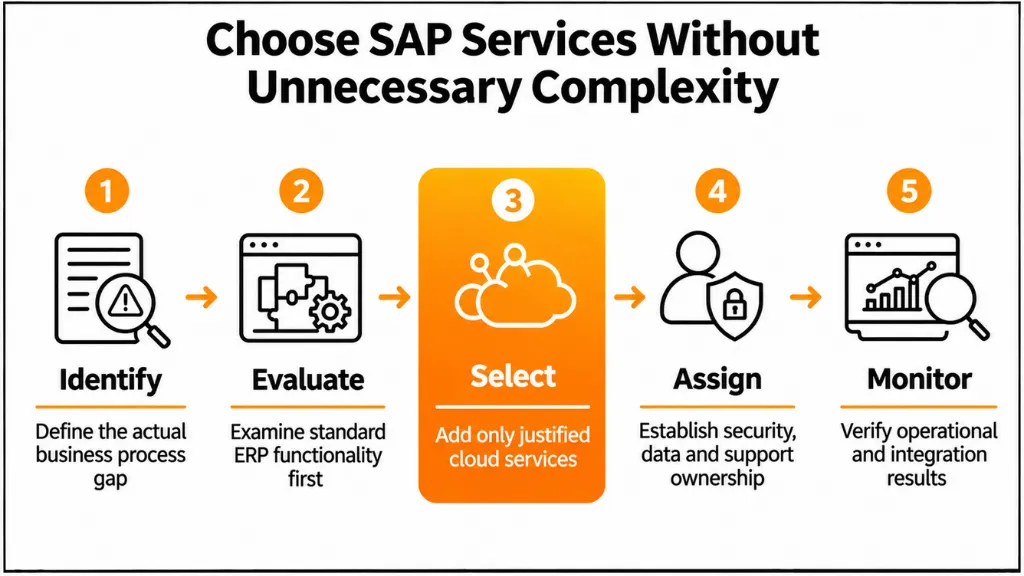
How to Choose the Right SAP Cloud Services
Selecting SAP cloud services should follow the organization’s business architecture and operational requirements.
Rather than introducing multiple products at once, companies can evaluate the services through a structured sequence.
Step 1: Assess Existing ERP Functionality
Review the SAP applications already in use.
Identify standard capabilities, configured business processes, integrations, and existing extensions.
Step 2: Categorize Business Requirements
Separate requirements involving ERP transactions, application integration, process automation, reporting, and AI.
This distinction helps prevent different technical responsibilities from becoming unnecessarily combined.
Step 3: Review Existing Services and Entitlements
Organizations may already have middleware, monitoring solutions, development environments, or analytics capabilities.
Therefore, additional subscriptions should be evaluated against existing investments.
Step 4: Validate Technical and Operational Behavior
Test relevant business transactions and application interactions.
Additionally, examine authentication, authorization, error handling, recovery, and monitoring.
A successful connection between two systems is insufficient if failures cannot be investigated or corrected.
Step 5: Confirm Ownership and Commercial Requirements
Before selecting a cloud service, identify the responsible business and technical teams.
Furthermore, confirm product entitlements, contractual requirements, regional availability, and licensing conditions with SAP.
The objective is to select services that address documented requirements without introducing unnecessary operational complexity.
SAP TechEd 2026 and Recent Enterprise Technology Developments
1. SAP Sapphire 2026: Autonomous Enterprise Innovations
SAP’s May 12, 2026, innovation announcements introduced developments across Joule Work, SAP Autonomous Suite, Business AI Platform, and cloud ERP. These innovations emphasize enterprise AI, coordinated workflows, and closer connections between business applications and data.
Source: SAP Sapphire 2026 Innovation News Guide.
2. SAP Cloud ERP Private and RISE With SAP
SAP’s June 12, 2026, roadmap discussion highlighted agentic AI, SAP-managed integrations, clean-core development, and improvements to ERP operations. Furthermore, SAP described AI-assisted modernization activities intended to support ongoing business transformation.
Source: SAP Community, 2026 and Beyond: Discover the Latest Innovations in SAP Cloud ERP Private.
3. SAP BTP Services and Enterprise Priorities for 2027
An October 23, 2026, industry analysis emphasized integration, clean-core extensions, process automation, AI services, and data architecture as relevant SAP BTP priorities. However, the appropriate selection continues to depend on existing systems and measurable business requirements.
Source: Inclusion Cloud, SAP BTP Services for US Enterprises in 2027: What Works & What to Prioritize.
Frequently Asked Questions About SAP Cloud Services
1. What are SAP cloud services?
SAP cloud services include cloud-based business applications and technology services that support enterprise operations. SAP S/4HANA Cloud provides ERP capabilities for finance, procurement, and inventory processes. Meanwhile, SAP Business Technology Platform supports application integration, extensions, automation, and AI-related development. Additional services include SAP Business Data Cloud and SAP Cloud ALM. Organizations should select these services according to their business requirements, existing systems, technical architecture, and operational responsibilities rather than assuming every service is necessary.
2. Which SAP cloud services does a small business need?
A small business should first identify the applications required to operate its essential business processes. Standard SAP cloud ERP functionality may address many requirements without extensive customization. However, businesses operating external applications may also need integration capabilities. SAP Build Process Automation can support workflows, while additional analytics services may become relevant as reporting requirements expand. Before adopting these products, organizations should evaluate costs, existing capabilities, implementation responsibilities, and ongoing support needs.
3. What is the difference between SAP BTP and SAP S/4HANA Cloud?
SAP S/4HANA Cloud provides business applications for managing financial transactions, purchasing, inventory, and related enterprise operations. SAP BTP provides supporting technology capabilities for integration, application development, process automation, and AI-related services. Consequently, SAP BTP is not a replacement for SAP S/4HANA’s core transaction responsibilities. Organizations can use BTP services to extend their ERP environment through supported interfaces. However, the architecture should clearly define where business records, application rules, and transaction responsibilities remain.
4. Does every SAP S/4HANA Cloud customer need SAP Integration Suite?
No. SAP Integration Suite is not required for every SAP S/4HANA Cloud implementation. Some integration requirements can be addressed through supported APIs and existing connectivity arrangements. However, complex interfaces may require message transformation, centralized API policies, error handling, or event-driven integration. SAP Integration Suite becomes relevant when these capabilities address documented technical requirements. Therefore, architects should evaluate interface complexity, existing middleware, security, and monitoring before selecting an additional integration service.
5. What is SAP Build Process Automation used for?
SAP Build Process Automation supports business workflows, approvals, rules, and repetitive operational activities. Organizations can use it to coordinate processes involving several teams or applications. For example, supplier onboarding may require approvals from procurement, finance, and compliance departments. Furthermore, document-processing capabilities can complement automation where information must be extracted or validated. However, businesses should review existing processes before automating them. Unnecessary steps, unclear responsibilities, and inconsistent rules should be addressed during workflow design.
6. Does every SAP customer need SAP Business Data Cloud?
Not every SAP customer requires SAP Business Data Cloud. Organizations with straightforward operational reporting requirements may already have sufficient capabilities within their current SAP applications. However, businesses combining information across multiple systems may need a more comprehensive data foundation. SAP Business Data Cloud supports governed enterprise information for analytics and AI applications. Therefore, adoption should depend on documented data integration, governance, and business context requirements rather than assuming that every ERP implementation needs a separate enterprise data platform.
7. Does SAP Business Data Cloud automatically fix poor data quality?
No. SAP Business Data Cloud provides capabilities for consolidating and governing enterprise information, but it does not automatically correct inaccurate source records. Existing problems involving incomplete, inconsistent, or duplicated information can affect downstream analytics and AI applications. Consequently, businesses should assess data quality before onboarding systems. They should also maintain validation and reconciliation procedures as information changes. Clear responsibility for source-system accuracy remains essential for reliable reporting and AI-supported business decisions.
8. Can SAP Cloud ALM monitor SAP Integration Suite?
SAP Cloud ALM supports monitoring scenarios involving SAP Integration Suite and other supported SAP environments. Its integration and exception monitoring capabilities can provide additional visibility into technical and business processing. Meanwhile, SAP Integration Suite includes local monitoring capabilities for investigating integration messages. These tools can complement each other. However, actual monitoring coverage depends on the supported scenario, configured systems, authorizations, and required setup. Organizations should verify these conditions before defining operational monitoring responsibilities.
9. How does SAP BTP support a clean-core strategy?
SAP BTP supports clean-core development by enabling applications and services to operate alongside SAP S/4HANA. These extensions can communicate with ERP through supported APIs instead of requiring unnecessary changes to the core system. Consequently, organizations can introduce business-specific functionality while maintaining clearer architectural boundaries. However, not every requirement needs a side-by-side application. Standard SAP functionality and ABAP Cloud development may also be appropriate. The correct approach depends on maintainability, supported interfaces, and business requirements.
10. How should enterprises choose SAP cloud services in 2026?
Enterprises should begin by reviewing their ERP environment, business processes, integration requirements, and existing technology investments. Next, they should distinguish core transactions from application extensions, automation, data, and monitoring needs. Furthermore, each proposed service should have a defined business purpose and accountable owner. Technical evaluation should cover authentication, supported interfaces, error recovery, and operations. Finally, organizations should confirm product availability and commercial conditions before purchasing additional services or approving implementation.
Conclusion
SAP TechEd 2026 highlights how enterprise technology is evolving through cloud services, artificial intelligence, automation, and intelligent business applications. Choosing the right SAP cloud services in 2026 is ultimately an architecture and business process decision.
SAP S/4HANA Cloud provides the core ERP foundation, while SAP BTP supports integration, applications, and automation. SAP Business Data Cloud addresses broader enterprise information requirements, and SAP Cloud ALM supports lifecycle and operational monitoring.
Furthermore, SAP’s evolving AI capabilities create opportunities to connect enterprise processes with intelligent applications.
However, additional technology does not automatically improve business outcomes.
Organizations should begin with existing functionality, identify genuine capability gaps, and select services that have clear responsibilities.
The right SAP cloud portfolio is not the one with the most products. It is the one that supports business requirements while keeping integration, governance, and operations manageable.
References
- Resolve Tech Solutions. SAP’s 2026 Roadmap: What Enterprises Need to Prepare for Now. November 7, 2025. https://resolvetech.com/saps-2026-roadmap-what-enterprises-need-to-prepare-for-now/
- SAP. SAP Sapphire 2026 Innovation News Guide. May 12, 2026.
- Inclusion Cloud. SAP BTP Services for US Enterprises in 2027: What Works & What to Prioritize. October 23, 2026.
- DataVapte. SAP Business Data Cloud Explained: Everything Enterprises Need to Know in 2026.
- SAP Community. 2026 and Beyond: Discover the Latest Innovations in SAP Cloud ERP Private. June 12, 2026.
- Supplied research draft. What SAP Cloud Services Does Your Business REALLY Need in 2026?. October 27, 2026.