SAP TechEd 2026 marked an important development in how SAP approaches enterprise AI, ABAP development, and intelligent business applications. Held in Berlin from October 27–29, 2026, the event focused on moving beyond AI-assisted coding toward agent-led development, enterprise automation, and governed AI workflows.
For SAP developers, the announcements were about more than generating code faster. Instead, they highlighted how AI agents can interact with enterprise applications, use trusted business data, and coordinate activities through supported interfaces.
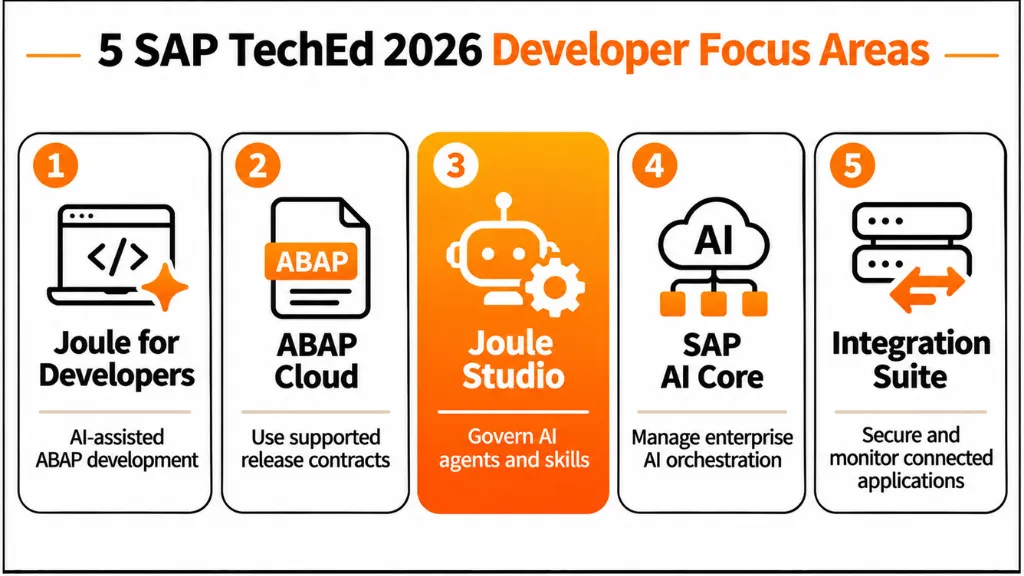
Moreover, developments across Joule Studio, ABAP Cloud, SAP Business AI Platform, and SAP Integration Suite demonstrate how enterprise development is becoming more closely connected to AI.
However, developers must still consider application security, transaction consistency, authorization, and system compatibility.
This article examines the major SAP TechEd 2026 developments and explains their implications for ABAP developers, SAP architects, and integration professionals.
What Is SAP TechEd 2026 and Why Does It Matter to Developers?
SAP TechEd is SAP’s technical conference for developers, architects, administrators, and enterprise technology professionals.
The 2026 Berlin event, accompanied by virtual sessions, featured technical presentations, workshops, product demonstrations, and roadmap discussions.
This year’s discussions concentrated on enterprise AI, agent-led development, cloud applications, and business data integration.
In particular, SAP highlighted the transition from AI systems that assist users toward AI agents capable of coordinating activities across enterprise environments.
Nevertheless, implementing these capabilities requires more than connecting an AI model to an application.
Developers must understand how agents access business information, invoke services, and operate within established SAP security controls.
Major SAP TechEd 2026 Technologies for Developers
| Technology | Key Focus | Developer Implication |
| Joule Studio | Custom AI agents, skills, and workflows | Develop and manage governed AI agents |
| Joule for Developers | Agent-led ABAP development | Support coding, modernization, and testing workflows |
| ABAP Cloud | Supported development and extension models | Use released APIs and approved development contracts |
| SAP Business AI Platform | Enterprise AI development and integration | Connect AI applications with business systems |
| SAP AI Core | AI model access and orchestration | Manage AI services and model interactions |
| SAP Integration Suite | APIs, events, and agent connectivity | Control and monitor cross-system operations |
| SAP Business Data Cloud | Business data and semantic context | Provide meaningful enterprise information to AI |
Together, these technologies illustrate SAP’s direction toward enterprise applications that combine AI capabilities with business processes.
SAP TechEd 2026: AI-Assisted ABAP Development and Agent-Led Workflows
One of the most significant themes at SAP TechEd 2026 was the evolution of ABAP development.
Traditionally, AI coding assistants have focused on helping developers explain source code, generate implementation suggestions, and prepare tests.
However, agent-led development introduces a broader approach.
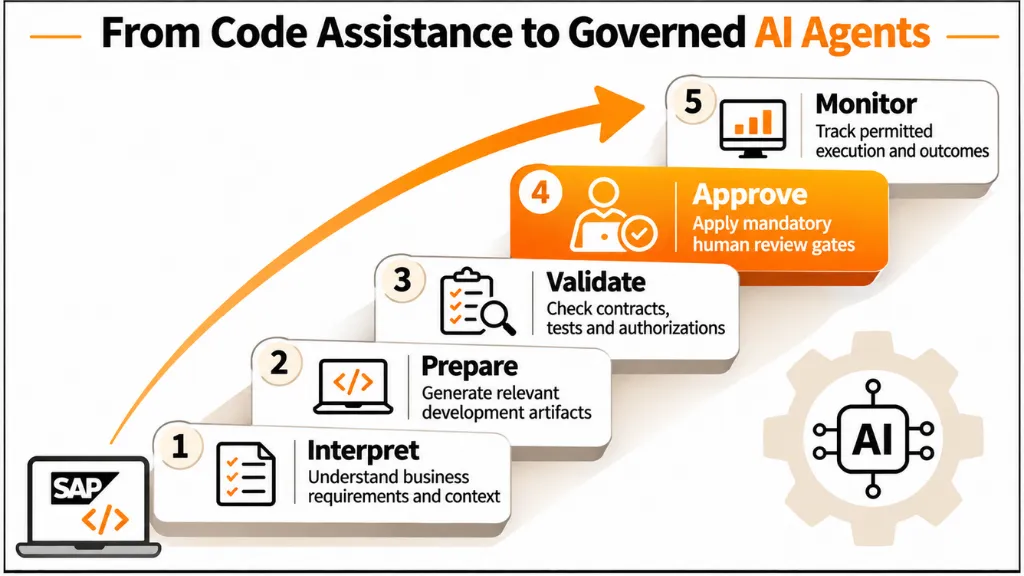
Instead of responding only to individual programming requests, AI agents can coordinate multiple development activities within supported environments.
For example, SAP demonstrated the Custom Code Migration Agent as part of Joule for Developers.
This capability works with ABAP Test Cockpit (ATC) findings to support the remediation of existing custom code.
Additionally, it organizes changes for developer review before implementation.
How the Custom Code Migration Agent Works
The demonstrated migration process includes identifying existing code issues, grouping affected objects, generating proposed changes, and preparing those changes for review.
Developers remain responsible for examining the resulting modifications.
Furthermore, the process supports the modernization of custom code during transitions from SAP ECC toward SAP Cloud ERP Private.
Therefore, AI can assist with repetitive remediation activities without removing the need for engineering judgment.
ABAP MCP Server and Developer Tools
Another important development concerns the ABAP Model Context Protocol (MCP) Server.
SAP has made the ABAP MCP Server generally available for supported development tools, including Eclipse and Visual Studio Code.
Consequently, compatible AI development assistants can interact with supported ABAP development capabilities.
SAP also introduced ABAP development in Visual Studio Code during Q2 2026, initially focused on ABAP Cloud.
These capabilities are particularly relevant for developers who want AI assistance that works with their actual development environment.
However, access to development tools does not remove ABAP Cloud restrictions or software release requirements.
Why ABAP Cloud Still Matters
ABAP Cloud establishes supported development boundaries through approved language features, released APIs, and development contracts.
AI-generated code must comply with these requirements.
For example, an AI assistant may suggest a classic ABAP object that is unavailable or unreleased in the target cloud environment.
In that situation, developers must verify the proposed implementation before using it.
Similarly, applications built with the ABAP RESTful Application Programming Model (RAP) must continue to enforce business rules and application behavior.
The central point is that AI changes how developers work, but it does not replace SAP’s application development rules.
SAP TechEd 2026: Joule Studio and Enterprise AI Agent Development
SAP Joule Studio was another major focus at SAP TechEd 2026.
The development environment supports creating custom AI agents and skills that interact with business applications and enterprise workflows.
Previously, organizations commonly relied on predefined AI capabilities for specific business functions.
However, business requirements frequently involve unique processes, data structures, and operational rules.
Joule Studio addresses this requirement by supporting custom agent development.
Natural-Language and Professional Development
Joule Studio supports different development approaches.
Business users can describe intended requirements through natural-language instructions.
Meanwhile, professional developers can refine implementation components using development tools and the Joule Studio command-line interface.
Furthermore, SAP highlighted capabilities for agent testing, deployment, and lifecycle management.
The development environment includes sandbox testing, execution traces, and evaluation capabilities.
These features help developers examine agent behavior before deploying solutions into business environments.
Joule Studio and n8n Workflow Integration
SAP also announced collaboration with n8n to extend workflow orchestration capabilities.
This collaboration connects agent development with multi-step workflow design across SAP and non-SAP applications.
As a result, organizations can work toward processes that combine AI-driven activities with application integration.
However, the n8n-related capabilities were introduced through an early-adopter approach, with broader availability following SAP’s rollout plans.
Connecting Agents with Business Context
Joule Studio also incorporates connections with SAP LeanIX, SAP Signavio, SAP Knowledge Graph, and SAP Domain Models.
These capabilities help developers understand business processes, application relationships, and relevant enterprise information.
Consequently, custom agents can be developed with greater awareness of the business processes they are intended to support.
Nevertheless, developers must still verify that agents have the appropriate permissions and use supported interfaces.
SAP TechEd 2026: SAP BTP and Enterprise AI Architecture
SAP TechEd 2026 also emphasized SAP Business AI Platform as the foundation for enterprise AI applications and workflows.
The platform direction connects application development, integration, data, AI models, and governance.
For developers familiar with SAP Business Technology Platform (BTP), this represents an expansion of the platform’s enterprise AI role.
Connecting AI Services with SAP Business Applications
Enterprise AI applications often require information from multiple systems.
For example, an AI-supported business workflow may need data from SAP S/4HANA, another enterprise application, and an external service.
SAP BTP-related development and integration capabilities provide ways to connect these components.
However, integration architecture must clearly distinguish between AI recommendations and actual business transactions.
An AI agent may prepare information or suggest an action, but the underlying application must continue enforcing authorization and business validation.
SAP AI Core and Model Orchestration
SAP AI Core supports AI-related capabilities, including model access and orchestration.
Within enterprise development, models require appropriate contextual information and controlled interactions with business applications.
Furthermore, developers need to consider input validation, output handling, and operational monitoring.
AI-generated recommendations can appear reasonable even when the underlying data is incomplete.
Therefore, applications should validate results before using them in sensitive business processes.
Clean-Core Development Remains Essential
SAP’s clean-core approach continues to be important as AI-generated development expands.
Extensions should use released APIs and supported development methods rather than modifying unsupported core objects.
Similarly, external AI services should not bypass authorization or transaction validation.
In practice, the availability of AI coding tools does not change the architectural responsibilities of SAP development teams.
SAP TechEd 2026: SAP Integration Suite and AI Agent Connectivity
SAP Integration Suite plays an important role in the enterprise AI architecture discussed at SAP TechEd 2026.
AI agents frequently need to communicate with multiple applications.
Therefore, the underlying integration environment must support controlled access, monitoring, and consistent business operations.
APIs, Events, and Agent Connectivity
SAP Integration Suite supports enterprise connectivity through APIs, messages, and event-driven integration.
Synchronous APIs allow applications to request operations and receive responses.
Meanwhile, event-driven approaches allow applications to react to business events.
SAP TechEd sessions also covered advanced event mesh and MCP-related connectivity.
Furthermore, integration capabilities can expose supported application functions for use by compatible AI agents.
However, the execution layer must continue enforcing security and business permissions.
Preventing Repeated Transactions
Agent-triggered operations introduce familiar integration risks.
For example, a business transaction might complete successfully even though the agent does not receive its response.
If the operation is repeated without reconciliation, a duplicate business document could be created.
Therefore, integration designs need controlled retries, transaction identifiers, and duplicate-prevention mechanisms.
These controls belong within application and integration architecture rather than relying solely on AI-generated instructions.
Enterprise AI Gateway and Agent Governance
SAP announced the Enterprise AI Gateway as part of its enterprise AI governance developments.
Built on SAP Integration Suite, it is designed to support authentication, policy enforcement, routing, monitoring, and auditing of AI interactions.
Its announced availability was planned for Q1 2027.
The separate agent gateway supports connections between agents, including interactions involving Agent2Agent (A2A) and MCP.
Consequently, architects must distinguish agent connectivity from broader enterprise AI traffic governance.
SAP Business Data Cloud Gives AI Agents More Business Context
Access to enterprise data is not enough for reliable AI applications.
AI systems also need to understand what business information is represented.
For example, inventory records may contain available quantities, reserved stock, and outstanding requirements.
Although these values may refer to the same material, they represent different business conditions.
SAP TechEd 2026 highlighted developments intended to improve this understanding.
SAP Knowledge Graph and Ontology Manager
Through SAP Knowledge Graph, enterprises can connect business information and understand the relationships between different data elements. Additionally, the Ontology Manager supports the definition of business concepts that provide meaningful context for AI applications.
Additionally, the Ontology Manager supports the definition of business concepts that can provide context for AI applications.
SAP discussed extending these capabilities to customer-specific SAP and non-SAP information.
Consequently, AI applications can be designed around more meaningful business relationships rather than isolated records.
The Ontology Manager was introduced in beta, while additional Knowledge Graph capabilities were planned for subsequent release phases.
Open Lakehouse and Dremio Integration
SAP also announced developments involving Apache Iceberg support and Dremio technology within SAP Business Data Cloud.
These capabilities are intended to improve access to SAP and third-party data across different environments.
Furthermore, SAP highlighted distributed SQL query capabilities for working with enterprise information.
The Dremio-related lakehouse capabilities were planned for general availability in Q1 2027.
SAP-RPT Models
SAP TechEd announcements also covered SAP-RPT model developments.
SAP-RPT-TS focuses on time-series forecasting.
Meanwhile, SAP-RPT-Decisions addresses automated decision-making use cases, including order approvals and supply chain exception handling.
These developments illustrate SAP’s broader emphasis on applying AI models to structured business information.
AI Governance Becomes a Core Development Requirement
As enterprise AI agents gain access to business applications, governance becomes increasingly important.
Organizations must define which systems an agent can access, what operations it may perform, and how its activities are monitored.
SAP TechEd 2026 introduced several related governance developments.
AI Governance Assistant
SAP introduced an AI Governance Assistant associated with SAP AI Agent Hub.
The assistant supports EU AI Act assessment activities by identifying documentation gaps, preparing assessment information, and identifying records requiring further review.
However, its outputs still require human legal and compliance assessment.
The initial availability was directed toward Early Adopter Care customers beginning in November 2026.
SAP LeanIX and Architecture Governance
SAP LeanIX provides architectural information that can support AI-related decisions.
For example, architecture standards, technical decisions, and system relationships can help guide agent recommendations.
SAP also discussed capabilities for extracting architecture principles from documentation and suggesting updates for human approval.
Therefore, governance is becoming more closely connected with enterprise architecture rather than being treated as a separate activity.
Sovereign Cloud Support
SAP also discussed expanded sovereign cloud support on AWS for SAP AI Core, Joule, and SAP Datasphere.
These developments are relevant to organizations with specific security and regulatory requirements.
Nevertheless, organizations must assess individual deployment and compliance requirements before adopting these capabilities.
SAP TechEd 2026: Developer Priorities and Technical Decisions
The conference introduced several developments, but not every capability is available in the same release phase.
Therefore, developers and architects should separate existing functionality from early-adopter programs and roadmap announcements.
SAP TechEd 2026 Developer Decision Matrix
| Development Area | Availability Discussed | Main Consideration | Developer Action |
| ABAP MCP Server | Generally available | Supported development access | Verify target tooling |
| CAP MCP adapters | Generally available | Exposing application services | Review service permissions |
| Joule Studio | Phased general availability | Custom agent development | Check tenant eligibility |
| n8n integration | Early-adopter rollout | Workflow orchestration | Assess rollout status |
| AI Governance Assistant | Early Adopter Care, November 2026 | AI risk assessment | Maintain human review |
| SAP Enterprise AI Gateway | Planned Q1 2027 | AI policy and traffic management | Review architecture requirements |
| Dremio lakehouse | Planned Q1 2027 | Enterprise data access | Evaluate data requirements |
| Ontology Manager | Beta rollout | Business semantic context | Verify tenant availability |
Availability reflects the announcements and reporting supplied for SAP TechEd 2026. Individual product environments and release conditions may differ.
Practical Priorities for SAP Developers
ABAP developers should concentrate on ABAP Cloud contracts, RAP development, and supported AI-assisted development workflows.
Integration engineers should assess MCP connectivity, API permissions, event-driven patterns, and monitoring requirements.
SAP architects should examine AI execution boundaries, application ownership, and enterprise governance.
Development leads should ensure that AI-generated changes undergo appropriate reviews, testing, and deployment controls.
Furthermore, technical teams should assess relevant capabilities against their existing SAP environments rather than treating every conference demonstration as an immediate implementation requirement.
Recent Developments in SAP TechEd 2026
1. Joule Studio and Joule Work Availability
SAP announced phased general availability for Joule Studio and Joule Work, extending enterprise agent development and access. These capabilities support SAP’s direction toward AI-assisted workflows across business applications.
2. ABAP and CAP MCP Development
SAP’s 2026 development updates included general availability of the ABAP MCP Server and CAP MCP adapters. Consequently, developers have additional supported options for connecting compatible AI tools with application development and services.
3. Enterprise AI Gateway and Business Data Cloud Roadmap
SAP discussed the Enterprise AI Gateway, expanded Knowledge Graph capabilities, and Dremio-based lakehouse developments. These capabilities were associated with planned Q1 2027 release milestones, making availability checks essential before implementation planning.
Frequently Asked Questions About SAP TechEd 2026
1. What is SAP TechEd 2026?
SAP TechEd 2026 is SAP’s technology conference for developers, architects, administrators, and business technology professionals. The Berlin event took place from October 27–29, 2026, with virtual participation available. It featured technical sessions, developer workshops, roadmap presentations, and enterprise AI discussions. In particular, the conference highlighted agent-led ABAP development, Joule Studio, SAP Business AI Platform, and integration technologies. These topics help technical professionals understand SAP’s current development capabilities and its direction for future enterprise applications.
2. What were the key announcements at SAP TechEd 2026?
SAP TechEd 2026 highlighted developments across Joule Studio, Joule Work, enterprise AI governance, business data capabilities, and agent orchestration. The announcements included custom AI agent development, n8n workflow integration, Enterprise AI Gateway capabilities, and enhancements involving SAP Knowledge Graph. Additionally, SAP discussed Dremio-based lakehouse capabilities and SAP-RPT models. However, availability differed across products. Some technologies were generally available, others entered early-adopter programs, and several capabilities were planned for Q1 2027.
3. How does SAP TechEd 2026 affect ABAP developers?
SAP TechEd 2026 emphasized the transition from AI-assisted programming toward agent-led ABAP development. Developers can explore capabilities involving Joule for Developers, the ABAP MCP Server, and AI-supported custom code migration. Furthermore, SAP highlighted ABAP Cloud, RAP, and supported development interfaces. Although AI agents can assist with implementation and modernization activities, developers must still review generated changes, validate application behavior, and ensure compliance with the target environment’s development restrictions.
4. What is Joule Studio in SAP?
Joule Studio is SAP’s environment for developing custom AI agents and skills. It supports natural-language requirements, professional development tools, testing, and agent lifecycle management. Furthermore, developers can connect agents with relevant enterprise processes and services. SAP TechEd 2026 highlighted its integration with Joule Work, business context capabilities, and n8n workflows. However, the availability of individual features depends on SAP’s release phases and customer eligibility. Organizations should verify supported capabilities before planning production deployment.
5. Is coding required to create AI agents with Joule Studio?
Joule Studio supports both business-oriented and professional development approaches. Business users can express agent requirements through natural-language instructions. Meanwhile, developers can refine implementations through professional tools and the Joule Studio CLI. This allows different users to participate in agent development according to their responsibilities. Nevertheless, complex business integrations, security policies, and application interactions still require technical review. Natural-language development does not eliminate the need to validate agent behavior or maintain appropriate enterprise controls.
6. What is the ABAP MCP Server?
The ABAP MCP Server supports interaction between compatible AI development tools and supported ABAP development capabilities. SAP announced general availability for supported environments, including tooling associated with Eclipse and Visual Studio Code. Consequently, AI-assisted workflows can use development context rather than relying only on generic programming information. However, the server does not remove ABAP Cloud restrictions, development authorization requirements, or released-interface rules. Developers remain responsible for verifying that proposed changes meet the target system’s technical and business requirements.
7. How does SAP Business AI Platform support enterprise AI?
SAP Business AI Platform brings together capabilities for developing, contextualizing, integrating, and governing enterprise AI applications. These capabilities are relevant when AI solutions require business data, application services, and interactions across enterprise systems. Furthermore, SAP TechEd 2026 highlighted Joule Studio, SAP AI Core, and governed connectivity within this architecture. Developers must still define application responsibilities and transaction boundaries. AI services can support business operations, but they should not bypass authorization or business validation requirements.
8. Why is SAP Integration Suite important for AI agents?
SAP Integration Suite provides connectivity capabilities involving APIs, messages, and events across enterprise applications. AI agents may need these connections to retrieve information or request supported business operations. However, agent-triggered activities require authentication, authorization, monitoring, and transaction safeguards. For example, a repeated operation could create duplicate records if the integration layer lacks appropriate controls. Therefore, developers should maintain controlled retries, transaction identifiers, and clear execution permissions rather than relying exclusively on AI instructions.
9. What is SAP Enterprise AI Gateway?
SAP Enterprise AI Gateway is an announced capability built on SAP Integration Suite for managing AI interactions across enterprise environments. Its described functions include authentication, policy enforcement, routing, monitoring, and auditing. Furthermore, it addresses interactions involving APIs, models, and agents. SAP’s announced roadmap targeted Q1 2027 for availability. Developers should distinguish this capability from the separate agent gateway, which supports agent connectivity. Organizations should confirm current availability, licensing, and technical requirements before implementation.
10. What should SAP developers focus on after SAP TechEd 2026?
SAP developers should focus on the technologies that match their existing systems and responsibilities. ABAP developers can assess agent-led development, RAP, and released development interfaces. Meanwhile, integration professionals can evaluate MCP connectivity, event-driven architecture, and governance controls. Architects should review agent permissions, business data ownership, and application boundaries. Additionally, teams should separate generally available functionality from roadmap announcements. This approach supports technical planning without assuming every demonstrated capability is immediately available.
Conclusion
SAP TechEd 2026 demonstrated how SAP is expanding the relationship between enterprise AI and application development.
Agent-led ABAP development, Joule Studio, SAP Business AI Platform, and governed integration emerged as important areas of technical development.
Furthermore, SAP Business Data Cloud and Knowledge Graph capabilities highlighted the importance of reliable business context for AI applications.
However, these developments do not remove the fundamental requirements of SAP engineering.
Supported APIs, business rules, authorization, transaction consistency, and operational monitoring remain essential.
For SAP developers, the most important outcome of TechEd 2026 is understanding how AI can support development and business processes while maintaining established enterprise controls.
Rather than adopting every announced capability immediately, development teams should evaluate product availability, implementation requirements, and compatibility with their SAP environments.
References
- Accel4. Top 5 Announcements at SAP TechEd 2026. November 10, 2026.
- Software-Heroes. SAP TechEd 2026. October 30, 2026.
- Spadoom. SAP TechEd 2026: What Developers and Architects Should Take Away. October 30, 2026.
- SAP Community. ABAP Sessions at SAP TechEd 2026. October 9, 2026.
- SAP Community. Prepare for SAP TechEd 2026 with SAP Business AI Platform Maturity Assessment.