Introduction
SAP Conversion Credits can help businesses account for eligible existing SAP investments when moving to S/4HANA, but the actual value is rarely as simple as “SAP gives us credit for what we’ve already paid.” The conversion path you choose, the structure of your existing licenses, and the terms of your SAP agreement can all determine how much value you retain during the transition. For IT finance teams building an S/4HANA migration budget, understanding these factors early can help prevent unexpected licensing costs and commercial surprises later.
Treat the credit as a fixed number and lock in your migration timeline around something else: infrastructure readiness, project bandwidth, whatever’s driving the schedule, and you can watch that number shrink without ever making a decision that looks wrong on paper. This post walks through what SAP conversion credits actually depend on and where organizations lose value they didn’t realize was time-sensitive.
These credits have a direct impact on SAP S/4HANA migration incentives, licensing decisions, and the overall transformation cost structure. Such things can creep up on the cost impact of an SAP ECC upgrade, resulting in a major financial loss during the migration process.
What SAP Conversion Credits Literally Mean.
SAP Conversion Credits generally refer to commercial credits or adjustments that may be available under specific SAP contract-conversion or migration arrangements when an organization moves from existing SAP licensing to a new S/4HANA commercial model.
The important point is that existing ECC licenses do not automatically convert into a fixed monetary credit. The actual commercial treatment depends on the organization’s existing agreement, eligible products and entitlements, the selected S/4HANA licensing or subscription model, and the specific SAP conversion terms offered to the customer.
The potential value and applicability can therefore depend on factors such as:
- Existing SAP contract and license entitlements
- Eligible products included in the conversion
- Selected S/4HANA commercial model
- Contract/conversion structure
- Timing and terms of the migration
- Product mapping and applicable SAP commercial rules
Do not treat conversion credits as a guaranteed discount or a universal percentage reduction in S/4HANA costs. Instead, evaluate the commercial value against the customer’s specific SAP agreement and applicable conversion terms.
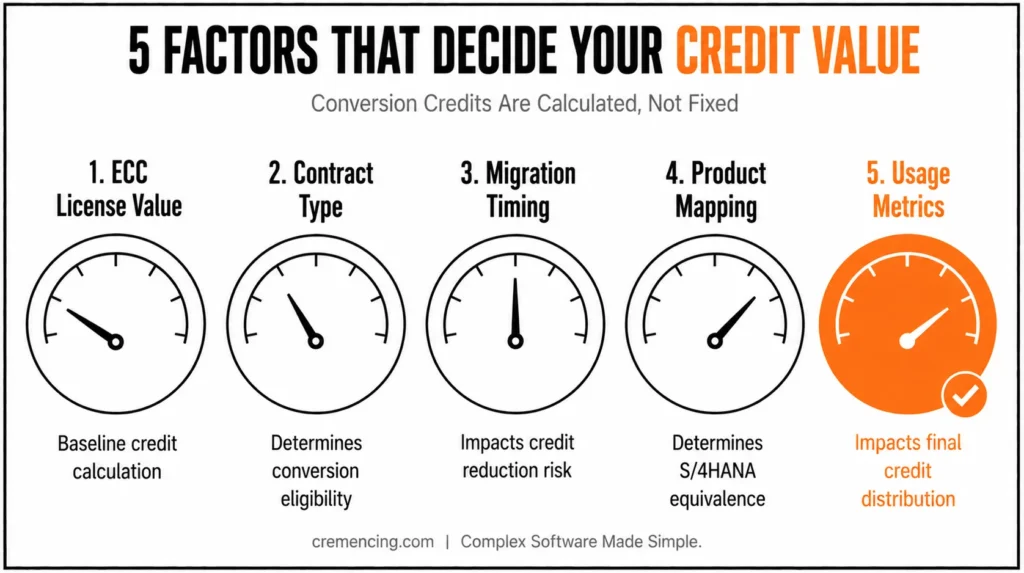
How SAP Conversion Credits Work in Practice
| Factor | Impact on Credit Value |
|---|---|
| ECC license value | Sets the baseline for credit calculation |
| Contract type (product vs. contract conversion) | Determines eligibility and how much value carries forward |
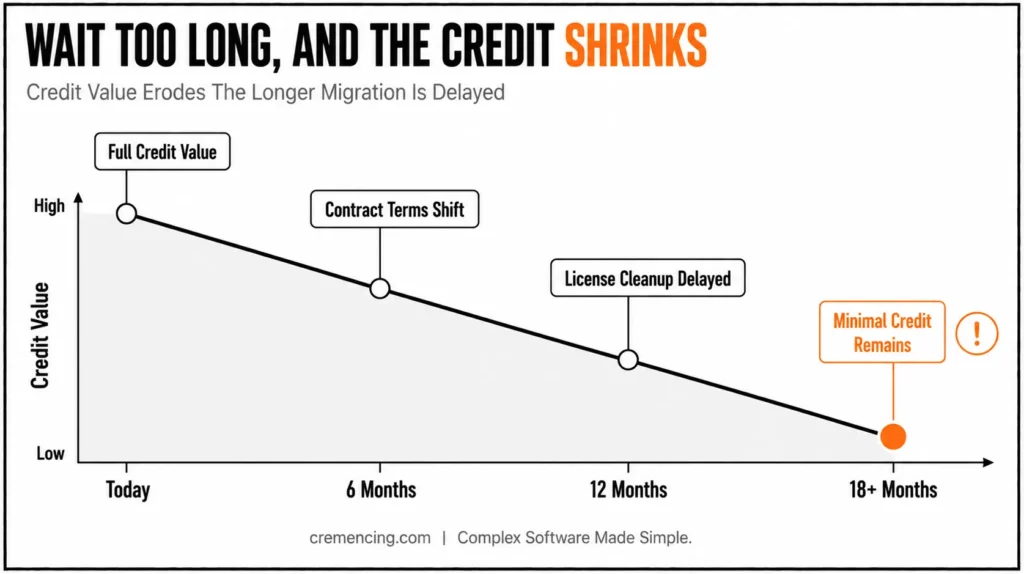
| Migration timing | Delay increases the risk of credit reduction |
| Product mapping | Determines S/4HANA equivalence value for each license |
| Usage metrics | Affects how credit is ultimately distributed across modules |
Impact of SAP conversion credits on the cost of migration.
Step 1: ECC License Assessment.
SAP analyses your current ECC license portfolio. This forms the foundation towards calculating SAP Conversion Credits.
Step 2: Usage and Contract Mapping.
SAP charts the utilization of the licenses within the modules and users. Efficiency in the use of credit decreases credit efficiency.
Step 3: Conversion Eligibility Check
Not all licenses are equal in the SAP S/4HANA migration incentive programs.
Step 4: Timing Evaluation
The timing of migration is a critical factor. Delays may decrease the credit advantage and raise the cost of SAP digital transformation delay.
Step 5: Final Credit Application
Credits can offset new S/4HANA licensing expenses, subject to the terms and conditions of the applicable contract.
Step 6: Post-Migration Adjustment
After migration, businesses can adjust their SAP licensing to better reflect actual system usage.
Benefits and ROI of SAP Conversion Credits
SAP Conversion Credits can significantly improve financial efficiency when businesses optimize and use them strategically.
Quantifiable benefits:
- Net licensing cost reduction of 15-30 percent of the net licensing cost.
- Reduced initial investment in S/4HANA migration.
- Enhanced ROI on the current ECC investments.
- Higher bargaining power with SAP deals.
- Less initial cash flow stress in change.
Strategic ROI impact:
The enterprise can be entered with the help of proper use of credits:
- When cost-impacting upgrade of SAP ECC, avoid overpaying.
- Synchronize the timing of migration with the financial optimization period.
- Realize the full potential of SAP S/4HANA migration incentives programs.
The credit opportunities are however, lost due to poor planning.
Typical Flaws that Businesses Commit.
- Delaying migration decisions
- Late migration decreases the available value of SAP Conversion Credits.
- Ignoring contract structure
- Old ECC contracts usually have restrictions that minimize credit flexibility.
- Misunderstanding credit timing
- It is assumed that credits are stable, but in many cases they change with time.
- Bad license cleanup rior to migration.
- Licenses that are not used bloat the calculation of costs.
- Taking credits as assured discounts.
- They are not fixed savings but rather conditional and time-sensitive.
Such errors are the direct cause of the loss of value in SAP contract conversion.
Before You Lock In a Migration Timeline, Check:
- Which conversion path (product vs. contract) applies to your current contract
- Whether unused licenses (“shelfware”) are inflating your baseline calculation
- Whether your contract has an expiration or review date that predates your planned migration
- Whether delaying 6–12 months has a quantified credit impact your SAP account team can confirm in writing
What Competitors Lack.
The vast majority of SAP material describes what conversion credits are but does not take note of actual financial erosion patterns.
Typically lacking:
- The way in which credit value declines with time prior to migration.
- Delayed decision-making: hidden impact on SAP digital transformation delay costs.
- Real-life examples of situations when credit is rendered unusable to some degree.
- Communication between optimization of the license and credit computation of the credit.
- The restructuring of contracts: how can this be done to enhance or destroy credit value?
- SAP conversion credits are not financial instruments as such but rather leverage mechanisms which occur over time. The largest driver of hidden costs in S/4HANA migration relates to missing the timing window.
Conclusion
It is important to note that SAP Conversion Credits will be critical in determining the cost of SAP S/4HANA migration in 2026. They are not fixed discounts but dynamic financial tools that are determined by the timing, licensing framework, and migration planning decisions.
Organizations that fail to convert the value of the contract to SAP S/4HANA, with delays or mismanagement of migration, often face SAP S/4HANA migration incentives loss, increased licensing costs, and lack of access to SAP S/4HANA migration incentives.
Organizations need to use credits as a financial tool and not as an economic fringe. Early planning and systematic implementation could help to greatly mitigate the impact of SAP ECC upgrade costs and prevent the SAP digital transformation delay cost from growing exponentially. There is considerable infrastructure, schedule, and technical maturity focused on by many enterprises planning their SAP transformation in 2026.
If you are planning the migration of SAP S/4HANA, consider early assessment of your conversion credit position. The strategic timing may directly enhance your financial performance and minimize the pressure of the long-term migration costs.
FAQ
What are SAP conversion credits?
They are financial changes that lead to lowering of S/4HANA licensing expenses depending on current ECC investments.
Are SAP conversion credits expired?
They do not run out per se, but the value can diminish based on time and the contract structure.
What is the impact of SAP conversion credits on migration cost?
They cut initial licensing expenses, but rely on the timing of migration and optimization of licenses.
Do you think SAP conversion credits can lower the total cost of the project?
Yes, but only when implemented in a strategic manner within the SAP-defined migration programs.
Why do SAP conversion credits get lost?
Late migration, bad license cleanup, and terms that were not favorable in contracts.
Should we negotiate conversion credits directly with SAP or through a licensing advisor?
Both are common. SAP account teams can confirm current program terms directly; independent licensing advisors are often used to benchmark whether the credit offered is competitive before signing.
Is there a deadline that affects conversion credit value?
Timing affects credit value more broadly than any single hard deadline, but organizations still running ECC without a defined migration schedule should treat that as a decision with a real cost, not a neutral default, given SAP’s broader ECC mainstream maintenance timeline.
Resources
https://help.sap.com
https://www.sap.com/products/erp/s4hana.html
https://community.sap.com