

For business leaders considering upgrading SAP S/4HANA, in the cloud or on-premises, it is more than a technical decision – it’s a strategic one. One approach that has the magic touch is an SAP S/4HANA Fit-to-Standard approach; it truly delivers.
Additionally, Fit-to-Standard is more than an approach; it’s a business-aligned strategy that reduces customizations, maximizes process efficiency, and speeds time to value. Also, when CIOs, IT leaders, and SAP transformation owners make it a defining strategy, their organizations realize:
- Faster deployments
- Reduced total cost of ownership (TCO)
- Frictionless future upgrades
This guide examines the Fit-to-Standard approach when deploying cloud and on-premises S/4HANA, with a review of its advantages, best practices, partnering advice, and executive considerations when returning ‘best bang for buck’.
Proven Value in Standardized Deployment
Recent enterprise ERP studies reveal that adopting standardized processes prevents severe scope creep, which otherwise impacts 50% of transformation projects. McKinsey data indicates nearly 70% of custom-heavy ERP programs miss target deadlines or return negative ROI. Conversely, organizations prioritizing standard workflows shorten initial deployment timelines by up to 30%. Furthermore, structured alignment workshops boost post-launch user adoption, resolving issues that cause 70% of implementation failures.
Why SAP S/4HANA Fit-to-Standard Matters
Enterprises are often tempted to over-customize their SAP systems to emulate legacy processes. However, customization is also risky:
- Extended timelines and delayed go-live
- Higher technical debt and maintenance costs
- Complex upgrades and patching cycles
- Lower take-up from users not comfortable with new processes
In other words, Fit-to-Standard responds to these challenges by using SAP’s standard processes, adopting best practices of business, and accepting limited and controlled exceptions.
Executive Benefits Include:
- Predictable project timelines
- Reduced total cost of ownership
- Enhanced adoption and user confidence
- Future-proof, scalable systems with easier upgrades and servicing
Understanding SAP S/4HANA Fit-to-Standard
Fit-to-Standard is an SAP Activate methodology that emphasizes the deployment of standard SAP S/4HANA processes instead of building custom workflows. It works for cloud and on-premise deployments, However with some modifications. Put simply, consider system architecture and integration points.
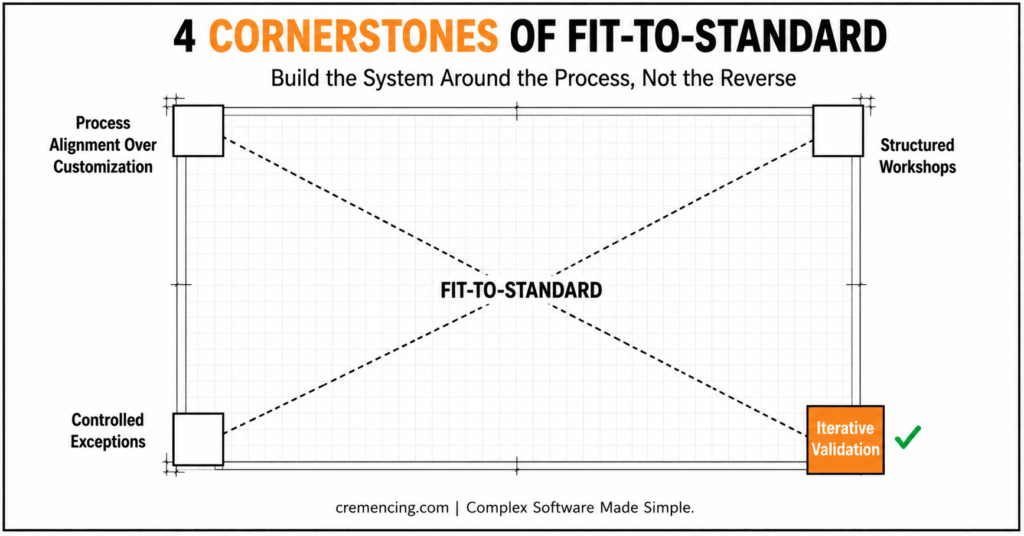
Core Principles of Fit-to-Standard
Process Alignment over Customization
- First, customize business processes to suit the best practices in SAP rather than build a solution.
Structured Workshops
- Next, facilitate Fit-to-Standard workshops with the business to walk through processes and ensure system design meets end-user needs.
Controlled Exceptions
- Then, identify holes that are critical and leave for approval the few exceptions needed to achieve a balance between flexibility and complexity.
Iterative Validation
- Finally, cycle workshops and testing phases to improve alignment and get stakeholder buy-in.
With the application of these principles, at the same time, organizations can mitigate risk, simplify and decrease complexity, and accelerate time-to-value.
Fit-to-Standard in Cloud versus On-Premise Deployments
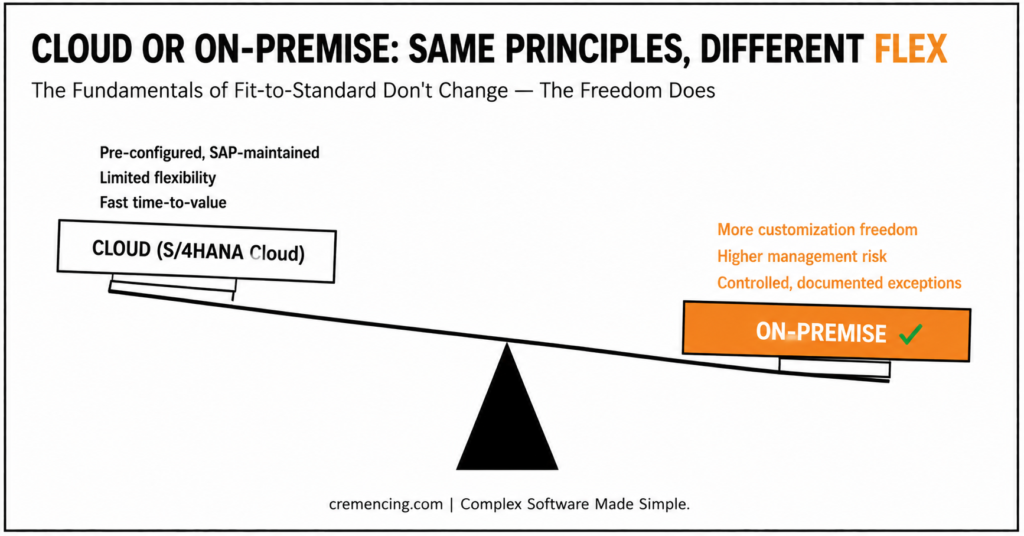
As a result, the fundamentals of Fit-to-Standard are unchanged; the strategy is affected by deployment type:
Cloud Deployments (S/4HANA Cloud)
- Pre-defined processes are pre-configured and maintained by SAP.
- Limited flexibility is a driver for the use of conventional workflows.
- Short deployment cycles mean quick time-to-value.
- Fit-to-Standard is crucial to align your enterprise processes with best practices in the cloud and prevent unnecessary extensions.
On-Premise Deployments (S/4HANA On-Premise)
- There’s more freedom for customization, but it adds to the line-of-sight and management risks.
- Fit-to-Standard approach helps curb over-customization, enabling imperative business-specific add-ons to be incorporated.
- Allows organizations to meet standardization while addressing specific, highly specialized workflows.
Example:
For instance, a European industrial concern deployed Fit-to-Standard for its cloud finance modules as well as on-premises production systems. Because of this, reference adoption was made to expedite deployment of finance, and select deviations during production were made to comply without adding untimely complexity.
Faster Implementation and Time-to-Value
- Best practices minimize the configuration cycle, testing, and rework.
- The usage of pre-configured templates is especially advantageous in cloud projects.
Reduced Complexity and Cost
- The fewer plugins they customize, the lower the development, testing, and maintenance costs.
- Cutting straight to upgrades helps minimize long-term technical burden.
Enhanced User Adoption
- Standardized procedures adhere to SAP best practices and are easier for employees to comprehend and follow.
- Workshops encourage participation and confidence in the use of the system.
Future-Ready Architecture
- Common procedures make it easy to integrate with SAP BTP, analytics, and AI applications, among other cloud innovations.
- “Makes organizations ready for Kaizen and turns everything on its head.”
Risk Mitigation
- Little to no customizations mean minimal system conflicts and post-go-live problems.
- Standardization aligns with industry and SAP best practices.
Best Practices for Executives Implementing Fit-to-Standard
- Engage Cross-Functional Stakeholders Early
Engage business process owners, IT, finance, supply chain, and executive sponsors. - Conduct Iterative Fit-to-Standard Workshops
Validate both typical and important atypical workflows. - Document Exceptions Clearly
Based on reasoning, explain non-compliances and evidence traceability of changes (upgrades, audits). - Prioritize Critical Processes
Focus on high-impact areas first that can deliver maximum business benefits. - Integrate Change Management
Train, communicate, and adopt end users. - Align Strategy with Deployment Type
Customize a Fit-to-Standard methodology for cloud & on-premises while preserving core tenets.
Executive Considerations for SAP S/4HANA Fit-to-Standard
- Cloud First or On-Premise? The deployment model influences customization flexibility, service consumption, and integration.
- Complexity of Processes: Very specific business processes might call for controlled Fit-to-Gap exceptions.
- Time and Budget: Fit-to-Standard speeds up projects and lowers cost, an executive must-have.
- Future Enhancements and Innovation: Adopting the standard facilitates plugging in AI, analytics, or BTP applications.
Conclusion:
Fit-to-Standard as Business Enabler
The Fit-to-Standard approach that offers predictable, low-risk implementations for SAP S/4HANA formats in the cloud or on premise. Consequently, companies can minimize redundant and unnecessary customizations by engaging stakeholders early thus often in the process and by relying on SAP best practices.
- Accelerate time-to-value
- Reduce technical debt and complexity
- Improve user adoption
Build for tomorrow with an SAP environment that grows with you
On the other hand, the implications for business executives are clear: Fit-to-Standard is more than just a methodology; it’s also a strategic business transformation lever.
Finish the executive-led Fit-to-Standard sessions to document process, validate flow, and confirm controlled exceptions. In other words, Alignment in the early stages leads to easier adoption, with less customization and realizable business value.
FAQs
What is SAP S/4HANA Fit-to-Standard?
It is an approach to implementing S/4HANA that focuses on using standard SAP out-of-the-box processes, reducing customizations to key gaps where required.
Is Fit-to-Standard applicable to cloud and on-premise?
Yes. The fundamentals remain the same; however, the cloud follows tighter templates and standards, while on-premise allows more tailoring.
What are the cost and schedule impacts of using Fit-to-Standard?
With less customization, Fit-to-Standard speeds deployment, reduces risk, and decreases initial investment and total cost of ownership.
Is Fit-to-Standard flexible at all?
Yes. Critical business requirements that cannot be met through standard processes will be handled via controlled and documented exceptions.
What is the importance of Fit-to-Standard for user adoption?
Conventional workflows make your processes easier to grasp and more in line with industry best practices, simplifying and improving efficiency in staff training.
What industries benefit most from a Fit-to-Standard approach?
Generally, industries with well-established SAP best practices, such as manufacturing, retail, and finance, benefit the most from Fit-to-Standard. However, even highly specialized industries can adopt this approach by using controlled exceptions for unique requirements. Therefore, most organizations, regardless of sector, can apply Fit-to-Standard with the right planning.
How does Fit-to-Standard impact SAP upgrade cycles?
Since Fit-to-Standard minimizes customizations, upgrades become significantly simpler and faster. As a result, organizations spend less time re-testing custom code with every new SAP release. Consequently, businesses following this approach experience smoother, less disruptive upgrade cycles over time.
Can Fit-to-Standard be combined with Fit-to-Gap methodology?
Yes, in fact, most organizations use a hybrid approach that combines Fit-to-Standard with Fit-to-Gap. In this way, standard processes are adopted wherever possible, while gaps are addressed through documented, controlled exceptions. Ultimately, this balance ensures both efficiency and flexibility during implementation.
What role do workshops play in a successful Fit-to-Standard implementation?
Workshops are essential because they allow business and IT teams to validate standard processes against real-world requirements. Additionally, they help identify potential gaps early, before development begins. As a result, structured workshops reduce rework and improve overall project alignment.
How does Fit-to-Standard support long-term digital transformation goals?
Since Fit-to-Standard relies on standardized, SAP-supported processes, it creates a strong foundation for future innovation. Furthermore, this approach makes it easier to integrate emerging technologies like AI, analytics, and SAP BTP. Ultimately, organizations following Fit-to-Standard are better positioned for continuous digital transformation.