

Introduction
SAP implementation services help businesses turn strategy into real, working systems. Organizations spend heavily on the SAP ecosystem in the hope of gaining increased efficiency, enhanced data visibility, and optimized workflows. But many of these projects fail to provide the anticipated result. Budgets are blown, schedules are slipped, and systems frequently don’t mirror real-world business processes.
The problem lies not in technology itself, but in where strategy meets execution.
And this is where SAP implementation services come into play. SAP can help revolutionize operations & drive sustained value–if done the right way. Implemented incorrectly, this creates complexity and makes it inefficient.
This guide explains how SAP implementation services fill this gap, a step-by-step approach taken in real projects, and tips to select a suitable SAP implementation service provider. We will also discuss the leading Gartner SAP implementation service provider firms and their best practices to achieve results.
What Are SAP Implementation Services?
This is the entire process of rolling out SAP solutions in an enterprise for better business operations and management of data. It comprises phases like planning, system design, configuration, integration, testing, deployment, & post-go-live support.
The focus is to use systems that really follow the business workflows instead of pushing organizations to follow a fixed structure around software.
Latest SAP Implementation Trends for S/4HANA Projects
A current SAP implementation strategy increasingly needs to account for more than configuration and go-live planning. SAP’s current implementation guidance places SAP Activate at the center of S/4HANA delivery, while SAP Cloud ALM provides project, testing, deployment, and traceability capabilities around implementation execution. At the same time, SAP’s clean-core direction is putting greater emphasis on standard processes, upgrade-stable interfaces, controlled extensions, integration quality, and data governance.
For S/4HANA 2025 on-premises, SAP also continues to document the Migration Cockpit as a structured mechanism for migration projects and migration objects. Together, these developments point to a more controlled implementation model: fit-to-standard first, governed extensions where justified, repeatable data migration, traceable testing, controlled deployment, and measurable post-go-live outcomes.
Major Components Involved in SAP Implementation Services
- Business Process Analysis: Understanding current workflows and finding gaps
- System Design & Architecture: Defining what kind of SAP to support operations
- Data Migration & Integration: Breaking down legacy info to build up portals on SAP.
- Testing & Validation: Ensuring system reliability before launch
- Deployment & Support: Running operations and managing improvements
An experienced SAP implementation service provider ensures all these elements are delivered optimally, minimising risks and maximizing value.
Aligning Strategy With Execution: SAP Implementation Services
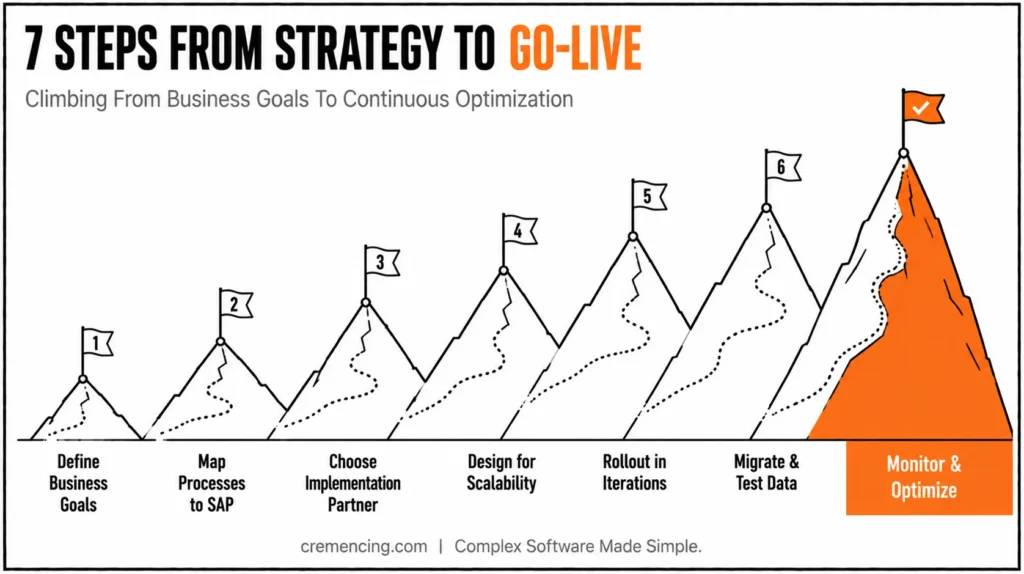
Step 1 → Clearly define what a Business strategy is
Establish Clear Business Goals: Every successful SAP project that is successful starts with knowing what business goals need to be met. This foundation is imperative because without it, implementation becomes aimless.
Organizations must define:
- Revenue growth goals
- Operational efficiency targets
- Customer experience improvements
Example:
Objectives of a hypothetical manufacturing company: Imperative SAP-driven automation: ›Cut down supply chain delays by 30%.
Step 2 — Mapping Business Processes with SAP Capabilities
The subsequent step is business process mapping with SAP capabilities.
This involves:
- Mapping current processes
- Identifying inefficiencies
Process matching to SAP modules (S/4HANA, MM, SD, etc.)
The key principle is simple:
SAP should support the organization’s business objectives while the implementation team evaluates standard SAP processes first and introduces justified configuration or extensions only where they deliver clear business value.
Step 3 — Choosing the SAP Implementation Service Provider
The right partner can make or break project success.
Look for:
- Proven industry experience
- Structured implementation methodologies
- Strong client success stories
A seasoned provider provides the technical knowledge combined with strategic insights. If your implementation involves ECC-to-S/4HANA transformation, review our detailed breakdown of SAP ECC to S/4HANA data migration for a deeper look at migration preparation, tools, validation, and testing.
Step 4: Innovate scalability and flexible architecture.
Systems that can scale to meet customer growth are a requirement of modern SAP implementations.
Focus on:
- Modular architecture
- Cloud or hybrid deployment models
- Integration with third-party systems
Scalable so that it can be scaled up and taken much further in the future without major redoing.
Step 5 — Rollout in Iterations
Therefore, successful projects use phased execution instead of a big-bang rollout.
Typical phases include the following:
- Pilot implementation
- Incremental rollouts
- Continuous improvements
This technique mitigates risk and enables early feedback
| Approach | Best suited for | Main advantage | Main risk |
|---|---|---|---|
| Pilot rollout | High-risk or complex business process | Validates the approach before wider deployment | Pilot may not expose every enterprise dependency |
| Phased rollout | Multiple regions, plants, or business units | Spreads organizational and technical change | Longer overall program duration |
| Broad cutover | Tightly integrated scope with strong readiness | Faster transition to the target landscape | Requires extensive cutover and readiness planning |
Step 6 – Data Migration and Testing
Data migration should be managed as a dedicated implementation workstream rather than a final technical task. In SAP S/4HANA 2025, the Migration Cockpit uses migration projects and migration objects to define the business data being transferred, while simulation and monitoring capabilities help teams identify issues before production migration. SAP recommends testing migration activities in a non-production environment before the final production transfer.
We all know that data is the heart of any SAP system. Data is the oxygen of any SAP system.
Key priorities:
- Clean and accurate data migration
- System integration testing
- User acceptance testing (UAT)
- Obtaining bad-quality data could cause the entire implementation itself to fail.
Step 7 – Monitor and Optimize, Then Scale
This is not to say that go-live = end of implementation.
Organizations must:
- Track KPIs and performance metrics
- Identify improvement areas
- Scale systems as the business grows
- Continuous optimization ensures long-term success.
Advantages & Return on Investment from SAP Implementation Services
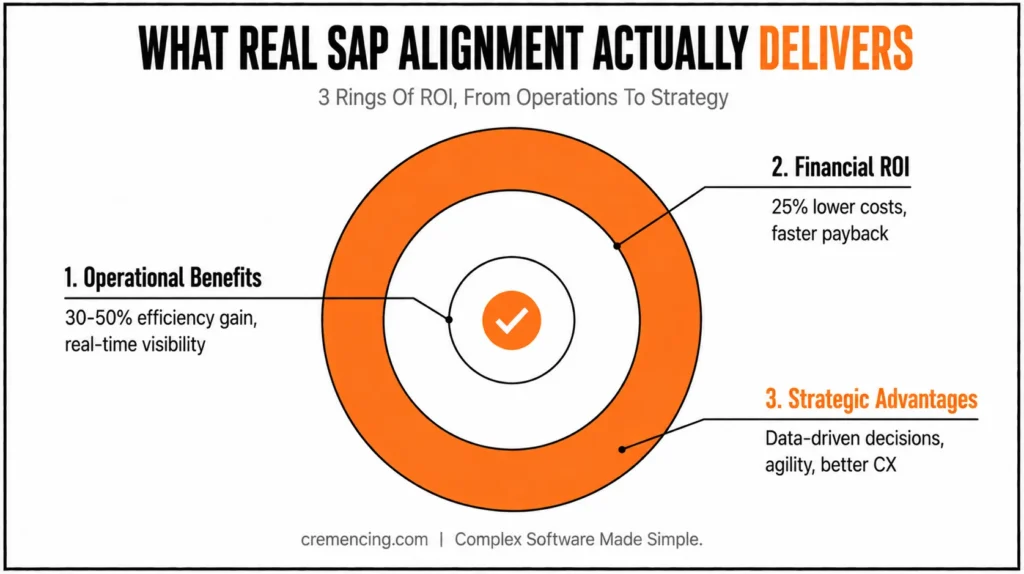
An implementation of SAP done right creates operational and financial benefits.
Operational Benefits
30–50% improvement in process efficiency
Real-time visibility into operations
Decreased manual errors and redundancies
Financial ROI
SAP implementation can reduce operating costs when it eliminates manual work, consolidates processes, improves data quality, or reduces unnecessary system complexity. The financial impact should be measured against the organization’s baseline costs. For teams evaluating lifecycle management during implementation, our analysis of SAP Cloud ALM explains how implementation, testing, deployment, and monitoring capabilities fit together.
Strategic Advantages
- Strategic Advantages
- Data-driven decision-making
- Improved agility and scalability
Enhanced customer experience
- Strategy: The best companies are ahead of the curve with alignment.
- Organizations are more likely to realize measurable value when business KPIs are defined before implementation and tracked after go-live.
Things to Avoid & Do Right
Common Mistakes
SAP is not just an IT project
- Choosing an inexperienced SAP implementation service provider
- Ignoring user adoption and training
- Vague governance and ownership
- Over-customizing the system unnecessarily
Best Procedures
- Plan your operations around your business reality
- Involve stakeholders across departments
- Focus on simplicity and scalability
- Use standardized frameworks
- Continuously monitor and optimize performance
Business Process Alignment Over Technology
Most organizations believe that SAP by itself will fix the problems of execution. Specifically, instead of fixing inefficiencies, SAP exposes them.
Key Insight
This is where technology facilitates change but processes drive success.
What High-Performing Organizations Do
- Redesign processes before implementation
- Remove redundant steps
- Standardize workflows across departments
- Align KPIs with system capabilities
Real Example
For example, a logistics company managed to achieve 35% faster delivery by:
- Mapping processes before SAP deployment
- Eliminating unnecessary approval layers
- Automating key workflows
This shows that results are driven by process alignment, not just technology.
Conclusion
SAP implementation services deliver value when business strategy is translated into controlled process, data, technology, and deployment decisions. The strongest implementations do not begin with customization. They begin by defining measurable business outcomes, evaluating standard SAP capabilities, identifying justified gaps, and establishing ownership for every critical workstream.
Overall, companies can have measurable outcomes if they are centred on business process alignment, SAP implementation service provider selection, and a well-structured approach for implementation.
SAP is treated not as a technology project by the most successful organizations but as a strategic transformation initiative. For more insights, read our blog on ERP Implementation Services
Frequently Asked Questions
What are SAP implementation services?
They are services that deploy and configure the SAP systems to optimally support business operations.
SAP implementation services add to the business advantage. How can it be done?
They connect system capabilities to business strategy, which enhances efficiency, visibility, and decision-making.
How to tell the SAP implementation service provider?
Seek experience, sector knowledge, a history of success implementing methodologies, and referrals from good clients.
Define a Gartner SAP implementation service provider?
It refers to providers who are recognized by Gartner for the quality of their SAP implementation and consulting services.
How much does SAP implementation cost?
SAP implementation cost varies significantly according to solution scope, users, integrations, data migration, customization, deployment model, and implementation partner. A project-specific estimate is more reliable than a generic percentage or industry-wide figure.
What is fit-to-standard in SAP implementation?
Fit-to-standard means evaluating SAP’s delivered business processes against business requirements first and identifying only the configuration, integration, or extension work required for legitimate gaps.
How does SAP Cloud ALM support implementation?
SAP Cloud ALM supports implementation project management, SAP Activate-aligned activities, fit-to-standard workshops, testing, deployment planning, and traceability across implementation objects.