Introduction
SAP ECC migration to S/4HANA is a critical step for businesses looking to modernize their ERP systems and improve performance. In fact, SAP announced that mainstream support will end for ECC, meaning enterprises face later deterioration, damaging to their costs, innovation, and operational efficiency, unless they jump into S/4HANA.
Furthermore, SAP S/4HANA is more than a new version of the software; moving from SAP ECC to an S/4HANA update requires extensive modifications. Indeed, it is a sophisticated, multi-faceted, and complex process of data, processes, systems, and people combined. As a result, companies that skip proper migration planning often end up overshooting their budgets, failing to deliver on time, facing extended downtimes, and ultimately mismanaging the entire migration.
Therefore, this guide will walk you through the steps of migrating your SAP environment. Whether you’re exploring your options or prepping for launch, this guide is here to help you take the safest leap possible.
SAP legacy ERP system (ECC) migration to the next-generation SAP platform, also called S/4HANA, is called SAP ECC to S/4HANA migration.
S/4HANA is designed for:
Real-time data processing
Simplified data models
Improved user experience (Fiori)
Advanced analytics and automation
S/4HANA Migration Execution Roadmap
Paragraph Migrating from SAP ECC to SAP S/4HANA requires a structured execution roadmap that aligns business objectives with system complexity. Organizations must first evaluate custom code, data volumes, and technical readiness using tools like the SAP Readiness Check and Maintenance Planner. Selecting the appropriate deployment model—Brownfield for system conversion, Greenfield for process re-engineering, or Selective Data Transition for hybrid scenarios—determines project scope and timelines. Essential preparatory steps include mandatory Business Partner conversion (CVI), custom code adaptation for the SAP HANA database, and rigorous data cleansing prior to migration. Comprehensive functional testing, multi-system integration validation, and targeted SAP Fiori user training ensure continuous operational stability, regulatory compliance, and minimal business downtime during go-live.
Why SAP ECC to S/4HANA Migration Is Necessary
Above all, end of SAP ECC support is driving urgency. In addition, there’s a growing need for faster decision-making. Meanwhile, demand for digital transformation continues to rise.
Types of SAP ECC to S/4HANA Migration Approaches
System Conversion (Brownfield) → System Upgrade
New Implementation (Greenfield): Fresh setup
Selective Data Transition: Hybrid approach
Each option may be more or less appropriate depending on business complexity and objectives.
Choosing between these isn’t just a technical preference — it’s a trade-off between speed, cost, and how much of your current process design you’re willing to keep.
Brownfield (System Conversion) preserves existing configuration and custom code, making it faster and cheaper upfront, but it also carries forward any technical debt already baked into the ECC system. Greenfield (New Implementation) starts clean, which is ideal for organizations that have accumulated years of workarounds and want to redesign processes around S/4HANA best practices — but it takes longer and requires more change management.
Selective Data Transition sits between the two, letting you migrate specific business units, processes, or historical data selectively, which works well for phased rollouts or multi-entity organizations that can’t move everything at once.
What are the steps for migrating from SAP ECC to S/4HANA
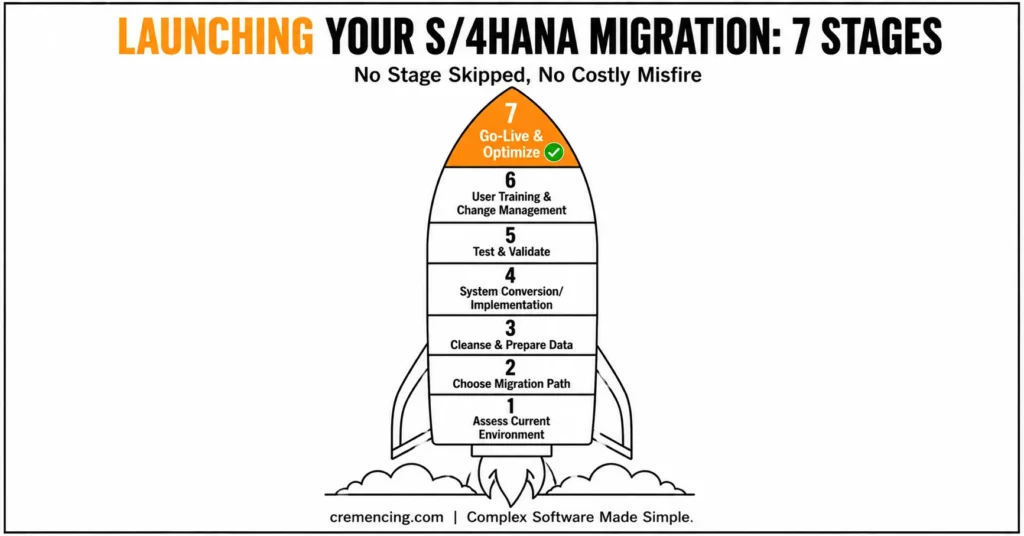
Step 1 – Assess Your Current SAP ECC Environment
Start by evaluating your existing ECC environment.
Key activities:
Identify customizations
Analyze data volume
Review system performance
Now we can make an informed decision on how to migrate.
Step 2 — Choose Your SAP ECC to S/4HANA Migration Path
Choose the right path:
Brownfield for faster transition
Greenfield for process redesign
Hybrid for flexibility
Example:
Selective migration is the typical way in which leveraged companies are based on documents, as you can come to a quick compromise between Speed and optimization.
Step 3 – Clean and Prepare Data for S/4HANA Migration
Data quality is critical.
Focus on:
Removing duplicate data
Archiving old records
Standardizing formats
Also, transitioning with clean data enables an easy migration and facilitates higher system performance.
Step 4 – S/4HANA System Conversion or Implementation
Here is where the bulk of migration happens.
Activities include:
Installing S/4HANA environment
Migrating data
Converting database structures
Step 5 – Test and Validate the S/4HANA Migration
Testing ensures system reliability.
Types of testing:
Functional testing
Integration testing
User acceptance testing
Step 6 — User Training for SAP S/4HANA Adoption
User adoption is often overlooked.
Key actions:
Conduct training sessions
Provide documentation
Address user concerns
Step 7 – Go-Live on S/4HANA and Optimize
After deployment:
Monitor system performance
Fix issues quickly
Optimize workflows
The foundation of success in any migration is continuous evolution.
Benefits & ROI of SAP ECC to S/4HANA Migration
An organizational measurable value is what SAP ECC to s/4hana migration offers.
Operational Benefits
Faster processing with real-time analytics
Simplified workflows
Reduced system complexity
Financial ROI
Lower infrastructure costs
Reduced maintenance expenses
Improved productivity
Strategic Benefits
Enhanced agility
Better decision-making
Future-ready digital platform
Organizations are offered a distinct and clear competitive advantage through successful migrations.
Common SAP ECC to S/4HANA Migration Mistakes & Best Practices
Common Mistakes
Underestimating migration complexity
Poor data preparation
Ignoring change management
Choosing the wrong migration approach
Lack of skilled resources
Best Practices
Start with a clear roadmap
Make use of the SAP ECC to SAP S/4HANA migration steps
Involve business stakeholders early
Focus on data quality
Partner with experienced consultants
SAP ECC to S/4HANA Migration Checklist Companies Skip
The majority of guides tell you how to do it, and they skip whether you are ready to pull the trigger.
Quick Reference — Are You Actually Ready to Migrate?
- Business case and ROI defined and signed off by leadership
- Data cleansing completed (duplicates removed, records archived, formats standardized)
- Migration approach selected (Brownfield / Greenfield / Selective) and matched to business complexity
- Infrastructure and environment provisioned
- Testing plan documented (functional, integration, UAT)
- User training scheduled with a named owner
- Rollback/contingency plan documented in case go-live is delayed
Critical Checklist Before Migration
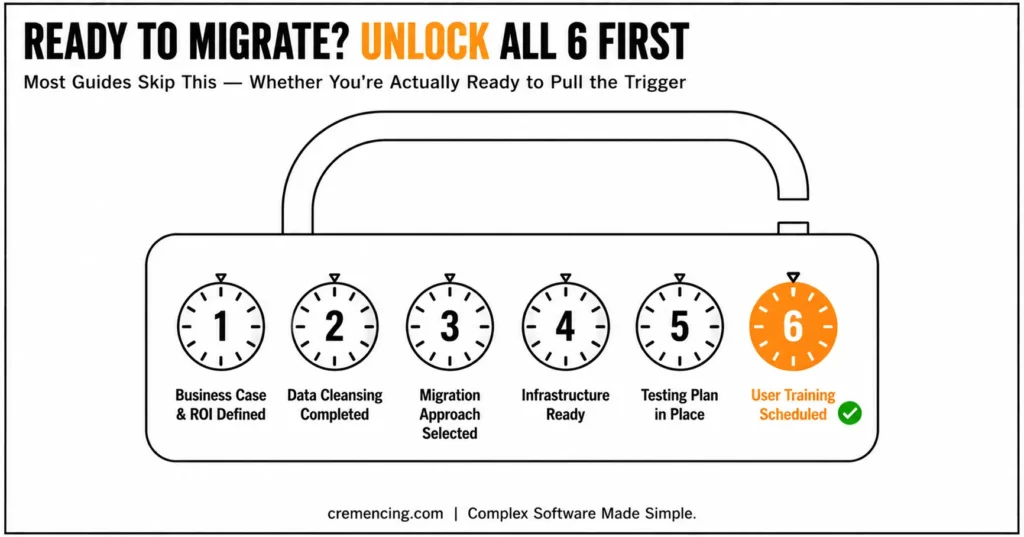
Business case and ROI defined
Data cleansing completed
Migration approach selected
Infrastructure ready
Testing plan in place
User training scheduled
Real Insight
Ignoring the preparation steps is the reason growth s 4hana migration projects for SAP ECC customers fail most often. Checklists ensure that nothing will be missed.
Example
How one company reduced its migration delays by 40%
- Following a structured checklist
- Preparing data early
- Conducting multiple testing cycles
Conclusion
So while migrating from SAP ECC to S/4HANA, it is not just a technical upgrade, but actually becomes a strategic transformation. No problem, the best organizations synchronize migration through planning with strategy and structure at all intended levels — high-quality source data will let you execute lousy work fast.
Migrating from SAP ECC to S/4HANA isn’t won or lost at go-live — it’s decided months earlier, in whether the business chose the right approach for its complexity and whether data was clean before conversion started. The organizations that avoid costly mistakes aren’t the ones with the biggest budgets; they’re the ones who ran the readiness checklist honestly instead of skipping straight to implementation.
If there’s one takeaway from this guide, it’s that the migration approach — Brownfield, Greenfield, or Selective — should be chosen based on what your data and processes actually need, not on which one sounds fastest. Get that decision right, and the rest of the migration becomes a manageable project instead of a recurring source of budget overruns and delays.
FAQs
1. What is SAP migration from ECC to S/4HANA?
Essentially, it is the process of transitioning a business’s existing SAP ECC system to the next-generation S/4HANA platform. In other words, it involves moving data, processes, and customizations from the legacy environment to a modern, real-time ERP system. Consequently, organizations gain improved performance, simplified data models, and a redesigned user experience through Fiori.
2. How long does an SAP ECC to S/4HANA migration typically take?
Generally speaking, the timeline can range from a few months to over a year. However, this largely depends on factors such as system complexity, data volume, and the chosen migration approach. Therefore, smaller organizations with cleaner data often complete migration faster, whereas larger enterprises with heavy customizations usually require significantly more time.
What are the main types of SAP ECC to S/4HANA migration approaches?
Broadly, there are three primary approaches: Brownfield (system conversion), Greenfield (new implementation), and Selective Data Transition (a hybrid method). Meanwhile, each approach suits different business needs — for instance, Brownfield is ideal for a faster transition, while Greenfield allows for complete process redesign.
4. Why is SAP ending ECC support, and how does it affect your S/4HANA migration timeline?
As SAP shifts its focus toward S/4HANA, mainstream support for ECC is being phased out. As a result, businesses that delay migration risk losing access to updates, security patches, and innovation. Ultimately, this makes timely migration planning essential to avoid operational and financial setbacks.
5. What is the biggest risk of an SAP ECC to S/4HANA migration without proper planning?
Without question, inadequate planning is the leading cause of migration failure. Specifically, poor data preparation, unclear scope, and skipped testing phases often lead to budget overruns and extended downtime. Hence, a structured checklist and clear roadmap are critical before any migration begins.
6. How important is data cleansing before your S/4HANA migration?
Extremely important — in fact, data quality is often the deciding factor between a smooth migration and a troubled one. Before migrating, businesses should remove duplicate records, archive outdated data, and standardize formats. As a result, clean data significantly reduces errors and shortens the overall migration timeline.
7. What role does testing play in a successful migration?
Testing plays a central role in validating system reliability. In particular, functional testing, integration testing, and user acceptance testing each verify different aspects of the new environment. Without thorough testing, organizations risk discovering critical issues only after go-live, which is far more costly to fix.
8. How does change management affect migration success?
Interestingly, change management is one of the most overlooked aspects of migration. Nevertheless, user adoption directly impacts how quickly an organization realizes ROI. Therefore, providing structured training, clear documentation, and ongoing support helps ensure employees can work effectively in the new system from day one.
9. What financial and operational benefits can businesses expect after migration?
Once migration is complete, businesses typically experience several key benefits. For example, real-time analytics enable faster processing, while simplified workflows reduce overall system complexity. In addition, companies often see lower infrastructure costs and improved long-term productivity, ultimately leading to stronger ROI.
10. What is the most common mistake companies make during SAP migration?
Above all, underestimating the complexity of migration is the most frequent mistake. Additionally, choosing the wrong migration approach or rushing through data preparation often compounds the problem. Consequently, organizations that skip early planning are far more likely to face delays, budget overruns, and post-migration issues.