
Introduction
Choosing between SAP HEC vs RISE with SAP is an important decision for businesses planning to modernize their ERP environment. Both models involve SAP-managed cloud services; however, they differ in service structures, licensing approaches, infrastructure management, and commercial arrangements.
In particular, understanding SAP HEC vs RISE is important for organizations running SAP ERP or planning a move to SAP S/4HANA. As a result, the decision can affect infrastructure management, existing license investments, migration planning, operational responsibilities, and long-term costs.
SAP HEC is traditionally associated with managed private cloud hosting, while RISE with SAP brings together ERP software, infrastructure, and managed services under a broader subscription arrangement. However, the exact scope depends on the selected offering and contract.
To clarify these options, this guide explains six important differences to help businesses evaluate both models and make a more informed cloud strategy decision.
What Is SAP HEC in the SAP Cloud Model?
SAP HANA Enterprise Cloud (HEC) is a managed private cloud service that provides hosting and technical operations for SAP environments.Specifically, it allows organizations to run SAP applications in a cloud environment without managing every part of the underlying infrastructure themselves.
Under the traditional HEC model, SAP provides managed hosting and operational services. These services, in turn, help organizations manage their SAP environments more efficiently. These can include infrastructure management, system monitoring, technical operations, and other services defined in the agreement.
For example, organizations may use HEC to move existing SAP environments away from their own data centers while retaining parts of their existing software and licensing arrangements, depending on their contract.
Overall, HEC can be relevant for businesses that want managed hosting but need to maintain an established SAP landscape.
What Is RISE With SAP Cloud ERP?
RISE with SAP is a business transformation offering built around SAP S/4HANA Cloud Private EditionIn essence, it combines software, cloud infrastructure, and managed technical services into a subscription-based arrangement.
Depending on the selected package and agreement, the offering can include:
- SAP S/4HANA Cloud Private Edition.
- Cloud infrastructure hosted by SAP or a supported hyperscaler.
- Technical managed services.
- Migration and transformation resources.
- Access to selected SAP tools and services.
As a result, the offering provides a more integrated route for organizations moving their ERP systems to the cloud.
However, RISE with SAP is not simply a hosting service. It combines several elements of the cloud ERP operating model, although implementation, business-process configuration, integrations, and other customer responsibilities still need to be planned. For more information about the offering, businesses can review the official RISE with SAP overview provided by SAP.
SAP HEC vs RISE With SAP: 6 Key Differences
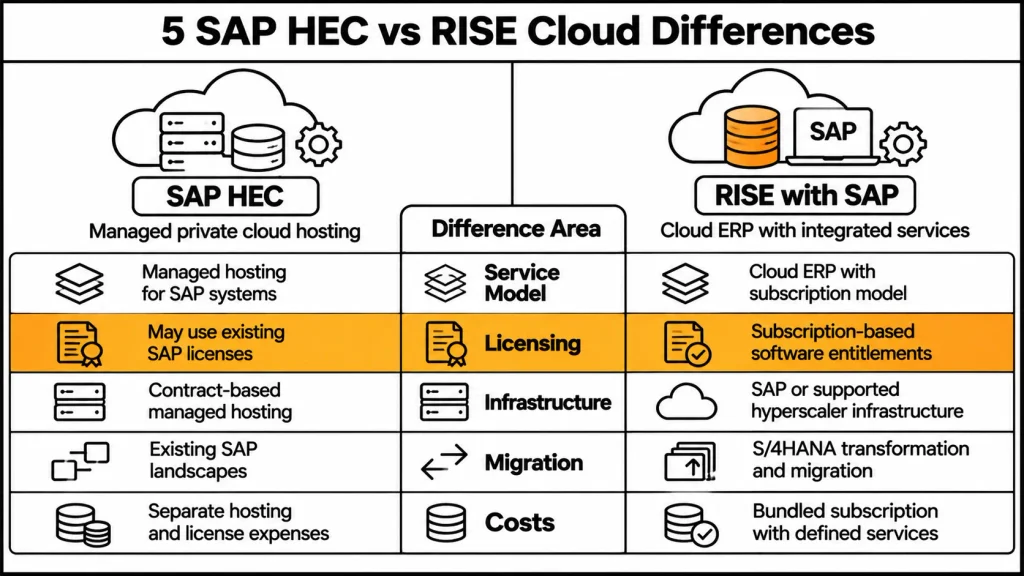
1. SAP HEC vs RISE: Service Model and Scope
First, one of the main differences between SAP HEC and RISE with SAP is the overall service model.
By comparison, traditional SAP HEC focuses on managed hosting and technical operations. In this arrangement, the organization receives a managed environment for its SAP systems. However, software licensing and other services may remain separate, depending on the agreement.
RISE with SAP offers a broader subscription model. It combines SAP S/4HANA Cloud Private Edition with infrastructure and defined managed services.
| Comparison | SAP HEC | RISE With SAP |
| Main purpose | Managed SAP hosting | Cloud ERP and transformation offering |
| Service structure | Hosting and technical operations | Bundled subscription |
| Software arrangement | May be separate from hosting | Included within the selected subscription |
| Infrastructure | Managed cloud environment | SAP or supported hyperscaler infrastructure |
| Overall scope | Primarily hosting and operations | Software, infrastructure, and managed services |
What businesses should consider:
Organizations should identify whether they need managed hosting or a broader ERP cloud transformation arrangement. Choosing a service based only on its name can create misunderstandings about what is actually included.
2. SAP HEC vs RISE: Licensing and Subscription
Licensing is another important factor when comparing SAP HEC and RISE with SAP.
Under traditional HEC arrangements, some customers may continue using existing SAP licenses while purchasing hosting and related services separately. This is commonly associated with a bring-your-own-license approach, although the exact terms depend on the agreement.
Conversely, RISE with SAP generally follows a subscription model in which the software entitlement and cloud services are combined.
Consequently, this changes how organizations evaluate their existing license investments and future software costs.
| Licensing factor | SAP HEC | RISE With SAP |
| License arrangement | May use existing licenses | Subscription-based software entitlement |
| Commercial structure | Hosting and licensing may be separate | Combined subscription arrangement |
| Existing licenses | May remain relevant, subject to contract terms | Must be evaluated during the move |
| Cost evaluation | Separate service and license costs may need review | Subscription scope and included services need review |
What businesses should consider:
Before moving to RISE, organizations should review their current SAP licenses, maintenance arrangements, contractual commitments, and remaining license value.
They should also confirm which software rights are included in the proposed subscription.Furthermore, a comparison based only on monthly or annual subscription amounts may overlook important differences in existing investments.
3. SAP HEC vs RISE: Infrastructure and Hyperscalers
Additionally, infrastructure is another area where the two models need careful evaluation.
Specifically, SAP HEC provides a managed hosting environment for SAP systems.The infrastructure arrangement depends on the specific service and contract.
RISE with SAP S/4HANA Cloud Private Edition supports deployment on SAP infrastructure and supported hyperscaler platforms. These can include Amazon Web Services (AWS), Microsoft Azure, and Google Cloud, subject to regional and offering availability.
Meanwhile, in this arrangement, the hyperscaler provides the underlying cloud infrastructure, while SAP manages defined services under the RISE agreement.
| Infrastructure factor | SAP HEC | RISE With SAP |
| Hosting arrangement | Managed private cloud | Managed private cloud |
| Infrastructure provider | Depends on the HEC arrangement | SAP or supported hyperscaler |
| Infrastructure operations | Defined by the hosting agreement | Defined by the RISE service scope |
| Cloud provider selection | Depends on available arrangements | Supported options depend on region and contract |
What businesses should consider:
Infrastructure selection should be based on more than provider preference. Organizations should evaluate data residency, regulatory requirements, network connectivity, performance, availability, and integration with existing systems.
Furthermore, they should confirm the exact infrastructure responsibilities in the service description rather than assuming that every infrastructure task is automatically included.
4. Customization, Migration, and ERP Flexibility
Therefore, migration requirements can influence whether an organization should retain an existing hosting arrangement or move toward RISE with SAP.Organizations can review the SAP S/4HANA Cloud Private Edition documentation to understand its features and technical requirements.
Moreover, businesses with established SAP environments may have custom developments, interfaces, integrations, and business processes that require careful assessment before migration.
RISE with SAP S/4HANA Cloud Private Edition supports private cloud ERP environments with flexibility for customer-specific requirements. Nevertheless, moving to RISE does not automatically remove the need to review custom code, integrations, and existing processes.
A migration project may involve:
- Reviewing the existing SAP system landscape.
- Assessing custom developments and modifications.
- Identifying integrations and dependencies.
- Evaluating data migration requirements.
- Planning testing and business validation.
- Reviewing the future operating model.
| Migration factor | SAP HEC | RISE With SAP |
| Existing SAP environment | Can support managed existing SAP landscapes | Supports a move to S/4HANA Cloud Private Edition |
| Custom developments | Depends on the existing SAP environment | Need assessment and compatibility planning |
| Migration planning | Depends on the hosting and system-change scope | Requires an ERP transformation and migration plan |
| Business-process changes | Depend on the organization’s requirements | May be part of the transformation initiative |
What businesses should consider:
A successful migration requires more than moving a database or application to another environment. Organizations should assess custom code, data quality, interfaces, business processes, and system dependencies before finalizing the migration approach.
Therefore, a readiness assessment can help identify technical and functional issues before the project moves into execution.
5. Pricing and Total Cost of Ownership
Since the pricing structures of SAP HEC and RISE with SAP are different, organizations should compare the complete cost of each arrangement.
For instance, with traditional HEC, costs may involve separate software licensing, maintenance, hosting, infrastructure, and additional services.
RISE with SAP combines defined software and cloud services into a subscription. However, this does not mean every implementation, integration, customization, or application-management activity is automatically included.
| Cost area | SAP HEC | RISE With SAP |
| Software licensing | May be separate | Subscription-based |
| Hosting | Contract-based service cost | Included within the selected subscription scope |
| Infrastructure | Depends on agreement | Included according to the service description |
| Migration | Depends on project scope | Requires migration planning and may involve additional project costs |
| Additional services | May be charged separately | May be outside the included subscription scope |
What businesses should consider:
A reliable cost comparison should include:
- Current SAP license and maintenance costs.
- Hosting and infrastructure expenses.
- Migration and implementation costs.
- Integration and customization requirements.
- Ongoing application-management costs.
- Additional services and potential usage charges.
- Contract duration, renewal, and exit conditions.
Ultimately, the goal should be to compare the total cost of ownership (TCO), not simply the initial quotation.
6. Long-Term ERP Strategy and Operational Responsibilities
Finally, the sixth difference concerns the organization’s long-term ERP strategy and the division of responsibilities between SAP, the customer, and implementation partners.
To illustrate, SAP HEC can provide a managed environment for an existing SAP landscape. RISE with SAP is designed to support a broader move toward cloud ERP and business transformation.
Nevertheless, neither model removes the need for customer involvement.
Under RISE with SAP, SAP manages defined infrastructure and technical operations. Customers still need to manage areas such as business-process configuration, application access, business data, integrations, and customer-specific changes.Additionally, partners may also support implementation and application-management activities.
| Responsibility | SAP / Service Provider | Customer / Partner |
| Defined infrastructure operations | According to service agreement | Oversight and coordination |
| Technical system operations | According to service scope | Coordinate requirements and changes |
| Business-process configuration | Not automatically included in technical operations | Customer and implementation partner |
| Application user access | Shared responsibilities depend on the task | Customer |
| Custom integrations | Only where specifically included | Customer or partner |
| Migration and implementation | Depends on contracted services | Customer and implementation partner |
What businesses should consider:
Before signing an agreement, organizations should review the official Roles and Responsibilities document. It helps clarify which activities are standard services, optional services, additional services, or customer responsibilities.
Consequently, this step can reduce confusion during implementation and ongoing operations.
SAP HEC vs RISE With SAP: Complete Comparison
To make the comparison easier, the following table summarizes the six main differences discussed above.
| Feature | SAP HEC | RISE With SAP |
| Main model | Managed SAP hosting | Cloud ERP subscription |
| Software licensing | May remain separate | Included in subscription entitlement |
| Infrastructure | Depends on HEC agreement | SAP or supported hyperscaler |
| Migration approach | Depends on existing landscape | Supports S/4HANA Cloud Private Edition transition |
| Customization | Depends on existing environment | Requires assessment and planning |
| Pricing | Hosting and other costs may be separate | Bundled subscription with possible additional costs |
| Strategic focus | Managed hosting | ERP cloud transformation |
Overall, the table provides a general comparison of both cloud models.However, actual services, entitlements, and responsibilities must be checked against the relevant SAP contract and service description.
When Should a Business Choose SAP HEC?
For businesses with specific hosting requirements, SAP HEC may be worth evaluating when an organization:
- Already operates an SAP environment and needs managed hosting.
- Wants to retain an existing licensing arrangement where contractually permitted.
- Needs a managed private cloud environment.
- Wants to review hosting separately from its broader ERP transformation strategy.
- Has specific operational requirements that fit the available HEC service scope.
Nevertheless, businesses should check the current commercial availability of the relevant HEC offering before making a decision. For example, some legacy HEC services may be available for existing customers or renewals rather than new sales.
When to Choose RISE With SAP for Cloud ERP?
On the other hand, RISE with SAP may be appropriate when an organization:
- Plans to move to SAP S/4HANA Cloud Private Edition.
- Wants software, infrastructure, and defined technical services under one subscription.
- Is planning a broader ERP modernization initiative.
- Wants to evaluate supported hyperscaler infrastructure options.
- Prefers a more integrated commercial and service arrangement.
Therefore, the organization should review migration requirements, implementation responsibilities, additional services, and contractual conditions before proceeding.
How to Choose Between SAP HEC vs RISE With SAP
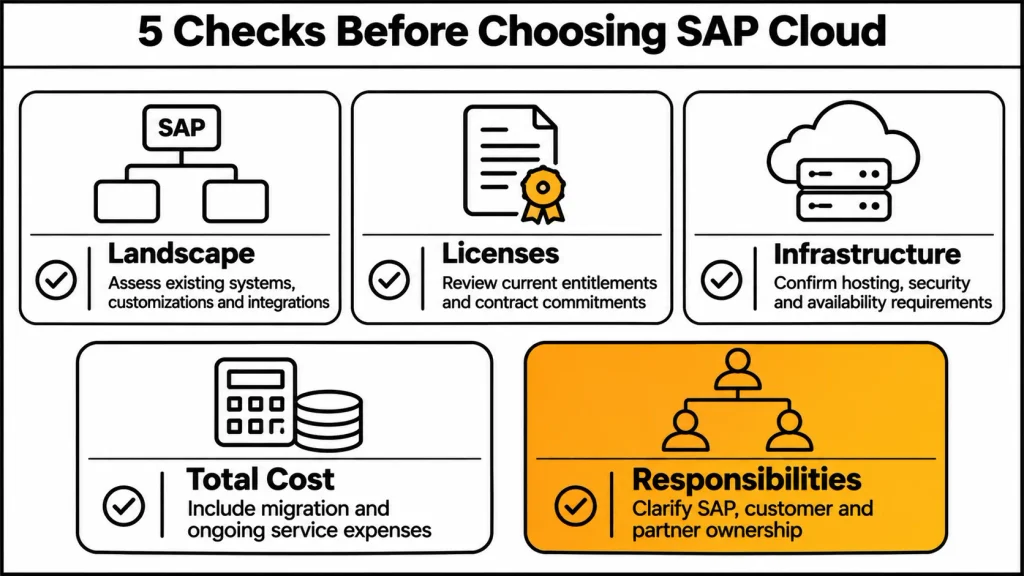
To select the right model, organizations first need to assess their existing SAP environment and future requirements.
A practical evaluation can follow these steps.
Step 1: Review the Existing SAP Landscape
Check existing software licenses, maintenance agreements, hosting contracts, renewal dates, and any restrictions on changing the service arrangement.
As a result, this review provides a starting point for understanding the complexity of a potential move.
Step 2: Review Existing Licenses and Contracts
Next, check existing software licenses, maintenance agreements, hosting contracts, renewal dates, and any restrictions on changing the service arrangement.
In particular, this is important for organizations considering a transition from a traditional HEC arrangement to RISE.
Step 3: Define Infrastructure Requirements
After identifying these requirements, compare them with the available SAP and hyperscaler deployment options.
Step 4: Compare the Full Cost
Subsequently, request a detailed cost breakdown for both options.Include software entitlements, infrastructure, managed services, migration, implementation, and ongoing support.
Therefore, do not compare quotations without checking whether they cover the same services.
Step 5: Confirm Roles and Responsibilities
Moreover, review the service description and Roles and Responsibilities documentation. Identify which tasks SAP will perform and which activities remain with the customer or implementation partner.
Step 6: Prepare a Long-Term Roadmap
Finally, consider the organization’s ERP direction, expected business growth, integration strategy, and future technology requirements.
Ultimately, the selected model should support the business strategy rather than simply solve an immediate hosting requirement.
Common SAP HEC vs RISE Decision Mistakes
Without reviewing the full service scope, organizations can face unnecessary costs and operational problems when comparing SAP HEC and RISE.
Here are some common mistakes to avoid:
Comparing only subscription prices:For example, a lower initial quotation does not necessarily represent a lower total cost.Therefore, you must review all included and excluded services before making a final choice.
Assuming every service is included:Similarly, managed infrastructure does not automatically mean that implementation, customization, and all application-management activities are covered.
Ignoring existing license investments: Review current license entitlements and contract conditions before deciding to move to a subscription model.
Underestimating migration complexity: Specifically,Custom code, integrations, data, and business processes can affect the time and cost of an ERP migration.
Overlooking customer responsibilities: Therefore, the organization still needs internal ownership for business processes, application access, data, and other customer-managed activities.
Not checking contract conditions: Confirm service availability, renewal terms, additional charges, and exit conditions before signing.
Conclusion
The comparison of SAP HEC vs RISE is not simply a choice between two cloud hosting options. It involves different service models, licensing structures, infrastructure arrangements, costs, and long-term ERP strategies.
SAP HEC has traditionally focused on managed hosting and technical operations for SAP environments. RISE with SAP offers a broader subscription model built around SAP S/4HANA Cloud Private Edition, infrastructure, and defined managed services.
For organizations evaluating either option, the most important step is to understand their current SAP landscape, review existing contracts, compare total costs, and clarify operational responsibilities.
There is no single option that fits every business. Ultimately, the right decision depends on the organization’s licensing position, migration requirements, infrastructure needs, budget, and long-term ERP roadmap.
SAP HEC vs RISE: Frequently Asked Questions
1. What is the main difference between SAP HEC and RISE with SAP?
SAP HEC traditionally focuses on managed SAP hosting and technical operations. RISE with SAP combines SAP S/4HANA Cloud Private Edition, infrastructure, and defined managed services in a subscription-based offering.
2. Is SAP HEC the same as RISE with SAP?
No. Both involve SAP-managed cloud services, but their commercial structures and overall scope are different. Specifically, HEC is traditionally a managed hosting service, while RISE is a broader cloud ERP subscription.
3. Can a company use its existing SAP licenses with HEC?
Existing SAP licenses may be used under certain HEC arrangements, depending on the contract and license terms.Furthermore, organizations should confirm their entitlements with SAP before making assumptions.
4. Does RISE with SAP include infrastructure?
Yes. The selected RISE with SAP offering includes defined cloud infrastructure services. In addition, the deployment can use SAP or supported hyperscaler infrastructure, subject to availability and contractual conditions.
5. Does RISE with SAP include SAP S/4HANA?
RISE with SAP S/4HANA Cloud Private Edition includes the relevant software entitlement as part of its subscription.However, the exact entitlement depends on the selected offering and contract.
6. Can businesses customize SAP S/4HANA Cloud Private Edition?
Private Edition supports customer-specific requirements, but custom developments and extensions need to be assessed and managed appropriately. The available technical options depend on the system and service conditions.
7. Is RISE with SAP more expensive than SAP HEC?
Not necessarily. The cost depends on licensing, system size, infrastructure, service scope, migration, and additional requirements.Consequently, organizations should compare total cost of ownership rather than relying on the initial subscription price.
8. Who manages infrastructure under RISE with SAP?
SAP manages the infrastructure-related services defined in the agreement. Where a hyperscaler is used, that provider supplies the underlying cloud infrastructure. Responsibilities are divided according to the applicable service model.
9. Does RISE with SAP include migration services?
RISE with SAP provides transformation-related resources and services according to the selected offering. However, organizations should not assume that all migration, implementation, customization, and integration work is included.Therefore, the project scope must be confirmed separately.
10. What should a company check before moving from HEC to RISE?
A company should review its existing licenses, hosting contract, SAP system landscape, custom code, integrations, migration requirements, infrastructure needs, subscription costs, and operational responsibilities. It should also confirm the commercial availability of the intended offering.