

Introduction
If you are considering SAP Build Apps certification in 2026, the biggest factor is not the certification badge—it is the change happening around the product itself. SAP deprecated SAP Build Apps as a standalone product on March 23, 2026, and is moving toward a unified SAP Build platform.
That matters for SAP developers, BTP professionals, and career switchers deciding where to invest their learning time. A certification can demonstrate structured knowledge, but it has less value if you prepare for an outdated product scope or expect the credential alone to create job opportunities.
The better approach is to evaluate the certification against the skills employers actually need: application development, SAP BTP, integrations, APIs, automation, and practical project experience. SAP’s current learning path also positions the SAP Build certification across the broader SAP Build portfolio rather than treating Build Apps as an isolated capability.
So, is SAP Build certification worth pursuing in 2026? It can be—but only if you treat certification as one part of a broader SAP Build and BTP skill strategy. This article examines the career value, job prospects, salary expectations, practical skills, and the product changes you should understand before making that investment.
What is SAP Build Apps Certification, and why does it matter
SAP Build Apps Certification proves your ability to create applications with the SAP low-code platform. Traditional programming is not your typical launchpad or even a direction here, as it deals with things like interfaces, logic definition, and establishing bridges to data.
This certification is a part of the wider ecosystem that is SAP and is highly used in the enterprise environment. For more insight, read our blog on SAP Build App Free Edition
What You Learn
- App design using visual tools
- Workflow creation without coding
- Integration with SAP systems
- Deployment and testing
If you are coming from ABAP, the transition to BTP development also requires understanding where SAP Build fits alongside pro-code technologies.
Why It Matters in 2026
Low-code development is growing rapidly. Now companies are seeking people who can generate applications in a short period of time with fewer development teams.
This generates demand for certified professionals who are familiar with SAP Build Apps.
SAP Build Apps Certification in 2026: What’s Changed
If you are researching SAP Build Apps certification in 2026, there is one important distinction to understand before spending time or money on certification preparation: SAP Build Apps is no longer positioned as a standalone product.
SAP Build Apps Is Being Folded Into SAP Build
SAP states that SAP Build Apps was deprecated as a standalone product on March 23, 2026, following the move toward a unified SAP Build offering. Existing customers can continue using SAP Build Apps under their current contracts, but SAP’s strategic direction is the broader SAP Build platform. That changes how candidates should evaluate the certification.
Why the Broader SAP Build Skill Set Matters
Rather than treating SAP Build Apps as an isolated career specialization, candidates should look at the wider SAP Build skill set. SAP’s current learning material connects SAP Build Apps with SAP Build Process Automation and SAP Build Work Zone and points learners toward the SAP Certified Associate – Low-Code/No-Code Developer – SAP Build certification.
The practical implication is simple: learning SAP Build Apps can still be valuable, but the stronger career strategy is to understand how application development fits into the broader SAP Build and SAP BTP ecosystem.
Skills That Go Beyond Visual App Building
That means learning more than visual app construction. Candidates should understand data resources, APIs, integrations, BTP destinations, application logic, security, and how low-code applications fit into enterprise SAP landscapes. SAP’s documentation explicitly covers SAP BTP destination integration and connections to SAP systems.
Why This Matters More to Employers Than a Badge
For employers, that broader capability is more useful than a certification badge by itself. A candidate who can build a working application, connect it to an appropriate backend service, understand the integration architecture, and explain the business problem being solved has a stronger practical profile than someone who has only completed certification preparation.
The Real Question to Ask Before Investing
Therefore, the better 2026 question is not simply “Is SAP Build Apps certification worth it?” It is “Does SAP Build certification, combined with practical application development and BTP skills, fit my career direction?” That is the question that should drive the investment decision. For developers evaluating SAP BTP as the broader extension platform, a side-by-side architecture provides useful context.
How SAP Build Apps Certification Works
Step 1: The Certification Path Header
SAP offers structured learning paths.
- Beginner-level courses
- Intermediate application building
- Certification exam preparation
One needs a well-defined roadmap.
Step 2: Get Acquainted with The Platform
You should learn and understand SAP Build Apps before you attempt the exam.
- UI design
- Logic building
- Data integration
Hands-on practice is essential.
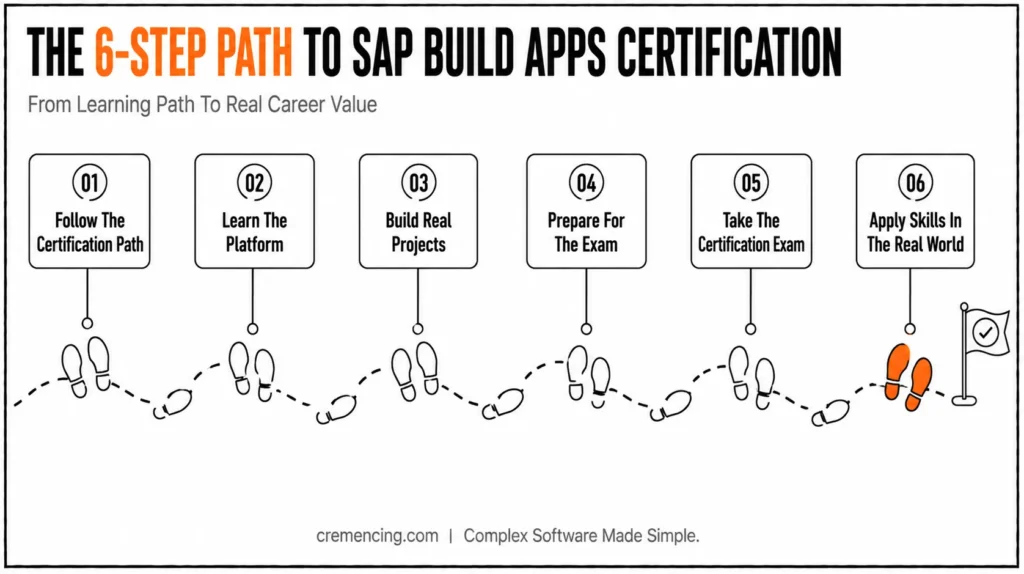
Step 3: Implement Real-World Projects
Certification alone is not enough.
- Build simple applications
- Work on real use cases
- Understand workflows
So here you can increase your odds of winning.
Step 4: Get Ready for the Entrance Exam!
Focus on:
- Key concepts
- Practical scenarios
- Platform features
Practice tests can help.
Step 5: Take the Certification Exam
The examination tests whether you are aware of the following:
- App building
- Data handling
- Integration
Upon passing the exam, certification is provided.
Step 6: Released into the Wild
After certification:
- Build projects
- Apply for roles
- Improve skills continuously
That’s how real career value is created.
Benefits & ROI of SAP Build Apps Certification
SAP Build Apps Certification: Maximize the value of your SAP Build Apps Certification.
Career Opportunities
Includes corporate functions such as the following:
- Low-code developer
- SAP Build Apps specialist
- Business application developer
There are more and more roles available in this space.
Salary Expectations
The following is the average salary range based on experience level:
| Experience Level | Estimated Salary Range |
| Beginner | Moderate entry-level salary |
| Intermediate | Competitive mid-level salary |
| Experienced | High salary with specialization |
As for salary, it depends on the city and experience, but certification is known to increase your chances of making more money.
Faster Career Entry
Low-code solutions drive down the need to build up strong programming foundations in preparation for tech roles, and facilitate obtaining tech-related job assistance much more quickly.
Increased Productivity
This allows professionals to build fast applications, and therefore, they are beneficial to any organization.
Long-Term Growth
Certified professionals can advance to:
- Solution architecture
- SAP consulting
- Enterprise application development
| Area | SAP Build Apps focus | Broader SAP Build career focus |
|---|---|---|
| Application development | Visual/no-code application building | Application development across SAP Build capabilities |
| Automation | Limited to app logic/use cases | SAP Build Process Automation |
| Digital workplace | Not the primary focus | SAP Build Work Zone |
| Integration | APIs, data resources, BTP destinations | Broader BTP integration understanding |
| Certification relevance | Useful learning component | Better aligned with current SAP Build certification direction |
| Career value | Application-building skill | Application + automation + SAP ecosystem capability |
| 2026 outlook | Standalone product deprecated | SAP Build is the strategic direction |
Common Mistakes and Best Practices
Common Mistakes
Candidates generally believe that certification alone is sufficient for them to obtain a job. This leads to them being disappointed once they learn that employers want experienced workers.
Another mistake is concentrating only on theory. The same holds true for knowledge—one cannot apply what they know without building real apps.
In addition, some think knowing the SAP ecosystem is not that critical.
Best Practices
Educate yourself through real projects and certification! This demonstrates practical skills. Learn where SAP Build Apps can be positioned within the world of the SAP portfolio.
Keep learning even after certification. Technology moves fast, and it is important to keep your knowledge current.
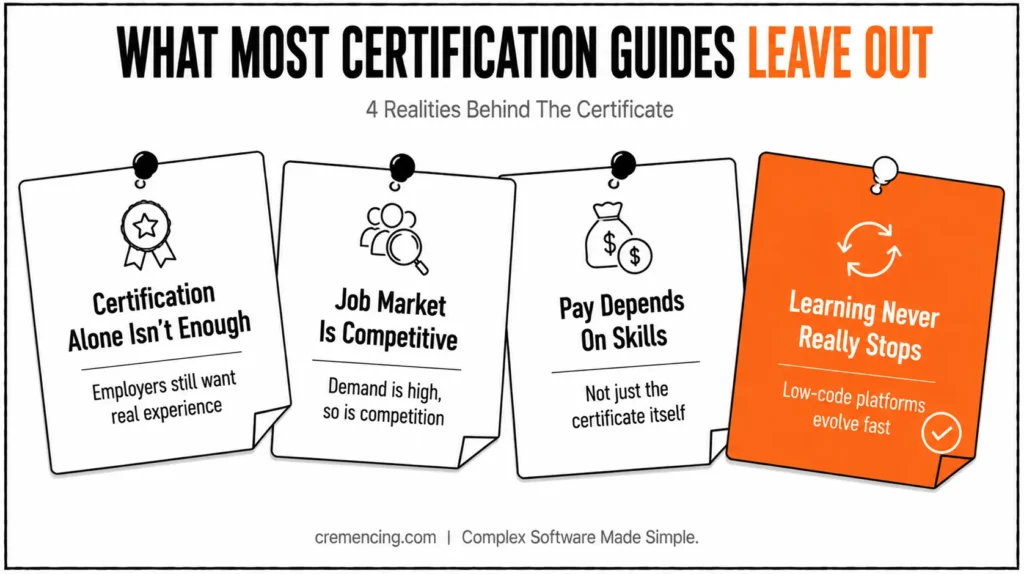
What You Will NOT Find in Most Guides
Defaults out all the good stuff about SAP Build Apps Certification while you’re just looking for the benefits.
Certification Alone Is Not Enough
People often expect that a certification will guarantee them a job. In reality, employers look for:
- Practical experience
- Problem-solving skills
- Real project work
Job Market Reality
This means that while a job in SAP building apps is on the highs but, the competition for it is also. It takes more than a certification to be noticed.
Compensation Hinges on Skills, Not Only Certification
Certifications do help, however, salary growth is reliant on:
- Experience
- Project work
- Understanding of business processes
Career Growth Requires Continuous Learning
Low-code platforms evolve quickly. The need for continuous learning and adaptation to remain relevant.
Conclusion
SAP Build certification can still be a sensible investment in 2026, but the reason has changed. SAP Build Apps is no longer a standalone product direction; SAP deprecated it as a standalone offering on March 23, 2026, while continuing the broader SAP Build strategy.
That means candidates should avoid building their career plan around a narrow “SAP Build Apps certification” concept. Instead, focus on the broader SAP Build ecosystem and the practical capabilities surrounding it. Learn how applications connect to SAP systems, understand BTP destinations and APIs, explore automation, and build something that demonstrates your ability to solve a real business problem.
Certification can support that profile, but it should not replace project experience. If your goal is to enter or expand within SAP BTP and low-code development, the strongest combination in 2026 is certification + practical SAP Build skills + BTP knowledge + demonstrable project work.
That is the real test of whether the investment is worth it: not whether you can add another credential to your résumé, but whether the credential helps you build capabilities that remain useful as SAP Build evolves.
If you want to understand what building an actual SAP Build Apps application involves, start with a practical application-development example.
FAQ
What is SAP Build Apps?
This is a certification that checks your competency in building apps using SAP Build Apps.
Is SAP Build Apps certification valuable?
Yes, but only with practical experience.
How many jobs are available after the certification?
Roles that you can apply for are minimal code designers and SAP Build Apps experts.
How much do you earn after certification?
Salary: Dependent on experience; certification can help maximize pay.
Do I need coding skills?
No, SAP Build Apps is not tailored for low-code development.
Does SAP Build Apps certification guarantee a job?
No. Certification can demonstrate structured knowledge, but employers can also evaluate practical application development, SAP BTP knowledge, integration skills, and business-process understanding.
Can SAP Build Apps connect to SAP systems?
Yes. SAP Build Apps supports integration with SAP systems and other data sources, including SAP BTP destinations for connecting to SAP systems.
Should an ABAP developer learn SAP Build Apps?
It can be useful for ABAP developers who want to expand into SAP BTP and low-code extension development. The strongest profile combines low-code skills with knowledge of APIs, SAP backend systems, integration, and clean extension architecture.