

Introduction
If you work with SAP S/4HANA, SAP ECC, or SAP cloud products, you’ve likely heard of the principle “Keep the Core Clean.” In other words, this principle encourages organizations to extend SAP systems without adding custom code that complicates upgrades or creates unnecessary dependencies.
So how can you put this principle into practice? One approach is to build side-by-side extensions on SAP Business Technology Platform (SAP BTP).
However, many organizations still rely on in-core customizations, such as Z-tables, enhancements, and modifications. Although these customizations can meet specific business needs, they may also create technical debt and make upgrades more complex. Therefore, organizations can consider side-by-side extensions to add capabilities while keeping the SAP core cleaner.
What Is a Side-by-Side Extension in SAP BTP?
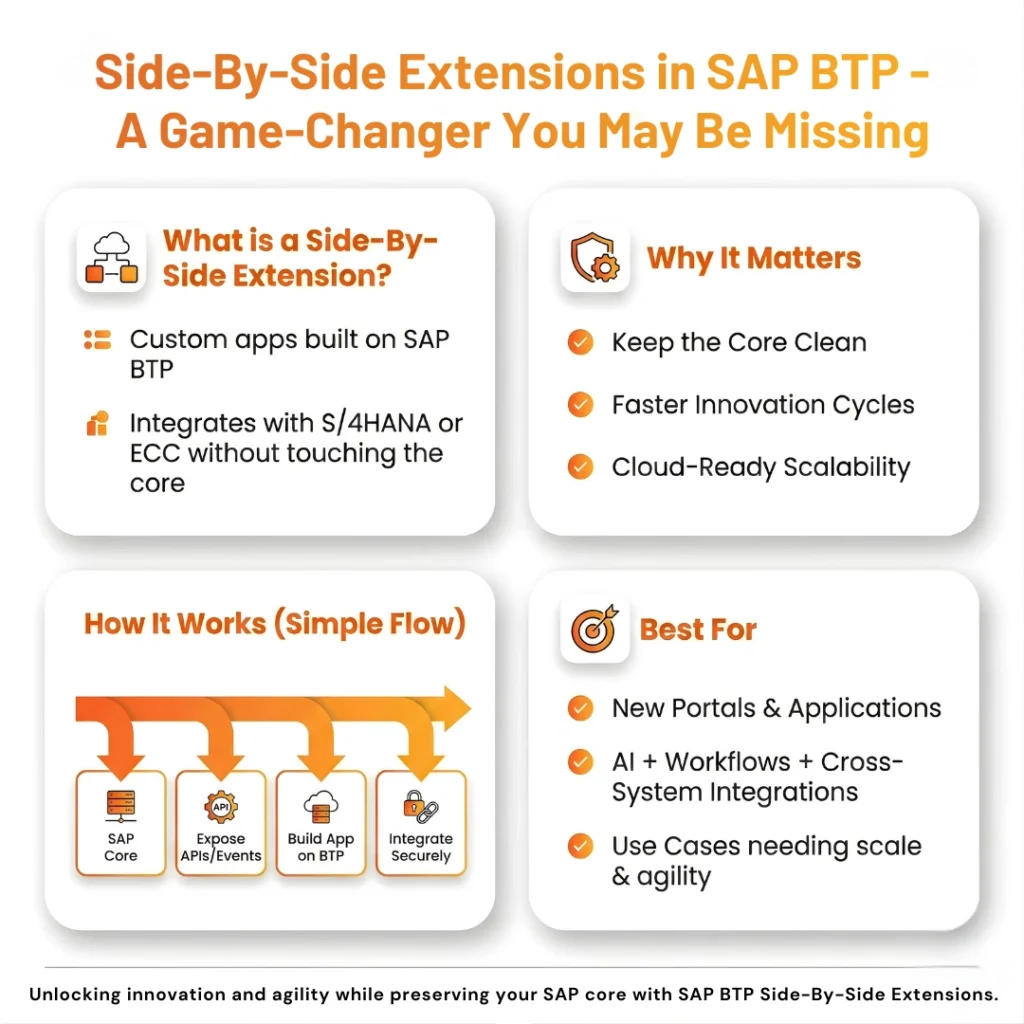
A side-by-side extension is a custom application or service built and run on SAP BTP to add capabilities to an SAP system without modifying its core code. Depending on the system landscape, secure connections may use SAP Integration Suite, destinations, and SAP Cloud Connector for on-premises systems.
For example, a company could build a customer order-tracking portal on BTP. The portal retrieves order and delivery information from SAP through APIs, while its interface and custom features run independently of the ERP system.
Key Characteristics
First, a side-by-side extension runs outside the SAP core, on SAP BTP. Second, it uses supported APIs, events, and integration patterns. As a result, teams can deploy and scale it independently of the ERP system.
In addition, teams can build these extensions with several technologies, such as the SAP Cloud Application Programming Model (CAP), SAP Build Apps (low-code), SAPUI5/Fiori, and Node.js or Java services. Finally, the extension connects to SAP systems through SAP Cloud Connector, SAP Integration Suite, and the Destination service with OAuth.
Built using:
- SAP Build Apps (low-code)
- SAP UI5 / Fiori
- Node.js / Java services
Connects via:
- SAP Cloud Connector
- SAP Integration Suite
- Destination service and OAuth
Why Side-by-Side Extension Matters More Than Ever
They Support Faster Innovation
Businesses may need to launch a customer portal, onboard a new logistics carrier, or add AI-based recommendations. However, building every new capability inside the ERP core can be slow and complex.
Instead, a side-by-side extension on SAP BTP helps teams use modern tools and deploy independently of ERP downtime. Moreover, they can test new ideas without changing production core code. As a result, teams can respond more quickly to changing business needs.
They Enable Scalable, Cloud-Ready Architecture
As a business grows, its user volumes, data loads, and integration needs often increase as well. Because side-by-side extensions run on SAP BTP, organizations can scale services as needed. Consequently, they can often meet growing demands without placing the same burden on the core ERP system.
What are the Key Features and Benefits of Side-by-Side Extensions in SAP BTP?
- Customization: Create bespoke custom applications and microservices to mold complex business processes.
- Scalability: Leverage BTP’s elastic, multi-region infrastructure.
- Security: Identity Authentication, collection of roles and secure communication.
- Futureproofing: Prevent new ideas from becoming trapped in overly tailored solutions.
- Vendor Alignment: Compliant with SAP’s extension strategy.
A Precise Case: Side-by-Side Use Scenario side by side
Let’s go through a practical, real-world, compound example that (sort of) mirrors what a lot of companies are doing now.
Company Background
A global wholesale distributor runs:
- SAP S/4HANA as its core ERP
- Multiple third-party logistics (3PL) partners
- An old customer portal that is difficult to upkeep
They want:
- A new partner, customer portal
- Instant information on orders, deliveries and invoices
- A method of rapidly incorporating a new logistics provider
- Modest disturbance to their SAP S/4HANA system
Challenge
Previously, every new requirement meant:
- Enhancements in the core
- Existing SAP Fiori apps now can be modified
- Risk during upgrades
- BAPI, ABAP, and functional also involved in long development cycles
They wanted a way to innovate at the edge, while maintaining stability in the core.
Solution:
Side-by-Side Extension on SAP Business Technology Platform
The company is partnering with Cremencing Solutions to architect a side-by-side:
Expose SAP Data Securely
- Leverage OData APIs and CDS views available in S/4HANA
- Set up SAP Cloud Connector to connect on-prem (or private cloud) ERP with SAP BTP
- Secure access via Destionations in BTP
Create the Extension App on SAP BTP
On SAP BTP, they develop:
A CAP-based backend service to:
- Consolidation of data from SAP and 3PL systems
- Apply custom business logic
- Take control of individual shopper views by order or delivery
A front end built with SAPUI5/Fiori or SAP Build Apps can enable customers to view orders, logistics partners to confirm shipments, and internal teams to track exceptions.
- For a customers to just be able to log in and see orders
- Logistics partners to confirm shipments
- Internal teams to track exceptions
Integrate 3rd Party Logistics Providers
Using SAP Integration Suite, they:
- Use APIs of various 3PLs
- Normalize shipment status data
- Send updates or status reports back into S/4HANA when necessary
Outcome
After implementing the side-by-side extension:
- Real-time tracking of orders and deliveries for customers
- A single, modern UI for business users without complex SAP GUI/Fiori modifications
- IT reduces core modifications dramatically
- New logistics service providers can be added without impacting S/4HANA
Business Impact:
1.) Less “Where is my order?” support tickets
Faster onboarding of new partners
Less SAP core and smoother incentives Some insights:LOWER investments in SAP code which means SMOOTHER upgrade paths.
This is the one type of, side-by-side extension in SAP BTP that many businesses might be utilizing — just haven’t consumed yet.
Side-by-Side vs In-App Extensions - When to Use Each?
There isn’t a one-size-fits-all approach. Both have their place:
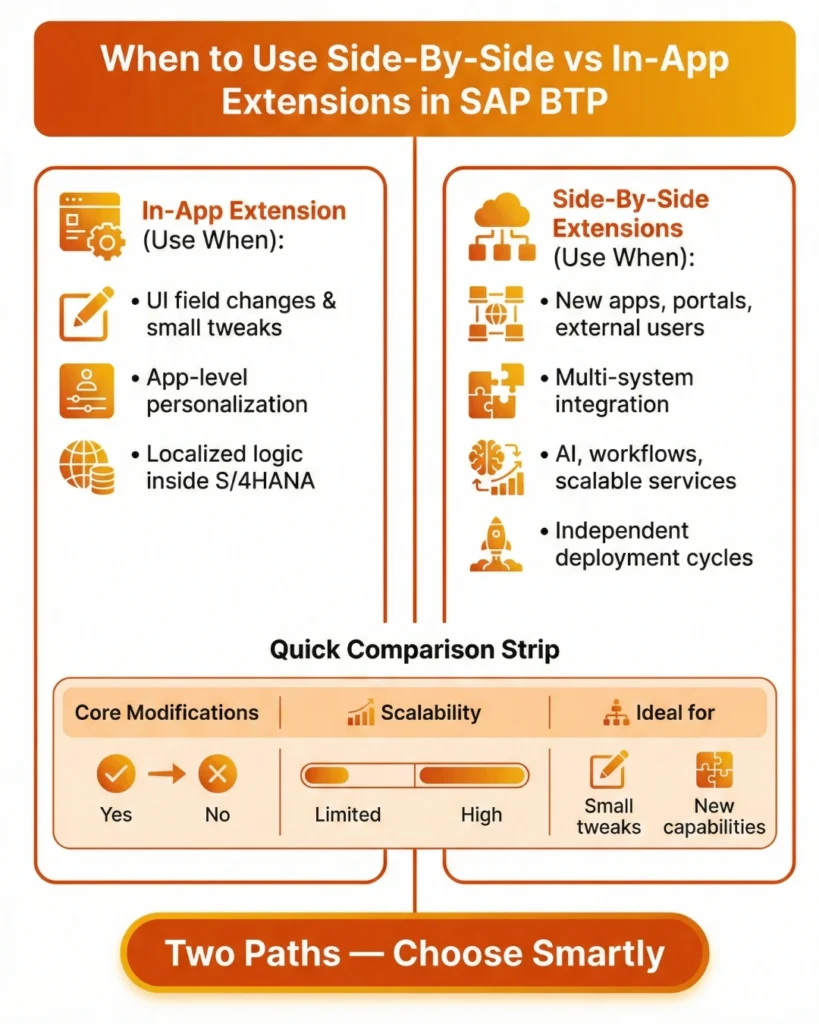
In-App Extensions (Key-User / Developer Extensibility) Use When:
- You’re making simple UI adaptations
- You’re adding a custom field to standard apps
- You’ll get localised logic in S/4HANA only
Use Side-by-Side Extensions When:
- You are creating new applications, or portals
- You need cross-system integrations
- You require independent scalability
- You wish to use AI, events, workflows and low-code capabilities on BTP
In most contemporary landscapes, you’re going to get a hybrid model: basic modifications in-app; complex upgrades side-by-side.
Technical Sidewalks For The Side By Side Extensions
When you develop a side-by-side extension on SAP BTP, most of the time you would be using:
- SAP BTP, Cloud Foundry-Runtime bzw. Kyma
- Cloud or any other supported data stores
- CAP-based services (Node. js/Java)
- SAP Fiori/UI5 or SAP Build Apps UIs
- SAP Event Mesh is a wiring fabric for event-driven architectures
Advantages of Side-by-Side Extensions
- Designed for scale and performance
- Agile Computing Agility: Faster development and deployment cycles.
- Composable: Microservices and modular services
- Strategic: In total harmony with the future roadmap of SAP
Helping You Effectively Utilize Side-by-Side Extensions
As an SAP Custom Development and SAP BTP partner, we usually help customers with:
- Architecture Design: Side-by-side vs in-app, integration patterns, security model
- Proof of Concept (PoC): Take baby steps in one realt person scenario
- End-to-End: Full implementation from networking to UI and deployment
- Coaching & Enablement: Helping your internal team with BTP development techniques
- Lifecycle Support – Ongoing monitoring, tuning, and improvement
If you’re not currently using the side-by-side extension pattern, we can work together to identify quick-win use cases, and to create your first production-ready solution.
Conclusion
Side-by-side extensions on SAP BTP offer a practical way to innovate while keeping the SAP core clean and stable. By building custom applications and services separately and connecting them through supported interfaces, organizations can respond faster to business needs, integrate with other technologies, and simplify upgrades. With thoughtful planning around APIs, security, and operations, side-by-side extensions help businesses expand SAP capabilities without compromising the reliability of their core systems.
FAQs
What is the side-by-side extension on SAP BTP?
A side-by-side extension is an explicit custom application or service executed on SAP BTP to extend some behavior of your SAP system without touching its core. It has got APIs, events and integration points to not get locked down so you can innovate while keeping the core clean.
Why would I use side by side extension over classic customization?
Side-by-side extensions:
- Avoid risky core modifications
- Support easier upgrades
- Allow cloud-native, scalable development
- Faster innovation and integration with other systems on what they excell at.
They are aligned with SAP’s clean core and RISE with SAP strategy.
Are all in-app extensions replaced by side-by-side extensions?
No. In-app (key-user) extensions are still useful for minor changes like new fields or adapting UIs. “Side by side Extensions are great for new applications, cross-system processes, and complex logic that should not reside in the ERP core.
How long does a side by side extension take to build?
Typical timelines:
- Simple PoC: 2–4 weeks
- Medium-complex app: 6–10 weeks
- Feature-rich enterprise solution with several integrations: Several months, range varies base on features
Resources
Official SAP Resources
- SAP Business Technology Platform Overview
https://www.sap.com/products/business-technology-platform.html - SAP Extensibility Explorer and Clean Core Guidance
- SAP Help Portal - SAP BTP & Extension Suite
- SAP Community: BTP extensions blogs and q&a articles