

Introduction
Most SAP project retrospectives blame failure on scope, budget, or timeline. Rarely do they name the real culprit hiding beneath all three: nobody on the SAP Basis team actually agreed on who owns what. And it’s an easy trap to fall into, because every team looks staffed on paper: an administrator here, a consultant there, maybe a security specialist. But a filled title isn’t the same as a defined role. They just feel the same, right up until something breaks. That gap is exactly where downtime, security holes, and blown timelines come from.
SAP Basis is the technical foundation of any SAP landscape, but here’s the catch: a foundation isn’t self-explanatory. Administrators, consultants, security specialists, HANA experts, and managers all work the same system from wildly different angles. And when nobody draws the lines between them, the cracks don’t show up in a memo. They show up as an outage.
SAP Basis is no longer just about monitoring background jobs and clearing spools. In today’s cloud-first enterprise, SAP Basis acts as the backbone of digital transformation, managing complex hybrid landscapes across RISE with SAP (S/4HANA Cloud, Private Edition) and public hyperscalers. Whether provisioning S/4HANA instances, optimizing in-memory SAP HANA performance, or enforcing strict Segregation of Duties (SoD), a well-structured Basis team prevents multi-million-dollar outages, guarantees data sovereignty, and ensures smooth cross-functional delivery from day one.
This guide breaks down exactly what each SAP Basis role owns, how those roles interact day to day, and how the split shifts once cloud and S/4HANA change what “infrastructure work” even means.
SAP Basis Role and Responsibility
SAP Basis jobs build a structure around the technical team responsible for managing, monitoring, and supporting SAP. These positions are responsible for ensuring that the SAP environments continue to operate smoothly, securely, and uninterrupted.
As you know, because SAP Basis is the technical foundation layer of the SAP system, it covers:
- System installation and configuration
- Performance monitoring
- User and security management
- Database administration
- System upgrades and patches
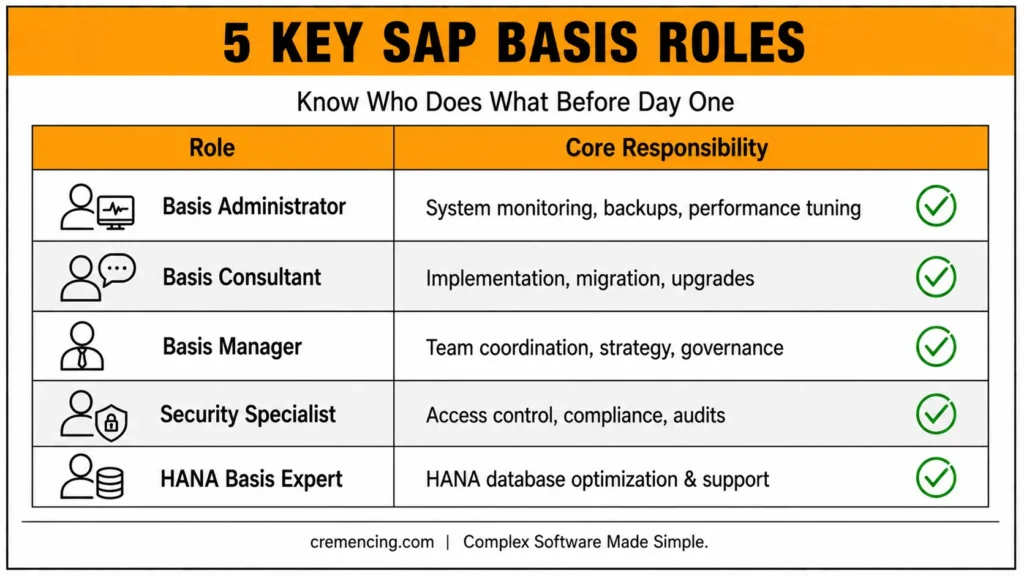
Key SAP Basis Roles
| Role | Responsibility |
| SAP Basis Administrator | System monitoring, backups, performance tuning |
| SAP Basis Consultant | Implementation, migration, upgrades |
| SAP Basis Manager | Team coordination, strategy, governance |
| SAP Basis Security Specialist | Access control, compliance, and audits |
| SAP HANA Basis Expert | HANA database optimization and support |
Each of them plays an important role in the overall success of the project functionality and business continuity requirements.
The Dynamic 4 Roles of SAP Basis in a Team
Step 1: Define Role Ownership
Each task related to the SAP system must have a designated owner.
- Who manages system uptime?
- Who handles user access?
- Who oversees upgrades?
Without ownership, accountability breaks down.
Step 2: Split Operational Versus Strategic Roles
Divide responsibilities into:
- Operational roles • administrators, support teams
- Strategic roles → consultants, managers
This is beneficial because it reduces load and improves efficiency.
Step 3: Map the Roles to System Landscape
Different environments require different expertise:
- ECC systems
- S/4HANA environments
- Cloud-based SAP systems
All of them have specific SAP Basis skill sets to master.
Step 4: Collaborate Between Roles
SAP Basis teams have to work together every step of the way:
- Functional consultants
- Developers
- Infrastructure teams
Collaboration decreases the risk of system conflicts and downtime.
Step 5: Set Up Monitoring and Reporting
Everyone is an owner of system monitoring:
- Performance reports
- Incident tracking
- Security audits
This ensures continuous system improvement.
Task and Responsibilities of SAP Basis Job Roles
Roles and Responsibilities of SAP Basis Administrator
The administrator handles day-to-day operations:
- System monitoring and health checks
- Backup and recovery management
- Transport management
- Performance tuning
This role is responsible for ensuring the smooth delivery of system software.
SAP Basis Consultant Duties and Responsibilities
Implementation/Optimization Focus Area of Population:
As consultants:
- System installation and upgrades
- Migration to S/4HANA
- Integration support
- Architecture design
They are instrumental in transformational projects. For more insights, read our blog on SAP Basis Consultants.
SAP Basis Team Roles and Responsibilities
A complete team includes the following:
- Administrators (operations)
- Consultants (projects)
- Security experts (compliance)
- Managers (strategy)
Having such a structure ensures that there is an equal distribution of work and experience.
SAP Basis User-Homepage Security Roles and Responsibilities
Security specialists focus on the following:
- User access control
- Role-based authorization
- Compliance audits
- Risk mitigation
Ineffective security management can cause significant business risks.
Find out more
Roles and Responsibilities of SAP HANA Basis
HANA specialists handle:
- Database optimization
- Memory management
- Performance tuning
- System replication
For modern SAP environments, this role is becoming increasingly important.
Responsibilities of SAP Basis Manager
Managers oversee:
- Team coordination
- Resource planning
- SLA management
- Governance and compliance
They align with business goals.
Advantages and Return on Investment (ROI) in Defining SAP Basis Roles
Defining roles gets results that show up in measurable ways:
- Reduced Downtime: Defined responsibilities eliminate confusion and speed up response time.
- Better Performance: 20–40% better performance in many cases
- Improved Security and Compliance: With dedicated security functions, you can reduce risks and be better prepared for auditors.
- Better Utilization of Resources, Less Confusion: Reduced Operating Costs
Common Mistakes and Best Practices
- Role Overlapping: Where multiple people do the same task, causing confusion
- No Proper Visibility: Before onboarding people, well-defined roles are necessary
Ignoring Security Responsibilities: Increases risk
Best Practices
- Clear definition of each role and responsibility
- Maintain updated documentation
- Use automation tools for monitoring
- Conduct regular training and audits
- Align roles with system complexity
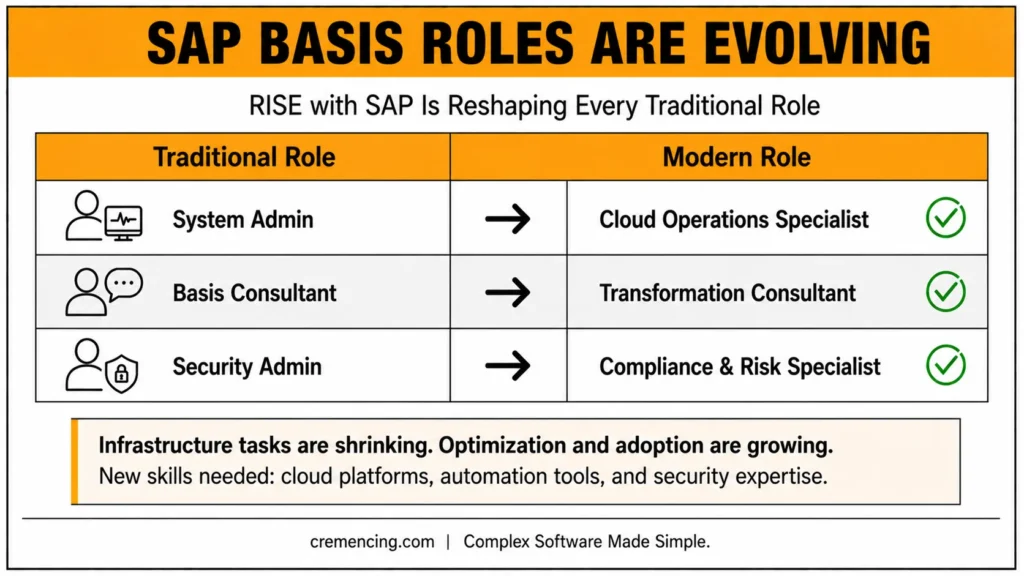
Cloud & S/4HANA-Driven Role Evolution
The majority of content misses how the role of SAP Basis is changing.
Shift to Cloud-Based SAP
- With RISE with SAP and related:
- Infrastructure tasks are reduced
- Focus moves to optimising and adopting
Automation and AI Applications in SAP Basis
Modern tools automate the following:
- Monitoring
- Alerts
- Performance tuning
This reduces manual workload.
New Skills Required
SAP Basis professionals now need:
- Cloud platform knowledge (AWS, Azure)
- Automation tools
- Security expertise
Impact on Traditional Roles
| Traditional Role | Modern Role |
| System Admin | Cloud Operations Specialist |
| Basis Consultant | Transformation Consultant |
| Security Admin | Compliance & Risk Specialist |
An understanding of this paradigm shift will prepare the teams for the future. For more insight, read our blog on what a technical RISE readiness assessment actually checks
Conclusion
Clear SAP Basis roles aren’t a nice-to-have; they’re the difference between a team that catches problems early and one that finds out about them during an outage. The five roles covered here (administrator, consultant, Manager, Security Specialist, HANA Expert) each own a distinct piece of the system, and the moment that ownership gets fuzzy is the moment accountability breaks down with it.
As more of that infrastructure work shifts toward cloud and RISE with SAP, the specific tasks each role owns will keep changing — but the underlying principle won’t: name an owner for every part of the system before you need one. Start by mapping your current team against the roles above and flagging anywhere ownership is assumed rather than assigned.
FAQ Section
What are SAP Basis Roles and responsibilities?
They include SAP system administration, monitoring, security management, and performance tuning as well as technical support.
SAP Basis Consultant Working Skills: What are the responsibilities of an SAP Basis consultant?
A consultant in this field is involved in implementation, upgrades, support of a system or migration, and design of the architecture.
What is the difference between an SAP Basis administrator and a consultant?
Administrators take care of day-to-day operations, while consultants work on implementation and upgrade projects.
Why are SAP Basis Roles important?
They ensure the stability, security, and performance of the systems used in business activities.
What are the requirements to get into SAP Basis roles?
Domain of skills: System Administration, Database Management, Security, Performance Tuning, and Cloud.
How is an SAP Basis team typically structured?
Most teams combine administrators for daily operations, consultants for project and migration work, a security specialist for access control and compliance, and a manager for coordination and governance. However, smaller organizations often combine several of these into one or two people.
Does SAP Basis work change under RISE with SAP?
Yes — infrastructure-layer tasks like hardware provisioning and patching largely move to SAP. As a result, the customer-side team’s focus shifts toward configuration, monitoring, and governance rather than hands-on system administration.
What’s the difference between a Basis Administrator and a Basis Security Specialist?
Administrators focus on system uptime, backups, and performance, while security specialists focus specifically on access control, authorization design, and compliance audits. That said, in smaller teams, one person may often hold both responsibilities.