
Introduction
Every S/4HANA migration budget eventually collides with the same line item: code nobody remembers writing. Teams that skip a structured custom-code assessment routinely discover, mid-migration, that a large share of their Z/Y programs are duplicative, unused, or quietly blocking the simplification items SAP’s own readiness tooling flags. The cost isn’t abstract; it shows up as extended testing cycles, delayed cutover dates, and a post-go-live landscape that’s just as tangled as the one you left.
Custom code lifecycle management (CCLM) is the discipline that prevents this: a structured process for discovering, classifying, and governing ABAP custom code both before migration and critically after it, when governance tends to lapse once the project team disbands.
This guide walks through that process end to end: how to run discovery and usage analysis, how to classify objects into Keep/Optimize/Retire/Replace, what modernization actually looks like under SAP’s clean core principles, and how to keep governance in place once the migration project itself is over.
Continuous SAP Code Control
Migrating to SAP S/4HANA is not the end of custom code management; it requires shifting from one-time remediation to continuous governance. Post-migration, organizations must establish a persistent Custom Code Lifecycle Management framework combining runtime tracking via the ABAP Call Monitor (SCMON) with automated quality gates via the ABAP Test Cockpit (ATC) integrated into the ABAP Development Tools (ADT).
By continuously monitoring program usage and enforcing SAP Clean Core principles such as utilizing released APIs and replacing legacy enhancements with extension points, IT teams prevent technical debt from re-accumulating. Establishing proactive lifecycle tracking and automated transport release checks ensures that post-go-live modifications remain cloud-ready, optimised for SAP HANA, and fully transparent throughout their operational lifespan.
What is Custom Code Lifecycle Management in SAP S/4HANA?
Structured SAP approach for analysing, governing, and modernizing ABAP custom code before and after S/4HANA migration is known as Custom Code Lifecycle Management (CCLM).
It guarantees that only pertinent code is included in the system – and that irrelevant, redundant code is either deleted or refined.
Core Objectives:
- Find Unused/Obsolete ABAP Code
- Before migration, assess the effect of code on the system.
- Monitor use on systems
- Legacy logic modernization for S/4HANA readiness
- Minimize technical debt in SAP Landscapes
Key Tools Used:
| Tool | Purpose |
| SAP ATC (ABAP Test Cockpit) | Code quality analysis |
| SAP Code Inspector | Static code checks |
| SAP CCLM | Lifecycle tracking |
| SAP Readiness Check | Migration readiness |
In practice, CCLM work centers on a small set of concrete entry points rather than a single tool. SCI (Code Inspector) and the ATC transaction run static checks against a defined check variant; for S/4HANA readiness specifically, SAP ships the SAP_S4HANA_CHECK variant, which flags simplification-relevant findings (deprecated table access, removed function modules, etc.).
Usage data comes from SCMON (code coverage/usage monitoring) and SUSG (usage of function modules, BAPIs, and other repository objects); this is what tells you whether a Z-program has actually executed in the last N months versus simply existing in the repository.
Step-by-Step Custom Code Lifecycle Management Process
Step 1 – Custom Code Discovery:
Enterprises start with scanning current ABAP systems.
Activities include:
- All custom objects (Z/Y programs) can be identified
- Mapping usage frequency
- Detecting duplicate logic
This results in a full list of technical debt.
Step 2 – Usage Analysis
Systems determine if code is live or not.
Key insights:
- Frequently used code
- Rarely executed programs
- Completely unused objects
This frequently uncovers that 30-50% of the custom coding is now redundant.
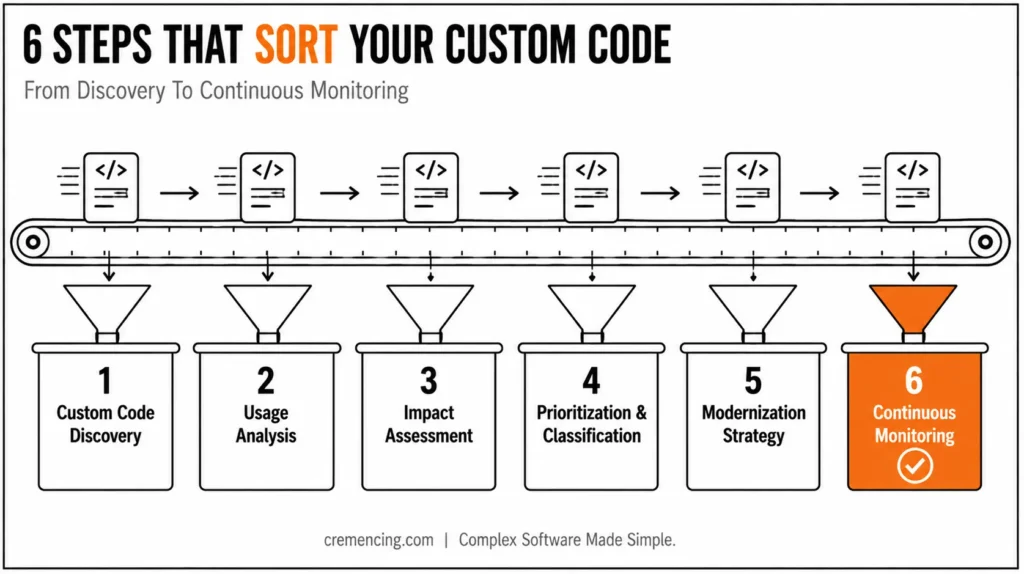
Step 3 – Impact Assessment
SAP systems check for dependencies before removing or modifying systems.
This includes:
- Functional impact analysis
- Interface dependencies
- Business process mapping
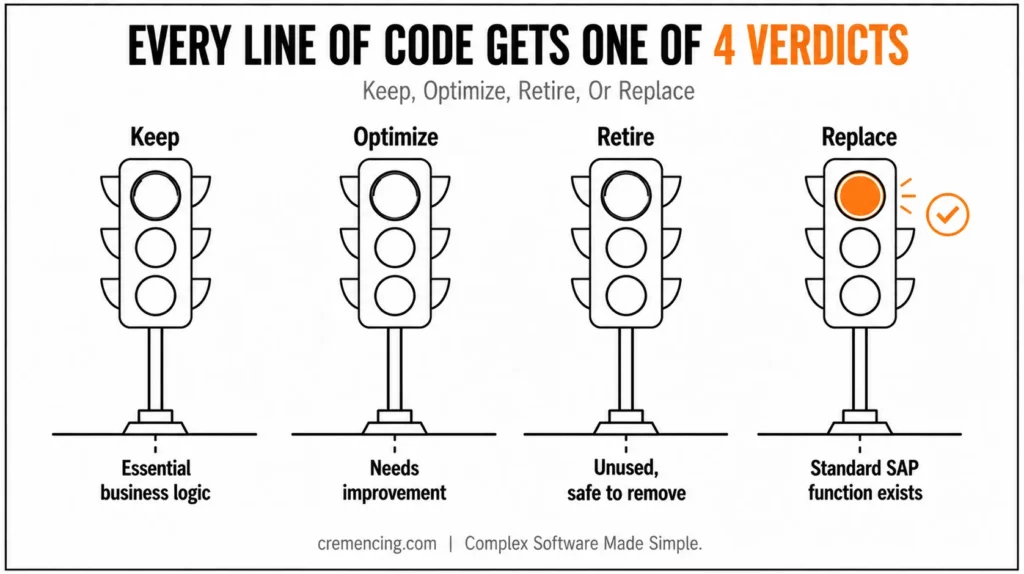
Step 4 – Prioritization & Classification
There are two kinds of code:
- Keep (essentially important logic within the business)
- Optimize (needs improvement)
- Retire (unused code)
- Replace (the standard SAP functionality exists)
Step 5 – Modernization Strategy
Modernization approaches include the following:
- The conversion of ABAP to SAP Fiori services.
- With the help of CDS views, logic can be moved to the views in the system.
- SAP BTP extensions are used.
- Rewriting inefficient code
Where custom logic wraps standard business logic that now has a released API, SAP’s guidance under the clean core strategy is to re-platform onto RAP (RESTful ABAP Programming Model) rather than continuing to extend classic BAPIs or direct table access this is also the only supported extensibility path in S/4HANA Cloud. On-prem systems have more latitude to keep classic ABAP short-term, but SAP’s own simplification notes increasingly flag direct table writes (e.g., to MARA, VBAK) as deprecated patterns to be replaced with released CDS-based APIs.
Step 6: Continuous Monitoring
After migration:
- Monitor new customer developments.
- Enforce governance rules
- Conduct Code Audits periodically.
Value & Return on Investment (ROI) of Custom Code Lifecycle Management
With proper life cycle management, SAP maintenance costs and complexity are drastically reduced.
Key Benefits:
- As much as 40% reduction in technical debt.
- Reduce migration cycles for S/4HANA through faster migration.
- Improved system performance
- Reduced testing effort
- Improved code governance and code compliance
ROI Impact Table:
| Area | Improvement |
| Migration Cost | -30% reduction |
| System Performance | +25% improvement |
| Maintenance Effort | -40% reduction |
| Testing Time | -35% reduction |
CCLM guarantees system sustainability in SAP landscapes.
Best Practices and Common Mistakes
Common Mistakes:
- A migration of all legacy code with no analysis
- You can ignore unused custom objects.
- Lack of a governance framework
- Lack of proper documentation of ABAP logic
- Skipping dependency analysis
Best Practices:
- Clean up before migrating.
- Apply SAP ATC and CCLM tools in a uniform manner
- Sync Code with Business Process
- Implement a clean core approach
- Implement development governance norms
What Most SAP Articles Miss:
The vast majority of articles only describe tools, not enterprise governance strategy.
Content not found in Competitor:
- Clean Core Strategy Alignment
- Why custom code is a hindrance to S/4HANA clean core principles.
Business-IT Alignment:
The issue here is, how do you map ABAP code to actual business value?
Continuous Lifecycle Governance:
Governance model beyond the migration phase (post-migration).
Code Analysis – Automation:
Optimize and detect code with the help of AI.
The REAL Cost of Technical Debt:
Unmanaged ABAP systems can have a significant impact on the financial results.
Here is where enterprise transformation takes place, not just technical cleanup. In today’s modern SAP landscapes, it’s not just about migration; it’s about constant optimization. To effectively modernize ABAP systems and reduce technical debt, consider structured custom code lifecycle management that is consistent with the principles of the ABAP systems architecture of SAP S/4HANA.
Governing legacy custom code is often the first step before modernizing; see ABAP to BTP transition 2026: what smart developers know.
Conclusion
Custom code lifecycle management isn’t a one-time migration task; it’s the difference between an S/4HANA landscape that stays clean and one that quietly reaccumulates the same technical debt within a few release cycles. The discovery, classification, and modernization steps outlined here get you through the migration itself; the governance step is what determines whether that work holds. Enterprises that treat ATC checks and usage monitoring as a recurring discipline, not a pre-migration exercise, are the ones who avoid running this same cleanup project again in three years.
Custom code lifecycle management, following the SAP S/4HANA migration, is not simply a technical task, but a corporate governance approach that guarantees the stability, performance, and scalability of the system in the long run.
This guide explains:
- How ABAP custom code is analyzed and categorized
- How businesses upgrade their old systems
- How Governance enhances S/4HANA readiness
- Understanding the effect of technical debt on SAP landscapes
Structured lifecycle management dramatically lowers the risks of migration and operational costs, and increases efficiency in the system.
Going forward, enterprises should adopt continuous code governance in line with the SAP clean code principles.
FAQs
What is custom code lifecycle management in SAP?
It is the method of analyzing, managing, and optimizing Custom ABAP code throughout the SAP system lifecycle.
Why is it important post S/4HANA migration?
It helps to decrease technical debt and to maintain only code that is relevant to the system.
What tools are involved in CCLM?
SAP ATC, SAP Code Inspector, SAP Readiness Check, and SAP CCLM tools.
What is the amount of unused ABAP code in SAP systems?
In enterprise environments, the typical code percentage that is unused is 30-50 per cent of custom code.
Are there system performance gains due to CCLM?
Yes, it improves runtime and system performance.
What’s the difference between Custom Code Migration and Custom Code Management in S/4HANA?
Custom Code Migration is the app used during the technical migration project to flag simplification-relevant findings; Custom Code Management is the broader, ongoing app collection used post-go-live for ATC governance, usage monitoring, and retirement tracking.
How long should usage monitoring run before deciding to retire an object?
A: Most SAP guidance points to observing at least one full business cycle, commonly 12 months, so that quarter-end, year-end, and seasonal-only programs aren’t misclassified as unused.
Can custom code be migrated as-is into S/4HANA Cloud?
No S/4HANA Cloud restricts extensibility to released APIs and the RAP model, so classic ABAP relying on direct table access or unreleased BAPIs cannot move over unchanged.




One Response