

Most SAP teams don’t fail at innovation. They fail at controlling what innovation leaves behind — duplicate systems, unclear ownership, and compliance gaps nobody planned for. SAP Landscape Governance is designed to address exactly these challenges, helping enterprises manage complexity as they expand across regions, cloud instances, and hybrid setups.
As enterprises expand across regions, cloud instances, and hybrid setups, this complexity multiplies fast. For example, A CIO rolling out a new Fiori app in one region often has no visibility into three similar apps already running elsewhere.
This is the exact problem SAP Landscape Governance solves. Rather, It’s not a policy document that slows teams down. It’s a framework that lets organizations move fast on new SAP technology, without losing control of what’s already running.
This guide breaks down what SAP Landscape Governance actually means, the five pillars top-performing enterprises build around, and a step-by-step model you can apply — backed by real outcomes from organizations that used it to cut system redundancy and speed up delivery.
Rising AI Governance Deficits in Enterprise Architecture
A recent SAP LeanIX survey reveals that 98% of enterprises deploy or plan to deploy AI agents, yet only 17% maintain performance visibility. Nearly half of these organizations lack clearly defined roles or management responsibilities for their autonomous software components.
While 63% of IT leaders believe enterprise architects should guide agentic AI governance, only 34% actively involve them in oversight. Without structured landscape controls, unmanaged AI deployments risk reproducing technical debt across cloud ecosystems.
Key Takeaways
- SAP Landscape Governance balances two goals at once: staying in control and moving fast on innovation.
- It rests on five pillars — standardization, role-based accountability, policy and compliance, safe innovation, and continuous monitoring.
- Real organizations have cut system duplication by up to 30% and sped up project delivery by 40% using this model.
- A repeatable seven-step process — from assessment to iteration — makes governance practical, not theoretical.
- The biggest risks aren’t complexity itself, but unclear ownership and over-standardizing to the point of blocking innovation.
What Is SAP Landscape Governance and Why Is It Important
Contrary to what the name suggests, SAP Landscape Governance has nothing to do with protecting the trees around your property boundary, but it does cover your SAP and all parts of your SAP landscape on-premise solutions (cloud-based or otherwise) and hybrid infrastructures.
It establishes policies, standards, responsibilities, furthermore procedures to help ensure that SAP environments are effective, secured and support business objectives.
Key benefits include:
- Operational Control: Reduce mistakes, repetition, and technical debt.
- Regulatory Compliance: Comply with internal procedures and external regulations.
- Elasticity for Strategy: Innovate and accelerate SAP Technology adoption.
- Risk Mitigation: Informals for system ownership, processes, and responsibilities were imbalanced.
For leaders, good governance simplifies without sacrificing speed also your SAP landscape stays strong and nimble.
BTP adoption has reached a real inflection point in 2026: about 50% of SAP customers now actively use BTP services, up 10 percentage points from last year, with another 26% starting their journey. Consequently, Clean Core has shifted from being just an architectural recommendation to an operational necessity, since custom logic that can’t fit standard extensibility is now expected to live on BTP rather than inside the core system.
This directly reinforces why structured landscape governance matters more than ever — without clear rules on what belongs where, organizations risk recreating the same technical debt in their new systems that they were trying to escape.
Core Elements of Managing an SAP Landscape Governance
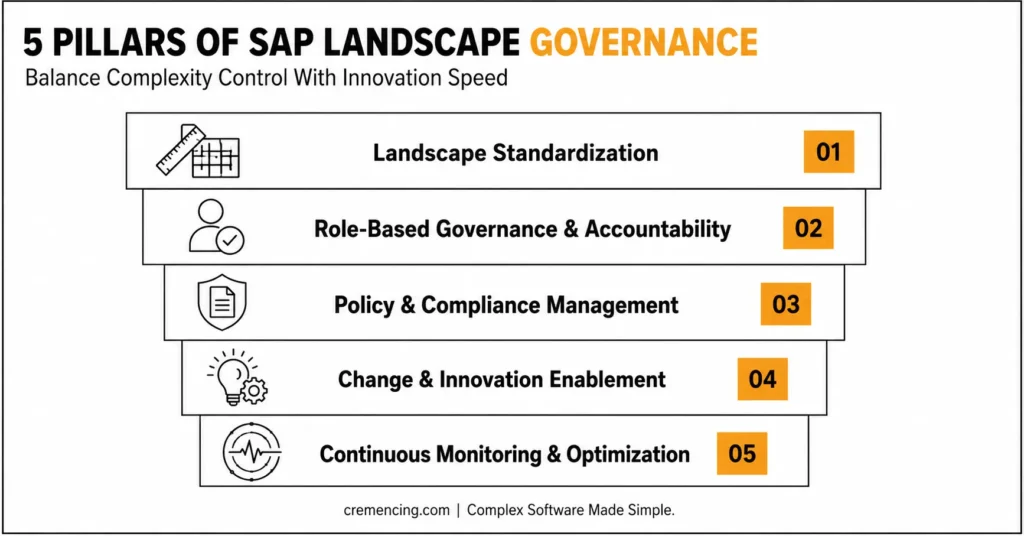
Overall, A mature governance model does the work of managing control, compliance, and speed. Moreover, best performers focus on five pillars:
Landscape Standardization: A Pillar of SAP Landscape Governance
First, Establish consistent baselines for guidelines across systems, environments, and processes:
- Specifically, standardise naming, configuration, and integration protocols.
- Additionally, There should be less duplication in system instances and technical configurations.
- Finally, Accelerate deployments and system upgrades.
Case in point:
A global manufacturer standardized its SAP modules across regions, reducing system duplication by about 30% and increasing the accuracy of cross-functional reports.
Role-Based Governance and Accountability
Indeed, Clear roles are crucial for efficiency and risk control:
- Define the “owners” of systems, processes, and governance.
- Use RACI matrices to help manage key processes.
- Match duties to support and incident SLAs.
As a resutl this clarity makes decision-making faster with control.
Policy and Compliance Management
Effective governance ensures internal and external mandates are followed:
- Set drive control and access rules between SAP environments.
- Keep your data secured, auditing, and regulation ready.
- Track compliance through automated dashboards and periodic reviews of orders.
Thus, executives are empowered with the assurances that even within dynamic and complex environments, risk is ready to be mitigated.
Change and Innovation Enablement
Governance should enable, not hinder, innovation:
- Control while reviewing and approving updates.
- Inspire exploration of new SAP modules, Fiori apps, or BTP solutions.
- Produce sandbox and test environments to iterate.
As a best-in-class solution, players are finding the proper compromise between consistency, however, the ability to be nimble with creating versions, consequently getting new considerations into production at light speed.
Continuous Monitoring and Optimization
Regimes require constant work, not one-time set-ups: Track KPIs like system uptime, incident response, and change success. In Addition, do regular landscape reviews to find technical debt and consolidation targets. Edit policies, positions, and guidelines as business needs evolve.
Hence, it is continuous monitoring is driving scalability, economy, and long-term durability.
Step-by-Step SAP Landscape Governance Implementation
And there are easy signposts leaders can embrace to ensure good governance:
- Assess the Current Situation: Collate details of all SAP systems, landscapes, and integrations.
- Identify threats and deficits: Highlight the areas where things are complicated, redundant, or don’t align.
- Governance framework definition: Set policies, assign roles, RACI matrix, and conformance guidelines.
- Standardize and consolidate: Eliminate duplicated systems and enforce standard configurations.
- Introduce innovation safely: With change management processes, controlled test environments should also be put in place.
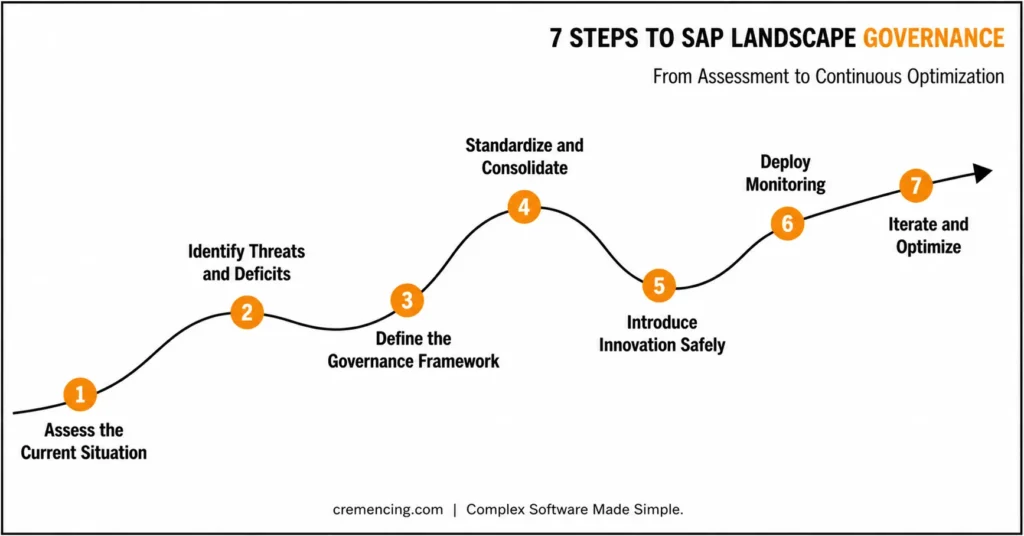
- Deploy monitoring: Measure KPIs, SLA follow-through, and compliance metrics.
- Iterate and optimize: Revisit periodically for efficiency and when your business setup changes.
Similarly, this model guarantees equilibrium of control and agility, allowing institutions to innovate with confidence.
SAP Landscape Governance Maturity Checklist
| Pillar | Key Action | Success Metric |
|---|---|---|
| Standardization | Unify naming, configuration, and integration protocols | Reduced system duplication (target: 25-30%) |
| Role-Based Accountability | Define owners via RACI matrix for every system/process | Faster decision-making, fewer ownership gaps |
| Policy & Compliance | Automate compliance dashboards and access controls | Zero unresolved audit findings |
| Change & Innovation | Use sandbox environments before production rollout | Faster time-to-production for new BTP/Fiori apps |
| Continuous Monitoring | Track KPIs — uptime, incident response, change success | Consistent SLA adherence quarter-over-quarter |
Real World: Innovation Velocity Driven by Governance
A multinational consumer goods corporation had several versions of SAP across the globe, resulting in inconsistent reporting, two or more systems in one region, and slow deployment.
Once SAP Landscape Governance is in place:
- System constants and naming standards
- Relevant roles and responsibilities through RACI matrices
- Real-time dashboards for monitoring compliance and incident trends
- Created sandbox environments for innovation
Outcome:
The organization reduced system redundancy by 25 percent, sped up new project implementation by 40 percent, and remained in full regulatory compliance; thus striking the right balance between controlling complexity while maintaining rapid changes.
Why Leaders Choose SAP Landscape Governance: Executive Insights
What you achieve with SAP Landscape Governance:
Minimized Operational Risk: Clearly owner and compliance reduces the chance for mistakes and exposure to regulators.
Faster Decisions: No more bottlenecks with clear roles and RACI frameworks!
Innovation enablement: Agile governance supports experimenting and using new SAP technologies.
Cost Saving: Reduced redundancy, efficient workflows, and managed updates all translate to cost savings.
Enhanced Transparency: Full transparency into the health and operation of SAP infrastructure.
Governance becomes a strategic promoter, not just a box-ticking exercise.”
Common Pitfalls to Avoid
Experienced players can stumble when they:
- Over-standardize and stifle innovation
- Do not clarify roles and responsibility
- Forget about 24-hour vigilance of the landscape
- Ignore compliance and security risks in complex hybrid environments
However, by sidestepping these traps, your SAP landscape remains manageable and flexible.
Conclusion:
An accelerated SAP Landscape Governance framework balances complexity control without slowing innovation. It allows enterprise leaders to scale SAP capabilities with confidence while reducing risk and costs.
To sum up, leaders should evaluate current systems, define policies, align roles and responsibilities, standardize environments, enable safe innovation, and continuously monitor outcomes. The payoff is a hardened, high-performing, and responsive SAP landscape that supports business value realization.
Overall, perform a governance health check and SAP landscape blueprint. Learn how to establish structured governance in your enterprise to enable innovation without risking compliance challenges.
FAQs:
Q1: What do you mean by the term SAP Landscape Governance?
It’s the foundation upon which policies, roles, standards, and processes are built to ensure your SAP environment is protected/optimized, compliant, and aligned with business objectives.
Q2: Why does SAP Landscape Governance matter for S/4HANA and Hybrid?
It abstracts complexity, enforces compliance and governance while also enabling agility to embrace new capabilities.
Q3: How are RACI matrices relevant to landscape governance?
RACI matrices lay out the ownership, responsibility, checking, and informing for systems and processes.
Q4: How often should SAP Landscape Governance be reviewed?
Regular (a minimum of annual) review, or as quicklyas possible when major systems are changed, means that your policy remains effective.
Q5: Can governance enhance the pace of innovation?
Yes. A governed approach enables you to experiment with low risks, control changes, and make the adoption of new SAP technologies faster.
Q6: What’s the difference between SAP Landscape Governance and Clean Core?
Clean Core is a technical principle — keeping customizations out of the S/4HANA core and building them on BTP instead. SAP Landscape Governance is the broader framework that makes Clean Core actually work in practice, by defining who owns what, which standards apply, and how compliance is tracked across the entire landscape.
Q7: Do small or mid-sized companies need SAP Landscape Governance, or is it only for large enterprises?
Any organization running more than one SAP system or environment benefits from it. Smaller companies can start with a lighter version — basic role definitions and naming standards — and scale the framework as their landscape grows.
Q8: What tools are commonly used to support SAP Landscape Governance?
Common tools include SAP Cloud ALM for monitoring and quality gates, RACI matrices for accountability, and automated compliance dashboards. Many organizations also use SAP LeanIX for broader enterprise architecture governance.
Q9: How long does it take to implement a governance framework across an SAP landscape?
Timelines vary by landscape complexity, but most organizations see initial structure — role definitions, policies, and standardization baselines — in place within 3 to 6 months, with continuous refinement afterward.
Q10: What happens if a company ignores SAP Landscape Governance?
Without it, organizations typically see duplicate systems, unclear ownership during incidents, slower decision-making, and rising technical debt — all of which increase costs and compliance risk over time.