Introduction
SAP Center of Excellence Optimization helps organizations move beyond basic SAP support and turn their CoE into a strategic business asset. Instead of focusing only on keeping systems running and resolving tickets, an optimized CoE aligns SAP capabilities with business goals, innovation, governance, and measurable value. Under that definition, a CoE that closes tickets quickly is doing its job well.
However, that definition is exactly what keeps most CoEs stuck as a cost center instead of a strategic asset. Delayed project delivery, low adoption of new SAP functionality, fragmented governance, and weak alignment with business strategy aren’t signs of a CoE failing at its job; they’re signs of a CoE succeeding at the wrong job, one defined too narrowly from the start.
Moreover, a CoE structured around business value instead of ticket throughput looks different: it has defined governance, a talent strategy tied to actual SAP roadmap direction, and metrics tracked against business KPIs rather than uptime alone. This is what separates a CoE that merely keeps the lights on from one that CIOs treat as an engine for enterprise-scale value, and it’s the shift this post walks through, pillar by pillar.
SAP Center of Excellence Optimization for Business Innovation
Modernizing an SAP Center of Excellence (CoE) requires shifting focus from operational maintenance to business capability enablement. Under SAP’s modern CoE framework, such as the Customer Center of Expertise certifications, organizations must align IT services directly with enterprise strategy rather than merely managing technical delivery.
Why SAP CoE Optimization Matters
In addition, transforming a legacy CoE into a strategic driver involves establishing business-aligned governance, standardizing process management via SAP Signavio, and accelerating innovation through the SAP Business Technology Platform (BTP).standardizing process management via SAP Signavio, and accelerating innovation through the SAP Business Technology Platform (BTP). By shifting routine system monitoring to automated services and adoption management, the CoE shifts from a reactive cost center to a proactively managed engine for continuous digital transformation. Successful execution depends on clear business-value metrics and cross-functional leadership alignment.
Definition of SAP Center of Excellence Optimization
SAP Center of Excellence Optimization is the means by which we improve the skills, organization, and management of your CoE to maximize its impact on the business. It ensures that your CoE:
- Supports the business and SAP transformation strategy
- Supports continuous innovation and improvement
- Delivers efficient and scalable operations
- Promotes knowledge transfer and sharing of best practices among teams
Therefore, a well-designed CoE is much more than tech support; it turns into an engine room that drives digital transformation. It turns into an engine room that drives digital transformation.
Fundamentals of a High-Impacting SAP CoE
| Reactive CoE | Optimized CoE | |
|---|---|---|
| Primary focus | Ticket resolution, keeping systems running | Business value, strategic enablement |
| Governance | Informal, decisions made ad hoc | RACI-based, defined escalation paths |
| Talent model | Technical skills only | Technical + business process fluency |
| Innovation | Reactive to requests | Proactive automation and process improvement |
| Success measured by | Uptime, ticket volume | Business KPIs, ROI, strategic alignment |
To make your CoE a strategic powerhouse, concentrate on these five pillars:
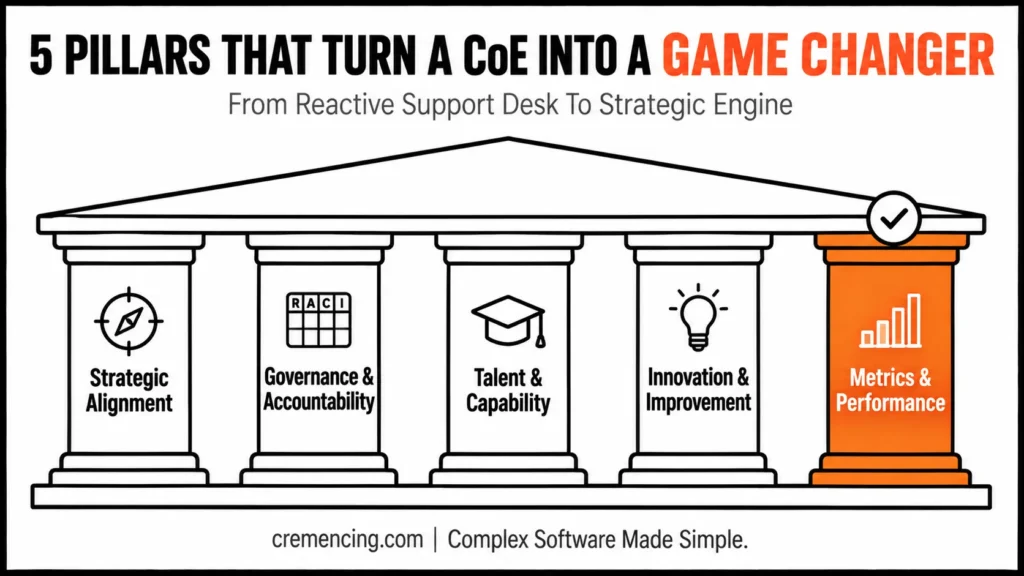
1. Strategic Alignment in SAP Center of Excellence Optimization
First, your CoE should be based on business requirements:
- Map CoE activities to business objectives, such as agility, compliance, and growth
- Establish KPIs that reflect quantifiable value
- Drive leadership of strategic moves and provide visibility in prioritizing and sponsoring programs to speed up adoption
Example: A worldwide retailer reorganized its CoE to cater for supply chain efficiencies. The result: faster automation of processes and easily measurable savings.
2.Governance and Accountability in SAP Center of Excellence Optimization
Furthermore, clear structures allow strategy methodology to avoid repetition and decision jamming:
- Clarify who’s doing what and when, with escalation paths
- Apply RACI matrices to all major SAP processes
- Standardize CoE operations with SLA and compliance regulations
This ensures that IT and business units operate leanly while holding each other accountable.
3. Talent and Capability Development for SAP Center of Excellence Optimization
Similarly, a CoE is only as good as its people:
- Invest in your people with SAP skills on S/4HANA, BTP, Fiori, and Integration Suite
- Encourage cross-functional knowledge sharing
- Promote career paths and incentivize top talent
Successful CoEs combine technical knowledge with business process understanding, acting as a liaison between IT and the business.
4. Innovation and Continuous Improvement
Moreover, optimized CoEs proactively inspire innovation:
- Look for ways to optimize and automate aspects of the process
- Exploit SAP technologies (AI, analytics, process visibility tools)
- Create feedback mechanisms for lessons learned and best practices
This makes your CoE a value-generator, not only a service desk.
5. Metrics and Performance Management
Finally, track outcomes, not just activities:
- Quantify the CoE effect on business KPIs (process efficiency, cost savings, uptime)
- Track SLAs and time to resolve incidents
- Perform health checks and benchmark regularly
Executives can now measure tangible ROI and grow their strategic influence.
Work on Your SAP Center of Excellence
Executive Playbook:
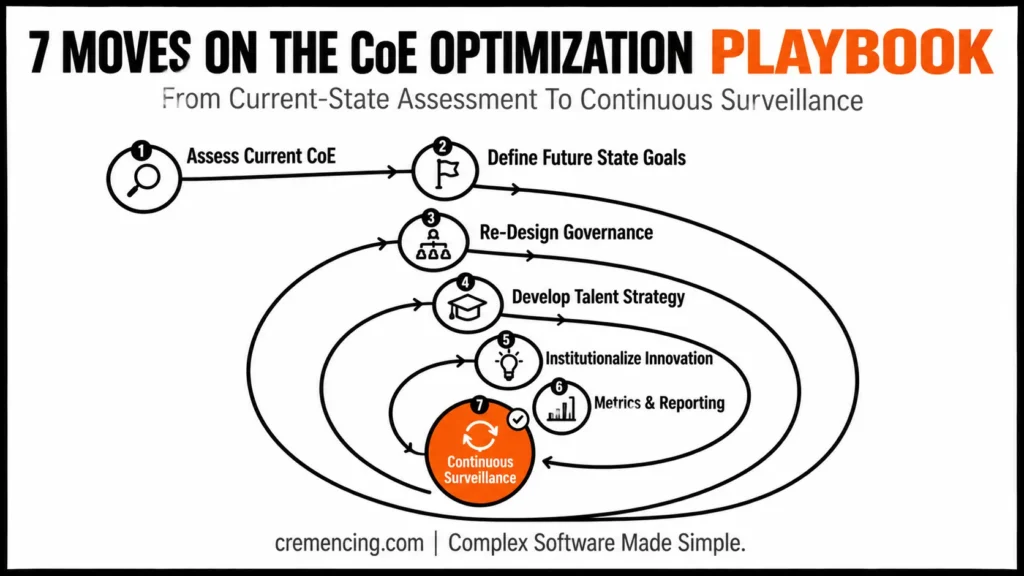
SAP Center of Excellence Optimization: 7-Step Playbook
- Assess current CoE (processes, roles, tools, governance)
- Define future-state goals (vision, enterprise alignment, SAP roadmap)
- Redesign governance (RACI, escalation paths, SLAs)
- Develop talent strategy (training, communication, retention)
- Institutionalize innovation (Kaizens, automation programs)
- Track metrics and reporting (performance, value-add)
- Continuous surveillance (recurring reassessment for sustainability)
Real Case: From the Batch to CoE as a Game Changer
For example, a CoE focused solely on resolving incidents at a multinational manufacturing company underwent SAP Center of Excellence Optimization: at a multinational manufacturing company underwent SAP Center of Excellence Optimization:
- Governance and RACI are defined
- Talent upskilled for S/4HANA and BTP
- Innovation initiatives introduced automated workflows, reducing manual approvals by 40%
- KPI tracking disclosed CoE’s impact on executive leadership
Outcome: The CoE became a catalyst for digital transformation, guiding business and strategy instead of merely responding to pain points.
SAP Center of Excellence Optimization: Executive Insights
As a result, SAP Center of Excellence Optimization provides:
- Efficiency of Operation: Minimized duplication and standardized processes
- Strategic Transparency: Defined KPIs and dashboards for visibility into business activities
- Innovation Pool: Accelerated adoption of new SAP functionalities
- Risk Mitigation: Effective governance and accountability prevent service interruptions
- Employee Engagement: Upskilled teams improve adoption and performance
A high-performing CoE is more than a support team; it’s a strategic advantage fueling enterprise-wide change.
Common SAP Center of Excellence Optimization Pitfalls
However, good-intentioned CoE initiatives can fail if you:
- Concentrate solely on processes without strategic fit
- Overcomplicate governance without practical enforcement
- Neglect lifelong learning and skill development
- Avoid metrics that demonstrate value to executives
Avoid these pitfalls to ensure your CoE drives measurable business value.
Conclusion: Turn Your CoE Into a Strategic Game Changer
Ultimately, a well-organized and optimized SAP Center of Excellence is more than an incident management or delivery shop.An incident management or delivery shop. It is a strategic game-changer that:
- Connects IT and business
- Supercharges creativity
- Enables measurable progress
Next Steps:
- Run a CoE optimization workshop
- Map roles to strategic initiatives
- Compare your CoE with in-class solutions to unlock full enterprise value
FAQs:
Q1: What do you mean by SAP Center of Excellence Optimization?
Increasing the sophistication of CoE structure, governance, talent, and innovation capabilities to drive strategic impact.
Q2: What is the significance of a CoE for S/4HANA transformations?
Configured CoEs can accelerate adoption, fuel innovation, and synchronize IT operations with business strategy.
Q3: What are the success criteria for a CoE?
Measured via KPIs like process efficiency, SLA compliance, innovation uptake, cost reduction, and business goal alignment.
Q4: Which positions are key to a high-performing CoE?
Business process owners, SAP architects and developers, functional consultants, and governance leads are all coordinated via transparent RACI.
Q5: What frequency is appropriate for optimizing a CoE?
Regular reviews, at least annually and after large SAP projects, to keep the CoE delivering on its strategic mandate.
Q6:How is a CoE different from a regular SAP support team?
A support team is typically scoped to incident resolution and keeping systems running; a CoE, done well, also owns governance, talent development, and connecting SAP capability to business strategy.
Q7:What’s a realistic timeline to see results from CoE optimization?
Governance and quick process wins can show up within a quarter, but the deeper shift from reactive to strategic typically plays out over multiple SAP project cycles, not a single initiative.
Q8:Does CoE optimization require a dedicated budget separate from SAP operations?
Usually yes for the transformation phase itself (assessment, redesign, training), even though the resulting CoE often operates within existing operational budgets afterward.
Q9:Can a smaller organization justify a formal CoE?
The five pillars scale down; even a small team can apply lightweight RACI governance and basic KPI tracking without needing a large dedicated organization.
Q10:What’s the biggest reason CoE optimization initiatives stall?
Per the post’s own “Common Pitfalls” section, the most common failure is treating it as a one-time governance exercise rather than the continuous-improvement cycle the 7-step playbook describes.