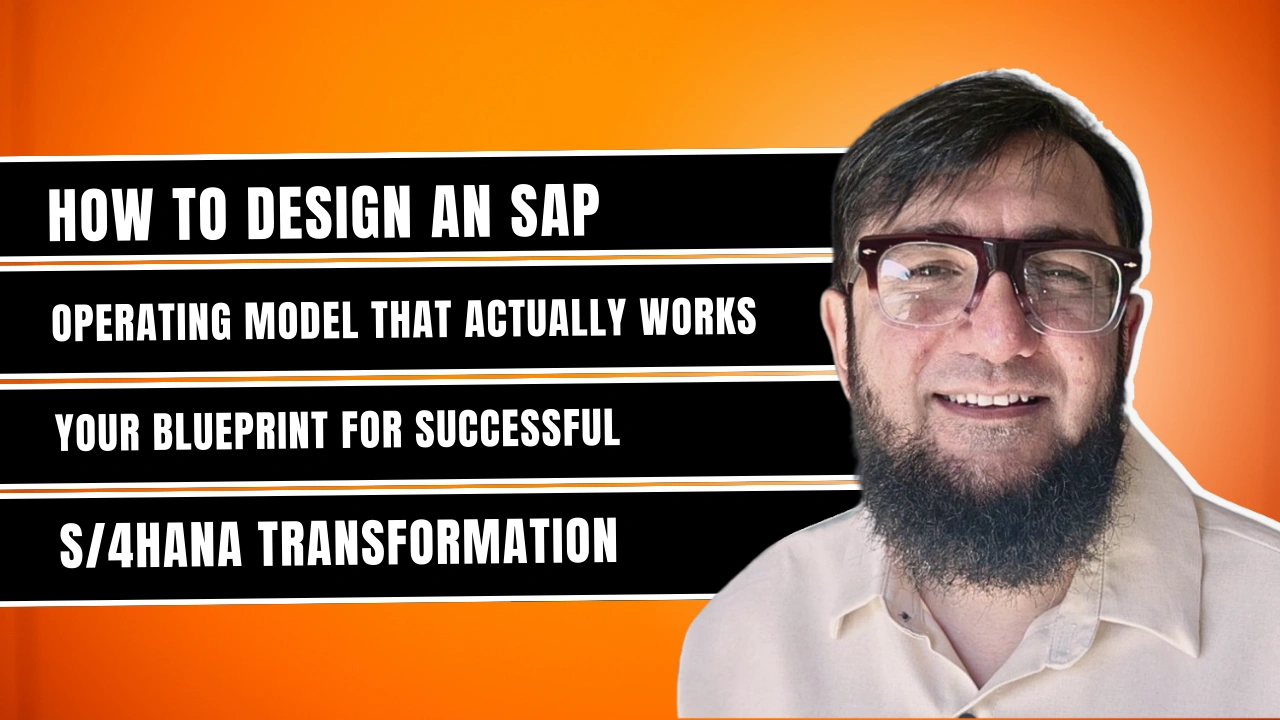
Enterprise transformations are seldom ever exclusively about technology; it’s also about people, process, and governance. However, too many businesses begin their S/4HANA conversion without a clear SAP Operating Model Design in place.
The result? Distorted roles, duplicated efforts, ballooning costs, and delays that need not have happened.
A successful S/4HANA transformation depends less on the technology than on who owns decisions, how processes are governed, and whether change actually sticks with the people using the system.
Skip that design work, and even a technically flawless migration produces distorted roles, duplicated effort, and costs that keep climbing after go-live.
SAP Operating Model Design is the blueprint that prevents this — it defines how people, process, and technology align so the transformation delivers business value, not just a working system.
For CIOs and transformation leads, getting this right is what separates a migration that pays off from one that quietly underdelivers for years.
S/4HANA Operating Model Design
Designing a functional SAP operating model for S/4HANA transformations requires establishing clear governance structures across business and IT domains before executing technical migrations. Rather than focusing solely on system configuration, enterprise frameworks must define decision rights, process ownership, and standard governance archetypes—such as centre-led or hybrid models—to maintain operational agility while enforcing core platform standards.
Operating model alignment directly impacts clean core initiatives by standardising master data, establishing Fit-to-Standard process governance, and regulating custom extensions across cloud and on-premises deployments. Integrating formal organisational change management into the operating framework ensures sustained user adoption, minimizes post-go-live hypercare dependencies, and secures long-term return on ERP investment.
What Is SAP Operating Model Design and Why Should You Care?
For this reason, at the heart of it, SAP Operating Model Design is how your organization structures elements of SAP systems, Moreover who governs these, and what they do in order to realize value.
SAP Operating Model Design plays a critical role in successful S/4HANA transformations. Furthermore, it raises important questions such as:
- What is owned where in the SAP landscape?
- What can be done about SAP optimization, standardization, and automation?
- What system of governance best drives adherence, control, and velocity?
- How do IT teams and business teams work well together?
Even a technically successful S/4HANA project won’t deliver ROI without an operating model.
As a next step, executive leaders must look beyond the migration project, as the operating model is an engine that keeps the wheels turning to enable transformation, scalability, and risk reduction.
Critical Success Factors of a Strategic SAP Operating Model
Therefore, creating a model that works is not just theory; it’s what happens when strategy meets execution. Here are the principles that every enterprise leader should be thinking about:
Align with Business Strategy
- Ask yourself: What are we valuing here: efficiency, innovation, or agility?
- How easily can SAP drive growth, lower costs, or make better decisions?
Example:
A multinational manufacturing company aligned its operational model, additionally with its digital supply chain strategy, standardizing processes globally while maintaining local flexibility. The result: faster planning iterations and less operational overhead.
Define Clear Roles and Governance
Even so Ambiguity kills efficiency. On the other hand, an effective SAP Operating Model Design is well-defined in the following criteria:
- SAP owners and decision rights
- Centralized vs. decentralized IT responsibilities
- Compliance, risk, and quality governance policies
Example:
For example, a multinational consumer goods company implemented “center-led” governance. In other words, Central IT shields S/4HANA Core standards, and regional teams enable individual local needs consistency without losing agility.
Optimize Processes Before Automating
A typical pitfall is to automate a broken process. To put it simply, Plot and dissect the end-to-end workflows before infusing S/4HANA functionalities. Focus on:
- Eliminating redundant approvals
- Standardizing master data and reporting
- Streamlining cross-functional processes
Eventually, this method simplifies the design, enhances system usage, and increases the benefit of automation.
Integrate Change Management
Transformation initiatives are made or broken by people. A robust operating model integrates change management:
- Clearly communicate roles and responsibilities
- Educate users and management about process modifications
- Create feedback mechanisms for continuous improvement
Example:
A leading logistics company placed change champions in each business group to drive adoption of S/4HANA best practices, actively countering resistance.
Embed Continuous Improvement and Scalability
Your SAP operating model should never be static. Embed ways to monitor, improve, and scale:
- Regularly review process performance
- Monitor system usage and compliance
- Update roles, governance, and workflows in response to changing business conditions
Above all, organizations that treat their operating model as a living framework gain an advantage, especially in rapidly evolving markets. For more insights read our blog on SAP Event Mesh
Common Operating Model Structures
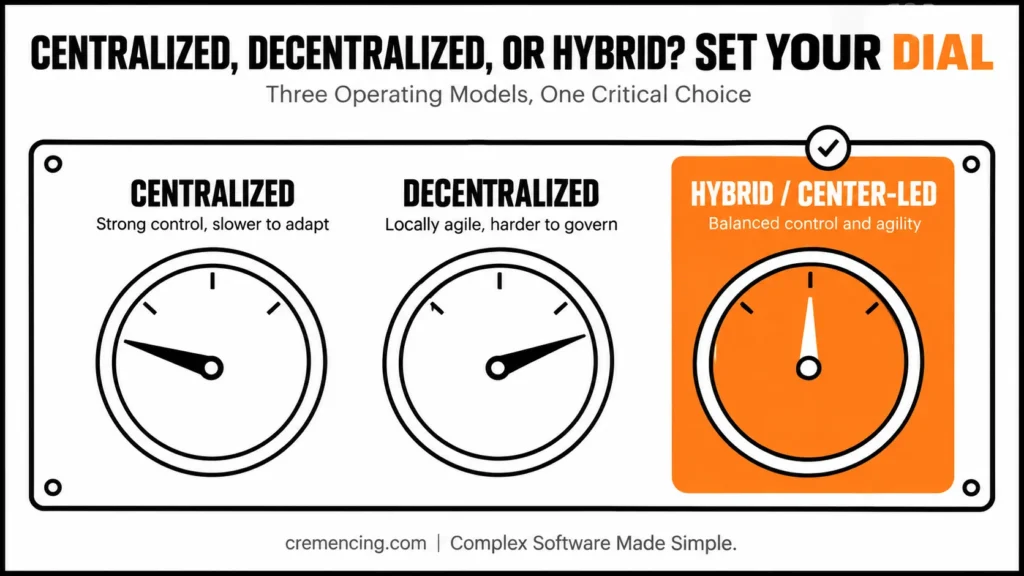
As a result, no two companies are the same, but generally speaking, three operating model archetypes emerge from SAP transformations:
| Model Type | Description | Pros | Cons |
| Centralized | IT and SAP procedures are directed from one center | Strong control, consistency, easier governance | Might be slow to respond to local needs |
| Decentralized | SAP business processes are managed by the business units themselves | Agile, responsive to local requirements | Potential for duplication, discrepancies, and increased cost |
| Hybrid / Center-Led | Centralizes core processes; local teams carry out regional needs | Balance of control and agility | Requires careful governance and coordination |
The choice of structure is crucial — it will determine efficiency, compliance, and speed of innovation.
Creating Your SAP Operating Model
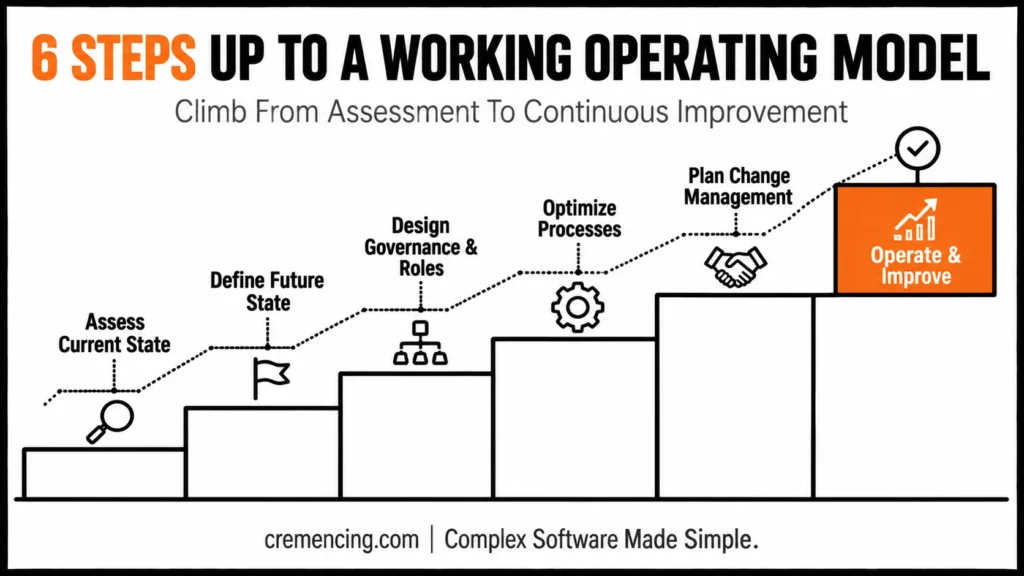
- Current State Assessment: mapping of SAP process, role & governance. Introduce pain points, bottlenecks, and threats.
- Definition (Future State): Createan operating model as the destination based on business strategy and transformation objectives.
- Design Governance & Roles: Determine decision rights, sign-off rules, and accountability.
- Optimize Processes: Standardize processes and optimize them before automating.
- Plan Change Management: Align strategies for adoption among your users, business units, and executives.
- Operate & Observe: Start small with your model, measure KPIs, and improve in iterative cycles.
Implement this roadmap, and your SAP Operating Model Design will be realizable, supportable, and provide value to the business.
Executive Insights: Why Businesses Benefit From a Good Operating Model
- Lower Cost & Simpler: No need to develop multiple work-arounds; lower system maintenance
- Increased Decisiveness: Defined roles and governance lead to faster approvals and fewer bottlenecks
- Better Compliance & Risk Management: Standardized policies and workflows reduce regulatory and operational risk
- Higher Adoption & Engagement: Users know what is expected, leading to higher satisfaction
- Growth: Scalable model supports expansion, mergers, and new digital initiatives
Leaders who prioritize operating model design achieve better ROI and faster time to value of strategic goals from S/4HANA initiatives.
Bridging Theory and Practice
Example:
A global retailer experienced delayed reporting due to inconsistent master data in different regions. Through a centralized operating model:
- Centralized core data governance
- Assigned local operational responsibilities to regional teams
- Established KPIs for system utilization and process productivity
Results: 30% faster month-end closing, improved data quality, and more collaboration between IT and business.
SAP Operating Model Design is not a soft concept — it drives real business outcomes.
SAP Operating Model Design Checklist
- Business strategy alignment confirmed before technical design begins
- Roles, decision rights, and governance model clearly defined
- Processes standardized before automation
- Change management plan integrated, not bolted on afterward
- Review cadence established (annual or trigger-based)
Common Pitfalls to Avoid
- Skipping process tuning and automating bad processes
- Ignoring change management results in low adoption
- Overcomplicating governance, creating bottlenecks
- Overlooking scalability, producing a one-size-fits-all model
Addressing these pitfalls avoids the operating model from becoming an albatross for the organization.
Final Thought:
SAP Operating Model Design isn’t a document you finish before go-live — it’s the ongoing discipline that determines whether your S/4HANA investment keeps paying off or slowly drifts back into the ambiguity it was meant to fix.
Start with an honest current-state assessment, define governance before you automate anything, and build change management in from day one rather than bolting it on afterward.
The organizations that treat this as a living framework — reviewed and adjusted as the business changes — are the ones who turn a technical migration into a lasting business advantage.
FAQs:
Q1: What do you mean by an SAP operating model?
Essentially, it’s a model describing how an organization organizes its SAP systems, processes, and governance structures to deliver value.
Q2: Why should we care about SAP operating model design in S/4HANA transformations?
Without it, however, companies face inefficiency, low adoption, high costs, and business misalignment. Therefore, getting this right early on becomes critical to long-term success.
Q3: How do I select the appropriate operating model structure?
To begin with, consider your business objectives, compliance demands, and company culture. Depending on your priorities, centralized, decentralized, or hybrid methods can then be used.
Q4: How does change management factor into the design of an operating model?
Fundamentally, change management enables users and leaders to understand why and how they operate under new processes and responsibilities. As a result, this accelerates ROI and minimizes resistance.
Q5: What is the cycle time for an SAP operating model?
Ideally, regular check-ins should occur — at least annually or whenever a significant business shift occurs — to validate scale, alignment, and ensure continuous improvements.
Q6: Can a poorly designed operating model undo the benefits of a successful S/4HANA migration?
Yes — in fact, even a technically flawless migration can fail to deliver ROI without proper governance and role clarity. Consequently, the operating model matters just as much as the technical rollout itself.
Q7: Which operating model structure works best for global organizations with regional differences?
Typically, a hybrid or center-led model works best in this scenario, since it centralizes core standards while still allowing regional teams the flexibility to address local needs. This way, organizations gain both consistency and agility.
Q8: Should process optimization happen before or after implementing S/4HANA automation?
Definitely before — otherwise, automating a broken process only make inefficiencies faster rather than fixing them. Thus, standardizing and streamlining workflows first ensures automation actually adds value.
Q9: What role does governance play in an SAP operating model?
Governance, essentially, defines decision rights, accountability, and compliance policies across the organization. Without clear governance, teams often experience ambiguity, bottlenecks, and inconsistent adherence to standards.
Q10: How can organizations measure whether their SAP operating model is actually working?
Generally, this is measured through KPIs such as system usage, process efficiency, compliance rates, and user adoption. Over time, tracking these metrics helps leaders identify where the model needs refinement.