

The ASAP methodology helped SAP implementation teams manage complex ERP projects through structured phases, documented business requirements, and clearly defined delivery milestones. However, modern SAP S/4HANA projects increasingly rely on a different approach to designing and implementing business processes.
SAP Activate methodology introduces SAP Best Practices, fit-to-standard workshops, iterative configuration, and continuous testing within a structured implementation framework. Instead of beginning with extensive documentation of every existing process, implementation teams evaluate standard SAP functionality before deciding what needs to change.
For SAP consultants, project managers, and enterprise architects, this transition involves more than replacing one methodology name with another.
It changes how business requirements are evaluated, how technical extensions are approved, and how project teams prepare for production deployment.
Moreover, understanding the distinction helps organizations retain useful project controls while adopting implementation practices suited to contemporary SAP environments.
This article examines ASAP methodology, the six SAP Activate phases, their differences, and the practical considerations involved in moving from traditional ERP implementation to SAP S/4HANA.
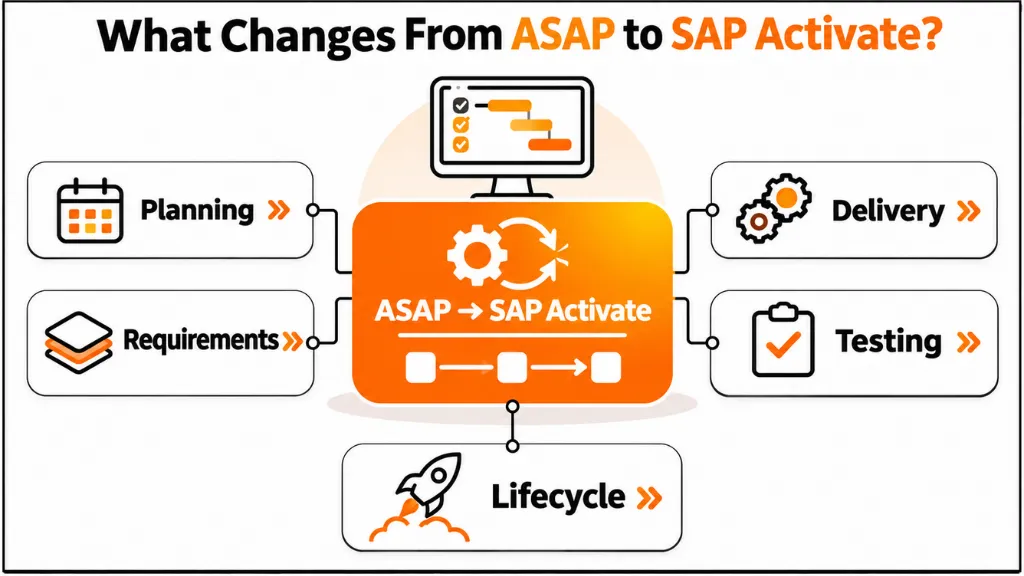
Quick Answer: ASAP Methodology vs SAP Activate
ASAP methodology is a traditional SAP implementation framework organized into five phases: Project Preparation, Business Blueprint, Realization, Final Preparation, and Go-Live and Support.
SAP Activate, meanwhile, uses six phases: Discover, Prepare, Explore, Realize, Deploy, and Run.
The central difference is the approach to solution design. ASAP commonly emphasizes blueprint-driven requirements, whereas SAP Activate begins with SAP Best Practices and fit-to-standard workshops.
Additionally, SAP Activate supports iterative realization, continuous validation, and ongoing operational improvement.
What Is ASAP Methodology in SAP?
ASAP stands for Accelerated SAP, a methodology originally developed to support structured implementations of SAP ERP systems.
Its purpose was to organize implementation work into defined activities, deliverables, and project milestones.
The methodology provided implementation accelerators, including templates, questionnaires, and predefined scenarios.
These resources helped project teams collect requirements, define business processes, configure SAP applications, and prepare for production deployment.
Furthermore, ASAP established a structured approach to controlling implementation scope and project responsibilities.
It became widely associated with traditional SAP ERP environments, including SAP R/3 and SAP ECC.
The Five Phases of ASAP Methodology
The ASAP implementation lifecycle traditionally consists of five major phases.
1. Project Preparation
Project Preparation establishes the initial direction of an SAP implementation.
During this phase, the organization defines project objectives, scope, governance, resources, and implementation schedules.
Business stakeholders also agree on responsibilities and expectations before detailed solution design begins.
Consequently, the project team develops an initial framework for coordinating implementation activities.
2. Business Blueprint
The Business Blueprint phase focuses on understanding and documenting business requirements.
Functional consultants work with business representatives to identify processes, operating procedures, and system requirements.
The resulting Business Blueprint describes how the proposed SAP environment should support organizational activities.
Furthermore, the approved documentation guides subsequent configuration and development work.
However, extensive upfront documentation can create challenges when differences between proposed processes and actual system functionality become visible later.
3. Realization
During Realization, functional and technical teams configure the SAP system according to approved requirements.
This phase includes application configuration, custom development, integration activities, and testing.
Developers and consultants work together to translate the documented solution into operational functionality.
Meanwhile, identified problems require correction before the project can proceed toward production preparation.
4. Final Preparation
Final Preparation focuses on activities required before production deployment.
These include user training, integration testing, data migration preparation, and cutover planning.
Additionally, project teams address unresolved implementation issues and confirm organizational readiness.
The objective is to ensure that technical and business activities can support the planned production transition.
5. Go-Live and Support
During Go-Live, the organization begins using its SAP system for productive business transactions.
Support teams monitor operations and resolve problems identified during the initial production period.
Furthermore, post-implementation assistance helps business users adapt to the new environment.
This phase concludes the traditional ASAP implementation structure while establishing the basis for ongoing operational support.
What Is SAP Activate Methodology in SAP?
SAP Activate methodology is SAP’s implementation framework for modern SAP solutions, particularly SAP S/4HANA.
It combines predefined implementation content, configuration guidance, and structured project delivery.
Unlike the traditional ASAP approach, SAP Activate supports cloud, on-premises, and hybrid deployment scenarios.
Furthermore, its implementation practices emphasize SAP standard business processes and iterative validation.
The framework contains phases, workstreams, tasks, deliverables, and supporting implementation artifacts.
The Three Core Pillars of SAP Activate
1. SAP Best Practices
SAP Best Practices provide predefined business process content designed for SAP solutions.
For SAP S/4HANA, the content includes ready-to-run transactional and analytical processes.
Consequently, implementation teams can begin with existing standard capabilities rather than designing every process from the beginning.
2. Guided Configuration
Guided configuration supports the setup and adjustment of relevant application functionality.
The original SAP Activate framework included guided configuration capabilities accessed through SAP Fiori-based tools.
These tools were intended to help business and technical teams coordinate configuration activities.
3. SAP Activate Methodology
The methodology provides the implementation structure through defined phases, tasks, workstreams, and deliverables.
It supports project planning, requirements evaluation, configuration, testing, deployment, and ongoing operations.
Together, these three elements establish a framework for implementing SAP solutions while encouraging greater use of standard functionality.
ASAP Methodology vs SAP Activate: Key Differences
Although both methodologies support structured SAP implementation, they differ in how teams approach requirements, configuration, and project delivery.
ASAP projects commonly begin by defining business processes through detailed blueprint documentation.
SAP Activate, however, starts by evaluating existing SAP Best Practices against the organization’s requirements.
Table 1: ASAP Methodology vs SAP Activate Comparison
| Comparison Area | ASAP Methodology | SAP Activate |
| Main approach | Blueprint-led implementation | Fit-to-standard and iterative implementation |
| Implementation phases | Five phases | Six phases |
| Requirements | Detailed Business Blueprint | Fit-to-standard workshops |
| Solution design | Requirements-driven configuration | Standard-process-first evaluation |
| Development | Often sequential delivery | Iterative realization |
| Testing | Major testing activities at defined milestones | Testing during implementation iterations |
| Main environment | Traditional SAP ERP | SAP S/4HANA and modern SAP solutions |
| Lifecycle | Implementation and post-go-live support | Implementation, deployment, and Run-phase operations |
These distinctions describe common implementation patterns. ASAP projects could use iterative activities, and SAP Activate still requires documentation and formal approvals.
Why ASAP Methodology and SAP Activate Differ
The most important distinction is not simply the number of phases.
Instead, it is how implementation teams decide whether existing SAP functionality satisfies business requirements.
With ASAP, teams commonly document a proposed solution before configuring the system.
SAP Activate encourages teams to demonstrate standard processes, identify differences, and determine which changes are genuinely necessary.
Therefore, the methodology changes the starting point for implementation decisions.
The Six Phases of SAP Activate Methodology
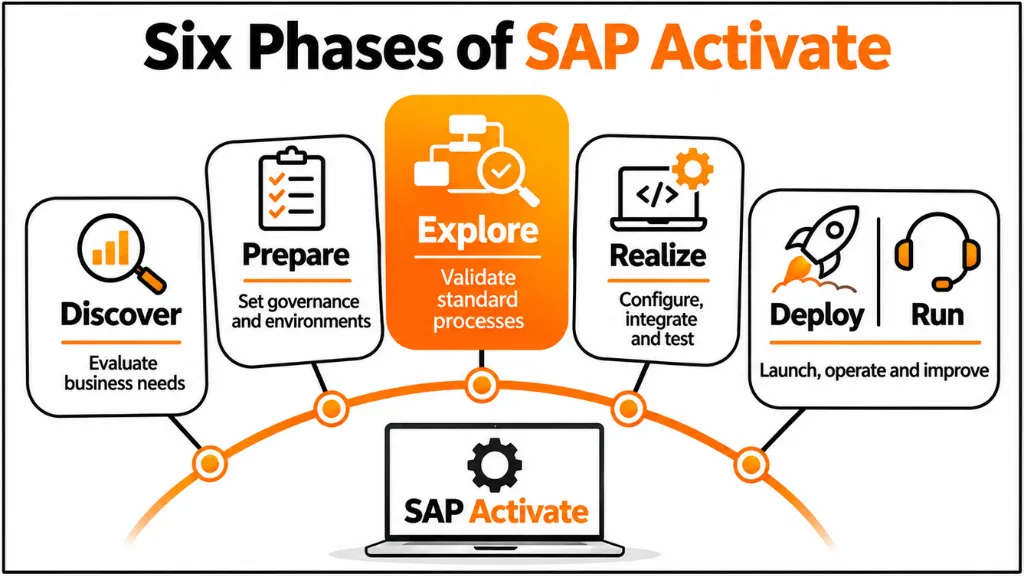
SAP Activate follows six phases: Discover, Prepare, Explore, Realize, Deploy, and Run.
Each phase supports a specific part of the implementation lifecycle.
1. Discover: Evaluate Business Requirements and SAP Solutions
The Discover phase begins with an assessment of the organization’s business needs.
Project stakeholders examine available SAP solutions, potential deployment models, and expected business outcomes.
Additionally, the organization considers whether the proposed solution aligns with its operational requirements.
The objective is to establish an informed direction before committing to detailed implementation activities.
2. Prepare: Establish Project Governance
During Prepare, project teams define implementation responsibilities, governance arrangements, and delivery plans.
They also identify relevant resources and establish the procedures used to coordinate project work.
Furthermore, planning activities may cover integration, data migration, testing, and implementation environments.
Clear ownership during this phase helps prevent unresolved decisions from affecting later project activities.
3. Explore: Perform Fit-to-Standard Analysis
Explore is one of the most important phases in SAP Activate.
Consultants demonstrate standard SAP processes and work with business representatives to evaluate their suitability.
The project team identifies configuration requirements, process differences, integration needs, and potential extensions.
These requirements are then recorded in the implementation backlog.
Consequently, the project develops its design around validated business needs rather than automatically reproducing all legacy processes.
4. Realize: Configure, Develop, and Test
During Realize, the implementation team completes configuration and development activities based on the approved backlog.
SAP Activate supports iterative implementation through planned development activities and regular validation.
Business users review functionality as it becomes available.
Furthermore, developers perform relevant testing and integration activities during implementation.
The phase also includes broader integration and user acceptance testing before the project advances toward deployment.
5. Deploy: Complete Cutover and Go-Live
Deploy focuses on preparing the production environment and confirming business readiness.
Activities include final migration preparation, operational checks, user training, and cutover execution.
Additionally, teams establish support arrangements and verify that critical business processes operate as expected.
The production launch should follow the project’s defined acceptance and approval criteria.
6. Run: Operate and Improve the SAP Environment
The Run phase covers productive operation after the implementation.
Application owners and support teams monitor the environment, address issues, and manage ongoing improvements.
Meanwhile, organizations continue reviewing operational requirements and system performance.
Unlike an implementation approach focused mainly on the initial go-live, SAP Activate explicitly includes continued operations in its lifecycle structure.
Why Fit-to-Standard Workshops Replace Traditional Blueprint Thinking
The transition from ASAP to SAP Activate changes how business requirements are examined.
Traditionally, the Business Blueprint documented the future SAP environment before extensive configuration began.
SAP Activate instead uses fit-to-standard workshops to evaluate predefined SAP processes.
How Fit-to-Standard Workshops Work
Consultants demonstrate relevant SAP functionality in an appropriate project environment.
Business representatives then compare the demonstrated process with their operational requirements.
For example, a purchasing workshop may examine purchase requisitions, purchase orders, goods receipts, and supplier invoices.
The team determines whether the standard process meets the business requirement.
If differences exist, participants assess whether supported configuration can address them.
However, requirements that cannot be satisfied through standard functionality may require extension or alternative-design decisions.
Why Standard Processes Come First
Starting with SAP Best Practices helps implementation teams examine functionality already available in the application.
Consequently, organizations can avoid recreating legacy processes without first evaluating standard alternatives.
Nevertheless, fit-to-standard does not mean ignoring mandatory business requirements.
Industry-specific needs, regulatory obligations, and necessary integrations must still be documented and addressed.
Custom Development and Clean-Core Decisions Under SAP Activate
Custom development remains relevant in SAP implementation projects.
However, modern SAP S/4HANA environments place greater emphasis on supported extensibility and upgrade compatibility.
Traditional SAP ERP implementations may contain custom ABAP applications, interfaces, and other modifications created over many years.
Some of these developments depend on application objects that are not available or supported in the target environment.
Evaluating Extensions During Explore
SAP Activate encourages implementation teams to identify extension requirements during solution design.
Architects first determine whether standard SAP functionality or configuration can meet the requirement.
If additional development is necessary, they evaluate the available extension options.
These may include key-user extensibility, developer extensibility, or side-by-side development on SAP Business Technology Platform, depending on the deployment model.
Therefore, selecting an extension approach requires understanding both the business requirement and target SAP environment.
Keeping Business Transactions Under ERP Control
An application extension may perform supporting calculations or retrieve external information.
However, the relevant SAP ERP application should continue enforcing its own transaction rules and authorizations.
For example, a separately developed supplier-risk service could provide information to SAP S/4HANA through a supported interface.
The ERP system would remain responsible for the applicable purchasing controls.
This separation supports clearer application responsibilities, although it introduces integration and operational dependencies.
Testing, Data Migration, and Cutover Under SAP Activate
Moving from ASAP to SAP Activate does not eliminate the need for controlled testing or production preparation.
Instead, implementation teams are encouraged to validate functionality regularly during Realize.
Continuous Testing During Implementation
Traditional SAP projects often scheduled major testing activities around implementation milestones.
SAP Activate supports testing throughout iterative development.
Furthermore, business representatives can review configured functionality before final project acceptance.
However, frequent testing alone does not guarantee that complete business processes work correctly.
Teams must validate application behavior and expected business outcomes.
Integration Testing and Transaction Accuracy
Technical connectivity does not automatically prove that an integrated process is successful.
For example, a warehouse application may exchange messages with SAP S/4HANA while still processing incorrect business information.
Therefore, integration testing should verify the complete transaction flow.
Testing should also consider failed messages, repeated requests, and reconciliation procedures.
Cutover and Go-Live Readiness
Cutover activities prepare the organization to move into productive operations.
Relevant activities include final data migration, operational checks, and confirmation of business readiness.
Moreover, project teams should verify critical processes and define recovery responsibilities.
The go-live decision should follow agreed acceptance criteria rather than depend only on technical deployment completion.
Mapping ASAP Methodology Deliverables to SAP Activate
Organizations transitioning from ASAP may already have established implementation templates and governance procedures.
These documents can remain useful.
However, they should be reviewed against the activities and deliverables of the selected SAP Activate roadmap.
Table 2: ASAP Methodology Deliverables and SAP Activate Mapping
| ASAP Deliverable | SAP Activate Approach | Relevant Phase | Required Decision |
| Project charter and plan | Project governance and planning | Prepare | Confirm scope and responsibilities |
| Business Blueprint | Fit-to-standard outputs | Explore | Document requirements and gaps |
| Functional specification | Configuration and development backlog | Explore / Realize | Confirm business ownership |
| Technical specification | Extension and integration design | Explore / Realize | Validate architecture |
| Integration test scripts | Iterative testing activities | Realize | Verify complete processes |
| Cutover checklist | Deployment and cutover planning | Deploy | Confirm readiness and recovery |
| Post-go-live support plan | Operational transition and support | Deploy / Run | Assign support responsibility |
The exact deliverables and activities depend on the SAP Activate roadmap selected for the implementation.
Retaining ASAP Methodology Governance in SAP Activate
Formal approvals remain important for business, financial, and technical decisions.
However, waiting until all documentation is complete before demonstrating functionality can delay feedback.
SAP Activate supports earlier validation while maintaining appropriate project controls.
For example, business owners can approve process requirements while technical architects review integration designs.
Meanwhile, developers implement and demonstrate approved functionality during Realize.
This approach allows structured governance and iterative delivery to operate together.
Moving from ASAP Methodology to SAP Activate
Organizations already using ASAP may consider adopting SAP Activate practices.
However, changing methodologies requires more than renaming implementation phases.
The project team should evaluate completed work, existing documentation, current project risks, and remaining activities.
Review the Current Implementation Stage
A project still performing requirements analysis may have greater flexibility to adopt fit-to-standard practices.
In contrast, a project approaching production deployment may already have substantial approved configuration and development work.
Therefore, a complete methodology redesign could introduce unnecessary disruption.
Targeted improvements may be more suitable for projects approaching go-live.
Reorganize Requirements Around Business Processes
Existing Business Blueprint documentation may contain useful information about organizational processes.
However, these documents should not automatically require every legacy feature to be recreated.
The implementation team can compare documented requirements with relevant SAP standard processes.
Differences can then be classified as configuration requirements, extension needs, integrations, or organizational changes.
Additionally, each significant decision should have appropriate business ownership.
Preserve Testing and Cutover Controls
Adopting iterative delivery should not weaken production-readiness requirements.
End-to-end testing, data migration reconciliation, and operational support planning remain necessary.
Furthermore, the project team should validate relevant cutover activities and recovery procedures.
The objective is to improve implementation practices without sacrificing established business controls.
ASAP Methodology and SAP Activate: Additional Resources
SAP Activate as the Successor to ASAP
McCoy’s March 29, 2016, article explains the shift from ASAP toward SAP Activate and describes the framework’s three elements: SAP Best Practices, guided configuration, and methodology.
The article also highlights the move from a predominantly blueprint-led approach toward a more agile implementation model.
SAP Community’s Overview of SAP Activate
A June 5, 2023, SAP Community article provides an overview of SAP Activate phases, methodology components, implementation content, and iterative development.
It also explains how fit-to-standard workshops and SAP Best Practices support implementation work.
The supplied materials do not establish a newer methodology release or recent announcement that can be reliably dated here.
Frequently Asked Questions
1. What Is ASAP Methodology in SAP Implementation?
ASAP methodology stands for Accelerated SAP. It is a traditional implementation framework used to organize SAP ERP projects through defined phases, documentation, configuration, testing, and production preparation. The five phases are Project Preparation, Business Blueprint, Realization, Final Preparation, and Go-Live and Support. Furthermore, ASAP includes implementation accelerators such as templates and predefined scenarios. These resources support the identification of business requirements and project activities. SAP Activate has since become the principal implementation methodology for contemporary SAP S/4HANA projects.
2. What is the difference between ASAP methodology and SAP Activate?
The main difference concerns how implementation teams design and deliver SAP solutions. ASAP commonly follows a blueprint-led approach in which requirements are documented before extensive configuration begins. SAP Activate, however, emphasizes SAP Best Practices, fit-to-standard workshops, and iterative realization. ASAP has five traditional phases, while SAP Activate has six. Both methodologies require governance, testing, and production preparation. Nevertheless, SAP Activate places greater emphasis on evaluating standard SAP processes before approving additional development or configuration.
3. Five Phases of the ASAP Methodology
The five traditional ASAP phases are Project Preparation, Business Blueprint, Realization, Final Preparation, and Go-Live and Support. Project Preparation establishes implementation objectives and governance. Business Blueprint documents operational requirements and intended processes. Realization includes system configuration, development, and testing. Meanwhile, Final Preparation addresses training, migration, and cutover activities. Go-Live and Support covers production deployment and initial operational assistance. Together, these phases provide a structured approach to moving from project initiation to a functioning SAP environment.
4. What are the six phases of SAP Activate?
SAP Activate follows six phases: Discover, Prepare, Explore, Realize, Deploy, and Run. Discover evaluates business needs and solution options. Prepare establishes the project organization and implementation plans. Explore uses fit-to-standard workshops to identify requirements and gaps. Realize involves configuration, development, integration, and testing. Subsequently, Deploy prepares the production environment and supports go-live. Run covers ongoing operations, monitoring, and continuous improvement. The exact activities and deliverables depend on the selected SAP product and implementation roadmap.
5. Is SAP Activate an agile methodology?
SAP Activate combines structured implementation phases with iterative delivery practices. In particular, Realize supports developing, demonstrating, and testing functionality through managed iterations. However, SAP Activate is not simply an unrestricted agile development approach. It still requires project planning, governance, requirements management, testing, and production approval. The methodology accommodates different implementation requirements and deployment environments. Consequently, the practical delivery approach depends on the organization’s project scope, business responsibilities, contractual requirements, and selected SAP Activate roadmap.
6. Does SAP Activate replace the Business Blueprint?
SAP Activate replaces the traditional blueprint-centered implementation approach with fit-to-standard evaluation and documented design decisions. During Explore, consultants demonstrate relevant standard SAP processes and compare them with business requirements. Identified gaps, configuration decisions, integrations, and extensions are recorded for subsequent implementation. However, this does not eliminate requirements documentation or technical specifications. Organizations must still maintain appropriate records and approvals. The objective is to assess available functionality before approving additional solutions for requirements that standard processes cannot satisfy.
7. What is a fit-to-standard workshop in SAP Activate?
A fit-to-standard workshop is an implementation activity in which consultants demonstrate standard SAP business processes to business representatives. Participants assess whether the demonstrated functionality meets operational requirements. For example, a purchasing workshop may examine purchase requisitions, purchase orders, goods receipts, and supplier invoices. Furthermore, the project team identifies differences that require configuration, integration, or extension. These decisions become part of the implementation backlog. The purpose is to begin with standard processes while retaining the ability to address legitimate business requirements.
8. Is ASAP methodology still used in SAP implementation projects?
Some organizations may continue using ASAP-derived documents, templates, and project governance procedures, particularly in established SAP ERP environments. However, SAP Activate is the principal methodology associated with contemporary SAP S/4HANA implementations. Existing ASAP materials do not necessarily need to be discarded. Instead, organizations can review useful deliverables and map them to relevant SAP Activate activities. This approach preserves established project knowledge while allowing teams to adopt fit-to-standard analysis, iterative implementation, and structured operational transition.
9. What is the role of testing and cutover in SAP Activate?
Testing and cutover remain essential components of SAP Activate implementation. During Realize, teams perform configuration and development testing, integration validation, and user acceptance activities. Furthermore, they verify that applications support intended business outcomes rather than merely exchanging technical messages. Deploy includes production preparation, migration activities, training, and cutover execution. Teams must also establish support arrangements and confirm operational readiness. The transition to an iterative methodology does not remove the need for formal acceptance criteria or business approval.
10. Can an existing ASAP implementation project move to SAP Activate?
An existing ASAP project can adopt SAP Activate practices, but the transition requires careful assessment. The team should review completed work, existing requirements, configuration decisions, and remaining project activities. Projects in early design stages may have more flexibility to introduce fit-to-standard workshops. Meanwhile, projects approaching go-live may benefit from targeted improvements rather than a complete methodology redesign. The organization should preserve essential governance, testing, and cutover controls while aligning remaining activities with an appropriate SAP Activate approach.
Conclusion
Moving from ASAP methodology to SAP Activate represents an important change in SAP implementation practices.
ASAP provided a structured framework centered on detailed requirements documentation, configuration, and defined project milestones.
SAP Activate builds on structured implementation management while emphasizing SAP Best Practices, fit-to-standard workshops, and iterative delivery.
Furthermore, its six-phase lifecycle extends through deployment into ongoing operational improvement.
However, the transition does not eliminate the importance of business documentation, testing, governance, and production readiness.
For organizations modernizing SAP ERP environments, the key is to retain useful implementation controls while evaluating standard SAP capabilities before introducing unnecessary customization.
References
- SAP Community. ASAP Methodology Implementation? and Activate Methodology. September 1, 2022.
- McCoy. Simplifying and Speeding Up SAP Implementations with SAP Activate. March 29, 2016.
- SAP Community. Short Overview on SAP ACTIVATE Methodology. June 5, 2023.
- Supplied research draft. Still Following SAP ASAP Methodology? What Changes When You Move to SAP Activate?
- SAP. SAP Activate Methodology.
- SAP Learning. Discovering SAP Activate: Implementation Tools and Methodology.