

You were hoping for more multiple-choice questions. You have to instead defend an Architecture to an AI stakeholder. The SAP Solution Architect Certification has changed for 2026 — and the biggest shift is the new practical exam. If you’re weighing whether to invest your time and money into it, this guide breaks down what the exam actually tests, how it differs from previous versions, and whether it’s genuinely worth pursuing for your career.
In this article, you’ll learn about SAP BTP in landscapes that are integrated with ECC 6.0 and SAP S/4HANA, how to prepare for the practical exam, at what cost, where it has value in your career, and when experience outweighs the badge.
Rising Enterprise Demand for Applied Cloud Architecture
Recent industry analyses show that active SAP S/4HANA migrations increased sharply to 40% of enterprises. Meanwhile, 58% of organizations now adopt private cloud architectures to manage modern enterprise workloads. Consequently, SAP architectural roles continue to expand year-over-year as enterprises actively prioritize applied integration capabilities. Industry data further indicates that vendor-certified SAP experts earn a 15% to 30% premium over non-certified peers.
Is the SAP Solution Architect Certification Worth It?
The SAP Solution Architect Certification is worth it when you already work with SAP BTP, design integrations or extensions, or need vendor-backed proof for a consulting or architecture role.
It is not a shortcut into architecture. Beginners without delivery experience may pass the assessment yet still struggle to make safe design decisions on a live SAP program.
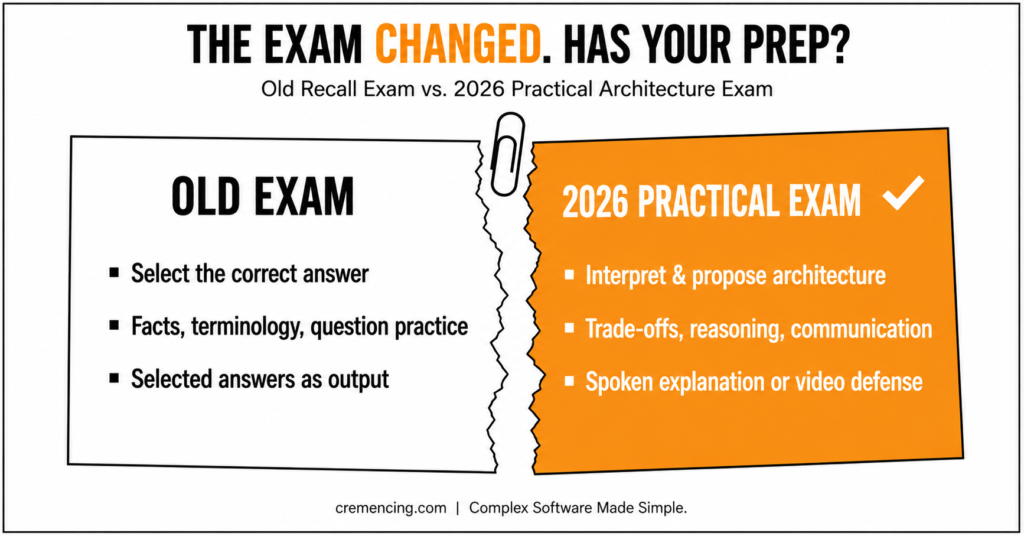
SAP Solution Architect Certification: Old Exam vs. 2026 Practical Exam
The SAP Solution Architect Certification practical format redefines the meaning of prepared. With a traditional knowledge-based exam, students may spend a lot of time reading about all of the product capabilities, the terms, the limits on the services, and sample questions.
The preparation is still important, but it is followed by a second skill: using the facts in an architecture and justifying the result.
SAP describes its newer assessments as performance-based and open book. Depending on the certification, candidates may complete tasks in a system simulation or respond to a scenario through an AI-supported roleplay or a video evaluated by an SAP expert.
For the SAP BTP architect pathway, candidate reports describe receiving a business requirement, creating a solution direction, and presenting or defending it as though speaking to a stakeholder.
| Feature | Old knowledge-focused approach | 2026 practical approach |
| Core task | Select the correct answer from defined options | Interpret a requirement and propose an architecture |
| Preparation focus | Facts, terminology, service capabilities, and question practice | Architecture reasoning, service selection, trade-offs, and communication |
| Use of resources | Usually limited by the previous exam model | Open-book access to approved documentation and learning resources |
| Candidate output | Selected answers | Spoken explanation, scenario response, or submitted video |
| Main risk | Forgetting a fact or misreading an option | Producing an incomplete design or failing to justify decisions |
| Best preparation | Topic review and practice questions | Scenario drills, architecture diagrams, timed explanations, and documentation lookup |
| Evidence of skill | Demonstrates knowledge of tested topics | Demonstrates applied reasoning under assessment constraints |
| Value to employers | Baseline validation | Potentially stronger signal when paired with project experience |
Why SAP Solution Architect Certification Beats Exam Dumps
The strongest improvement in the SAP Solution Architect Certification is relevance. A solution architect rarely receives four possible answers in a real workshop. The architect receives incomplete requirements, conflicting priorities, integration constraints, security concerns, budget pressure, and stakeholders who want a simple recommendation. The practical exam moves closer to that working pattern.
The SAP Solution Architect Certification format also reduces the value of old exam dumps. A copied answer can identify a service, but it cannot reliably explain why that service fits a particular data-residency requirement, failure model, identity design, or clean-core strategy.
Candidates must connect platform knowledge to business and technical consequences. That does not make the assessment a perfect measure of architecture ability. A short scenario cannot reproduce months of discovery, governance, testing, commercial negotiation, and operational support.
It samples how you frame problems, choose components, explain trade-offs, and respond under pressure. The SAP Solution Architect Certification practical exam also tests communication. A candidate may understand the architecture but present it badly, while another may speak confidently and leave security, operational, or integration gaps.
Preparation must cover technical quality and explanation structure. One caution matters before purchasing. SAP’s public certification pages have been transitioning, and the research found that practical-exam help pages describe newer assessments as non-proctored, while some Training Shop pages still contain older remote-proctoring language.
Check the individual SAP Solution Architect Certification product page, delivery method, permitted resources, and current exam code on the day you buy.
The Old SAP Solution Architect Certification Approach and Its Limits
The older SAP Solution Architect Certification preparation pattern rewarded broad product recall. Candidates reviewed SAP BTP services, memorized which capability belonged to which area, learned common architecture terms, and worked through multiple-choice questions.
For experienced consultants, this created a useful revision framework. For less experienced candidates, it sometimes created the appearance of competence without requiring them to build a defensible solution.
That gap matters in SAP architecture. Knowing that SAP Integration Suite provides integration capabilities does not prove that you can select an integration style, define error handling, identify monitoring ownership, control credentials, or separate synchronous from asynchronous flows.
Knowing that SAP BTP supports side-by-side extensions does not prove that you can protect the ERP core from unnecessary customisation. The old SAP Solution Architect Certification approach also made weak preparation strategies look productive. Candidates could count completed questions, memorised definitions, or mock-exam scores.
Those numbers felt precise, but they did not always reveal whether the candidate could explain why one design was safer than another. Question banks remain useful for checking factual gaps. They help confirm whether you understand service names, responsibility boundaries, account structures, security concepts, data services, analytics options, and integration capabilities.
The mistake is treating those questions as the complete preparation plan.
SAP Solution Architect Certification: Answer Structure
The SAP Solution Architect Certification now asks for a different level of synthesis. You must identify the business objective, separate mandatory requirements from preferences, detect missing information, and create a design that can survive reasonable challenge.This is closer to a design review than a recall test.
The old SAP Solution Architect Certification approach felt more predictable because each question had a defined response. The scenario assessment leaves candidates uncertain about detail, assumptions, and AI interpretation.
Public guidance explains the process but not every scoring rule or weighting.This uncertainty does not automatically make the practical exam unfair. Architecture itself contains uncertainty. The better response is to prepare a repeatable answer structure rather than attempting to guess a hidden script.
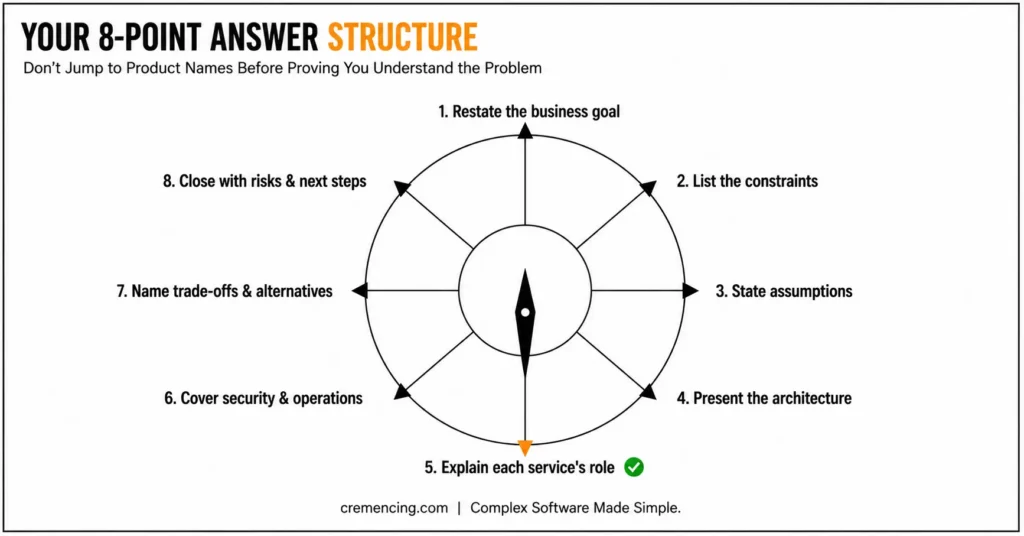
Use this sequence:
- Restate the business goal.
- List the important constraints.
- State your assumptions.
- Present the proposed architecture.
- Explain why each major SAP BTP service is present.
- Cover identity, security, integration, data, operations, and lifecycle management.
- Name the main trade-offs and alternatives.
- Close with risks, open questions, and next steps.
That structure prevents the most common failure: jumping directly into product names before proving that you understand the problem. Before you decide whether the practical exam is worth the investment, it helps to know the core skills every SAP Solution Architect needs — since certification only matters if it’s backed by real capability.
How the New SAP Solution Architect Certification Practical Exam Works
The practical SAP solution architect certification assessment focuses on applied architecture. SAP’s current guidance describes performance-based exams as open book and supports scenario-based assessment through an AI roleplay or, where offered, a video submitted for expert review.
Candidate reports for the SAP BTP pathway describe being given a business need and then explaining or defending a proposed solution to an AI stakeholder.
The SAP Solution Architect Certification is not easy. It shifts the bottleneck to memory retrieval and judgment. While allowed to use documentation, there are still things to know about what to look for, what to believe and how the information relates to the architecture.
Anything stated on a product page during assessment should not be a substitute for prior knowledge of the account models, connectivity, identity, extension patterns, integration, data handling and operations.
A SAP Solution Architect Certification response starts with requirements, not SAP service names. Now imagine that a company wants to expand an order process for external distributors, which is based on SAP S/4HANA.
Does not explain the flow for weak candidates: SAP Build, SAP Integration Suite, SAP HANA Cloud, and SAP Cloud Identity Services.
SAP Solution Architect Certification: Choosing the Architecture
A better candidate will ask himself, “Who is using the data? Where is the master data stored? What needs real-time confirmation? Which data can be exported from the ERP system, who will be responsible for monitoring, and who will be responsible for retries if something goes wrong?
The next step is to select the architecture. The candidate may suggest a side-by-side extension on SAP BTP for the clean core; utilize released APIs of SAP S/4HANA; deploy integration logic in SAP Integration Suite; and implement an identity design that separates workforce users from external users.
This depends on the scenario. Value is not about creating the longest service list, it’s about linking components to requirements. You should also explain what you rejected. If an event-driven pattern adds unnecessary complexity for a low-volume synchronous requirement, say so.
However, if direct point-to-point integration creates monitoring and lifecycle problems, explain why an integration layer is preferable. If storing replicated data in SAP HANA Cloud is unnecessary, keep the data in the source and access it through an appropriate service.
The SAP Solution Architect Certification practical exam appears to test six capabilities at once.
Requirement interpretation
Can you turn business language into architecture concerns without inventing unsupported needs?
The candidate must separate stated requirements from personal assumptions. Where information is missing, identify the gap and explain the assumption used to continue the design.
SAP BTP service knowledge
Do you understand what the proposed services do, where they run, and how they interact?
Simply naming SAP services does not prove architectural understanding. Every selected service needs a role within the proposed solution.
Trade-off analysis
Can you compare alternatives rather than presenting one design as automatically correct?
A strong architect explains why one option fits the requirement better and acknowledges where the chosen approach adds cost, dependency, operational effort, or technical limitations.
Security and governance
Do you address identity, authorisation, connectivity, data protection, auditability, ownership, and lifecycle controls?
A proposal that explains business functionality but ignores security is incomplete, especially where external users, cloud connectivity, or sensitive data are involved.
Communication
Can you explain the design in language appropriate for a stakeholder rather than hiding behind product vocabulary?
The examiner needs to understand the proposed outcome, not only the names of the SAP services.
Operational thinking
Do you cover monitoring, error handling, support boundaries, recovery, transport, change control, and cost awareness?
A design that works only during a successful demonstration is not enough. The architecture must explain how teams operate and support it after go-live.
SAP Solution Architect Certification: AI Roleplay & Validity
The SAP Solution Architect Certification AI roleplay can be useful because it introduces follow-up pressure. Real stakeholders do not simply accept a diagram.
They ask why a service is needed, whether the design works with existing systems, what happens during failure, how the company avoids unnecessary dependency, and who supports the solution after go-live.
Candidates may prefer the human-reviewed video option where available because it allows a prepared presentation format. That option still carries risk: the submission must meet the required format, communicate the design clearly, and upload successfully.
SAP says expert evaluation may take up to ten business days, while AI-supported responses may receive automated evaluation more quickly.
A reported SAP Community case described a candidate facing an upload or network problem and receiving an unsuccessful result. One report does not establish a widespread defect, but it supports a sensible rule: test your browser, microphone, camera, network stability, upload path, power supply, and backup connectivity before starting.
The SAP Solution Architect Certification credential remains time-bound. The research found that successful candidates receive a digital badge valid for 12 months and may need annual stay-certified activity to keep it current.
SAP also limits attempts for a certification and applies a waiting period after repeated failures, so candidates should confirm the latest rules before booking.
SAP Solution Architect Certification Migration Checklist
Treat the SAP Solution Architect Certification change as a preparation migration, not a minor exam update.
1. Confirm the exact credential
Search results for SAP Solution Architect Certification may lead to several architecture pathways. Confirm that your target is the SAP BTP Solution Architect credential, verify the current code, and read the individual assessment page before purchasing.
The practical exam discussed here is not a universal examination for every SAP architect role.
2. Map the official learning journey
The SAP BTP Solution Architect learning journey covers architecture, application development, automation, integration, data, analytics, AI services, and platform foundations.
For SAP Solution Architect Certification preparation, turn each area into an architecture capability, not a memorisation list. Ask what requirement it solves, what dependency it creates, and what alternative you would consider.
3. Build a scenario library
For SAP Solution Architect Certification practice, create eight scenarios:
- Clean-core extension
- External partner portal
- Legacy-system integration
- Event-driven business process
- Enterprise analytics requirement
- Workflow automation
- Cloud data service
- AI-enabled business process
For each scenario, prepare a one-page architecture, assumptions, trade-offs, security model, integration pattern, operational plan, and cost considerations.
4. Practise a fixed answer structure
Give yourself limited preparation time. Spend the first minutes extracting objectives, users, systems, data, non-functional requirements, and unknowns.
Then produce a design and deliver a five- to eight-minute explanation. Record the session and check whether every component has a stated purpose.
5. Train for stakeholder questions
For SAP Solution Architect Certification rehearsal, ask a colleague to challenge the design. What happens if the target system is unavailable? Where are logs stored? Who receives alerts? How do you handle external identity? What is the exit plan?
6. Learn documentation retrieval
Practise finding authoritative SAP information quickly. Bookmark the official learning journey, practical-exam guidance, SAP Help Portal product documentation, and relevant architecture guidance.
Open book only helps when you can reach the correct page without losing the assessment window.
7. Check commercial value
For SAP Solution Architect Certification budgeting, the research found a United States single-attempt price of US$230 excluding tax in July 2026, but pricing varies by country, taxes, subscription, and purchase route.
SAP Learning Hub may include attempts, practice systems, live sessions, and stay-certified access, so compare the full cost rather than one exam fee.
8. Decide whether the timing is right
Take the SAP Solution Architect Certification when you can connect the content to real delivery work.
Strong timing points include completing a BTP implementation, moving from senior consultant to architect, joining an SAP partner, entering a role that requires certified resources, or preparing for architecture interviews.
Delay the SAP Solution Architect Certification when you have never worked with SAP BTP, cannot explain integration and security fundamentals, or expect the badge to replace project evidence.
In that case, complete hands-on learning, contribute to a design, and return when the assessment validates experience rather than substitutes for it.
Conclusion
The SAP Solution Architect Certification is a more robust exam in 2026 since the actual exam type is not about remembering things but about reasoning, making trade-offs, and communicating with stakeholders. It is definitely worth the investment for experienced SAP BTP professionals who have a clear role, employer, or partner requirement in mind. Hands-on delivery is the better first investment for the beginner. Do not use a badge as a statement of experience you do not have.
Frequently Asked Questions
1. Is the SAP practical exam open book?
Yes. SAP describes the newer SAP scenario-based assessment as open book, allowing approved learning and documentation resources. That does not remove the time constraint. You still need enough SAP BTP knowledge to find the right source quickly, interpret it correctly, and apply it to the architecture rather than copying product descriptions.
2. What happens in the P_BTPA_2511 scenario-based assessment?
The reported P_BTPA_2511 format gives the candidate a business scenario and asks for an architecture response. In the AI roleplay, you explain and defend the SAP BTP design to a simulated stakeholder. Where available, the alternative is a recorded video assessed by an SAP expert rather than an automated conversation.
3. How should I prepare for the new SAP exam format?
Preparation should combine the official learning journey with repeated architecture scenarios. Old sample questions remain useful for checking facts, but they are not enough for the SAP practical exam 2026. Practice requirement analysis, service selection, diagrams, security, integration, operations, trade-offs, and a timed verbal explanation.
4. What should I do if the exam upload or network fails?
Technical failures should be documented and reported through SAP certification support immediately. A SAP Community report described an upload or network problem during a scenario-based attempt, although one report does not prove a common platform issue. Test the browser, microphone, camera, power, network, and backup connection before beginning.
5. Is SAP Solution Architect certification worth it?
It is worth it for professionals who already use SAP BTP and need credible validation for consulting, partner, or architecture roles. The SAP BTP certification worth-it decision becomes weaker when a candidate lacks project experience, has no employer requirement, or expects certification alone to create an architect-level career.
6. How long is the SAP Solution Architect Certification badge valid?
The credential remains valid for 12 months. After that, candidates typically need to complete stay-certified activities to keep the SAP Solution Architect Certification current without retaking the full exam.
7. Can I retake the SAP Solution Architect Certification if I fail?
Yes, but SAP limits the number of attempts and applies a waiting period after repeated failures. Confirm the current retake policy on the official certification product page before booking again.
8. Do I need SAP BTP hands-on experience before attempting the SAP Solution Architect Certification?
It’s strongly recommended. Since the 2026 practical exam tests applied architecture reasoning rather than recall, candidates without real SAP BTP delivery experience often struggle to defend design decisions convincingly.
9. Is the SAP Solution Architect Certification recognized by employers and SAP partners?
Yes, particularly when paired with project experience. Many SAP partners treat the certification as a baseline requirement for consulting or architecture roles, though it’s rarely accepted as a standalone substitute for delivery experience.
10. What’s the difference between the AI roleplay and the video submission option?
The AI roleplay gives faster, automated evaluation through a simulated stakeholder conversation, while the video option — where available — is reviewed by an SAP expert and may take up to ten business days for results.
References
SAP Certification Practical Exams