

SAP teams often manage business processes across multiple applications, while IT service teams manage operational workflows through ServiceNow. When these platforms operate separately, important information remains distributed across different systems, creating delays in support, governance, and business operations.
This challenge becomes more complex as organizations adopt multiple SAP solutions such as SAP S/4HANA, SuccessFactors, Ariba, BTP, and SAP Cloud ALM. SAP ServiceNow Integration by Module helps enterprises connect specific SAP capabilities with ServiceNow workflows so teams can synchronize relevant information, automate repetitive activities, and improve visibility across business and IT operations. This guide explains which SAP modules benefit most from ServiceNow integration and what organizations should consider before implementation.
Why SAP Module-Level Integration With ServiceNow Matters
Large enterprises rarely operate with a single SAP application.
A typical SAP landscape may include:
- SAP S/4HANA for core business processes
- SAP SuccessFactors for human capital management
- SAP Ariba for procurement
- SAP BTP for extensions and integrations
- SAP Cloud ALM for application lifecycle management
- SAP LeanIX for enterprise architecture management
- SAP GRC for governance and compliance
At the same time, ServiceNow is often used as the central platform for IT service management, operational workflows, and enterprise service processes.
The challenge appears when each system manages information independently.
For example, an employee access issue may involve:
- User information from SuccessFactors
- Authorization processes from SAP GRC
- Service requests managed in ServiceNow
- Technical activities handled by SAP teams
Without integration, teams may manually transfer information between platforms. This increases administrative work and creates the possibility of inconsistent data.
Module-level integration addresses this problem by connecting specific SAP capabilities with ServiceNow workflows based on actual business requirements. Instead of integrating everything unnecessarily, organizations can focus on the processes where information exchange creates measurable operational improvement.
What Is SAP ServiceNow Integration by Module?
SAP ServiceNow Integration by Module refers to connecting individual SAP applications or functional areas with ServiceNow based on their specific operational needs. Each SAP module manages different business information, which means the integration approach should be designed according to the module involved.
For example:
- SAP SuccessFactors may require integration for employee lifecycle processes.
- SAP Ariba may require integration for procurement-related workflows.
- SAP GRC may require integration for access requests and compliance activities.
- SAP BTP may require integration for application workflows and enterprise extensions.
A module-based integration strategy helps organizations avoid a common mistake: creating one large integration model without understanding the different responsibilities of each SAP solution.
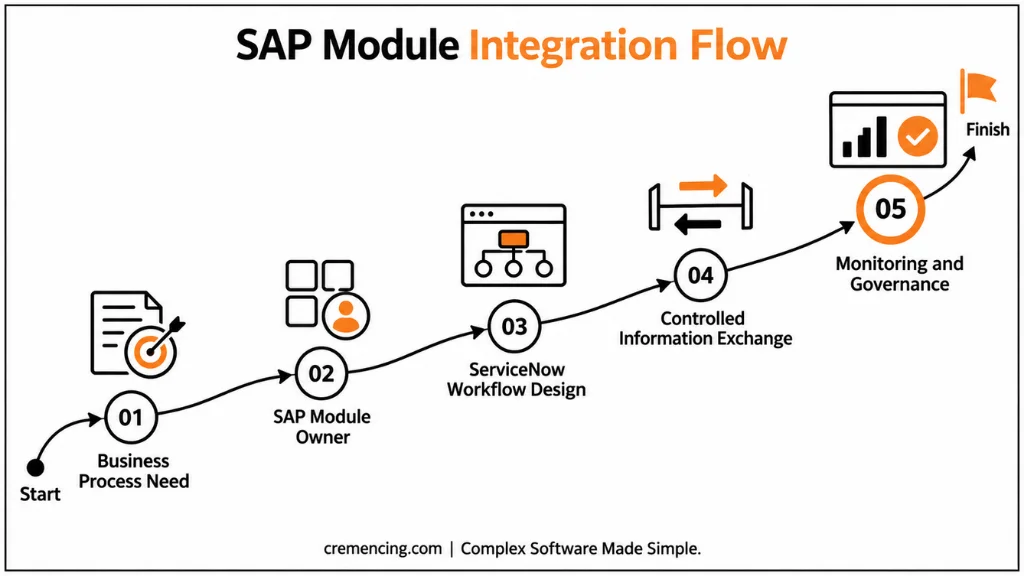
The correct approach is identifying:
- Which SAP system owns the data
- Which ServiceNow workflow consumes that information
- What events should trigger communication
- Which processes require automation
This creates a more controlled integration architecture.
How SAP and ServiceNow Integration Architecture Works
SAP and ServiceNow integration typically works across three layers because the two platforms manage very different kinds of enterprise processes. The SAP Application Layer (S/4HANA, SuccessFactors, Ariba, and GRC) is where core business data actually lives and gets created, things like employee records, financial transactions, or procurement data. The ServiceNow Workflow Layer, by contrast, handles the process side of things: requests, incidents, approvals, notifications, and service workflows.
Between them is the integration layer, built with tools like SAP Cloud Integration (CPI), SAP Integration Suite, APIs, web services, or middleware platforms, that manages communication between the two systems.
This middle layer is where the real technical work happens; data transformation, authentication, message routing, and error handling all take place here. For example, SAP SuccessFactors might hold an employee’s core HR data, while ServiceNow manages that same employee’s service requests (like an IT ticket or an HR case). The integration layer makes sure the right information flows between the two systems as needed, without either platform having to duplicate or take over ownership of a process that isn’t really its job to manage.
Why Organizations Need Module-Based SAP and ServiceNow Integration
A module-based approach provides several advantages compared with broad, undefined integration strategies.
Better Process Ownership
Each SAP module has different business responsibilities. Connecting modules individually helps teams define ownership clearly.
For example:
- HR teams manage SuccessFactors data
- Procurement teams manage Ariba processes
- Security teams manage GRC workflows
- IT teams manage ServiceNow operations
This reduces confusion when workflows cross multiple platforms.
Improved Data Accuracy
When information moves automatically between systems, teams spend less time manually updating records.
For example, employee lifecycle information from SAP SuccessFactors can support automated service workflows in ServiceNow. Similarly, compliance-related information from SAP GRC can support controlled approval processes.
More Controlled Automation
Integration should automate repetitive activities while maintaining governance. A module-based approach allows organizations to introduce automation where it provides value without creating unnecessary complexity across the entire SAP landscape.
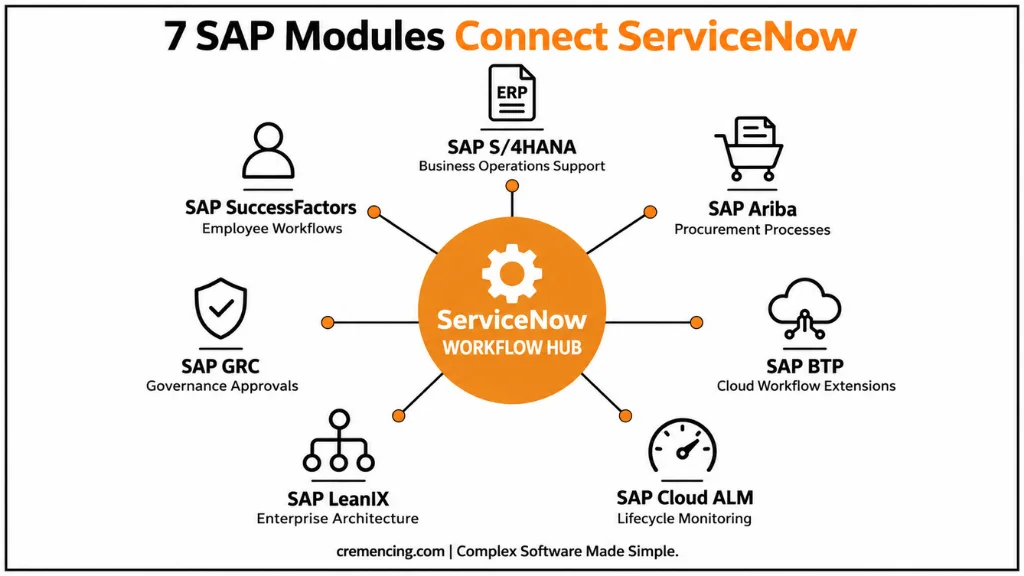
7 SAP Modules You Should Connect With ServiceNow to Eliminate Workflow Silos
1. SAP S/4HANA and ServiceNow Integration
SAP S/4HANA is the core ERP platform for many enterprises, supporting critical business processes such as finance, procurement, supply chain, and asset management. Because these processes directly affect business operations, connecting SAP S/4HANA with ServiceNow can improve how technical issues, service requests, and operational workflows are managed. A common scenario is SAP application support.
A business user reports an issue through ServiceNow, such as a problem with an SAP transaction or business process. The ServiceNow incident contains the initial request details, while SAP teams require technical information to analyze the underlying issue.
With integration, relevant information can move between both platforms without requiring support teams to manually recreate records.
Typical SAP S/4HANA and ServiceNow integration scenarios include:
- Incident synchronization
- Change request coordination
- Configuration information exchange
- Application support workflows
- Business service management
For example, a ServiceNow incident related to an SAP finance process can be routed to the appropriate SAP support team while maintaining visibility for the service desk. This reduces delays caused by manual communication and helps teams maintain a consistent support process.
Organizations using SAP S/4HANA Cloud may use APIs and SAP BTP-based integration approaches, while SAP S/4HANA on-premise environments may require additional middleware or enterprise integration platforms depending on the landscape design.
2. SAP SuccessFactors and ServiceNow Integration
Employee-related processes often involve both HR applications and IT service workflows.
SAP SuccessFactors manages employee lifecycle information such as:
- Employee records
- Organizational assignments
- Employment changes
- Worker status information
ServiceNow commonly manages employee service processes, including:
- IT access requests
- Employee onboarding workflows
- Service requests
- Support activities
Without integration, HR and IT teams may manually exchange employee information during events such as onboarding or role changes.
SAP SuccessFactors ServiceNow Integration helps connect these processes by allowing relevant employee information to support automated service workflows.
For example:
A new employee record is created in SAP SuccessFactors.The integration sends required information to ServiceNow. Service requests are automatically created for activities such as account setup, equipment requests, or application access.
This improves coordination between HR and IT teams while reducing manual administrative activities.
However, organizations must carefully manage data privacy and authorization requirements. Employee information should only be shared when required for a defined business process.
3. SAP Ariba and ServiceNow Integration
Procurement processes often involve multiple teams, approvals, and supplier interactions.
SAP Ariba manages procurement-related activities such as:
- Supplier collaboration
- Purchasing processes
- Procurement workflows
- Supplier information
ServiceNow manages service workflows and operational requests.
Connecting these platforms can improve collaboration between procurement teams and IT service teams.
SAP Ariba ServiceNow integration can support scenarios such as:
- Supplier-related service requests
- Procurement workflow coordination
- Approval process automation
- Supplier support activities
For example, a procurement team may submit a supplier-related request through ServiceNow. The integration can connect this request with relevant SAP Ariba information, allowing teams to access the required procurement context without manually searching across systems.
The integration design should define which system owns procurement information and which system manages service workflow activities. SAP Ariba remains the system for procurement transactions, while ServiceNow manages service-oriented workflows.
4. SAP BTP and ServiceNow Integration
SAP Business Technology Platform plays a different role compared with traditional SAP applications.
It provides capabilities for:
- Application development
- Integration services
- Data management
- Extension scenarios
- Workflow automation
Many organizations use SAP BTP to build extensions around SAP S/4HANA and connect enterprise applications.
SAP BTP ServiceNow Integration becomes relevant when organizations need to connect cloud-based applications and workflows.
For example, an enterprise may develop a custom business application on SAP BTP that requires ServiceNow workflow capabilities.
The integration can enable processes such as:
- Request approvals
- Task creation
- Notifications
- Workflow status updates
SAP BTP can also support integration architecture through services such as SAP Integration Suite and API management capabilities.This allows organizations to connect SAP and ServiceNow without tightly coupling the two platforms.
5. SAP Cloud ALM and ServiceNow Integration
SAP Cloud ALM supports application lifecycle management activities for SAP cloud environments.
It provides capabilities for:
- Implementation management
- Monitoring
- Operations
- Service management
Many enterprises use ServiceNow as their central IT service management platform, creating a requirement to connect operational workflows between both systems.
SAP CALM ServiceNow Integration can help synchronize relevant information between SAP Cloud ALM and ServiceNow.
Common scenarios include:
- Incident synchronization
- Monitoring alert management
- Support process coordination
- Application operations workflows
For example, an SAP Cloud ALM monitoring alert can trigger a ServiceNow incident workflow, allowing IT operations teams to manage the issue through their standard service management process.
The integration approach depends on the organization’s operating model. Some organizations may use SAP Cloud ALM as the primary SAP application monitoring platform while ServiceNow manages enterprise service workflows.
6. SAP LeanIX and ServiceNow Integration
Enterprise architecture management has become increasingly important as organizations manage complex application landscapes.
SAP LeanIX helps organizations understand:
- Application portfolios
- Technology landscapes
- Business capabilities
- Enterprise architecture relationships
ServiceNow maintains operational service information through areas such as configuration management and service management workflows.
SAP LeanIX ServiceNow Integration connects enterprise architecture information with operational service processes.
This integration can help organizations align:
- Application ownership
- Business services
- Technology information
- Operational records
For example, an enterprise architect may use SAP LeanIX to understand application dependencies, while IT operations teams use ServiceNow to manage related services and incidents. Connecting these platforms improves visibility between architecture planning and daily IT operations.
7. SAP GRC and ServiceNow Integration
Security and compliance processes often require coordination between SAP governance systems and IT service workflows.
SAP GRC manages areas such as:
- Access governance
- Risk management
- Compliance activities
- User access controls
ServiceNow commonly manages:
- Access requests
- Approvals
- Service workflows
- User communication
SAP GRC ServiceNow Integration helps connect governance processes with enterprise service management.
A common scenario involves user access requests.A user submits an access request through ServiceNow.The request information moves to SAP GRC.SAP GRC performs the required risk analysis and approval checks. The result is communicated back through the ServiceNow workflow.
This creates a controlled process where ServiceNow manages the user experience while SAP GRC manages compliance evaluation.
Role of SAP CPI in SAP ServiceNow Integration
SAP Cloud Integration (CPI), now part of SAP Integration Suite, can act as an integration layer between SAP applications and ServiceNow.
SAP CPI ServiceNow Integration scenarios commonly involve:
- Data transformation
- Message routing
- API communication
- Error handling
- System connectivity
CPI becomes valuable when organizations have complex landscapes with multiple SAP applications.
For example, a company may connect:
SAP SuccessFactors → SAP CPI → ServiceNow
or:
SAP S/4HANA → SAP CPI → ServiceNow
The integration layer manages communication rules while keeping source applications independent.
This architecture makes future changes easier because integration logic is maintained separately from individual applications.
SAP ServiceNow Integration by Module Comparison
| SAP Module | Primary Integration Purpose | Common ServiceNow Use Case |
| SAP S/4HANA | Business application support and operational workflows | Incident management, change coordination, application support |
| SAP SuccessFactors | Employee lifecycle process connection | Onboarding, access requests, employee services |
| SAP Ariba | Procurement workflow coordination | Supplier requests and procurement-related services |
| SAP BTP | Cloud application and workflow integration | Enterprise workflow automation and extensions |
| SAP Cloud ALM | Application monitoring and operations | Alert management and incident workflows |
| SAP LeanIX | Enterprise architecture visibility | Application and service management alignment |
| SAP GRC | Governance and compliance workflows | Access requests and approval processes |
This comparison shows why organizations should evaluate integrations based on business capability rather than only technical connectivity.
Conclusion
SAP ServiceNow Integration by Module helps organizations connect individual SAP capabilities with ServiceNow workflows based on real business requirements. Instead of creating disconnected processes across SAP S/4HANA, SuccessFactors, Ariba, BTP, GRC, and other platforms, enterprises can build structured integrations that improve information flow and operational visibility.
The most successful integration strategies focus on clear ownership, appropriate data exchange, and long-term governance. As SAP landscapes continue expanding across cloud and hybrid environments, module-specific integration approaches will help organizations reduce workflow silos while maintaining control over critical business processes. By connecting the right SAP modules with ServiceNow, teams can create more coordinated enterprise operations without adding unnecessary complexity.
Frequently Asked Questions
1. What is SAP ServiceNow Integration by Module?
SAP ServiceNow Integration by Module connects specific SAP applications with ServiceNow workflows based on their business purpose. Instead of creating one general integration approach, organizations connect modules such as SuccessFactors, Ariba, BTP, and GRC according to their operational requirements.
2. Why should SAP modules be connected with ServiceNow?
Connecting SAP modules with ServiceNow helps organizations reduce workflow separation between business applications and IT service management processes. It improves information sharing, reduces manual updates, and helps teams coordinate activities across different enterprise platforms.
3. What is SAP SuccessFactors ServiceNow Integration used for?
SAP SuccessFactors ServiceNow Integration is commonly used to connect employee lifecycle information with service workflows. Typical scenarios include onboarding, employee requests, access processes, and HR-related service activities where both HR and IT teams require coordinated information.
4. How does SAP Ariba ServiceNow Integration help organizations?
SAP Ariba ServiceNow Integration helps connect procurement-related processes with service management workflows. It can support supplier requests, procurement-related communication, and workflow coordination between purchasing teams and enterprise service operations.
5. What is SAP BTP ServiceNow Integration?
SAP BTP ServiceNow Integration connects SAP Business Technology Platform applications with ServiceNow workflows. Organizations use this approach when cloud applications, extensions, or custom solutions require service requests, approvals, or workflow automation.
6. Why is SAP CPI used in ServiceNow integration scenarios?
SAP CPI ServiceNow Integration helps manage communication between SAP systems and ServiceNow by handling data transformation, message routing, and connectivity. It is useful in complex SAP landscapes where multiple applications need controlled integration.
7. How does SAP GRC ServiceNow Integration support compliance processes?
SAP GRC ServiceNow Integration connects governance workflows with service management processes. It commonly supports access request handling, approval workflows, and communication between users requesting access and teams responsible for compliance evaluation.
8. What should organizations consider before implementing SAP ServiceNow Integration?
Organizations should define integration objectives, data ownership, security requirements, monitoring processes, and workflow responsibilities before implementation. A clear operating model ensures that integration improves business processes instead of creating additional complexity.
References
SAP Integration Suite Documentation
SAP Business Technology Platform Documentation
Cloud ALM Documentation