
Key user extensibility in SAP S/4HANA exists to fix a very specific, very expensive problem: business users waiting on IT for changes SAP already lets them make themselves. A Fiori app that can’t find a field your team just added. A regional compliance requirement that sits in a developer’s backlog for six weeks because the change touches a “core” table. A go-live pushed back because a two-field tweak to a purchase order somehow needed a full ABAP development cycle, a transport, and a regression test pass.
None of that is a technology limitation. It’s a governance and tooling gap and it’s expensive. Every week a business user waits on IT for a change that SAP already lets them make themselves is a week of lost time-to-market, a growing queue of “small asks” competing for scarce developer hours, and one more reason the core drifts further from clean.
That’s what SAP-governed, no-code, and low-code tools Custom Fields and Logic, Adapt UI and their Public Cloud equivalents solve: business users add fields, adjust screens, and configure validation logic directly, without opening a single ABAP editor or touching a standard object. Done right, it turns a six-week IT request into a same-day change. Done without governance, it turns into its own kind of technical debt. This post covers both halves.
Why Executives Care About Extensibility in SAP S/4HANA
Every SAP executive ends up facing the same dilemma:
SAP S/4HANA Extensibility is a key aspect here that allows for adaptation without changing core code and, therefore, ensures the system’s stability and enables continuous change.
Executive-level impact includes:
- Time to Market: More Quickly Responding to New Requests
- Cost management: Standardization lowers the cost of development and maintenance
- Upgradability: Dirty core systems are harder/more expensive to upgrade than clean ones
- Business ownership: Remove IT bottlenecks and empower your teams
- Risk Mitigation: Less invasive changes, less post-go-live pain
Use of SAP S/4HANA adaptability determines whether S/4HANA can be expanded as a business grows or becomes a limiting factor.
Benefits of Key User Extensibility in SAP S/4HANA
Therefore, Key User Extensibility is SAP’s low-code/no-code paradigm that enables qualified business users to make permitted changes directly to data in SAP S/4HANA.
- SAP S/4HANA In-App Extensibility: Changes are created within S/4HANA with SAP governance tools
Use-cases for Key User Extensibility:
However, changes are created within S/4HANA with SAP governance tools
- Supplementing Business Objects with Additional Fields
- Enhancing forms and reports
- Adjusting validation rules
- Writing custom logic on top of the existing middleware pieces
- Personalizing UI and layouts
- All modifications are upgrade-safe, and there is no change to SAP standard objects following the clean core principle.
Similarly, all without changes to SAP standard objects, is the basis of the clean core concept.
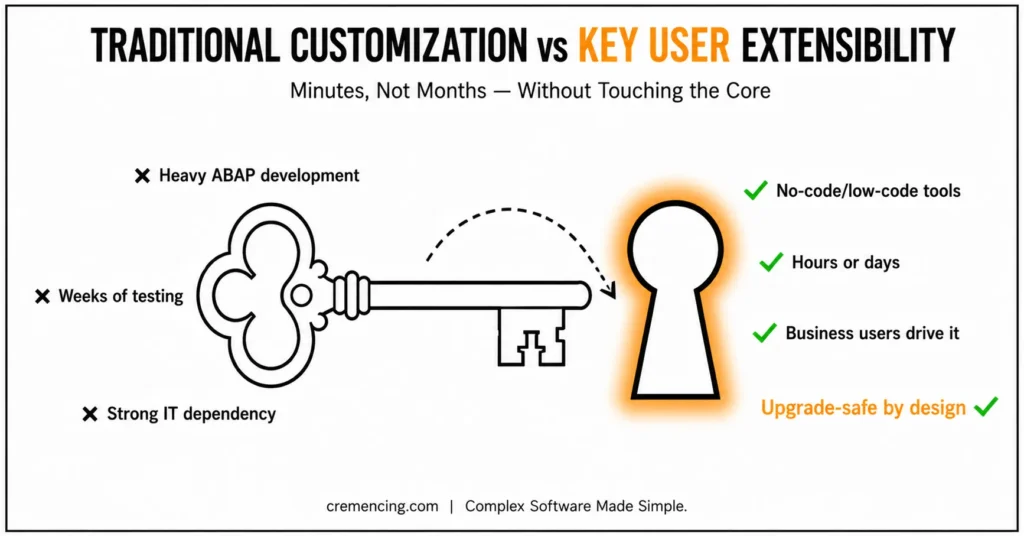
Key User Extensibility vs. Standard Customization
| Traditional SAP Customization | Key User Extensibility in S/4HANA |
| Heavy ABAP development | No-code or low-code tools |
| Long design and testing cycles | Hours or days |
| Strong dependency on IT teams | Business users drive enhancements |
| Difficult upgrades | Upgrade-safe by design |
| Accumulating technical debt | Minimal long-term maintenance |
One stifles innovation; meanwhile, the other fuels it.
Key User Extensibility Core Capabilities
SAP provides tools to enable extensibility while ensuring governance and stability:
In practice, key users do this work in one app: Custom Fields and Logic (CFL), reached from the Fiori launchpad. CFL bundles three distinct functions:
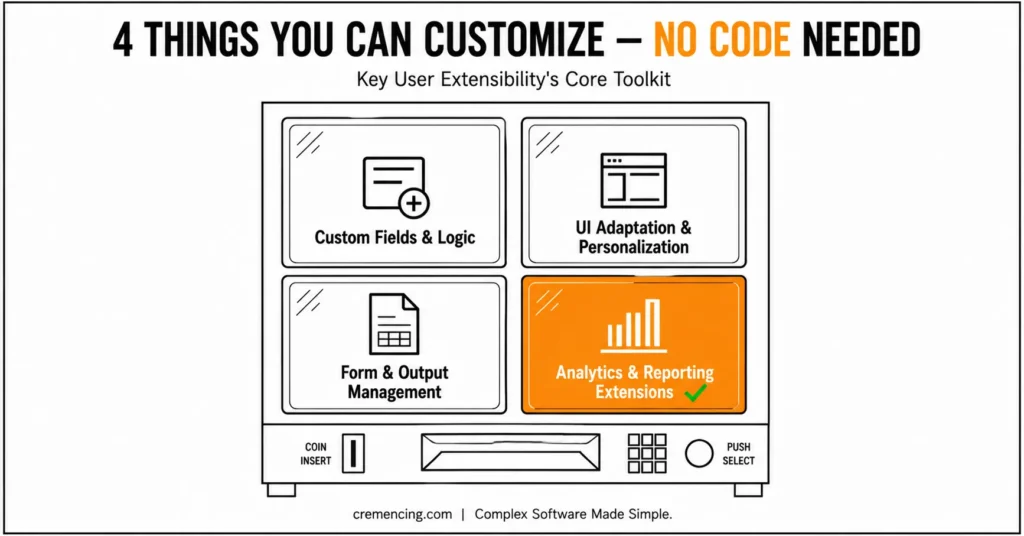
- Custom Fields
Add a new field to a chosen business context (e.g., Procurement: Purchasing Document) and, once activated, it’s automatically available across the relevant Fiori apps, CDS-based reports, and integrations tied to that context. - Data Source Extensions
Expose a field that already exists on an underlying table or interface CDS view but isn’t yet surfaced in a given app’s data source or analytical query, without creating a brand-new field. - Custom Logic
Attach validation or default-value rules to a Business Add-In (BAdI) enablement point entirely through configuration.
On-premises and private cloud systems need one setup step before CFL is even visible: a PFCG role containing the SAP_BASIS_BC_EXT business catalogue has to be assigned to the key user. Public Cloud tenants skip this the app is pre-scoped and simply needs to be added to the user’s launchpad. For more insights, read our blog, SAP Business Process.
| Extensibility Layer | Who Uses It | Typical Tooling | Skill Required | Clean-Core Safe? |
|---|---|---|---|---|
| Key User (In-App) | Business users | Custom Fields and Logic, Adapt UI | None — config only | Yes |
| Developer (RAP-based) | ABAP/BTP developers | Custom Business Objects, RAP, Cloud BAdIs | ABAP/RAP | Yes, if built to RAP standards |
| Classic (on-prem legacy) | ABAP developers | Enhancement spots, user exits, modification | ABAP | Only if isolated from core objects |
Analytics and Reporting Extensions
Can navigate custom fields and extensions from:
- Embedded analytics
- CDS views
- Fiori reports
Thus, reporting adapts as the business changes, rather than months after the fact.
How No-Code Extensibility Accelerates Business Outcomes
Key user extensibility power is in the business impact:
- Rapid Decision Making: Teams can customize fields or add logic on the fly to enable improved reporting similarly insights without IT backlogs
- IT Streamlining: From Delivery to Governance and Enablement
- Greater user adoption: Users like systems that they can impact
- Lower TCO: Consequently, less custom development translates into less testing and rework, As well as lower upgrade costs.
Moreover, it also translates into real cost savings over time.
Governance: Keeping Extensibility Under Control
Extensibility doesn’t equal chaos when governed properly.
Moreover, best practices include:
- Clear approval workflows for extensions
- Role-based access for key users
- Documentation of all extensions
- Periodic review and cleanup
Developer-Friendly, Core Cleanliness, and The Extension Trap
Clean Core approach:
- Minimal modifications to the SAP standard
- Easier upgrades
- Faster innovation adoption
Key user extensibility helps:
- Replace the core, not the contents
- Achieve business flexibility without technical compromise
Therefore Alignment is crucial for CIOs developing multi-year S/4HANA roadmaps.
Real-World Scenario: Extensibility in Action
A multisite make-to-order global manufacturer rolling out S/4HANA:
- Finance requires additional compliance fields in journal entries for regional reporting
Traditional approach:
- Development request
- Weeks of testing
- Delayed rollout
Key user extensibility approach:
- Fields added in minutes
- Validation rules are configured immediately
- Reports update automatically
Therefore business as usual, no interruptions.
When to Use Key User Extensibility
- Requirements change frequently
- Differences across regions or units
- Focus on speed, not deep customization
- Core cleanup and upgrade readiness are the top priorities
For deep logic or cross-system integration, moreover, use developer extensibility or SAP BTP.
Executive Summary for Using Key User Extensibility
Leaders must ensure:
- Clear governance model
- Adequate training for key users
- Extensions aligned to business value
- IT manages, not commands
- Minimal cross-cutting, non-functional programming, and OOP paradigms
In addition Innovation without fragility.
The Strategic Significance of Extensibility in SAP S/4HANA
Organizations adopting key user extensibility:
- Move faster than competitors
- Reduce long-term SAP costs
- Improve adoption and satisfaction
- Stay upgrade-ready
Those that don’t:
- Risk of getting stuck in a cycle of customization that stalls progress
Make S/4HANA a Living Platform.
- Evaluate the current use of extensibility
- Empower key users with the needed tools
- Align extensibility with a clean core approach
In addition, properly executed, key user extensibility turns SAP into a growth platform, done in minutes, not months.
FAQs
What is extensibility in SAP S/4HANA?
Flexibility and safety in upgrades are invaluable for CIOs
What is key user extensibility?
Enables trained business users to deliver no-code/low-code changes within the application
Is the key user extensibility upgrade-safe?
Yes, enhancements follow the SAP clean core approach
Will user-facing extensibility replace custom builds?
Replaces much of traditional custom development; sophisticated integrations may still need developer extensibility
Who owns extensibility in a company?
Business teams lead; IT ensures governance and standards
Does Key User Extensibility require any ABAP knowledge?
No that’s the defining feature. Custom Fields and Logic and Adapt UI are configured entirely through guided Fiori apps. ABAP knowledge is only needed once a requirement exceeds what those apps expose (custom business objects, complex integrations).
What happens to key-user extensions during an S/4HANA upgrade?
Because they’re built through SAP’s governed extensibility framework rather than by modifying standard objects, they’re designed to carry through upgrades without manual rework;. That’s the practical meaning of “upgrade-safe” in this context.
Can key user extensibility be used in SAP S/4HANA Cloud or only on-premise?
Both, though the setup differs: public cloud editions pre-scope the extensibility apps for the tenant, while on-premise and Private Cloud systems require an administrator to first assign the relevant business catalogue to a key user’s role.