
Every month-end close that slips by two extra days usually traces back to the same root cause: nobody owned the exception queue. Missed approvals, blocked invoices, and failed interfaces don’t show up as line items on a P&L; they show up as overtime hours, delayed financial statements, and auditors asking why the same control gap keeps recurring. For IT managers and SAP process owners, this is exactly what SAP exception management exists to solve: the quiet cost center nobody budgets for, because it sounds like plumbing, not strategy.
It isn’t plumbing. Indeed, the organizations that run the tightest SAP landscapes don’t have fewer exceptions than everyone else; rather, they have a system for treating every exception as a signal instead of a fire to put out. To that end, this post breaks down exactly how that system works, where SAP S/4HANA’s situation handling and clean-core model fit into it, and finally, what to check first if your team is still managing exceptions by email thread.
Processes do not fail loudly in most SAP landscapes. They fail in the dark by exception:
- Missed approvals
- Blocked invoices
- Failed integrations
- Incomplete master data
Moreover, these issues incrementally chip away at effectiveness, hindering decisiveness and fanning the flames of operational risk. For enterprise leaders, this creates a deadly illusion: everything seems stable, but performance continues to slide.
SAP Business Process Exception Management is an identity-making capability for the best-run businesses. Top performers don’t just repair exceptions; they architect processes to identify, control, and manage exceptions systemically, not reactively.
The difference isn’t technology alone. It’s mindset, governance, and execution.
The Importance of SAP Business Process Exception Management for Senior Executives
Thousands sometimes millions, of transactions occur on any SAP system daily. Even a tiny rate of exception can result in:
- Delayed financial closes
- Missed supplier payments
- Revenue leakage
- Audit findings
- Poor user adoption
Leaders often concentrate on process automation and standardization, but not exception handling.
Proper Exception Management ensures a direct impact on:
- Operational resilience: Fewer breakages and less firefighting
- Cost management: Lower labor and intervention costs
- Reduced risk: Early identification of compliance and control weaknesses
- Quality of decision: Right information, in time, with no hidden breaks
- User efficiency: Reduced headaches, transparency of responsibilities
Best-in-class know exception management isn’t an operational afterthought; it’s a strategic capability.
What is SAP Business Process Exception Management?
SAP Business Process Exception Management is the formal and structured process of:
- Identifying exceptions
- Performing root cause analysis
- Resolving issues
- Preventing exceptions across enterprise end-to-end business processes in SAP
Areas where deviations can exist:
- Procure-to-Pay
- Order-to-Cash
- Record-to-Report
- Hire-to-Retire
- Supply chain and logistics
Common exceptions:
- Missing or incorrect master data
- Authorization gaps
- Process design flaws
- Integration failures
- Custom logic conflicts
- Poor user adoption
Dealing with these exceptions is not easy using manual tracking or reactive methods.
Why The Best In Business Treat Exceptions Differently
Mediocre organisations consider exceptions as accidents. High performers treat them as indicators.
Instead of asking:
“How do we fix this issue?”
They ask:
“Why is this exception being thrown and how can we prevent it?”
This mindset gives rise to three key contrasts:
1. Architect Mechanisms with Exceptions in View
Top performers understand exceptions will happen. What counts is how processes are constructed to treat them:
- Predict where exceptions will occur
- Define clear escalation paths
- Assign ownership upfront
- Embed exception handling in process design

SAP scenarios include:
- Automated checks and validations
- Standardized approval fallback paths
- Transparent exception queues
Minimizes chaos when exceptions occur.
2. Render Exceptions Transparent, Not Opaque
In most SAP systems, exceptions are buried in logs or reports. Champions make them visible, measurable, and actionable:
- Real-time exception monitoring
- Role-based dashboards
- Clear prioritization by business impact
For executives, this enables:
- Knowing where value leakage occurs
- Understanding systemic process weaknesses
- Making data-driven improvement decisions
3. Rule on Exceptions Like Any Other Business Process
Governance:
Top performers establish:
- Type-specific ownership clearances
- Defined resolution SLAs
- Approval rules for recurring exceptions
- Documentation and auditability
Exceptions are managed, counted, and continually improved, no longer “someone else’s problem.”
For more insights, read our Blog on SAP S/4HANA No-Code Extensibility
Typical Mistakes in SAP Exception Handling
- Over-Customization: Custom error handling creates more exceptions, especially during upgrades
- Manual Workarounds: Spreadsheets, emails, and offline tracking suppress issues instead of solving them
- Lack of Root Cause Analysis: Fixing symptoms ignores recurring root causes
- Poor Business-IT Alignment: Exceptions between teams without accountability
Leading companies proactively design their SAP landscape to avoid these traps.
| Approach | ECC / Manual Tracking | S/4HANA with Clean Core |
|---|---|---|
| Detection | Reactive — user reports the issue | Proactive — Situation Handling triggers on defined conditions |
| Visibility | Buried in SLG1 logs or spreadsheets | Role-based Fiori apps / embedded analytics |
| Ownership | Ambiguous, often IT-by-default | Defined via workflow routing to business owner |
| Root cause tracking | Manual, inconsistent | Structured, tied to process KPIs |
What SAP S/4HANA Does for Exception Management
SAP S/4HANA supports modern exception management, especially with clean core methodology:
- Embedded analytics for real-time visibility
- Standardized workflows and approvals
- Better data consistency
- Faster processing and reduced latency
Technology is only part of the solution. Alignment is required in:
- Process design
- Governance models
- User training
- Exception ownership
What SAP S/4HANA Does for Exception Management
In practice, this shows up in two concrete places. Situation Handling lets process owners define trigger conditions (e.g., a purchase order approaching a due date with no goods receipt) and route a notification directly to the responsible user inside Fiori; no custom ABAP report is required. For legacy ECC landscapes without Situation Handling, the same visibility historically came from the application log (SLG1), which is why many “we already do this” claims fall apart under inspection: SLG1 logs are searchable, but nobody is watching them proactively.
Only then does S/4HANA become a framework for proactive exception management, not just faster firefighting. For more insights read our blog on SAP Process Visibility
Real-World Example: Exception Handling in Action
Scenario: Multinational services company with slow month-end close cycles.
Root cause: Untracked exceptions
- Blocked invoices
- Incomplete approvals
- Inconsistent master data
Implemented SAP exception management:
- Categorized and prioritized exceptions
- Assigned ownership clearly
- Addressed root causes
Result:
- Faster close cycles
- Reduced manual effort
- Improved audit confidence
Fixing exceptions fixes outcomes.
Top Tips for Exception Management in SAP Business Processes
- Focus on Business Impact: Prioritize exceptions affecting cash flow, compliance, or customer experience
- Standardize Before Automating: Bad processes create more bad exceptions
- Limit Custom Exception Logic: Avoid modifications when standard SAP functionality suffices
- Treat Exceptions as Improvement Inputs: Every exception indicates areas for process improvement
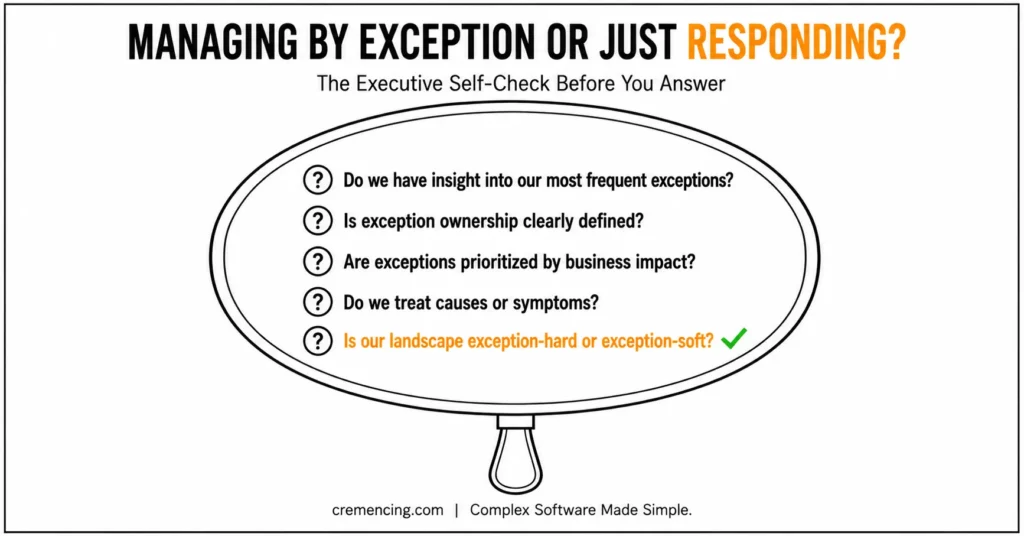
Executive Checklist: Managing by Exception or Just Responding?
Ask yourself:
- Do we know our top 5 recurring SAP exceptions by volume?
- Is each exception type assigned to a named owner (not a team)?
- Are exceptions ranked by business impact, or just by age?
- Root cause or symptom: which are we actually fixing?
- Detection: proactive (situation handling/monitoring) or reactive (user complaint)?
If unsure, poor exception management is likely the problem.
The High Return on Investment of Getting Exception Management Right
SAP exception management is not about eliminating all exceptions — that’s impossible.
Organizations that manage exceptions well:
- Reduce operational risk
- Improve process maturity
- Increase trust in SAP data
- Enable scalable growth
Those who don’t:
- Are plagued by hidden inefficiencies over time
Make Exceptions a Source of Competitive Advantage
- Identify where exceptions occur most frequently
- Address root causes, not just symptoms
- Align exception handling with clean core and S/4HANA strategy
Managed properly, exceptions transform from operational noise into insights for better performance.
Conclusion:
The gap between organizations that manage exceptions well and those that don’t isn’t a tooling gap; most run the same S/4HANA release, the same Fiori apps, and the same clean-core roadmap slides. What separates them is whether exception handling is a designed process with named owners and defined SLAs or an inbox that gets cleared whenever someone has time.
That distinction shows up everywhere in this post: in whether exceptions are logged silently or surfaced through a situation. Handling, in whether root causes get fixed or just symptoms, and in whether ownership sits with a person or “the team.” None of it requires new technology. It requires deciding, in advance, who owns what and holding that line as volume grows.
In practice, if your team can’t currently name its top five recurring SAP exceptions and who’s accountable for each one, that’s the actual starting point. After all, a bigger dashboard won’t fix it, and neither will another automation project. Instead, what’s needed is an honest inventory of where things are breaking and who’s supposed to notice.
FAQs
What is SAP BPM – Business Process Exception Management?
Methodology for identifying, resolving, and proactively managing variations in SAP process execution
How are exceptions useful in SAP systems?
Unchecked exceptions cause delays, rework, non-compliance, and low user productivity
Does S/4HANA eliminate process exceptions?
No, S/4HANA reduces some causes, but exceptions must still be managed
How can firms mitigate recurring exceptions?
Focus on underlying causes, process design, limiting customization, and enforcing governance
Who should own exception management?
Business process owners lead, with IT supporting governance and system enablement
What’s the difference between an exception and an error in SAP?
Typically, an error blocks processing entirely, whereas an exception is a deviation from the expected process path that may or may not stop the transaction. For instance, a blocked invoice can still exist in the system while awaiting resolution.
How does situation handling relate to exception management in S/4HANA?
Essentially, it’s the framework that lets process owners define proactive triggers and automatically route the resulting notification to the right person, rather than relying on someone finding the issue in a log.
Can exception management be measured with KPIs?
Yes common measures include exception volume by type, average time-to-resolution, and percentage of recurring vs. one-off exceptions.