SAP process visibility is usually the missing piece when a digital transformation stalls — not the technology. Most postmortems blame the wrong platform, a rushed migration, or an underpowered integration. Most digital transformation postmortems blame the technology: the wrong platform, a rushed migration, an underpowered integration. That diagnosis is usually wrong. S/4HANA migrations are complete, cloud infrastructure goes live, and new interfaces ship; however, cycle times still get longer, manual workarounds continue to pile up, and user confidence still drops.
In fact, the real failure point isn’t the system; rather, it’s that leadership never had a clear view of how SAP processes actually ran in the first place. As a result, CIOs, enterprise architects, and transformation owners end up managing a dashboard’s version of reality: uptime, milestones, and release notes, while process bottlenecks, silent exceptions, and value leakage continue to happen underneath it. Ultimately, SAP process visibility closes that gap. Therefore, this post breaks down what it actually is, where it delivers measurable impact, and why the best-run SAP shops treat it as a prerequisite, not a nice-to-have.
Who Gains the Most from SAP Process Visibility?
SAP process visibility is especially valuable for process owners, transformation leaders, and business analysts because it shows how processes actually perform and where problems occur. For example, SAP Signavio Process Intelligence can analyze process data to identify bottlenecks, inefficiencies, process variants, and root causes. In addition, process flows also provide transparency into performance over a defined period. helping teams see where delays or deviations occur. As a result, this visibility supports more informed decisions about process improvement rather than relying only on assumptions or manually collected information. However, the information users can access depends on configured authorizations and the available source data.
Weapon for Digital Transformation Success
Technology is hardly ever the “missing link” in a digital transformation failure.
Transformations fail because leadership teams lack visibility into how SAP processes are actually executed.
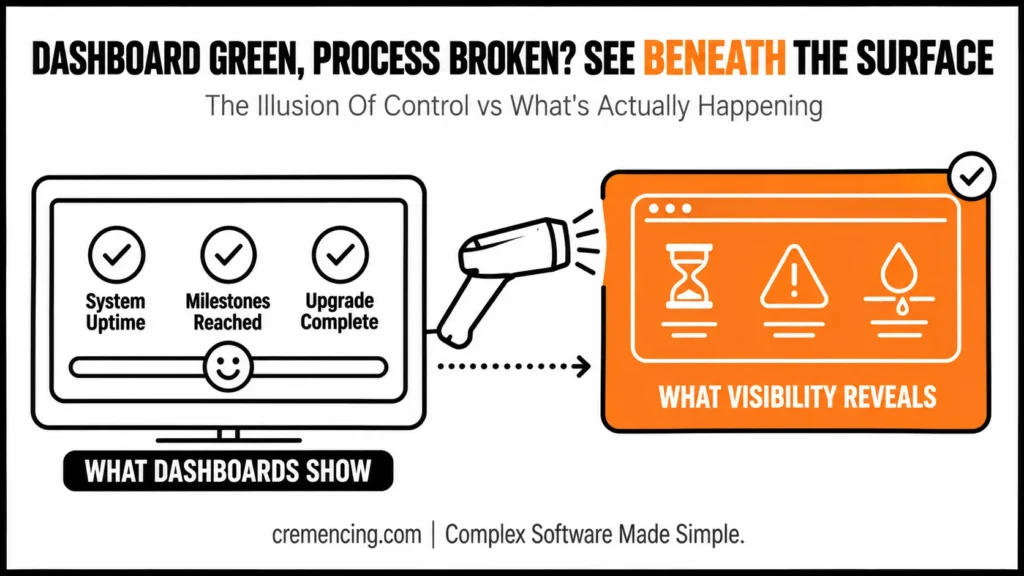
This visibility gap is the dangerous illusion of control for CIOs, enterprise architects, and SAP transformation owners.
- First, dashboards provide visibility into system uptime.
- Next, project teams track whether key milestones are being achieved.
- Meanwhile, upgrades continue to move through the planned stages.
Beneath all that run process bottlenecks, exceptions under the radar, and inefficiencies leaching business value.
Companies that leverage SAP process visibility don’t just upgrade SAP; they operate smarter, faster, and more resilient businesses.
What Is SAP Process Visibility?
Reporting vs. Process Visibility: What’s the Difference?
| Aspect | Traditional Reporting | SAP Process Visibility |
|---|---|---|
| Timing | Historical, periodic (weekly/monthly) | Real-time or near real-time |
| Focus | What happened | What is happening and why |
| Data source | Aggregated KPIs | End-to-end transactional process data |
| Action trigger | Manual review | Automated alerts and early warnings |
| Use case | Compliance, retrospective analysis | Proactive bottleneck prevention |
SAP process transparency is the capability to observe, analyse, and understand end-to-end business processes in real time or near real time across your SAP landscape.
It is reporting beyond routine metrics, answering executive-level questions.
- First, where are processes slowing down?
- Next, why are exceptions recurring?
- Finally, which steps cause the most rework or delays?
As a result, it brings visibility to your core processes such as order-to-cash, procure-to-pay, record-to-report, and supply chain execution – without relying on guesswork or latency.
Why Process Visibility is Key to any Digital Transformation
Many SAP transformations focus heavily on technology:
- First, the S/4HANA migration is completed.
- Next, the cloud infrastructure is deployed.
- Finally, new user interfaces are launched.
Yet business stakeholders often report:
- Longer cycle times
- Increased manual workarounds
- More exceptions than before
- Declining user confidence
Underlying reason: process blind spots.
Without SAP process visibility:
- First, problems emerge only when people complain.
- Next, bottlenecks are discovered too late.
- As a result, IT reacts instead of preventing problems.
- Ultimately, continuous improvement becomes guesswork.
Therefore, businesses that see more of what’s happening can catch issues early and act proactively.
Strategic Capability: SAP Process Visibility
For high-performance firms, SAP process transparency is a strategic management capability, not just reporting.
Turning Data into Actionable Insight
SAP data is abundant, but insights are lacking. Visibility processes link transactional data to business context, showing:
- First, identify where delays occur.
- Next, determine which approvals stall progress.
- Finally, analyze exceptions and their impact on revenue or compliance.
Enables leadership to move from “what happened” to “what needs to change.”
Aligning IT and Business Teams
IT misalignment is a major obstacle in SAP programs. Process visibility creates a common ground of truth:
- See the same issues
- Order fixes according to business impact
- Measure improvement objectively
Minimises friction, critical during transformation efforts.
Accelerating Decision Making with SAP Process Visibility
Speed matters in digital transformation.
Without visibility, decisions rely on:
- Monthly reports
- Manual analysis
- Anecdotal feedback
Benefits of adopting SAP operational visibility:
- Real-time alerts for critical exceptions
- Immediate insight into process deviations
- Data-backed prioritization of improvement efforts
Businesses can accelerate time to resolution, minimise operational risk and react with greater agility to market changes. For more insights, read our blog on SAP Build Process Visibility
SAP Process Visibility into S/4HANA Transitions
New data models, simplified processes, and penetrating insights with the S/4HANA transformation.
Without strong visibility:
- Customisations mask inefficiencies
- Legacy issues resurface post-migration
- Business mistrust of new systems
With embedded process visibility, companies can:
- Vet process performance pre- and post-migration
- Identify regression risks early
- Verify promised business value and impact realization
Forward-thinking organizations embed process visibility in S/4HANA readiness and post-go-live strategy.
Typical Use Cases of SAP Process Visibility that deliver immediate business value
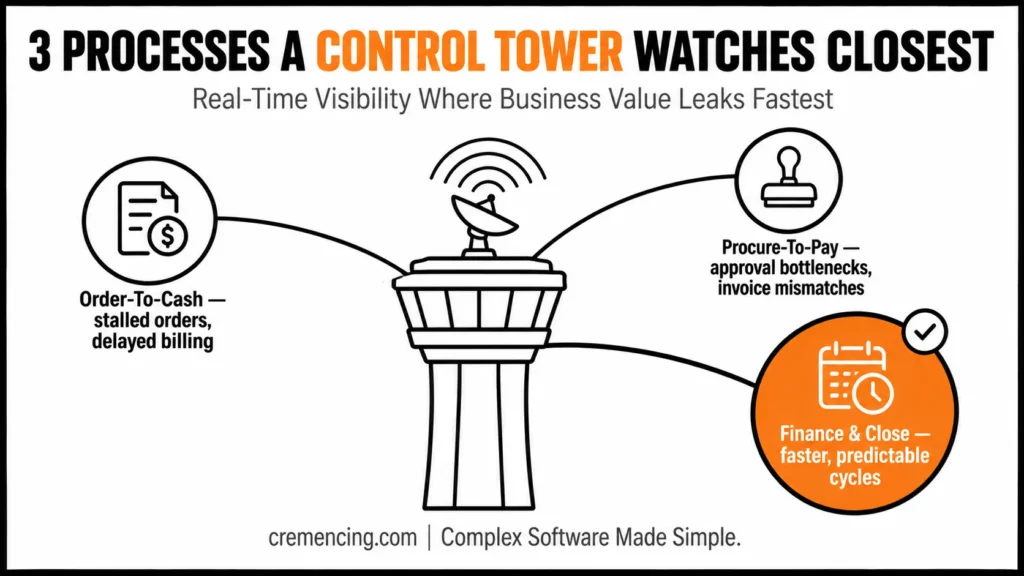
Order-to-Cash Optimization
Visibility reveals:
- Where orders stall
- Why is billing delayed
- Credit checks impacting cash flow
Outcome: Increased revenues recognised, increased customer satisfaction.
Procure-to-Pay Control
Visibility highlights:
- Approval bottlenecks
- Invoice mismatches
- Supplier-related delays
Result: Lower processing fees and more compliant.
Finance and Close Acceleration
SAP operational visibility identifies:
- Posting delays
- Reconciliation issues
- Manual interventions during close
Outcome: Faster and more predictable financial close cycles.
Where SAP Process Visibility Delivers Measurable Impact
| Process Area | Common Problem It Surfaces | Business Outcome |
|---|---|---|
| Order-to-Cash | Stalled orders, delayed billing, credit-check bottlenecks | Faster revenue recognition, higher customer satisfaction |
| Procure-to-Pay | Approval delays, invoice mismatches, supplier lag | Lower processing costs, better compliance |
| Record-to-Report | Posting delays, reconciliation gaps | Faster, more predictable financial close |
From Opinions on Operations to Monitoring and Management
Traditional SAP operations:
- A problem occurs
- Users complain
- IT investigates
- Fixes are applied
SAP process transparency:
- Early warning signals
- Trend-based insights
- Prevention instead of correction
Minimizes firefighting and frees teams to focus on innovation.
Why Best-Run Businesses Make Process Visibility a Priority
Three Characteristics of Digital Leaders:
- Track what counts, system KPIs, and business process health
- Making decisions based on data visibility is the source of decision-making
- Continue to get better visibility; it is maintained, not a one-time checkbox
SAP process transparency is not a feature, but a prerequisite.
Creating SAP Process Visibility the Right Way
Simply plugging in tools isn’t enough. Successful organizations focus on:
- Clear process ownership
- KPIs aligned with business benefits
- Governance ensuring insights are acted upon
Done right, SAP process transparency becomes a sustainable competitive advantage, not merely a reporting layer.
The Business Case for Investing in SAP Process Visibility
CIOs and leaders no longer ask whether visibility is needed, but how soon.
Impacts:
- Operational efficiency
- Customer experience
- Risk management
- ROI from SAP investments
Visibility turns SAP into a performance engine, not just a cost centre.
Leveraging Visibility to Create Transformation Impact
Process visibility is an enabler, not the end goal. Organisations using visibility can:
- Simplify processes
- Reduce exceptions
- Standardize operations
- Drive continuous improvement
Missing process visibility is missing one of the strongest levers of success.
Conclsuion
Success or failure in digital transformation is not just hinged on technology choices, but also the ability of leaders to see very clearly inside their SAP processes what’s really going on. SAP process visibility takes away the illusion of control and replaces it with a true story of execution, performance, risk – punctuated by real-time detail.
By making processes end-to-end transparent, you move from reactive fighting to monitoring ahead. Bottlenecks are surfaced early, exceptions are dealt with before they flame out, and efforts to improve are data-driven, not faith-based. This clarity helps IT and business teams be in lockstep, accelerate decision making and make sure SAP expenditures result in realisable business results.
Frequently Asked Questions
1. What does SAP process visibility mean?
- Understand in real-time how SAP business processes behave, where delays occur, and the reasons for problems
2. Does SAP process transparency matter only post-migration to S/4HANA?
- No. It is equally important before, during, and post-migration
3. What is SAP viewing different from reporting?
- Reporting is historical; visibility shows live process behaviour with actionable insights
4. Does SAP visibility reduce operational risk?
- Yes. Proactively identifying variances and bottlenecks minimises compliance problems, revenue loss, and service interruptions
5. Who gains the most from SAP process visibility?
- SAP process visibility benefits business managers and decision-makers the most, because it gives them a clear view of business processes, helps identify problems, improves decision-making, and increases efficiency.
6. Which SAP tools support process visibility?
- Capabilities like SAP Signavio Process Insights and SAP Build Process Automation give organizations real-time visibility into how SAP-driven processes actually execute, complementing standard SAP reporting.
7. Is process visibility only relevant for large enterprises?
- No. Mid-sized SAP customers benefit as well — process bottlenecks and manual workarounds affect efficiency regardless of company size, and visibility tools scale to the process complexity involved.
8. How long does it take to implement SAP process visibility?
- Initial dashboards for a single process area (like order-to-cash) can often be configured in weeks, though full end-to-end coverage across multiple processes typically takes longer and depends on data readiness.
9. Does process visibility require additional licensing beyond core SAP?
- Yes, in most cases — dedicated process visibility or process mining capabilities are typically separate SAP offerings or third-party tools layered on top of core ECC or S/4HANA licenses.
10. How does process visibility support change management during a transformation?
- It gives leadership objective, shared data on where problems actually occur, which reduces disagreement between IT and business teams about priorities and helps validate whether promised transformation benefits are being realized.